Talapatram

The Road of Twelve Months

The dead and the grieving walk the same year.

The year-long journey through the way-stations toward Yama’s city, sustained month by month by the pindas of the living: in this model the dead still need the living. Grief counselors speak of the mourner’s year of firsts; the text gives both travelers the same twelve-month road.

The Trucks That Kept Coming
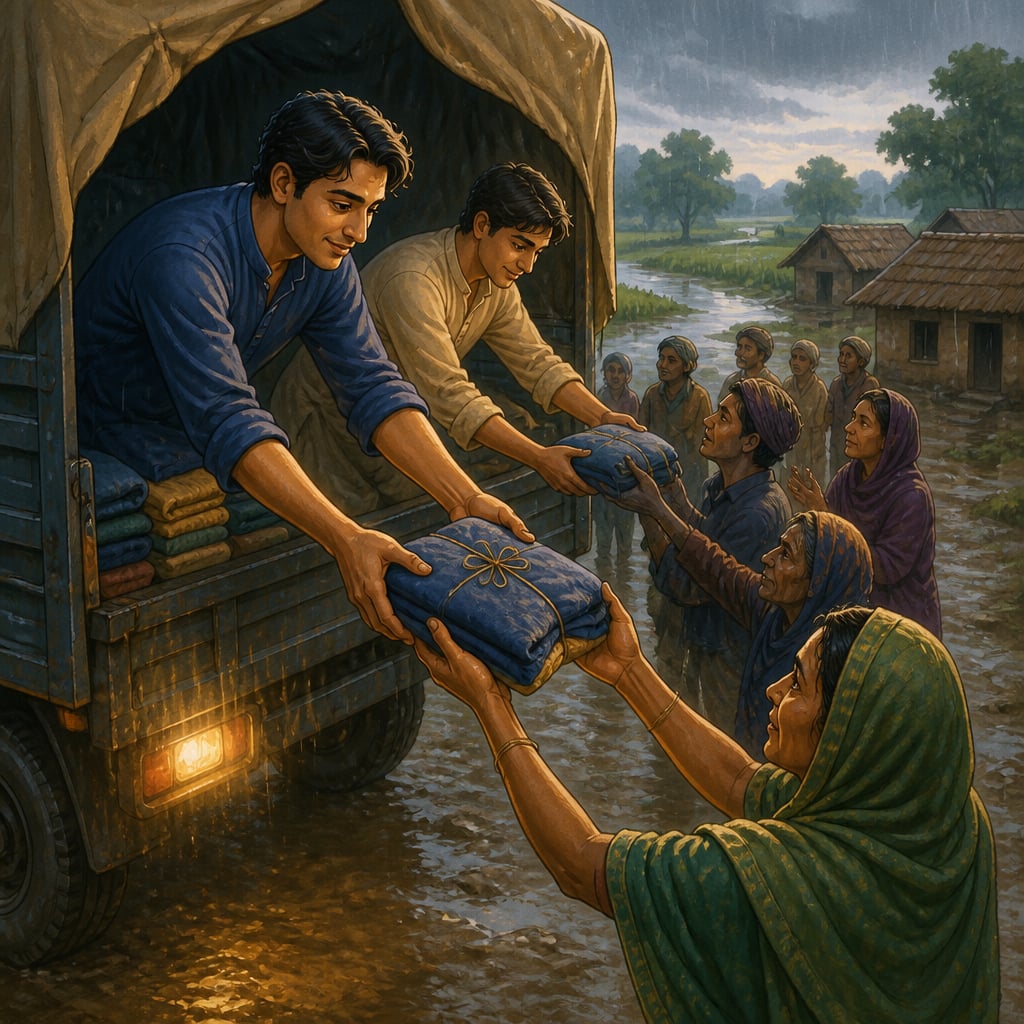
Relief trucks that keep coming, months later

When a flood or an earthquake strikes an Indian village, a convoy arrives within days: news vans, politicians, relief trucks, volunteers with cameras. Then the news cycle moves, and the convoy moves with it. Anshu Gupta, a former corporate professional who founded the Delhi organisation Goonj, built his life's work on what he noticed about the weeks after: the village is still broken, the winter still comes, and the road is now empty.

So Goonj runs on the opposite rhythm. Its trucks, carrying sorted cloth, utensils, and materials, keep arriving in month two, month five, month nine, long after the disaster has stopped being news. Gupta's insight was almost embarrassingly simple: a crisis is not an event. It is a road, and it is walked for a long time. Help that arrives once, loudly, and leaves is not help matched to the shape of the need.

Hold that shape in mind, a long road, sustained by deliveries that keep coming, because it is the exact shape the Garuda Purana gives to what happens after death. This lesson walks that road.

A Year of Way-Stations

Here we reach the strangest and most detailed stretch of the text: the material recited across the thirteen days of mourning, the part everyone has heard of and almost no one has read.

A lamp lit at the road's way-station

In the text's model, the departed does not arrive anywhere at death. The subtle body, the traveler we met two lessons ago, sets out on a road: a journey south toward the city of Yama, through a series of way-stations the text names one by one, each a stage with its own terrain and trials. And the journey takes one year. Month by month, the traveler crosses another stretch, passes another station, and draws closer to the court where the record will be read.

But the truly startling feature of the road is not its length. It is the supply line. The traveler, says the text, cannot provision this journey alone. The strength to walk each month's stretch comes from behind, from the living. The rice-ball offerings, the pindas, made by the family during the death rites and at the monthly ceremonies, reach the traveler as sustenance. In the text's model, the first ten days of offerings build the traveler a new subtle body, limb by limb. The monthly offerings then feed it, stage by stage, for the whole year. The anniversary rites complete the road.

Stop and let the design register. In this map, the dead still need the living. Death does not end the relationship; it reverses the direction of care. The parent who fed the child is now fed by the child, month by month, across a distance no visit can cross. The family left behind is not, in this model, bereft and useless. It is employed. It holds the supply contract for a journey it cannot see.

What the Body Knows It Carries

What does the traveler carry personally, if the living carry the food? The text has already answered, and the answer bears repeating on the road:

शरीरं वह्निरादत्ते सुकृतं दुष्कृतं व्रजेत् । शरीरं वह्निना दग्धं पुण्यं पापं सह स्थितम् ॥

śarīraṃ vahnir ādatte sukṛtaṃ duṣkṛtaṃ vrajet śarīraṃ vahninā dagdhaṃ puṇyaṃ pāpaṃ saha sthitam

The fire takes the body; the good and the ill deeds travel on. The body is burned by the flame, but merit and fault remain with the traveler.

Garuda Purana, Preta Khanda 12.26

So the division of labour on the road is exact. The traveler carries the record: the merit and fault no fire can touch, which the court at the road's end will read. The living carry the provisions: the monthly sustenance no traveler can generate alone. Each side carries what only it can carry. The text has drawn, in cosmological ink, a picture of obligation that survives death in both directions. Notice how far this is from the popular image of the Garuda Purana as a catalogue of horrors. The longest section of the so-called book of fear is a logistics manual for continuing to love someone.

The Year of Firsts

Now set a second map beside the text's map, drawn eight centuries later by a different profession.

Grief counselors, hospice workers, and bereavement researchers converge on a piece of practical wisdom they tell nearly every mourning family: the hardest stretch is not the funeral. It is the year after, and it is walked in stages. They even have a name for it: the year of firsts. The first Diwali without her. The first birthday, first monsoon, first harvest, first wedding anniversary: each one a station on a road that must be passed through, not around. And the counselors' consistent finding is that grief needs exactly what the text prescribes. Not one loud ceremony, but sustained, scheduled, repeated acts of remembrance, spaced across a full year.

Hold the two maps to the light and watch the lines coincide. The text says: the departed walks for twelve months, sustained by monthly offerings of the family. The counselors say: the family walks for twelve months, sustained by monthly acts of remembrance. The tradition gave the dead and the grieving the same road, and had them walk it together. Every month, on the appointed day, the family gathers, cooks, offers, remembers; the traveler, in the model, receives; and both parties move one station further. Whether you read the road as cosmology or read it another way, the design carries everyone on it forward, on schedule, in company. The tradition says the rites carry the dead; the same rites observably carry the living; this text lets both be true at once, and neither cheaply.

Goonj's trucks run on the rhythm the news cycle forgot. The monthly pindas run on the rhythm the funeral crowd forgets. Both were designed by someone who understood that the real journey begins when the crowd goes home.

The road, then, is provisioned. But one obstacle on it has a reputation darker than all the way-stations combined: a river at the boundary of Yama's realm, whose name alone made generations shudder. What the text actually says about crossing it is the best-kept secret in the book, and it is the next lesson.

Case studies

Goonj: Aid on the Road's Schedule

After leaving a corporate career, Anshu Gupta founded Goonj in 1999 around a neglected resource, urban surplus cloth, and a neglected timeline, the months after a disaster stops being news. Goonj processes thousands of tonnes of material a year through sorting centres and delivers it to villages as dignified exchange for community work, with deliberate presence in the second, sixth, and ninth months after floods and earthquakes, when the relief convoys are long gone.

The masika shraddha calendar encodes the same design intelligence: the real journey, for the traveler and the family alike, runs for a year, so care is scheduled monthly for a year. Goonj rediscovered the tradition's rhythm in humanitarian form: sustained carrying, matched to the shape of the road rather than the attention of the crowd.

Goonj became one of India's most respected development organisations, and Gupta received the Ramon Magsaysay Award in 2015. Its core method, treating the aftermath as the main event, has been studied and copied across the sector.

Help that arrives once, loudly, and leaves is shaped like the giver's convenience. Help that keeps arriving quietly is shaped like the need.

Goonj reports channeling over 5,000 tonnes of material annually through its centres to villages across more than 25 Indian states.

The Berlin Airlift: Fifteen Months of Deliveries

In June 1948, Soviet forces blockaded every road, rail, and canal into West Berlin, leaving over two million people without supply lines. The Western allies' response was not one dramatic convoy but a schedule: transport aircraft landing around the clock, one roughly every few minutes at the peak, carrying coal, flour, and medicine. The airlift ran for about fifteen months, through winter fog and mechanical exhaustion, until the blockade was lifted and beyond.

The airlift is the road-of-twelve-months principle at civilizational scale: a population on a hard passage, sustained not by one heroic gesture but by provisions arriving on schedule, month after month, from people they could not see. The deliveries were individually small, a planeload against a city's need, and collectively they carried everyone across.

Some 2.3 million tonnes of supplies were flown in across roughly 278,000 flights. The blockade collapsed in May 1949; the airlift continued months longer to build reserves. The operation is remembered less for any single flight than for the unbroken rhythm of all of them.

What sustains people through a long passage is never the size of any single delivery. It is the certainty of the next one.

At its height in spring 1949, the airlift landed an aircraft in Berlin on average every 30 to 60 seconds, delivering up to 13,000 tonnes in a single day.

Living traditions

The monthly rhythm of the first year after a death remains one of the most widely kept observances in Hindu family life, including in diaspora households that have set aside much else: the masika dates are tracked, the family gathers, food is cooked and offered. Grief professionals who work with Indian families increasingly note the overlap between this calendar and their own recommended practice of scheduled remembrance across the year of firsts.

  • Pinda-daan ghats of Gaya: The most renowned site in India for offerings to the departed, where families from across the country come to perform pinda-daan, especially for journeys they feel remain incomplete. The Vishnupad temple anchors a ritual landscape that has served the road of this lesson for well over a thousand years. Chapter 4 returns here in detail.

Reflection

  • Think of the last loss or crisis in your circle. When did your care arrive, and when did it stop? What would it mean to schedule the month-nine visit now?
  • The road's design says the dead still need the living. Whether or not you hold the text's map, who that you have lost still receives some form of monthly care from you, and what does that practice do to your grief?
  • In the road's division of labour, the traveler carries the record and the living carry the provisions. In the hardest situation you are currently part of, which list have you been confusing: carrying what is theirs, or neglecting what is yours?

More in What Actually Happens When We Die?

All lessons in What Actually Happens When We Die? · Garuda Purana ebook course