The Sentence That Ends
No forever in this map.
The narakas taught as the tradition’s model of consequence: specific, purposive, and finite, because karma exhausts and the wheel turns. No eternal damnation exists in this map; its justice is corrective, never forever.
A Thousand Prisoners, Sitting in Silence
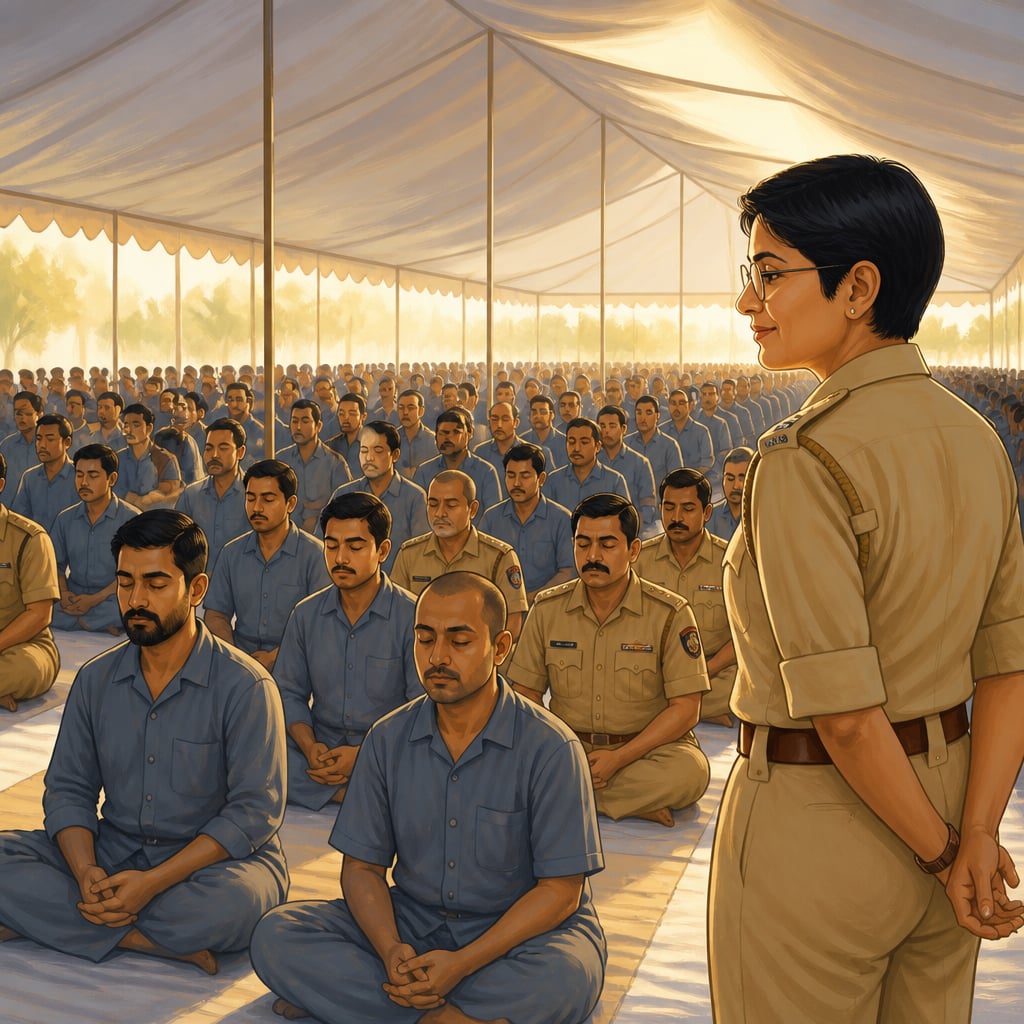
In April 1994, inside Tihar Jail in Delhi, then the largest prison complex in Asia, something unheard of took place. More than a thousand inmates sat down together in a vast tent to spend ten days in complete silence.
The woman who arranged it was the jail's Inspector General, Kiran Bedi, the first woman to hold the post. Tihar when she arrived was notorious: overcrowded, violent, corrupt, a warehouse where men were stored and worsened. Bedi's conviction ran the other way. A prison, she argued, should be an ashram: a place a person leaves better than they entered. She brought in teachers of Vipassana, the ancient silent meditation discipline, and offered the hardest men in India ten days of watching their own minds.
Hardened prisoners wept openly on the final day. Some asked forgiveness of the guards; some wrote to their victims' families. Not everyone changed, and no one pretended otherwise. But the experiment made a claim the whole world's prison debate still circles: is a sentence for ending a person, or for correcting one?
Hold Bedi's question. The Garuda Purana answered it, about the deepest sentences in its cosmology, fifteen centuries before Tihar.
The Word That Changes Everything
We have arrived at the narakas: the realms of consequence below Yama's court, the source of every lurid retelling this text has suffered. The descriptions are genuinely fearsome, and the text means them to be. Each naraka is specific, matched to a category of harm: cruelty here, betrayal of trust there, misused power in its own precinct. It is the moral cartography we mapped in Chapter 2, given terrain.
But one word in the text's own account dissolves the popular nightmare, and it is time to read it:

प्रायश्चित्तेष्वचीर्णेषु यमलोका ह्यनेकधा । यातनाभिर्विमुक्ता ये यान्ति ते जीवसन्ततिम् ॥
prāyaścitteṣv acīrṇeṣu yama-lokā hy anekadhā yātanābhir vimuktā ye yānti te jīva-santatim
For those whose wrongs went unexpiated, the realms of Yama are many. But those released from the yatanas go forth again into the stream of living beings.
Garuda Purana, Preta Khanda 46.9
The word is released. Vimukta: freed, let out, discharged. The verse states it as plainly as a gate schedule: the traveler undergoes the consequence, the consequence completes, and the traveler rejoins the stream of life. The very next verse continues the itinerary: such a one is born again in the human world, carrying marks of the old wrongs, and the story goes on.
Stop on what this means for the map. In this cosmology, there is no eternal damnation. The concept does not exist. No soul is ever discarded; no verdict is ever final; no gate lacks an exit date. The fiercest sentence in the fiercest naraka is, by the text's own arithmetic, a term. Karma is finite, so its consequences are finite: a deed is a deposit of specific size, and when its fruit is exhausted, the account simply closes and the wheel turns. The narakas are not the opposite of the mercy in this text. They are a wing of its hospital.
Correction, Not Vengeance
Read the design that follows from the one word, because every feature of the naraka system now falls into place.
The sentences are specific: matched to the harm, not generic torment. That is diagnosis, not rage. The sentences are proportionate: measured to the deed's weight, exhausted when the weight is paid. That is accounting, not fury. And the sentences end in return: the discharged traveler is not exiled to some permanent elsewhere but sent back into life, into a new human birth. The old marks fade, and the whole road is available again, including, the text will insist in Chapter 7, the road all the way out.
A system with those three properties has a name, and it is not vengeance. It is correction. The narakas are the tradition's statement that consequence exists to restore the moral order and the wrongdoer to it, never to gratify anger, not even cosmic anger. Vengeance wants the suffering; correction wants the return. You can tell which one a system is by asking one question: what happens at the end? Vengeance has no end. Correction has a gate, and the text has just shown you the gate.
Set the two great maps side by side and the choice this civilization made stands out sharply. Eternal damnation, the doctrine that a finite life's wrongs can earn infinite suffering, is the load-bearing wall of several other cosmologies. This tradition examined the same question, how must wrong be answered?, and legislated the opposite: no infinite penalty for a finite deed, ever, for anyone. The proportionality principle that modern law regards as an achievement of enlightened jurisprudence is, in this text, a property of the universe itself.
The Prison That Believes in Return

The modern world's own laboratories keep rediscovering the design. Norway's Halden prison, opened in 2010 to hold serious offenders, was built on a doctrine the Norwegian service states openly: the punishment is the loss of liberty, and nothing else; the sentence's job is to return a functioning neighbour, because nearly every prisoner eventually comes back to the street. So Halden has trees, workshops, music rooms, and guards who eat with inmates. Norway's reoffending rates rank among the lowest in the world, while systems built on warehouse-and-forget rank among the highest. Bedi's Tihar tent made the same wager with Indian materials: treat the sentence as a term of correction, and more of the discharged rejoin the stream as neighbours rather than returning as cases.
Neither Halden nor Tihar proves a cosmology, and this course will not pretend otherwise. What they demonstrate is narrower and solid: systems designed for return outperform systems designed for disposal, in this world, measurably. The text's map put that principle at the foundation of the cosmos. Its narakas, the most feared rooms in Indian literature, turn out to be built on the most hopeful sentence in the book: everyone comes back.
And with that, the chapter's question is answered in full. What actually happens when we die? A departure shaped by the life; a road provisioned by love; a river crossed on generosity; a level court; and consequences that correct and release. The traveler's story does not end at the road's end. It returns, which raises the question the family at home has been living all along: what exactly are the rites for? The course now walks back out of Yama's city, back to the house where the lamps are lit, for the chapter this text is recited in: the rituals, decoded.
Case studies
Vipassana in Tihar
Taking charge of Tihar Jail in 1993, Kiran Bedi inherited roughly 8,000 inmates in a complex built for far fewer, with violence and despair as the daily regime. Against considerable official scepticism she reframed the prison as a place of correction, and in April 1994 organised a ten-day Vipassana meditation course inside the jail, taught in a huge tent, with over a thousand prisoners sitting the full discipline of silence and self-observation. Guards took the course too.
Bedi ran the naraka design inside a real sentence: consequence kept specific and lawful, but aimed wholly at return, the inmate rejoining the jiva-santati of society as a corrected neighbour. The weeping, the letters of apology, the changed men were prayashchitta happening inside the term: repair chosen from within, which the tradition holds discharges more than time ever can.
The Tihar experiment drew worldwide attention, won Bedi the Ramon Magsaysay Award in 1994, and led to a permanent meditation programme in the jail. Vipassana courses subsequently spread to prisons on several continents.
Even inside walls, the decisive question is the map's question: is this sentence ending a person or correcting one? The answer changes what walks out at the gate.
The April 1994 Tihar course seated over 1,000 inmates simultaneously, among the largest Vipassana courses ever held, and Tihar has run a permanent programme since.
Halden: The Prison Designed for Return
Norway's Halden prison, opened in 2010 for serious offenders, was designed from the ground up on the principle Norwegian corrections states openly: loss of liberty is the entire punishment, and the sentence's job is to return a functioning neighbour. Cells have windows without bars; inmates cook, study, and work; guards are trained to talk, eat, and play sport with prisoners. Critics called it a luxury hotel. Norway called it arithmetic: nearly everyone gets out eventually.
Halden is the sentence-that-ends built in concrete: specific (liberty alone is taken), proportionate (nothing beyond the term is added), and aimed entirely at the release into the stream. The narakas' three design properties, drawn by a tradition that never saw Scandinavia, reappear wherever a system is honest about the same truth: the discharged rejoin the living, so the sentence should build the person who rejoins.
Norway's two-year reoffending rate runs around 20 percent, among the world's lowest, against roughly 60 percent or more in the most punitive systems. Halden has become the reference case in global corrections debate.
Systems designed for disposal manufacture their own repeat customers. Systems designed for return get neighbours back. The gate's design decides what comes through it.
Norway's national two-year reconviction rate is approximately 20 percent, versus reported rates above 60 percent in several warehouse-model systems.
Living traditions
The expiation instinct remains thoroughly alive in Indian practice: pilgrimages undertaken to settle old wrongs, fasts kept as self-imposed terms, the Prayaga and Ganga snans understood as accounts closed, and the everyday vocabulary of prayashchitta that surfaces whenever someone says they must make something right before they can move on. Tihar's meditation programme continues, and India's prison-reform debate still runs on the question Bedi borrowed from the tradition: whether a sentence is for ending people or correcting them.
Reflection
- Who currently serves an unending sentence in your inner courtroom, another person, or yourself? Applying the map's law, what term would actually match the deed, and has it perhaps already been served?
- Where you hold authority, home, team, classroom, friendship, do your consequences pass the gate test? Could the person serving one tell you, precisely, what would end it?
- The verse offers two windows for every wrong: expiation now, by your own resolve, or the system's schedule later. Which unrepaired wrong of yours is still choosing its window, and what is the actual cost of waiting?