The Oil Press at Coimbatore
V.O. Chidambaram Pillai took two ships against the British India Steam Navigation Company, and was made to turn an oil press in Coimbatore jail
In October 1906 V.O. Chidambaram Pillai registered the Swadeshi Steam Navigation Company at Tuticorin and put two steamers on the Colombo run against the British India Steam Navigation Company. With Subramania Siva he then backed the nine-day Coral Mills strike of February 1908, at a mill managed by his shipping rival's own agents. Arrested on 12 March 1908, he was given two terms of transportation for life, cut to six years on appeal, and set to turn a bullock's oil press in Coimbatore Central Prison.
The Bullock's Work
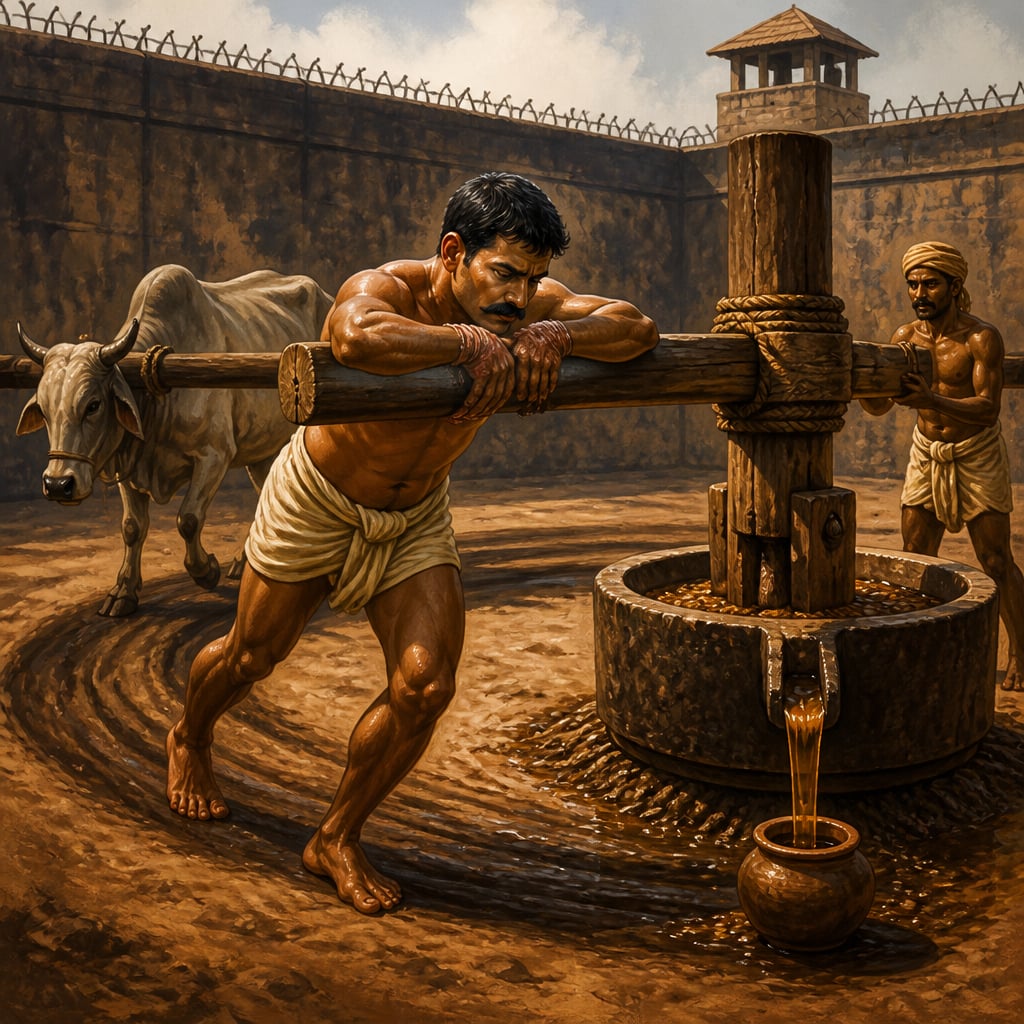
It is the afternoon of a hot day in the second half of 1908, inside the Central Prison at Coimbatore. In the yard stands a chekku, a village oil press. A deep wooden mortar is set in the ground, with a heavy wooden pestle leaning into it. A long wooden arm is bolted to the pestle, so that a bullock can walk in circles and crush sesame seed into oil.
There is no bullock at this press. A man of thirty-six is leaning into the arm and walking the circle himself. Sesame oil is seeping out below. His hands are already raw, because for weeks before this he was set to separating coir fibre and spinning rope, until the skin of his palms split and bled.
His name is V.O. Chidambaram Pillai. A year earlier he was a practising lawyer at Tuticorin and the promoter of a shipping company with a share list and two steamers of its own. He had gone to sea against the largest shipping firm in the Indian Ocean. Now he is turning a press that is built for an animal, and he will keep turning it.
How does a man go from a ship's deck to an oil press in a year and a half? The answer is not a story about one arrest. It is a story about what happens when Indians stop asking for a share of a trade and simply enter it.
Two Ships Against a Monopoly
Tuticorin, on the Gulf of Mannar, was a working port. Cotton, coir and pilgrims moved from there to Colombo, ninety-odd hours of cargo and passenger traffic every week. All of it went on the ships of the British India Steam Navigation Company, or BISN, which held a near monopoly on the route. Its local agents were a European firm at Tuticorin, A. and F. Harvey.