The Taluqdar Who Would Not Sign
Offered his estate back at Shankarpur in November 1858, Beni Madho Singh gave up the fort and would not give up himself
Beni Madho Singh of Shankarpur in Rae Bareli was the largest taluqdar of Awadh still fighting after Lucknow fell. In November 1858 Lord Clyde offered him very favourable terms; he answered that he would yield his fort but not himself, walked out of the uninvested face that night, and lost every gun at Dundia Khera on the 24th. He crossed into the Nepal terai and was killed there in late 1859, in a Dang valley engagement the record barely describes.
The Offer at Shankarpur
It is the second week of November 1858, in the Baiswara country of south Awadh. British columns have closed on the mud fort of Shankarpur from three sides. Hope Grant's guns face it from the north. Wetherall and Pinckney sit to the east and south. Only the west is open. Brigadier Evelegh has been held up by bad roads. He also had to fight his way through, at Moraman on the 8th and at Simri on the 9th.
Inside the fort is a Bais Rajput taluqdar named Beni Madho Singh, and with him a following the British estimated at fifteen thousand. He is roughly fifty-four years old. He is the adopted heir of Shiv Prasad Singh of Shankarpur, and he holds four forts: Shankarpur, Pukhbiyan, Bhikha and Jagatpur. Lucknow fell to the British eight months ago. Almost every other big landholder in Awadh has made his peace.
Then a message comes into the fort. The Commander in Chief, Lord Clyde, wants to avoid a bloody storm. He offers Beni Madho very favourable terms if he will surrender.
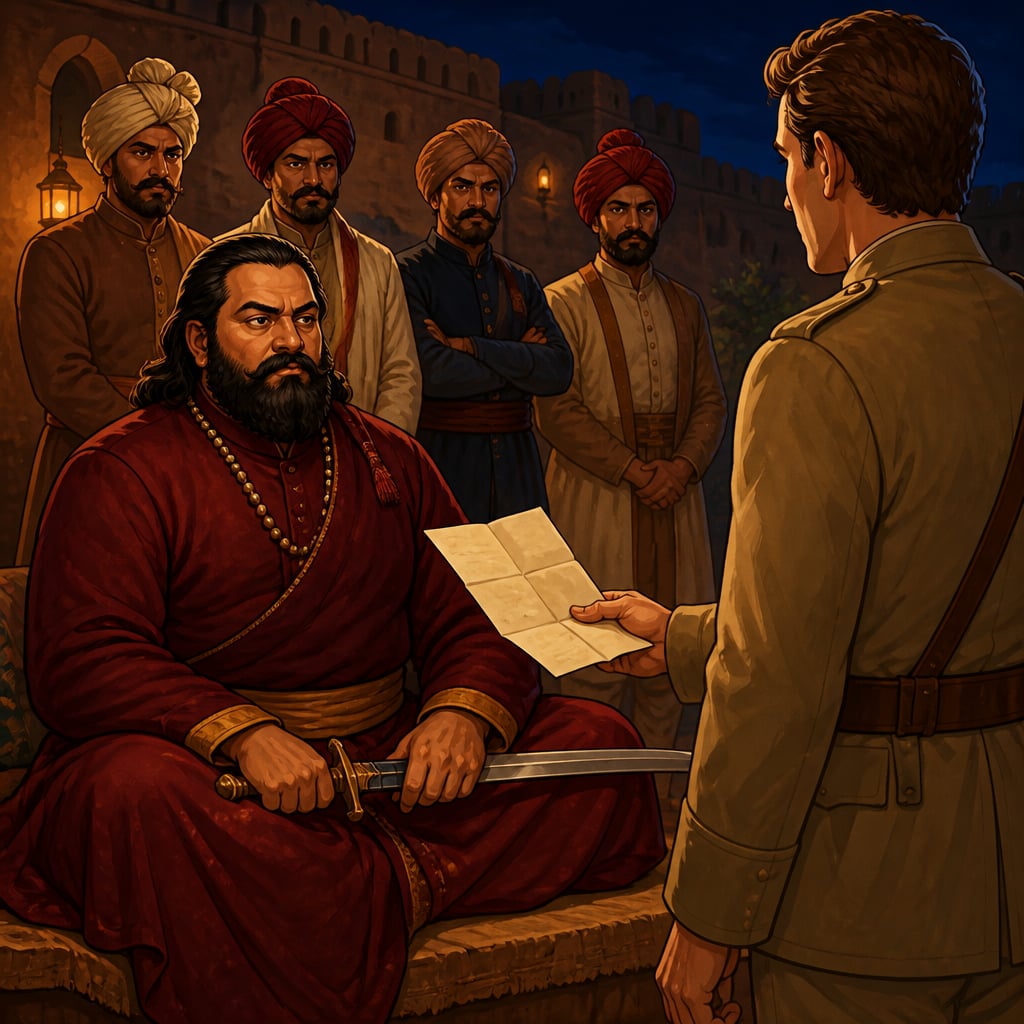
Beni Madho sends an answer back. It is the one sentence of his that the British wrote down, and it is why this lesson exists. He said he would give up his fort, because he could not defend it. He would not give up himself, because he belonged to his King.
That night he walked out of the open west face with his men and kept fighting for another year.
Why That Answer Was Expensive
To understand the price of that sentence, you have to know what Beni Madho was refusing.
On 15 March 1858 the Governor General, Lord Canning, had issued the Oudh Proclamation. It confiscated the proprietary right in the soil of the whole province, every estate except six that had stayed loyal. Then it held out the way back: a taluqdar who came in and submitted could have his estate returned. Canning was not being generous. He had worked out the fastest way to end the war in Awadh. Buy back the landholders one by one, because the landholders were the war.