The Road from Nasibpur to Kabul
Rao Tula Ram ran Rewari as his own government for six months, broke a British column at Nasibpur, then left India to find an ally and died in Kabul
In May 1857 Rao Tula Ram took over the Rewari district, raised about five thousand men, cast his own cannon and fed the rebel army holding Delhi. On 16 November 1857 his force met Colonel John Grant Gerrard's column at Nasibpur near Narnaul, killed Gerrard in the first charge, and then lost the field. He left India through Rajputana, argued his case in Iran and in Kabul, tried to reach the Russian court, and died in Kabul in 1863 without ever coming home.
Two Miles Northwest of Narnaul
It is the morning of Monday, 16 November 1857. A British column has been marching since before dawn across the dry country south of Delhi. The men are tired. Two miles northwest of the town of Narnaul they reach a small village called Nasibpur and halt for a short rest. The horses are blown. Water bottles come out.
The column is commanded by Colonel John Grant Gerrard. He has been sent to finish a job that Delhi's fall in September had left open. Somewhere ahead of him is a chief from Rewari who has spent six months arming, taxing and governing a stretch of country as if the Company did not exist.
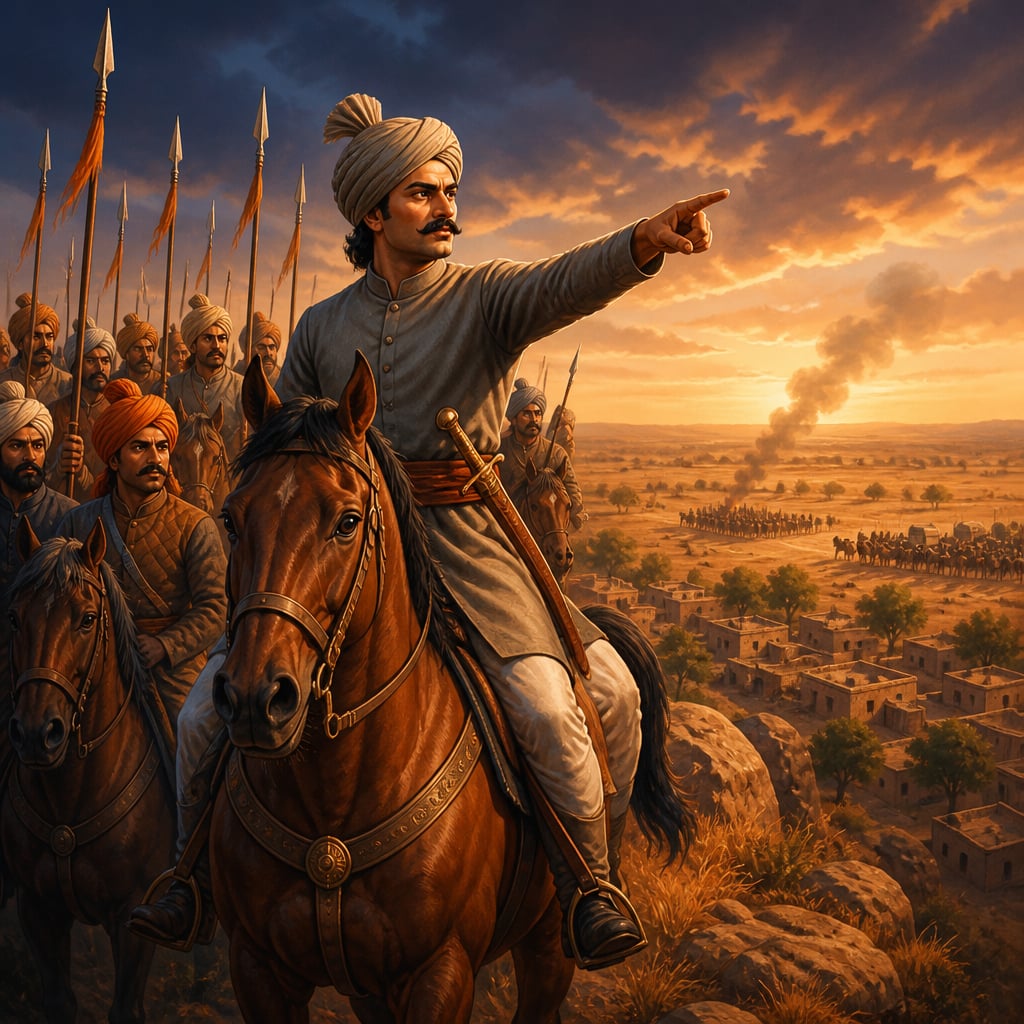
That chief is Rao Tula Ram. He is thirty-one years old. He has about five thousand men, a cannon workshop he built himself, and no illusions about what a British column can do. His own force is drawn up near the village.
Within the hour, Tula Ram's men charge. The charge goes through. British officers go down, and Gerrard himself is hit and dies of the wound. By evening the field belongs to the British anyway, and Tula Ram is riding away from it.
What he does next is the reason this lesson exists. Most rebel chiefs of 1857 either died in the field, were hanged, or made terms. Tula Ram did none of those things. He rode out of India and kept fighting for six more years, in Iran, in Afghanistan, and by letter towards Russia, and he never came home.
The Six Months Before
Rewari sits in the Ahirwal country of what is now southern Haryana, on the old road from Delhi towards Rajputana. Rao Tula Ram was born there, at Rampura on the edge of the town, in December 1825. He was a boy when his father Rao Puran Singh died. He grew up in a family that had held local authority for generations. He also grew up watching it shrink, year by year, as the Company's writ spread.