Hanged at Chandni Chowk
Raja Nahar Singh held the Delhi to Agra road for the rising, and paid for it near the fountain on 9 January 1858
Nahar Singh, raja of the hundred and one villages of Ballabgarh, backed the Delhi rising in May 1857 and fed it through the summer from the main road south of the capital. Arrested in December, tried by a military commission of five officers and hanged at Chandni Chowk on 9 January 1858, he lost his life and his state on the same day. His own letters, captured in the Delhi palace, were the evidence against him.
The Fountain at Chandni Chowk
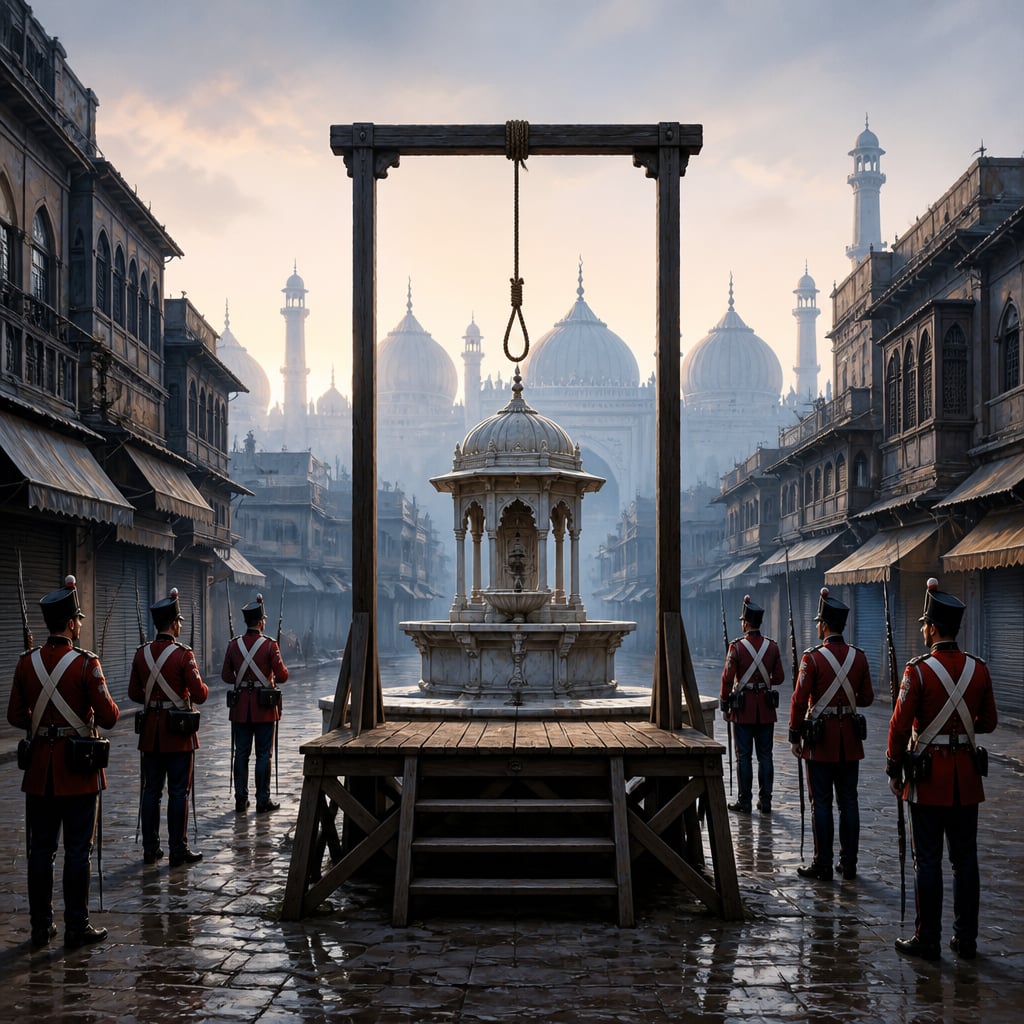
It is the morning of Saturday, 9 January 1858. Delhi has been in British hands for close to four months. The shops of Chandni Chowk are shut. Soldiers hold the road at both ends. A gallows stands near the fountain in the middle of the street, a few steps from a town house that belongs to the man about to be hanged.
His name is Raja Nahar Singh. He is the ruler of Ballabgarh, a small state of about a hundred villages on the road south of Delhi. He is in his middle thirties. Three weeks ago a military commission of five British officers tried him in Delhi and sentenced him to hang and to lose everything he owned.
He is not a soldier taken in the field. He was arrested in December, weeks after the fighting around him had ended, and he came to this spot from a room in Metcalfe House. Local accounts in Ballabgarh say three of his men died on the same platform that morning, and name them as Gulab Singh, Bhura Singh and Kushal Singh.
The question worth asking is not how a raja ended up on a gallows. Many did that year. The question is what a man with a hundred villages and no chance of winning thought he was doing between May and September 1857. And why the Company decided that a state of a hundred and fifty years standing should not exist after him.
A Hundred Villages on the Agra Road
Ballabgarh sits about twenty miles south of Delhi, in what is now Faridabad district in Haryana. The Tewatia family that ruled it had been there since the early eighteenth century, when Gopal Singh built up a holding around the village of Sihi. His descendants raised the fort, fought the Mughal officers, and slowly turned a fighting family into a recognised state.