Seven Hundred Verses Recited for a Thousand Years
What the Devi Mahatmyam is, its place in the Markandeya Purana, and why it is the Navaratri text. Why a book of battles is really about you.
What the Devi Mahatmyam is, where it sits inside the Markandeya Purana, and why its seven hundred verses are the text recited through the nine nights of Navaratri. And the question the whole course turns on: why a book of gods and demons is really a book about you.
The Ninth Night
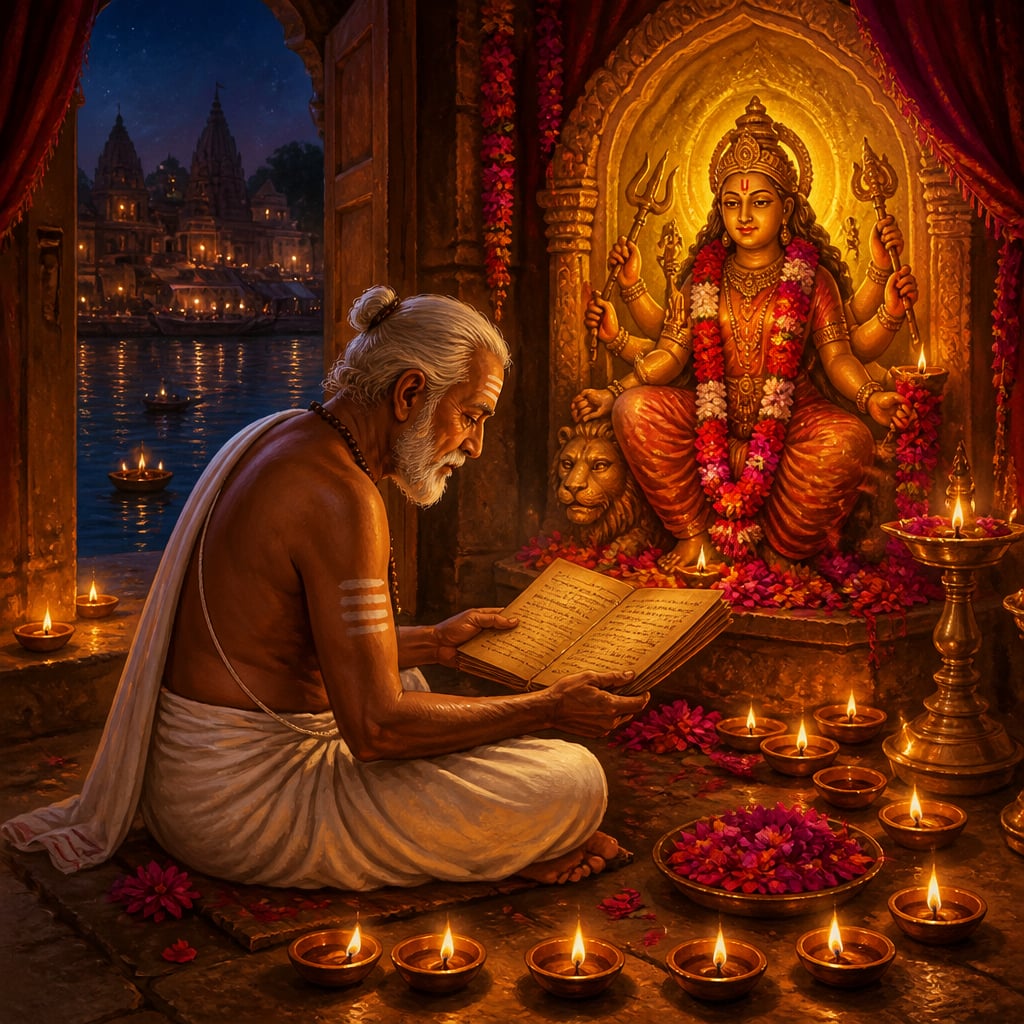
Picture an old priest on the ninth night of Navaratri, in a small shrine to the Goddess on the banks of the Ganga at Varanasi. He is one of thousands doing the very same thing tonight, across India, in the same hours. An oil lamp throws his shadow onto the wall. Marigolds lie heaped at the feet of the image of Durga, and the air is thick with camphor smoke.
He opens a worn book. Its pages have been turned on this night every year for as long as he has been a priest. When his voice begins, it is low and sure. He is reading seven hundred verses that have been recited, out loud, for more than a thousand years.
The book is the Devi Mahatmyam, "the Glory of the Goddess." Most people know it by other names. In Bengal they call it the Chandi, and the act of reciting it the Chandi Path, the reading of the Chandi. Across much of India it is simply the Durga Saptashati, the "seven hundred verses of Durga." Saptashati means seven hundred. By tradition the text holds exactly that many verses, and that number is part of how it is counted and revered.
What is this text, where did it come from, and why is it the one book above all others read through the nine nights of Navaratri? That is what this first lesson is for. And there is one more question underneath it, the one the whole course turns on: why is a book of battles, of gods and demons and severed heads, really a book about you?
A Text Inside a Text
The Devi Mahatmyam does not stand alone. It sits inside a much older and larger work, the Markandeya Purana, one of the eighteen great Puranas. Within that Purana, the Devi Mahatmyam is chapters eighty-one to ninety-three, thirteen chapters in all. At some point, more than a thousand years ago, these thirteen chapters were lifted out and treated as a scripture in their own right: recited, memorised, and worshipped on their own. Few passages in any tradition have travelled so far from their parent book.
The frame is simple. A king who has lost his kingdom and a merchant thrown out by his own family both wander into a forest. They meet a sage named Medhas. Each man is miserable, and each is puzzled that he still cares about the very people who have wounded him. The sage answers them by telling three stories, the three great deeds of the Goddess. Those three stories are the heart of the text.

- The first deed (Prathama Charita): the Goddess as Mahakali, waking Vishnu to destroy two demons born of the cosmic deep.
- The middle deed (Madhyama Charita): the Goddess as Mahalakshmi, formed from the combined light of all the gods, slaying the buffalo-demon Mahishasura.
- The final deed (Uttama Charita): the Goddess as Mahasaraswati, defeating the brothers Shumbha and Nishumbha and the blood-born demon Raktabija.
One Goddess, three forms, three victories. The course walks all three.
Why This Is the Navaratri Text

Navaratri means "nine nights." For nine nights in the autumn, and again in the spring, households and temples across India turn to the Goddess. The text they turn to, more than any other, is this one.
There is a fit between the shape of the festival and the shape of the book. Nine nights, three deeds, three forms of the one Goddess. Many traditions divide the nine nights into three sets of three, one set for each of Her forms. The reciter reads the Prathama Charita, then the Madhyama, then the Uttama, and by the tenth day, Vijayadashami, the "victory tenth," the whole cycle of battles has been read and won.
The text is rarely recited bare. Around it sit shorter hymns that frame the reading the way a gate frames a road: the Devi Kavacham, the "armour" that guards the reciter limb by limb, and the Argala and Kilaka, the "bolt" and the "pin" that open and secure the recitation. We meet all of these in the final chapter, treated as what they are, living prayers.
One verse returns again and again, in the temple tonight and in this course. It is the great refrain:
या देवी सर्वभूतेषु मातृरूपेण संस्थिता। नमस्तस्यै नमस्तस्यै नमस्तस्यै नमो नमः॥
yā devī sarva-bhūteṣu mātṛ-rūpeṇa saṃsthitā namas tasyai namas tasyai namas tasyai namo namaḥ
To the Goddess who dwells in all beings as the Mother, salutations to Her, salutations to Her, again and again salutations.
Devi Mahatmyam, Chapter 5
Read the middle line closely. The Goddess is not only far away in heaven, fighting a monster. She dwells in all beings. Hold on to that. It is the key that turns the whole text.
Why a Book of Battles Is a Book About You
The stories are full of war. So it is fair to ask what a modern reader, who fights no demons, is meant to take from them.
The tradition itself gives the answer, and it is old, not modern. In the Shakta tradition, the tradition of Goddess-worship, each demon has long been read as a named state of mind. Not instead of a real demon, but as a second layer of meaning the sages placed inside the story on purpose. The buffalo-demon Mahishasura is the brute ego that no single strength can bring down. Madhu and Kaitabha are the heaviness and the stickiness that keep you asleep to your own life. Raktabija, whose every falling drop of blood becomes another demon, is craving: the want that multiplies the moment you strike at it.
In each lesson we walk the battle as the scripture tells it, with the Goddess honoured exactly as the devotee honours Her. And in the closing beats of each lesson, we name the inner enemy that particular demon has always stood for, in the tradition's own reading. The Goddess wins every battle. The mirror is what you carry into your own.
Be clear about the reverence. The inner reading does not shrink the Goddess to a symbol. She is worshipped as real, as the living power behind all the gods. The allegory sits inside that worship and deepens it. Reading the Chandi this way is not a modern trick played on an old book. It is how the tradition has read its own scripture for a very long time.
The Same Book, Still Recited
None of this is a museum piece. In 2021, the United Nations cultural body, UNESCO, added Durga Puja in Kolkata to its Representative List of the Intangible Cultural Heritage of Humanity, naming the festival one of the living treasures of the world. At the centre of that festival, in thousands of pandals and homes, is the recitation of these same seven hundred verses. The priest at Varanasi and the reciter in a Kolkata pandal are reading the words the sage Medhas is said to have spoken in his forest, unbroken, across more than a thousand years.
Back in the small shrine on the Ganga, the old priest reads on. Tonight he finishes the first of the three deeds. The king who lost his kingdom and the merchant who lost his home are still waiting, in the forest, for the sage to begin. We meet them in the next lesson.
Living traditions
The Devi Mahatmyam remains one of the most recited scriptures in India, performed live every Navaratri in temples and homes and broadcast on radio and television. Its refrain, Ya Devi sarva-bhuteshu, is among the most widely known verses in the Goddess tradition.
- Vindhyavasini Temple, Vindhyachal: A major temple to the Goddess as Vindhyavasini, "she who dwells in the Vindhya mountains," a form the Devi herself names in the text. A living centre of Shakti worship, busiest during the two Navaratris. (The Shakti Peethas course covers the wider network of Goddess sites; this is one anchor point tied directly to the Devi Mahatmyam.)
Reflection
- The course promises that each demon names an inner enemy. Before you meet a single battle, which inner enemy do you already suspect the text will hold up as a mirror for you?
- The merchant in the frame story still loves the family that threw him out. What is something you keep caring about even though it has hurt you, and why do you think the caring stays?
- The refrain says the Goddess dwells in all beings. If that included both you and the person you find hardest to face, what might change in how you meet them?