Talapatram

One Goddess, Three Great Deeds

Mahakali, Mahalakshmi, Mahasaraswati; the three charitas ahead, and how the Chandi is recited. A reverent overview of the practice.

Before the battles begin, a reverent map of the whole text: the three great deeds (charitas), the three presiding forms of the one Goddess, Mahakali, Mahalakshmi, and Mahasaraswati, and how the Chandi is actually recited, with the Kavacha, Argala, and Kilaka that frame the Path across the nine nights of Navaratri. Three victories the reader will walk, outwardly in the story and inwardly in themselves.

The Same Goddess, Three Different Faces

Before the first battle of the Chandi is even spoken, it is worth seeing the shape of the whole thing, because a genuine puzzle waits inside it. Across the three great stories the reciter is about to read, the same Goddess appears in three forms so different they could be three separate deities. In the first she is dark as the dissolving night. In the second she is golden, blazing with the massed light of every god. In the third she is luminous and clear, a Goddess of pure knowing. One power, three faces that share almost nothing to the eye.

Why would a single Goddess need three such different forms? The tradition's answer is the key to this whole course. She is not fighting one enemy three times over. She is fighting three fundamentally different kinds of trouble, and each kind demands a different kind of power.

Three Deeds, Three Kinds of Trouble
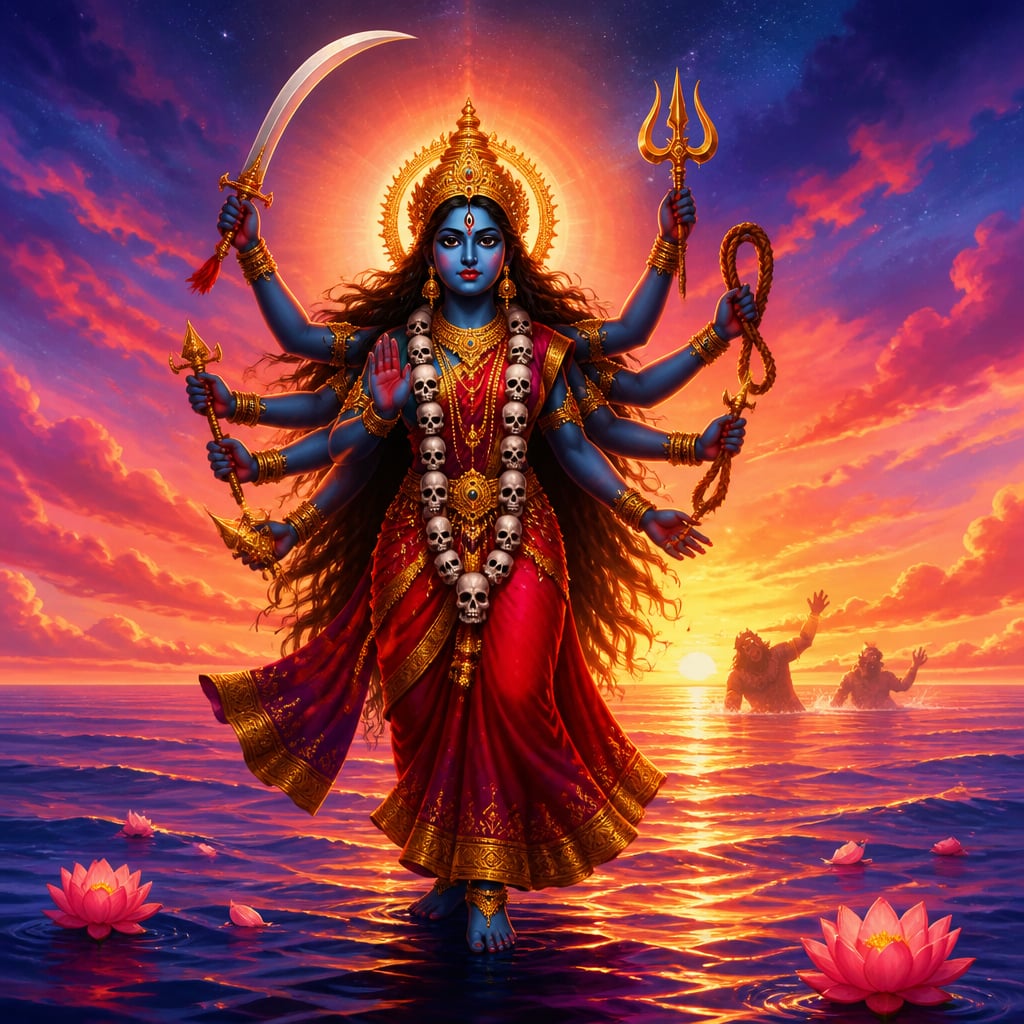
Mahakali triumphant after the first great deed

The Devi Mahatmyam tells three great stories, called the three charitas. Each is presided over by one form of the Goddess, and the tradition ties each form to one of the three gunas, the three basic qualities the whole world is woven from.

Deed (Charita) The demon The presiding form The quality it meets
First (Prathama) Madhu and Kaitabha Mahakali tamas, heaviness and darkness
Middle (Madhyama) Mahishasura Mahalakshmi rajas, restless force
Final (Uttama) Shumbha, Nishumbha, Raktabija Mahasaraswati sattva, clarity and light

Read the table down the last column, because that is where the teaching sits. The three enemies are not the same problem in larger and larger sizes. They are three different orders of difficulty.

Mahalakshmi formed from the gods facing Mahishasura

One Goddess, three forms, because heaviness, brute force, and subtle craving are simply not the same enemy. A dissolving darkness wakes you; a massed radiance breaks the charging ego; a clear light reaches the faults too fine for any blow to touch.

Why the Order Cannot Change

Mahasaraswati radiant against Shumbha Nishumbha and Raktabija

Notice that the deeds run in a fixed sequence, from the grossest trouble to the finest, and this is not a storyteller's convenience. You cannot fight them in another order.

You cannot face the ego while you are still asleep. A person sunk in fog and inertia has no ground to stand on to meet anything at all; the heaviness has to lift first. And you cannot end subtle craving while you are still ruled by brute pride, because pride will simply take the fight against craving and make it one more thing to be proud of. Waking comes before facing the ego. Facing the ego comes before ending craving. The three deeds are a staircase, and the course climbs it in the exact order the text lays down.

This is why the reciter's own prayer, at the close of the reading, asks for two kinds of thing in a single breath.

देहि सौभाग्यमारोग्यं देहि मे परमं सुखम्। रूपं देहि जयं देहि यशो देहि द्विषो जहि॥

dehi saubhāgyam ārogyaṃ dehi me paramaṃ sukham rūpaṃ dehi jayaṃ dehi yaśo dehi dviṣo jahi

Grant good fortune and health, grant me the highest happiness; grant beauty, grant victory, grant fame, and destroy the enemies within.

Devi Mahatmyam, Chapter 11

Worldly good and inner victory, health and fortune and also the destroying of the enemies within, asked for together. That double asking is the whole spirit of the course in a single line.

The Map You Carry In

Keep this shape in your head as you read, so that no single battle feels like an isolated fight. Each is one face of the same power meeting one kind of trouble, in the one order the troubles can be met. The reciter frames the whole reading with short guarding hymns, the armour, the bolt, and the pin, which the final chapter returns to in full; but the heart of the Chandi is these three deeds and the three victories they hold.

And the tradition has always read those victories twice over: as the Goddess's, out there on the cosmic field, and as three a person can win inside. Waking, then facing the ego, then ending craving, is the inner staircase the text hands you, and the Goddess who wins each battle is honoured as the very power that would win it in you.

सर्वस्य बुद्धिरूपेण जनस्य हृदि संस्थिते। स्वर्गापवर्गदे देवि नारायणि नमोऽस्तु ते॥

sarvasya buddhi-rūpeṇa janasya hṛdi saṃsthite svargāpavarga-de devi nārāyaṇi namo'stu te

O you who dwell as the very intelligence in the heart of every being, giver of both heaven and liberation, O Narayani, salutations to you.

Devi Mahatmyam 11.8

The map is drawn. The reciter at the lamp has finished the armour and the bolt and the pin, and the first deed is about to begin. It opens not with a hero but with a sleeping god and a dissolving world, and with the Goddess who is the sleep itself. That is where we go next.

Living traditions

The framing hymns are still exactly what people recite. Buy a printed Durga Saptashati today, in almost any Indian language, and you will find the Kavacha, the Argala, and the Kilaka bound in before the first chapter, just as this lesson describes. The map is not a scholar's reconstruction; it is the running order of a living book.

  • Chamundeshwari Temple, Mysuru: The temple to the Goddess as Chamundeshwari, the form who slew Mahishasura, crowning the hill above Mysuru, the city whose very name recalls the buffalo-demon. It is the ceremonial heart of the grand Mysuru Dasara, one of India's most famous Navaratri celebrations, and a fitting place to hold the whole map of the three deeds in mind. (Read a Temple and the Shakti Peethas course go deeper into temple sites; here it anchors the recitation and the Navaratri arc.)

Reflection

  • The three deeds are waking up, facing the ego, and ending craving. Which of the three feels most like the battle in front of you right now?
  • Reciters put on armour before they begin. What would it mean for you to prepare, deliberately, before facing something difficult in yourself?
  • The three forms are one Goddess. Where do you treat parts of yourself as if they were separate people, when they might be one self in different forms?

More in What the Chandi Is

All lessons in What the Chandi Is · Durga: The Goddess Who Saves the World ebook course