Mahamaya: The Power That Binds and Frees
Why even the wise stay attached; the Goddess as the force of both delusion and liberation.
Medhas answers the two seekers by unfolding the strange double nature of Mahamaya: the same power that binds beings to the world in delusion is the power that, when she is pleased, sets them free. Attachment is not a private failing but the working of a cosmic power, and recognising it as such is the first turn from being bound toward being free.
The Sage's Answer
The king and the merchant had asked their question, and Medhas had given it a name: Mahamaya. Now, seated in the hermitage while the evening fire burned low, the sage went further. He did not describe a gentle helper, and he did not describe a simple enemy. He described a power with two faces, and told the men that both faces belong to one Goddess.
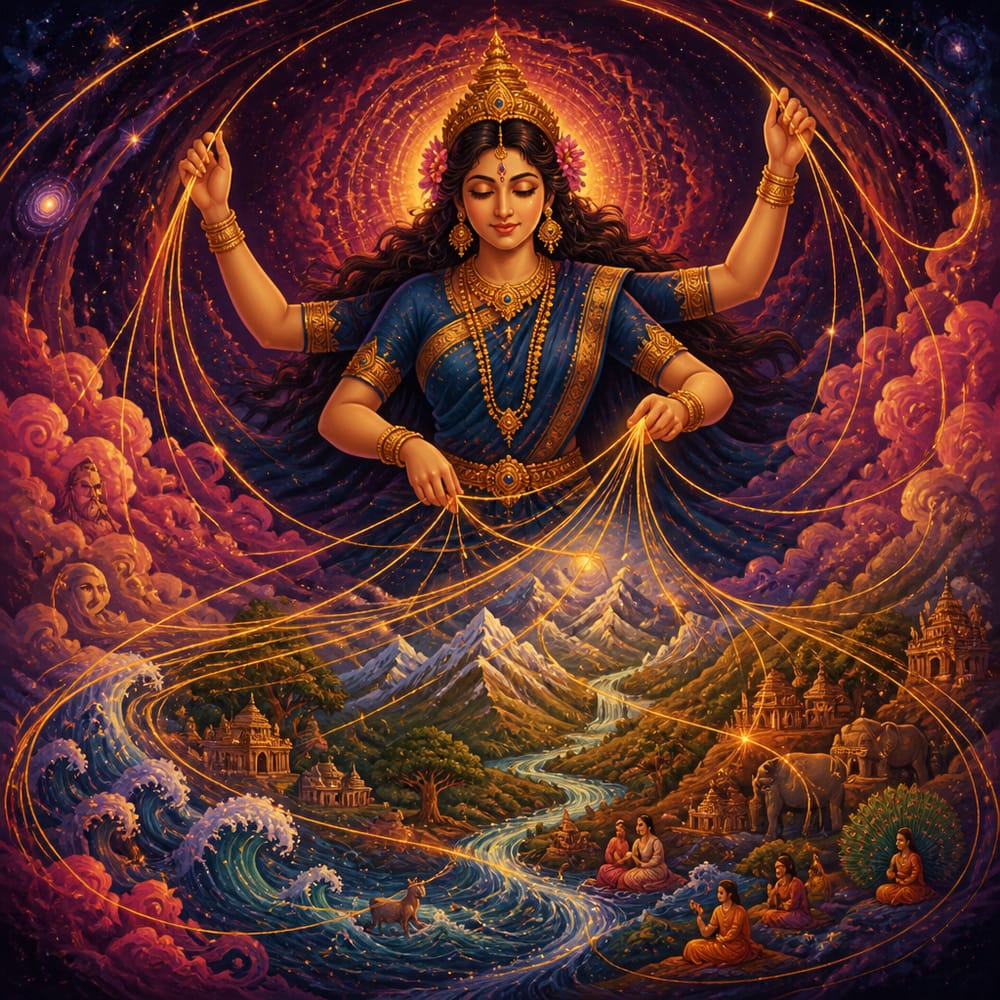
She is the power, he told them, by which this whole moving and unmoving world is spun out and held together. Everything you can name stands up inside her measuring: the kingdom and the family, the wealth and the loss of it, and the very feeling that these things are yours. She is what makes a world appear at all. And the same power that makes the world appear is the power that binds you to it, tying your heart to what you own with the thread the last lesson called mamata, the sense of mine.
That is her first face. It is the face Suratha and Samadhi already knew, without knowing its name. They had been living inside it their whole lives.
The Power That Frees
Then Medhas turned the coin over. This same Goddess, he said, when she is pleased, becomes the boon-giver for the liberation of beings. The very power that binds is the power that releases. She is at once the highest knowledge, the wisdom that frees, and the cause of the world's bondage.
सा विद्या परमा मुक्तेर्हेतुभूता सनातनी। संसारबन्धहेतुश्च सैव सर्वेश्वरेश्वरी॥
sā vidyā paramā mukter hetu-bhūtā sanātanī saṃsāra-bandha-hetuś ca saiva sarveśvareśvarī
She is the supreme, eternal knowledge that is the cause of liberation, and she alone is the cause of bondage to the world, she, the ruler of all rulers.
Devi Mahatmyam, Chapter 1
Read that verse slowly, because it is one of the boldest lines in the whole text. It does not split reality into a good power that frees and a bad power that binds, the way we usually want it split. It says the binder and the freer are one. The rope that ties you and the hand that unties you belong to the same Goddess. She wears two faces, and both are truly hers:
- the binding face, the power that spins out the world and ties your heart to what you own
- the freeing face, the same power that, when she is pleased, releases you from it
There is no second force to run to, no outside rescuer. There is only Her, wearing one face or the other.
For the two seekers this is either the worst news or the best, depending on how they hear it. If one power holds all the strings, then there is no slipping free by cleverness. But if that same power can free as easily as it binds, then freedom is not somewhere far off. It is the very thing that has hold of you, turning its other face toward you.
Yoga-Nidra: The Sleep of the World

Medhas gave the men an image for this. Between the great cycles of the world, when everything dissolves back into a single dark ocean, the Lord Vishnu rests in a deep sleep upon those waters. That sleep is not empty, and it is not merely Vishnu's. That sleep is Herself, the Goddess as Yoga-nidra, the yogic slumber in which the whole world lies folded like a seed, waiting to be woken.
She is the sleep, and she is also the waking. In the very next chapter the gods will find themselves in danger and will sing, not to Vishnu, but to her, begging her to release her hold so that Vishnu can rise and act. Hold that picture, because it is the whole teaching in a single image. The power that puts the world to sleep is the same power that is asked to wake it. Nothing outside her binds. Nothing outside her frees.
या देवी सर्वभूतेषु निद्रारूपेण संस्थिता। नमस्तस्यै नमस्तस्यै नमस्तस्यै नमो नमः॥
yā devī sarva-bhūteṣu nidrā-rūpeṇa saṃsthitā namas tasyai namas tasyai namas tasyai namo namaḥ
To the Goddess who dwells in all beings in the form of sleep, salutations to Her, salutations to Her, again and again salutations.
Devi Mahatmyam, Chapter 5
The Pull That Holds You
Now bring this back to the two men in the forest, because the tradition always does. Suratha and Samadhi came ashamed of their own hearts. Each thought his helpless clinging was a private weakness, a failure of a man who ought to know better. Medhas has just told them something that changes the whole weight of that shame. The pull they feel is not their personal flaw. It is the working of a power that spins whole worlds and reaches even the wise. They are not weak men. They are caught in something vast.
That reframing is the first freedom, and it is a real one. As long as you believe your attachment is only your own foolishness, you fight it alone, and you lose, because the struggle is itself another kind of clinging. The moment you see it as maya, the great measuring power at work in everyone alike, something loosens. You stop attacking yourself and start looking at the power itself.
And here is the quiet turn the tradition points to. The same Goddess who binds is the one who frees. So the answer the text offers is not to hate the pull, and not to hate yourself for feeling it. The answer is to turn toward the power behind it and ask it, in effect, to loosen its own hold. That is what worship of the Goddess means here. It is not begging a distant stranger for a favour. It is turning to face the very power that both binds and releases you, and letting it turn, for you, from the one face to the other.
The men do not understand all of this yet. They only know that their shame has been lifted a little, and that the sage is about to show them what this power looks like when it moves. He begins with the oldest story of all, the cosmic night, when the world itself had to be woken, and when the Goddess was the sleep that had to be asked to let go. That is the next chapter.
Living traditions
The Goddess as Yoga-nidra has left a mark most people never trace to her. The deep guided relaxation now taught in studios and apps worldwide as "yoga nidra" borrows its very name from this idea: a conscious, powerful rest. The word carries a thousand-year-old picture of the Goddess as the sleep of the world.
- Kamakhya Temple, Guwahati: A major living center of Shakti worship, where the Goddess is honoured as the creative power at the very source of the world, the same world-spinning force Medhas calls Mahamaya. It is one of the most important Goddess sites in India and draws pilgrims through the year. (The Shakti Peethas course maps the wider network; this one anchors the idea of the Goddess as the power that projects the world.)
Reflection
- The text says the same power both binds and frees. Where in your life is a single thing at once a comfort and a cage?
- Does it change anything to see your attachment as a universal pull that reaches even the wise, rather than your own private weakness?
- If the power that binds you is the same one that could free you, what would it mean to turn toward it rather than fight it?