When Vishnu Slept and the World Dissolved
The cosmic night; the Goddess is Yoga-nidra, the sleep itself. The comfortable sleep you do not want to wake from.
At the end of a world, everything dissolves into one dark ocean where Vishnu lies asleep on the cosmic serpent and the sleep itself is the Goddess as Yoga-nidra. Watched over by Mahakali, the dark dissolving power, this is the great cosmic night, and a mirror of the heavy, comfortable sleep of inertia that a person can lie in for years.
The Night with No Stars
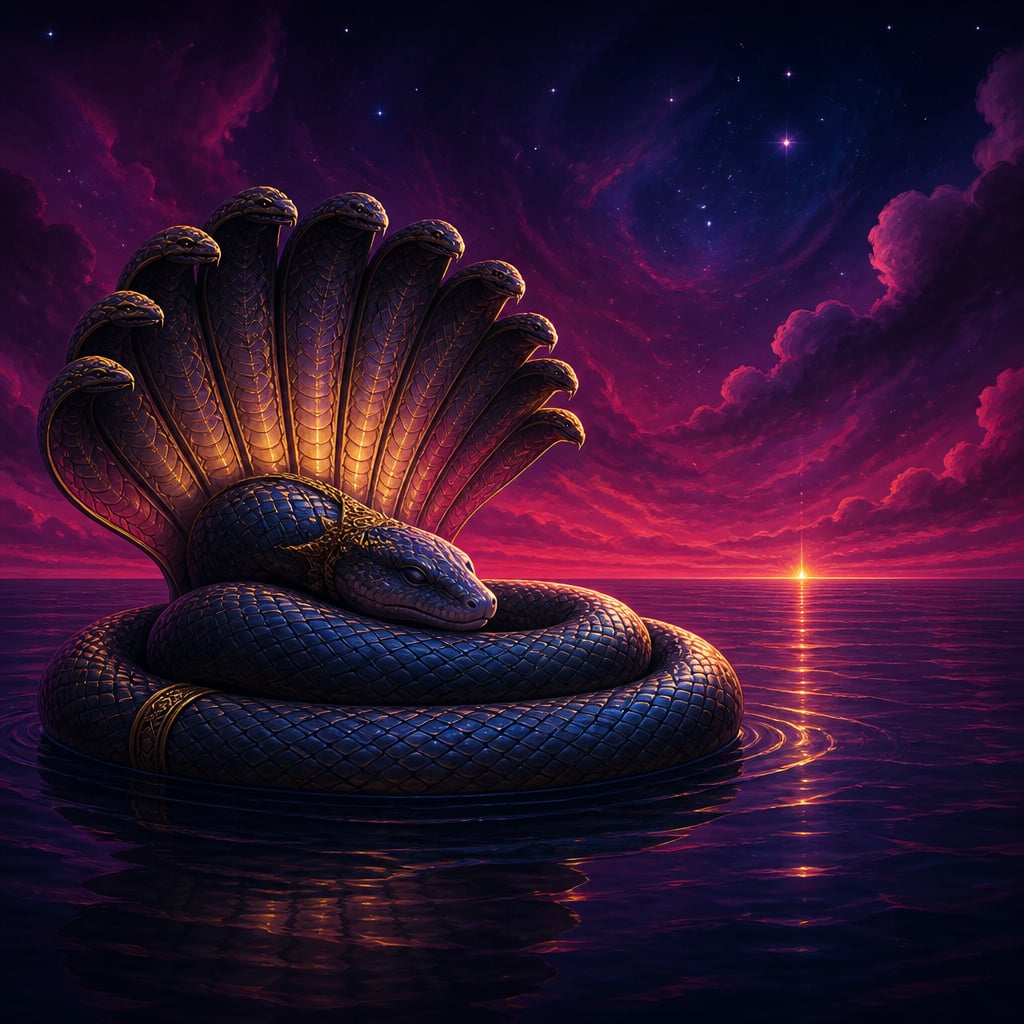
Before the first act of creation, there is a night. Not the night that follows a day, but the great night that swallows a whole world when its time is done. The tradition calls it pralaya, the dissolving. The mountains and the rivers, the gods, the living and the dead, all of it softens and sinks and returns to a single dark water. There is no sun to rise over it and no shore for it to break on. There is only one endless ocean, still in every direction.
On that water, something floats. A vast serpent, coiled into a raft of its own body, drifts on the swell. And on the serpent, at rest, lies Vishnu, the preserver of worlds, deep asleep. His slow breathing is the only motion in all that dark. From his navel a single lotus has grown up through the water, and on the lotus sits Brahma, the maker, waiting for the world to begin again.
Everything is poised. The world has ended and not yet restarted. And the one who could set it going again is asleep.
The Sleeper on the Waters
Look closely at that sleep, because the text wants you to. Vishnu is not merely tired, and the sleep that holds him is not a thing that happened to him from outside. The sleep is Herself. It is the Goddess in her form as Yoga-nidra, the yogic slumber, settled over his eyes, folding the whole world into rest.
The last chapter promised exactly this. The power that binds the world and the power that frees it are one Goddess, and here she wears her binding face as sleep. The world has not been destroyed by an enemy. It has been laid down to rest by the very power that made it. Between two great days of creation, she is the night in between.
Brahma, awake on his lotus, is about to learn how complete her hold is. He can see the sleeping Vishnu below him. He cannot wake him. No one can reach past the Goddess to the god she has folded into rest. If danger comes now, in the pause between worlds, there is no one to meet it.
त्वं वैष्णवी शक्तिरनन्तवीर्या विश्वस्य बीजं परमासि माया। सम्मोहितं देवि समस्तमेतत् त्वं वै प्रसन्ना भुवि मुक्तिहेतुः॥
tvaṃ vaiṣṇavī śaktir ananta-vīryā viśvasya bījaṃ paramāsi māyā sammohitaṃ devi samastam etat tvaṃ vai prasannā bhuvi mukti-hetuḥ
You are the Vaishnavi power of endless might, the seed of the universe, the supreme maya. All this world is deluded by you; and you, when pleased, become the cause of liberation on earth.
Devi Mahatmyam, Chapter 1 (Brahma's hymn to Yoga-nidra)
Read the last line of that verse. The same Goddess who has deluded and folded the whole world is the one who, when she is pleased, becomes the cause of liberation. Even here, at the stillest point of the story, the door is not locked. It only waits to be knocked on.
Mahakali: The Dark That Dissolves

This first of the three great deeds is watched over by the Goddess in her form as Mahakali, the dark, dissolving power. It is easy to hear the word dark and flinch, but the tradition does not mean evil by it. Mahakali is the darkness of the night that ends a day, the dissolving that must come before anything can be made new. She is the power that takes the old world apart and holds it, folded and safe, until it is time to begin again.
The whole cosmos rests inside her dark the way a seed rests in the ground through winter. Nothing is lost. Nothing is being punished. The world is only asleep, held by the Goddess, waiting.
त्वया धृतमिदं विश्वं त्वया सृष्टमिदं जगत्। त्वयैतत्पाल्यते देवि त्वमत्स्यन्ते च सर्वदा॥
tvayā dhṛtam idaṃ viśvaṃ tvayā sṛṣṭam idaṃ jagat tvayaitat pālyate devi tvam atsy ante ca sarvadā
By you this universe is upheld, by you this world is created; by you, O Goddess, it is protected, and you devour it at the end of all things.
Devi Mahatmyam, Chapter 1 (Brahma's hymn to Yoga-nidra)
The Sleep You Don't Want to Leave
Read as the tradition reads it, this great cosmic sleep is not only a story about the end of a world. It is a picture of a state you know from the inside.

There is a sleep that is not tiredness. It is the heavy comfort of a life that has stalled and does not want to be disturbed. It wears familiar faces:
- the tenth press of the snooze button
- the evening that dissolves into a screen
- the plan you will start tomorrow, and tomorrow, and tomorrow It is the warm, dim place where nothing is asked of you and nothing changes. The tradition has a name for the quality of that heaviness. It calls it tamas, and it is exactly the darkness Mahakali presides over.
The text is honest about how strong that sleep is. Even a god lies helpless inside it. Even the maker, wide awake, cannot break it from outside. If you have ever known that something in your life needed to wake and change, and found that willpower alone could not rouse it, you already understand the scene. The sleep is not a small thing. It folds up whole worlds.
But the verse has already given away the secret the rest of the chapter will unfold. The sleep is not your enemy, and it is not a punishment. It is a power, and the same power that lays you down is the one that can lift you. The question the next lesson asks is what finally forces the issue. And the answer, strangely, is danger. Two shapes are about to rise out of the dark water, and their coming is what will make someone turn, at last, to the sleeping power and ask her to let go.
Living traditions
The image of Vishnu asleep on the serpent upon the one ocean, with Brahma on the navel-lotus, is one of the most reproduced scenes in Indian art, painted and sculpted across a thousand years. It fixes a single idea in the mind: before every making there is a rest, and the rest is held by the Goddess.
- Kalighat Kali Temple, Kolkata: One of the most revered temples of the Goddess as Kali, the dark, dissolving power who presides over this first deed. It is counted among the Shakti Peethas and draws vast crowds who come to the Mother in her fierce, dark form. (The Shakti Peethas course maps the sacred network; here the site anchors the worship of Mahakali, the dark power of the Prathama Charita.)
Reflection
- The text describes a sleep that is heavy comfort rather than tiredness. Where in your life are you drowsing in a warm, dim place where nothing is asked of you and nothing changes?
- Brahma could see clearly that Vishnu needed to wake, and still could not force it. When have you known exactly what needed to change and found you could not make it happen by will alone?
- Mahakali's dark holds the world like a seed through winter, nothing lost. Is there a dark or fallow time in your own life that might be a holding rather than an ending?