The Goddess Withdraws, and the World Wakes
She releases her hold, Vishnu wakes, the demons are undone by their own boon. Waking is not force; it is the Goddess letting go.
Pleased by Brahma's hymn, the Goddess loosens her hold and Vishnu wakes, not by force but by her release. He battles Madhu and Kaitabha, and the two demons, drunk on their own strength through her lingering delusion, undo themselves by their own rash boon. The tradition reads the whole first victory as one truth: waking is a letting-go, the first freedom, and the enemies of the sleep defeat themselves once you are truly awake.
She Lets Go
The Goddess heard Brahma's hymn, and she was pleased. And so, of her own will, she did the one thing that changes everything. She loosened her hold. The sleep that had folded Vishnu lifted from his eyes. The Goddess as Yoga-nidra rose out of him, and Vishnu woke.
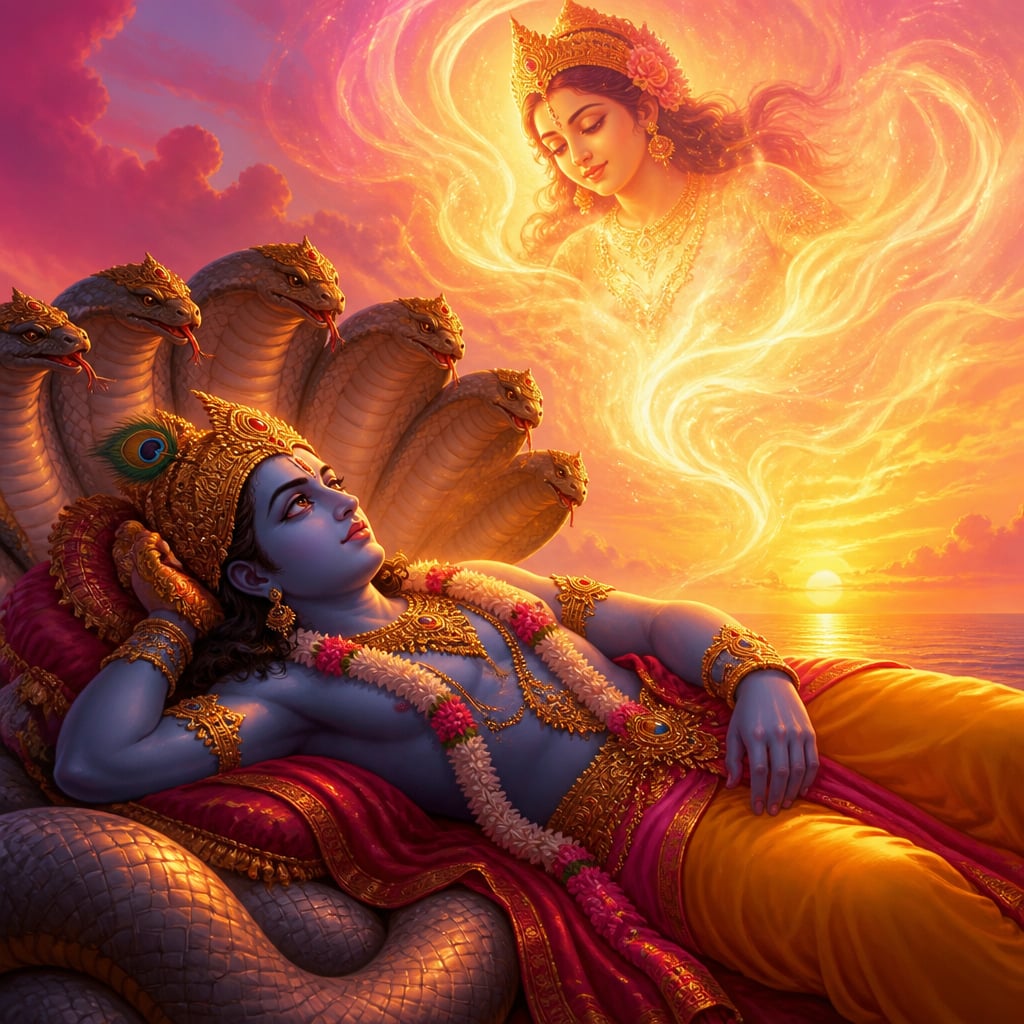
Hold on to how the waking happened, because the whole lesson is here. Vishnu was not shaken awake. Brahma did not find a way to force him up. The demons did not frighten him into rising. He woke because the Goddess, praised and pleased, chose to let go. The waking was not an act of force. It was an act of release. The strongest thing in the scene simply relaxed its grip, and the god came back to himself.
या देवी सर्वभूतेषु चेतनेत्यभिधीयते। नमस्तस्यै नमस्तस्यै नमस्तस्यै नमो नमः॥
yā devī sarva-bhūteṣu cetanety abhidhīyate namas tasyai namas tasyai namas tasyai namo namaḥ
To the Goddess who in all beings is named consciousness itself, salutations to Her, salutations to Her, again and again salutations.
Devi Mahatmyam, Chapter 5 (Ya Devi refrain, the consciousness aspect)
Five Thousand Years
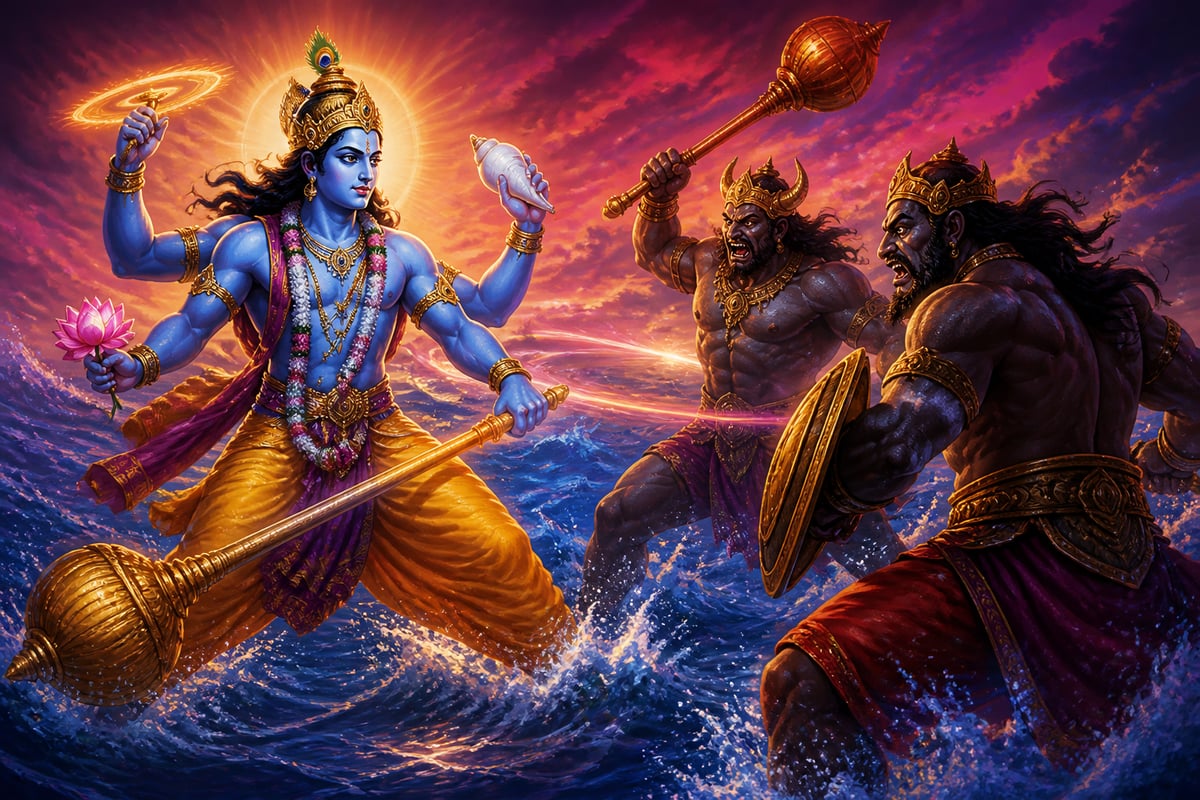
Awake at last, Vishnu turned to face Madhu and Kaitabha. What followed was not quick. The text says the battle lasted five thousand years, the two demons matching the preserver of worlds blow for blow, neither side able to end it. This is worth sitting with. Even fully awake, even a god, does not dispatch excess and attachment in a single stroke. They are old and strong, and the fight is long.
And here the Goddess is at work in a way the demons cannot see. For all their strength, Madhu and Kaitabha are drunk. They are filled with the pride of their own power, swollen with the certainty that no one alive can stand against them. That intoxication, that mada, is not an accident of temperament. It is the Goddess's maya still at work, this time not as sleep but as the delusion that makes the strong overreach. The very power that once held Vishnu down is now quietly undoing his enemies from the inside, and they never feel it happen.
Undone by Their Own Word
The delusion does its work through their pride. Sure of themselves, pleased by their own long stand against a god, the two demons grow careless and generous. They look at Vishnu and say, in effect, we are delighted by your fighting. Ask a boon of us, and we will grant it.
It is the boast of two beings who cannot imagine losing. And it is exactly the opening Vishnu needed. He answers simply. Then grant me this, that I may slay you both.

The words are out, and a promise cannot be unsaid. The demons see the trap they have walked into and try to wriggle free with a condition. Slay us, they say, only where the water does not cover the earth, certain that in a world drowned to one endless ocean there is no such dry place. But Vishnu spreads his own vast thighs above the flood, a stretch of dry ground in a world of water, lays their heads across it, and ends them there. From that deed he carries a name ever after: Madhusudana, the slayer of Madhu.
Waking Is a Letting Go
Now gather the whole deed into its mirror, as the tradition does. The first victory of the Goddess is not really about a battle at all. It is about a waking, and the waking is the teaching.
You cannot force yourself out of the heavy sleep by sheer will. Brahma tried and failed. What broke the sleep was not effort but release: the Goddess, turned toward and pleased, choosing to let go. The first freedom is a loosening, not a fight. It arrives when the deeper power softens, not when you strain harder against yourself.
The whole first victory turns on two truths:
- waking is a letting-go, not a feat of force: the sleep lifted because the Goddess, pleased, chose to release it
- once awake, excess and attachment overreach and undo themselves, bound by their own rash word
And once the waking has happened, notice what becomes of excess and attachment, the two demons born of the sleep. Awake, Vishnu does not, in the end, simply out-muscle them. Drunk on themselves, they overreach and undo themselves by their own rash word. The wanting and the clinging that seemed unbeatable while you slept lose their grip the moment the deeper power is roused and you are truly awake. They were always strongest in the dark, and daylight thins them.
She is the sleep and she is the waking, the binder and the one who lets go, honoured through the whole deed as the power on whom even Vishnu depends. The one who recites this story is not collecting a trick for self-improvement. They are being shown, reverently, that the strength to wake was never theirs to force. It was always Hers to give, and the asking is done with praise.
या देवी सर्वभूतेषु शान्तिरूपेण संस्थिता। नमस्तस्यै नमस्तस्यै नमस्तस्यै नमो नमः॥
yā devī sarva-bhūteṣu śānti-rūpeṇa saṃsthitā namas tasyai namas tasyai namas tasyai namo namaḥ
To the Goddess who dwells in all beings in the form of peace, salutations to Her, salutations to Her, again and again salutations.
Devi Mahatmyam, Chapter 5 (Ya Devi refrain, the peace aspect)
The first deed is done. The world is awake, the maker is safe, and creation can begin again. But a harder enemy is coming, one that no single god, not even the awakened Vishnu, will be able to bring down alone. His name is Mahishasura, and he is the subject of the great middle deed. That is the next chapter.
Living traditions
The name Madhusudana, born in this deed, travelled far beyond it. It became one of the common names for Vishnu and Krishna across later scripture and daily worship, so that a victory from the first pages of the Devi Mahatmyam is spoken quietly in households that may never have read the story it comes from.
- Kumortuli, Kolkata: The old potters' quarter where the great clay images of Durga are shaped each year before Durga Puja, then carried out, awakened with ritual, worshipped, and finally immersed. To walk its lanes among the half-made and finished Goddesses is to see the cycle of making, waking, and dissolving this chapter is built on. (Durga Puja is treated in depth in the Hindu Festivals course; here the site anchors the theme of the Goddess awakened.)
Reflection
- Vishnu woke by release, not by force. Think of a real change you finally made. Did it come through gritted effort, or did something loosen and let it happen?
- The demons were undone by their own rash boon. Where has a craving or a grievance in you overreached and tripped on itself, once you were paying attention?
- The whole deed insists the decisive power was the Goddess's, not Vishnu's alone. What would change if you held your own hard-won breakthroughs as partly given rather than wholly grasped?