The Two Demons Born of the Deep
Madhu and Kaitabha rise to destroy Brahma; Brahma's hymn to the sleeping Goddess. Excess and attachment, the two things that keep you under.
Out of the sleeping Vishnu's own body rise two demons, Madhu and Kaitabha, excess and attachment, born of the sleep itself. They rush to kill the helpless Brahma, who cannot wake Vishnu and cannot fight them. So Brahma turns to the sleep itself, singing a great hymn to the Goddess as Yoga-nidra, begging her to release her hold, the move the tradition reads as how the two demons of the drowse are truly met.
Two Shapes Rise from the Dark
Brahma sat on his lotus above the sleeping Vishnu, waiting for the world to begin. He was not alone for long. Out of the very body of the sleeping god, from the hardened wax of Vishnu's own ears, two shapes pulled themselves loose and stood up on the dark water. They were Madhu and Kaitabha, two demons, huge and fierce and newly awake, dripping from the flood and already looking for something to destroy.
That detail matters, and the tradition never lets you miss it. The demons did not come from somewhere else. They rose from the sleeping god himself, out of the same cosmic slumber that is the Goddess. The dangers of the long sleep are not invaders that arrive from outside. They are grown from the sleep, made of the same dark.
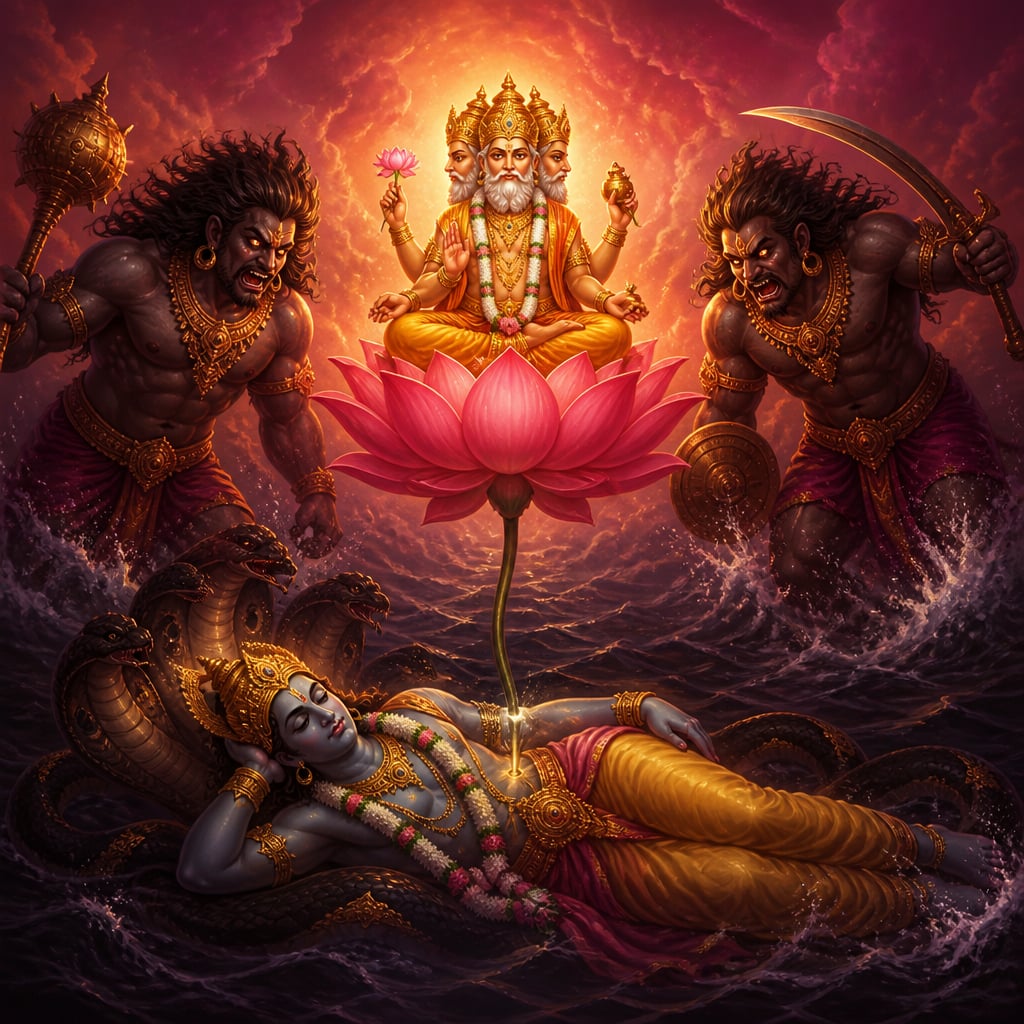
The two of them looked around the empty ocean and saw only one thing worth attacking: Brahma, alone on his flower, soft and unarmed. And they rushed at him to tear him down.
Excess and Attachment
The tradition reads the two demons closely, and their names carry the reading. The two demons are read as a pair, and their names carry the reading:
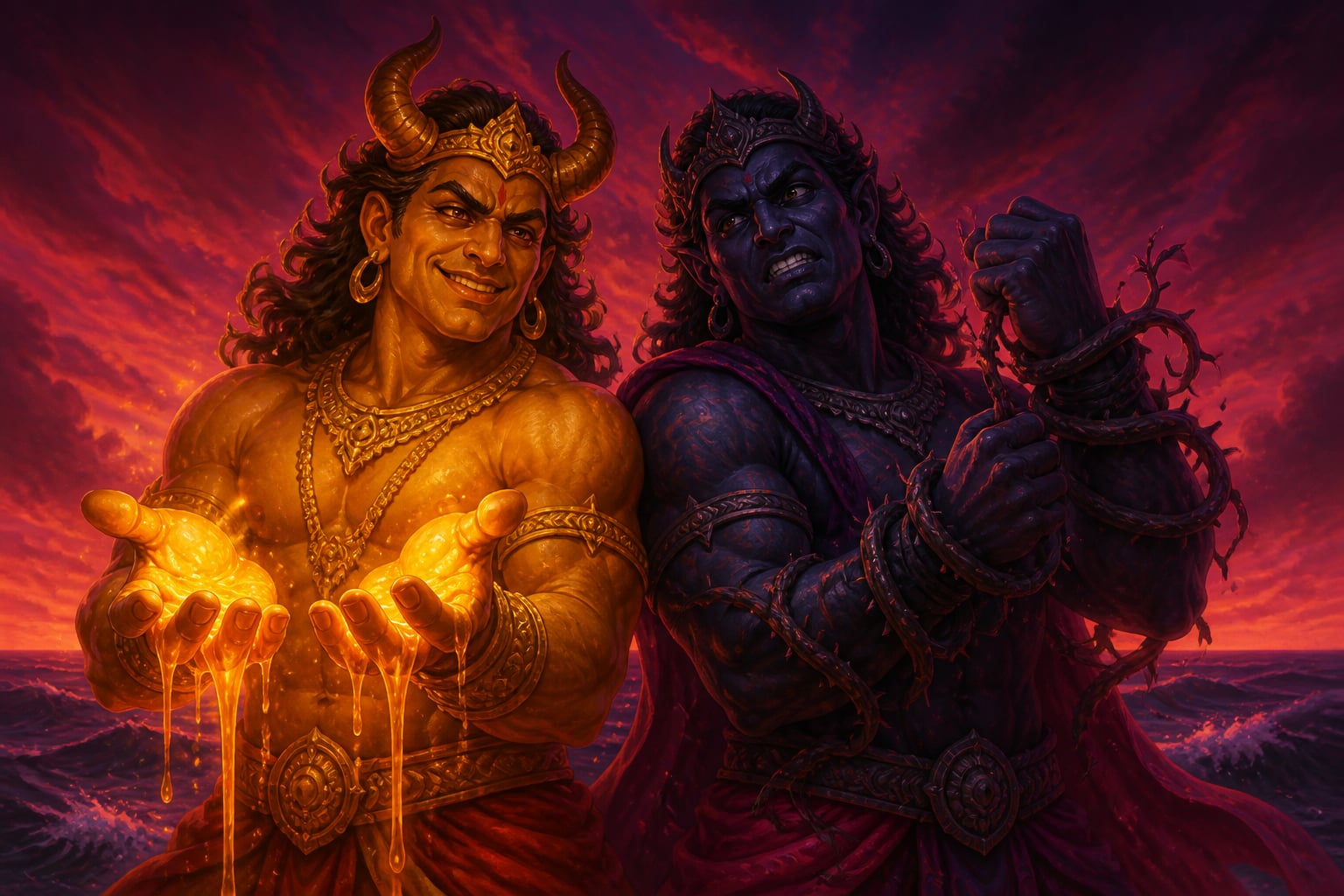
- Madhu, honey, the sweet and the too-much: excess, the pull toward more of the pleasant thing, more comfort, more food, more of whatever softens the edge of the day.
- Kaitabha, the sticky and the clinging: attachment, the grip that holds you to what you already have, long after it has stopped serving you.
Read together they are the two guardians of the heavy sleep. Excess keeps pouring more into the drowse. Attachment refuses to let any of it go. Between the two of them, a life can stay under for years, well fed and firmly held and going nowhere. And both, remember, were born from the sleep itself, which is exactly how it feels from the inside. The longer you drift, the more the wanting and the clinging seem to grow out of the drift on their own, without anyone inviting them.
Brahma, awake but powerless, is in real danger from them. He cannot fight them; they are too strong and he was made to create, not to battle. He cannot wake Vishnu; the sleep is too deep. He is the part of you that can see clearly what needs to change and still cannot, by itself, make the change happen.
Brahma Sings to the Sleep

So Brahma does the only thing left to him. He does not throw himself at the demons, and he does not keep uselessly shaking the sleeper who will not stir. He turns instead to the sleep itself. He turns to the Goddess, Yoga-nidra, and he begins to sing.
His hymn is one of the oldest and most loved passages in the whole text. He praises her as the power behind everything, the sound beneath all sounds, the nectar, the very letters of the sacred syllable Om. He is not flattering her, and he is not bargaining. He is naming, out loud, what she truly is, so that she will turn her freeing face toward him and lift her hold from Vishnu's eyes.
त्वं स्वाहा त्वं स्वधा त्वं हि वषट्कारः स्वरात्मिका। सुधा त्वमक्षरे नित्ये त्रिधा मात्रात्मिका स्थिता॥
tvaṃ svāhā tvaṃ svadhā tvaṃ hi vaṣaṭkāraḥ svarātmikā sudhā tvam akṣare nitye tridhā mātrātmikā sthitā
You are Svaha and Svadha, you are the Vashatkara, the very soul of sacred sound. You are the nectar, O eternal and imperishable one, present as the three measures of Om.
Devi Mahatmyam, Chapter 1 (Brahma's hymn to Yoga-nidra)
Notice what Brahma has understood. The real problem is not the two demons at all. The real problem is that the power that could meet them is asleep, held by the Goddess. So he does not waste himself on the symptom. He goes straight past it, to the power that holds everything, and asks that power, with praise, to release the sleeper.
या देवी सर्वभूतेषु शक्तिरूपेण संस्थिता। नमस्तस्यै नमस्तस्यै नमस्तस्यै नमो नमः॥
yā devī sarva-bhūteṣu śakti-rūpeṇa saṃsthitā namas tasyai namas tasyai namas tasyai namo namaḥ
To the Goddess who dwells in all beings in the form of power, salutations to Her, salutations to Her, again and again salutations.
Devi Mahatmyam, Chapter 5 (Ya Devi refrain, the power aspect)
What the Hymn Knows
When excess and attachment have you under, the instinct is to fight them head-on, or to grit your teeth and try to shake yourself awake by force of will. Brahma shows a different move. He cannot beat the demons, and he cannot force the waking. What he can do is turn, honestly and with reverence, toward the deeper power that holds the whole situation, and ask it to shift.
The text is not telling you that effort is useless. It is telling you the order of things. First the power has to turn from its binding face to its freeing one. First the sleep has to agree to lift. The demons of excess and attachment cannot be beaten while the very strength that would beat them is still folded in sleep. Fighting them in that state is like swinging at shadows while the one who could actually help you lies dreaming a few feet away.
Brahma's hymn is the sound of someone who has stopped struggling against the symptom and started appealing to the source. It is not weakness. It is the most intelligent thing anyone in the scene has done. Whether the Goddess answers, and what happens when the sleeper finally opens his eyes, is the last lesson of this first deed.
Living traditions
Brahma's hymn set a pattern the tradition never left: when the strength to act is out of reach, you turn toward the power that holds the situation and name it truly. The same instinct runs through countless later hymns to the Goddess, in which the singer meets danger not with a boast but with praise.
- Jwalamukhi Temple, Himachal Pradesh: A temple where the Goddess is worshipped not as an image but as a living flame that rises from the rock, one of the Shakti Peethas. It is a vivid place to feel the idea at the heart of this lesson: the Goddess as a power that is roused and turned toward, not a distant figure. (The Shakti Peethas course covers the network; here it anchors the theme of appealing to the living power.)
Reflection
- Madhu is excess and Kaitabha is attachment. Which of the two has more hold on you right now, the wanting of more, or the clinging to what you already have?
- Brahma could neither fight the demons nor wake the sleeper by force. When has fighting a bad habit head-on failed you, and what deeper state was really holding it in place?
- The maker met danger with a hymn rather than a weapon. Is there a struggle in your life where turning toward the difficulty honestly might serve you better than forcing it?