Talapatram

The Devas' Song: Ya Devi Sarva-Bhuteshu

The Shakradi Stuti; the great refrain-hymn. She is not out there defeating a monster; she is in all beings. A sacred hymn taught reverently.

The victorious gods, before reclaiming their thrones, sing the Goddess's praise, and the hymn takes a turn that reshapes the whole deed: she is not merely a warrior out there but dwells in all beings, as consciousness, power, mercy, sleep, and mother. The tradition, taught reverently, reveals that the battle was always inward too, and the power that slew the demon is the deepest thing the reader already carries.

They Sang Before They Took Back Their Thrones

The battle was won. The buffalo-demon lay fallen, and the sky belonged to the gods again. After the long years of wandering the earth as beaten exiles, every road back to their stolen thrones lay open at last. And the gods did the one thing you would least expect of anyone who has just won back everything they lost. They did not run for the thrones. They stopped, and they sang.

Hold on to that pause, because the pause is the lesson. What a person does in the first moment after a victory tells you more about them than the victory itself.

या देवी सर्वभूतेषु विष्णुमायेति शब्दिता। नमस्तस्यै नमस्तस्यै नमस्तस्यै नमो नमः॥

yā devī sarva-bhūteṣu viṣṇu-māyeti śabditā | namas tasyai namas tasyai namas tasyai namo namaḥ ||

To the Goddess who in all beings is proclaimed as Vishnu-maya, the great world-power, salutations to Her, salutations to Her, again and again salutations.

Devi Mahatmyam 5.14 (Aparajita Stuti)

Who Is Singing, and Why It Matters
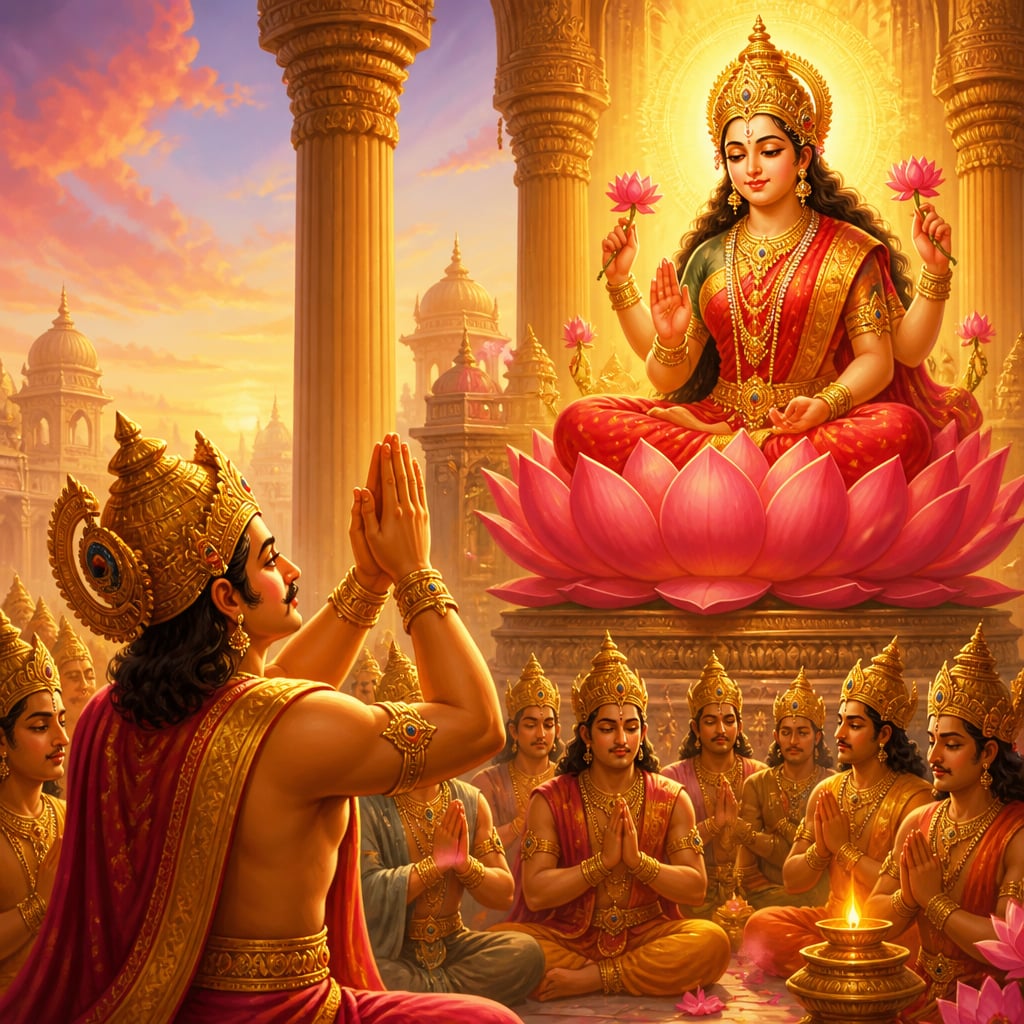
Indra leading the devas' hymn to the Goddess

The gods gathered before the Goddess and poured out their praise: she is the one who removes the fear of every being, the prosperity in good homes and the ruin of wicked ones, the wisdom in thoughtful hearts, the refuge of all who bow. It is a beautiful hymn. But the deepest thing about it is not the words. It is who is speaking them.

These are the gods who made her. A few lessons ago they poured out their own massed light to give her form, and armed her with their own weapons. In a plain sense she is their own power, gathered up and given a shape. And now, the battle won, they stand before that power and bow.

Sit with how strange that is. A lesser victor would have said the obvious thing: our light did this, we made this happen, now let us take back what is ours. The gods say nothing of the kind. They do not congratulate themselves and they do not reach for the spoils. They recognise that the power which saved them, though it had come out of them, was never merely theirs to command. It was something larger, that they could call on but could not own.

Gratitude Is Accurate Seeing

Here is the turn for you, and it is not the soft thing gratitude is usually taken to be. The gods' praise is not politeness. It is accurate seeing: knowing the true size of what saved you.

After you come through something hard, there are two moves available, and they lead in opposite directions. One is to seize the credit and the spoils at once: I did this, I am strong, now for the reward. The other is the gods' move: to stop, before grabbing anything. You see that the strength which carried you was larger than the small self now reaching for the trophy. Even the strength that felt like your own was never only yours.

या देवी सर्वभूतेषु लक्ष्मीरूपेण संस्थिता। नमस्तस्यै नमस्तस्यै नमस्तस्यै नमो नमः॥

yā devī sarva-bhūteṣu lakṣmī-rūpeṇa saṃsthitā | namas tasyai namas tasyai namas tasyai namo namaḥ ||

To the Goddess who dwells in all beings in the form of good fortune, salutations to Her, salutations to Her, again and again salutations.

Devi Mahatmyam, Chapter 5 (Ya Devi refrain, the good fortune aspect)

A farmer glowing with the Goddess's inner light

The hymn even names where that larger power lives: not only on the far cosmic field, but in all beings, as their fortune, their wisdom, their very awareness. The gods are not thanking a hired champion who has gone home. They are bowing to a power that runs through everything, themselves included, which is exactly why none of them can seize it as private property and carry it off.

Why the Victors Sing First

So the gods sing before they take back their thrones because gratitude, here, is not decoration laid over the win. It is the guard that keeps the win from curdling. The instant a victor seizes the credit, the brute self he has just defeated is back, wearing a crown. To stop and praise the source first is to refuse that quiet trap, and to hold on to what the whole battle was actually for.

This is worth carrying, because the course is about to climb into subtler country. The great enemy of open pride, Mahishasura, is fallen. But arrogance is not the only ego-trap. A subtler pair waits, twin demons who are not brute force but something slipperier: the trap of thinking too much of yourself, and its mirror, the trap of thinking too little. They rule three worlds between them, and they open the final deed. We turn to them next.

Living traditions

The refrain that the Goddess dwells in all beings, as consciousness, power, and mercy, is among the most sung verses in the tradition, carried in recitation, devotional music, and film. Its quiet claim, that the power one reveres also lives within every being, has shaped how generations imagine the nearness of the sacred.

  • Bhagavathy Amman Temple, Kanyakumari: A famed temple to the Goddess at the very land's end, where three seas meet, worshipped as the Kanya, the Mother at the edge of the world. It is a fitting place to hold this lesson's turn: the Goddess who fills the horizon is the same one the hymn finds within every being. (The Shakti Peethas course maps the wider network of Goddess sites.)

Reflection

  • The hymn says the Goddess dwells in all beings, including you. If the power that slew the demon is also the awareness in your own chest, how does that change the way you meet your inner battles?
  • Where do you seek the sacred, or your own real strength, out there, when the hymn says it is in all beings, yourself included?
  • The gods sang before they took back their thrones. When something hard is finally won in your life, is your first move gratitude, or seizure?

More in The Enemy Too Big to Face Alone

All lessons in The Enemy Too Big to Face Alone · Durga: The Goddess Who Saves the World ebook course