Talapatram

The Demon No God Could Kill

Mahisha's boon; the gods thrown out of heaven. The problem that beats every one of your strengths taken singly.

Mahishasura, a buffalo-demon, wins a boon that no man or god can slay him, then defeats the assembled gods and seizes heaven, taking over the offices of the gods themselves. The tradition reads him as the brute ego, the arrogance that beats every one of your strengths taken singly and that no separate power can bring down alone.

Cast Out of Heaven
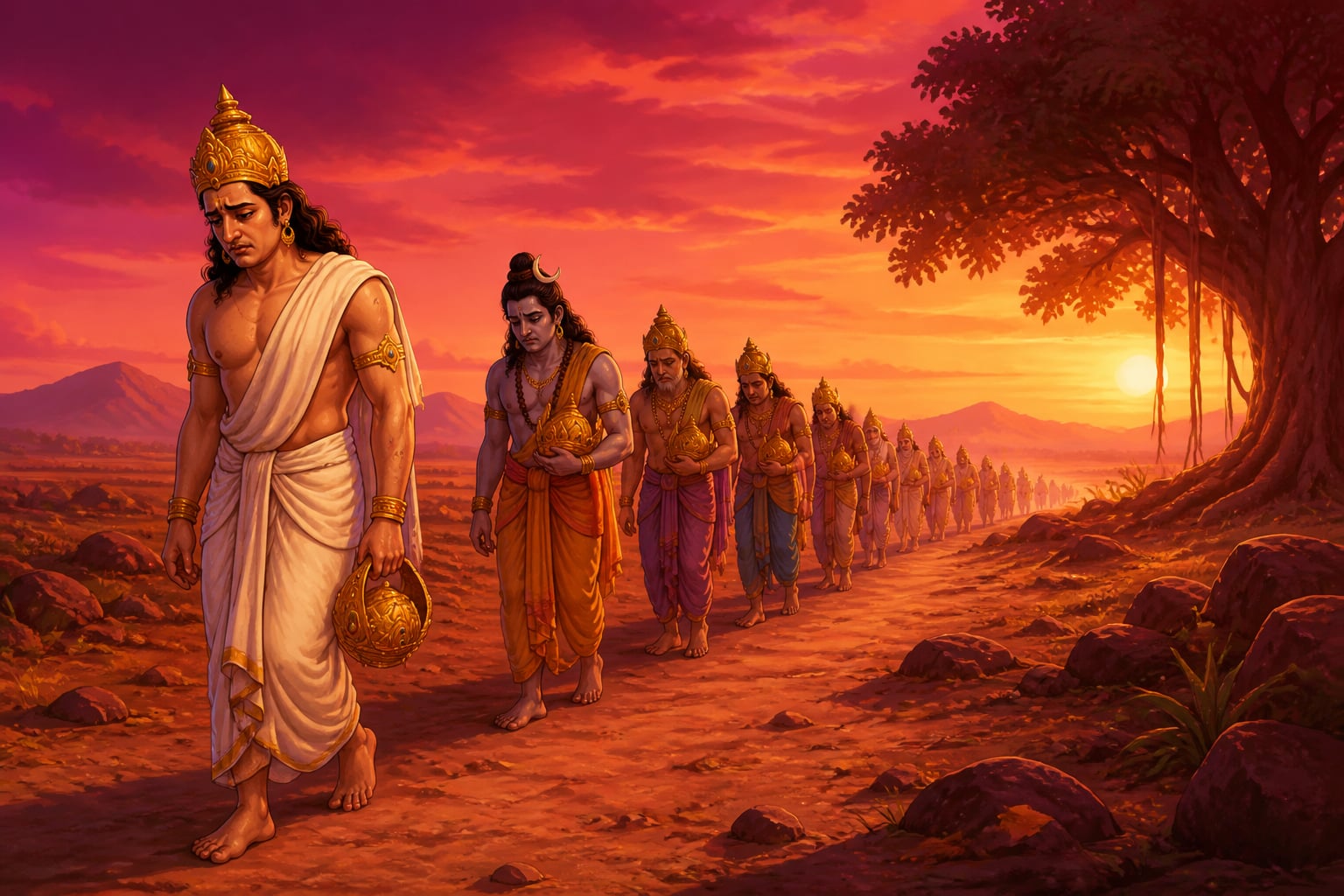
Indra and exiled gods trudging a dusty road

The gods were wandering the earth like beggars. Indra, who had ruled the heavens, walked among mortals with no throne and no roof. The bright halls of the sky were shut to him and to all the devas, and the one who had taken them was not a god at all. He was a demon with the head of a buffalo, and his name was Mahishasura.

They had fought him. That was the bitter part. The whole assembly of the gods had gone to war against him and lost. He had beaten Indra and the guardians of the eight directions, driven them from the sky, and then done something stranger and worse than simply ruling. He seized the offices of the gods themselves. Where the sun should burn, he burned. Where the wind should blow, he blew. Where the rain should fall, he decided whether it fell. He sat in heaven doing the work of every god at once, and doing it for himself, and the true gods stood on the earth with empty hands and watched a world run by the wrong power.

दुर्गे स्मृता हरसि भीतिमशेषजन्तोः स्वस्थैः स्मृता मतिमतीव शुभां ददासि। दारिद्र्यदुःखभयहारिणि का त्वदन्या सर्वोपकारकरणाय सदार्द्रचित्ता॥

durge smṛtā harasi bhītim aśeṣa-jantoḥ svasthaiḥ smṛtā matim atīva śubhāṃ dadāsi | dāridrya-duḥkha-bhaya-hāriṇi kā tvad-anyā sarvopakāra-karaṇāya sadārdra-cittā ||

O Durga, remembered in danger you take away the fear of every being; remembered by the untroubled you give a mind of great goodness. O remover of poverty, pain, and fear, who but you is ever tender of heart for the good of all?

Devi Mahatmyam 4.17 (Shakradi Stuti)

The Buffalo Who Could Not Be Killed

How had it come to this? Mahishasura had done long and fierce penance, standing through seasons, burning away comfort, until a boon was granted him. And he had chosen his boon with a proud care. Let no man and no god be able to kill me, he asked. He did not trouble to include women in the request. In his mind a woman was no possible threat, not worth the breath of naming. That single gap, left open by his own contempt, is the hinge the whole story turns on, though no one can see it yet.

Mahishasura routs the gods on the battlefield

Armoured by the boon, he went to war and could not be stopped. No god could match him, because the boon itself forbade it. Strength met him and was thrown back. Cunning met him and was outlasted. One by one, every power the gods could bring was turned aside, because each of them was exactly the kind of power the boon had shut out. The devas were not weak. Each was a master of his own domain. And each, sent in alone, was beaten.

What Usurped Power Looks Like

Mahishasura sprawled arrogantly on Indra's stolen throne

The tradition lingers on the strangeness of Mahisha in heaven, and it is worth lingering with. He did not leave the world broken and empty. He kept it running. The sun still rose, after a fashion. The seasons still turned, more or less. But everything was tilted, everything served him, and nothing was in its right hands.

That is how a certain kind of arrogance takes over a life too. It does not always announce itself with ruin. Often it simply moves into every office at once, deciding what gets your attention, what you fear, what you chase, running the whole show competently and for itself. From the outside the life still works. From the inside, the true powers have been pushed to the margins and are watching a usurper wear their crowns.

You have probably watched this happen to a person. Someone whose self-importance has quietly moved into every room of their life: it decides which friendships they keep, what they will and will not hear, how they read every slight. From the outside they are functioning, even impressive. But the better parts of them, the honesty, the warmth, the willingness to be wrong, have been pushed to the edges. Still there, still watching, no longer in charge. That is a life with a buffalo-demon on the throne.

The Enemy That Beats Each Strength Alone

Mahishasura is the brute ego, the swollen self-importance that no single one of your strengths can bring down on its own.

Think again of how the gods lost. Not through weakness, but because they came at the demon one at a time, each with his single power, and arrogance of that size beats every separate strength taken singly. You can out-argue it, and it ignores the argument. You can out-work it, and it outlasts you. You can shame it, and it only grows. Willpower against it fails, because willpower alone is just one more god sent in by himself to be thrown out of heaven.

This is why an ego of this size is so exhausting to face. Every tool you own is a real tool, and every one of them, used by itself, has already lost. The gods on the earth have learned this the hard way. They have tried everything they have, separately, and lost everything they had.

It helps to see why the single strengths fail, because each fails in its own way:

Each faculty is not merely beaten. It is turned, one at a time, to feed the very thing it was sent to fight.

What they have not yet tried is the one thing the rest of this chapter is about. They have not yet stopped acting alone. As long as each god fights as himself, with his own weapon, for his own domain, Mahishasura keeps the throne. Something has to gather them into one. The next lesson is the story of what that gathering looks like, and of the power that comes into being only when the parts, at last, stop fighting on their own.

Living traditions

Mahishasura is one of the most recognised figures in Indian sacred art, almost always shown in the moment of his defeat beneath the Goddess. That an enemy is remembered chiefly through the image of being overcome says something the tradition means: the arrogance he stands for is known best by the power that steadies it.

  • Durga Kund Temple, Varanasi: An old and much-loved temple to Durga in Kashi, with its sacred tank beside it, thronged especially through Navaratri. A fitting place to sit with this lesson's theme: the Goddess as the refuge people turn to when every other help has failed. (The Shakti Peethas course maps the wider network of Goddess sites.)

Reflection

  • The gods each brought a single strength and each was thrown out of heaven. What is a problem in your life that has beaten every one of your strengths, tried one at a time?
  • Mahisha left one door open because he scorned what he could not imagine as a threat. What do you refuse to take seriously that might be your own open door?
  • The gods lost while acting alone, each in his own domain. Where in your life do your strengths work in isolation when they might need to be gathered into one?

More in The Enemy Too Big to Face Alone

All lessons in The Enemy Too Big to Face Alone · Durga: The Goddess Who Saves the World ebook course