Talapatram

Mahishasura-Mardini

The slaying; the most-depicted image in Indian art, read closely. The ego falls to the whole integrated self, steady.

The Goddess, having held steady rather than chasing his shapes, corners the buffalo-demon in the open, sets her foot on his neck, pierces him, and beheads him as he emerges in his true form. This is Mahishasura-Mardini, the most depicted image in Indian art. The tradition reads it as the ego falling not to a trick but to the whole, integrated self held steady, and insists the blow is a clear, almost tender finality that grants even the demon release.

Foot on the Neck
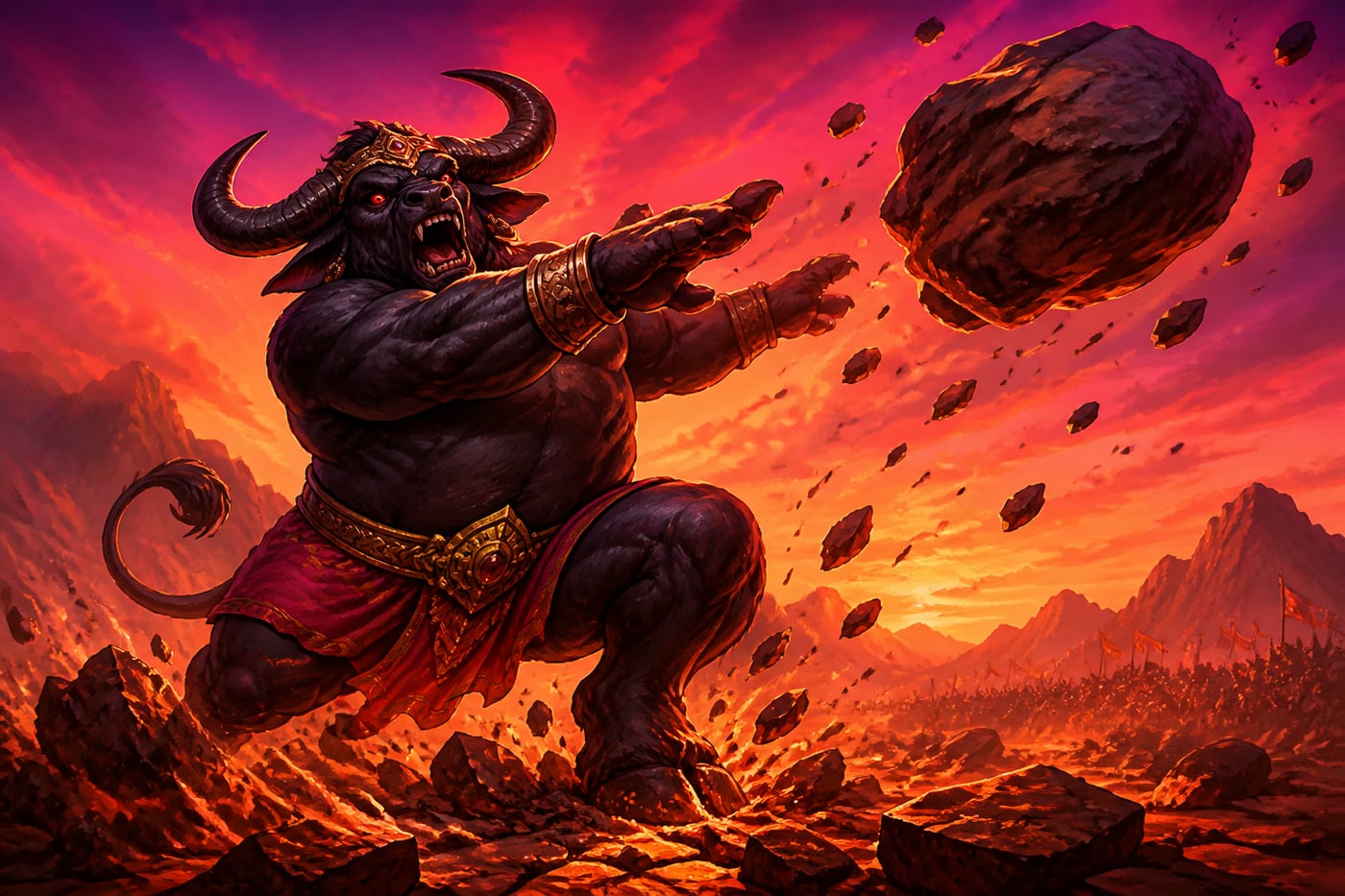
Mahishasura tossing a mountain in final battle

The demon came back to his buffalo form one last time, bellowing, tossing mountains, sure that the changing had saved him before and would save him again. But the Goddess had waited for exactly this. She had not chased his shapes. She had held her center, gathered and steady, and now the buffalo stood before her in the open with nowhere left to flee.

She sprang. In one motion she was upon the great buffalo, and she set her foot upon its neck and pressed it down into the earth. All his weight, all his tossing strength, was pinned beneath a single steady foot. Then she drove her trident into him. The changing was over. There was no room, under that foot, to become anything else.

सर्वस्वरूपे सर्वेशे सर्वशक्तिसमन्विते। भयेभ्यस्त्राहि नो देवि दुर्गे देवि नमोऽस्तु ते॥

sarva-svarūpe sarveśe sarva-śakti-samanvite | bhayebhyas trāhi no devi durge devi namo'stu te ||

O you who are the form of all, the ruler of all, endowed with every power: save us from all fears, O Goddess. O Durga, salutations to you.

Devi Mahatmyam (Aparajita Stuti)

The Stroke

Even now the demon tried his old trick. As the trident bit, Mahishasura began to come out of the buffalo's mouth in his own true form, half a man, sword in hand, fighting his way free of the dying beast, reaching for one more shape. But he was caught between forms, no longer wholly buffalo and not yet wholly anything else, and the Goddess did not wait for the change to finish. With her great sword she struck, and severed his head, and the demon fell.
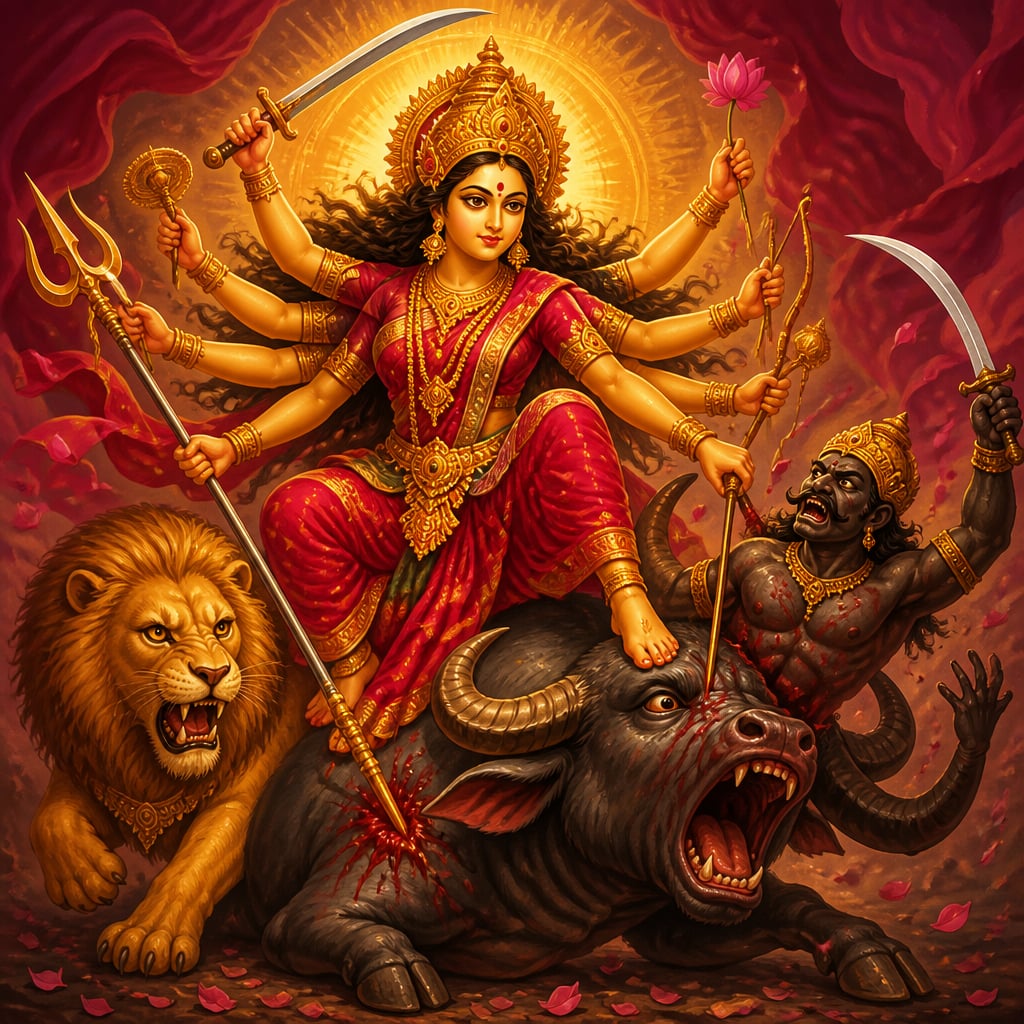
The Goddess plants her foot on the buffalo

The tradition fixes the scene at exactly this instant: her foot planted on the buffalo, the trident in its body, the demon half-emerged in his real shape at last, and the sword coming down. It is caught in stone and paint ten thousand times across India, the Goddess calm and almost gentle in her face even as the blow lands. She is not raging. She is steady.

The Ego Falls to the Whole Self, Steady

The shape-shifter is not beaten by a cleverer trick or a luckier blow. He is beaten because the Goddess held steady until he ran out of forms, and then met him, planted and whole, in the open.

Everything the chapter taught comes together in that planted foot:

You do not defeat a shape-shifting fault by out-maneuvering each disguise. You defeat it by becoming steady and whole enough that, when it finally has nowhere left to change into, you are simply there, foot planted, unshaken.

Notice that the planted foot is not passive, and it is not sudden. It took the whole battle to earn it: the fused self of the second lesson, the full arsenal of the third, the refusal to chase shapes of the fourth. Steadiness at the end is not the absence of effort but its fruit. The Goddess can stand calm on the demon's neck precisely because everything before this moment was gathered and spent well. A steadiness that has not been earned this way is only stiffness, and stiffness does not hold when the buffalo bucks.

Notice her face in all those images. She is not cruel and she is not furious. The blow falls on the arrogance, on the demon, never with hatred. In the tradition's own telling, the demon slain by the Goddess's own hand is not merely destroyed but released, granted by her a liberation his life could never have reached. The steadiness that ends the ego is not a rage against it. It is a clear, almost tender finality that gives even the fallen thing its dignity.

या देवी सर्वभूतेषु दयारूपेण संस्थिता। नमस्तस्यै नमस्तस्यै नमस्तस्यै नमो नमः॥

yā devī sarva-bhūteṣu dayā-rūpeṇa saṃsthitā | namas tasyai namas tasyai namas tasyai namo namaḥ ||

To the Goddess who dwells in all beings in the form of compassion, salutations to Her, salutations to Her, again and again salutations.

Devi Mahatmyam, Chapter 5 (Ya Devi refrain, the compassion aspect)

This is why the image is everywhere. Mahishasura-Mardini, the Goddess who crushed the buffalo-demon, is the single most depicted scene in Indian sacred art, from ancient rock reliefs to the poster on a shop wall. People return to it because it holds, in one still picture, the thing everyone needs: the calm, whole, steady presence under which even the most slippery arrogance finally comes to rest.

Restored gods gazing up at their reclaimed sky

The demon is fallen. The gods, who wandered the earth homeless, look up at a sky that is theirs again. And their first act, now that the battle is won, is not to seize back their thrones. It is to sing. What they sing, and the astonishing turn it takes, is the last lesson of this deed.

Living traditions

Mahishasura-Mardini is one of the defining images of the tradition, cast, carved, painted, and printed beyond counting. Its endurance says something the tradition means: people keep returning to the picture of a calm, whole, steady presence under which even the most slippery arrogance finally comes to rest.

  • Mahishasuramardini Mandapam, Mahabalipuram: A seventh-century Pallava rock-cut cave whose great relief shows the Goddess on her lion charging Mahishasura, one of the most admired carvings of the scene anywhere. To stand before it is to meet this lesson in stone: the steady, almost serene Goddess at the height of the fight. Part of a UNESCO World Heritage group of monuments. (Temple art is explored further in the Arts and Read a Temple courses.)

Reflection

  • The Goddess wins by holding steady until the demon runs out of shapes. What in you keeps shifting until it is met by a steady, whole presence rather than a chase?
  • The decisive image is a calm foot on the neck, not a furious blow. Where do you look for a clever trick when what is actually needed is steady, patient pressure?
  • The Goddess's face is calm and the tradition says she grants the demon release. When you finally master a long fault in yourself, can you do it without self-hatred, almost tenderly?

More in The Enemy Too Big to Face Alone

All lessons in The Enemy Too Big to Face Alone · Durga: The Goddess Who Saves the World ebook course