Wood Carving: Saharanpur to Sandalwood, the Future of Indian Crafts

Akshaya Tritiya at the Rath Khala
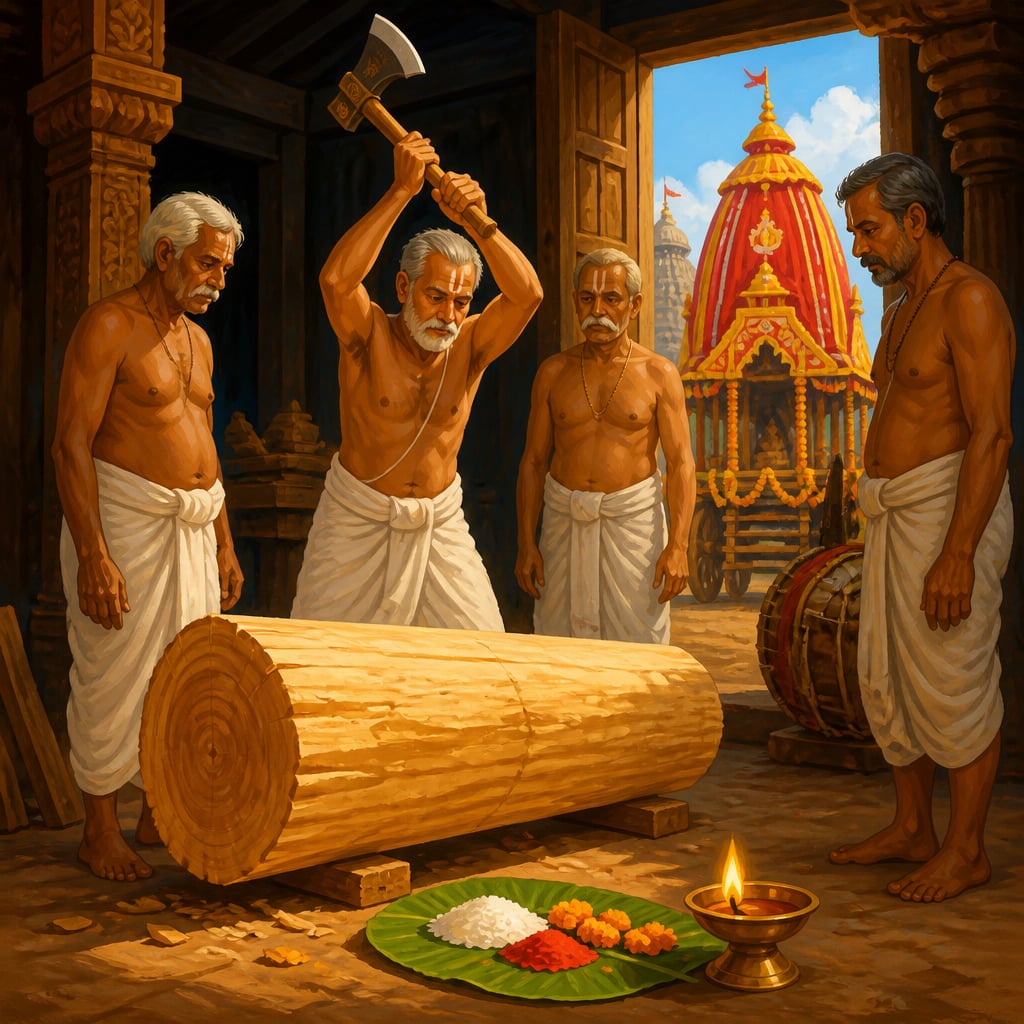
Maharana carpenters at the Puri Rath Khala raising the first axe on Akshaya Tritiya

It is Akshaya Tritiya morning at the Rath Khala in Puri. A small crowd has gathered outside the temple workshop on the south side of Bada Danda, the wide road where Lord Jagannath's chariots will roll in two months' time.

Inside, four men in white dhotis stand around a fresh log of phasi wood. They are the Maharana carpenters. Their families have built the chariots of Jagannath, Balabhadra and Subhadra for the Rath Yatra every single year for at least the last six hundred years. Some say longer. The first axe blow of the new chariots must fall today, on this most auspicious morning, or the chariots will not be ready in time.

The senior carpenter lifts the bhauri, the small ceremonial axe. He whispers the name of Vishwakarma. He swings. The chip falls.

A drum begins to play near the temple gate. The crowd folds its hands. Outside this workshop, in a small lane in Saharanpur, in a tiny shop in Mysore, in a wooden hut in the Kashmir Valley, another carpenter is also picking up a chisel this morning. Indian wood carving did not die. This lesson is the story of why.

Daru: When God Himself Is Made Of Wood

Most cultures carve wood. Very few worship it.

In the Sanskrit tradition the word for wood is dāru, and dāru is not just a material. The Atharva Veda calls the World Tree dāru. The Rig Veda speaks of the daru-yajna, the sacrifice that begins with the cutting of a tree. In the Brihadaranyaka Upanishad the whole universe is compared to a great tree, with its roots above and its branches below. To work wood, in this view, is to work with the body of the cosmos.

The most striking proof of this is in Puri itself. The deity in the Jagannath temple is not made of stone. He is not made of bronze. He is wood. Once every twelve to nineteen years, on a date the priests calculate from a hidden manuscript, the deities are remade from a fresh neem tree found in the forest. The rite is called the Nabakalebara, the New Body. The wood ages. The god is reborn.

Wood is the only material in India treated this way. Stone is permanent. Metal can be melted and recast. Cloth wears out and is replaced. But wood lives, ages, and is renewed the way a body is renewed. It is the material closest to the human form. That may be why India built so many of its most sacred objects from it.

Daru-Shilpa: The Carver's Inheritance

The craft of carving wood is dāru-śilpa, one of the sixty-four classical arts of the Shilpa Shastras. The patron deity is Vishwakarma, the divine architect, who appears in the Rig Veda as the first artisan of the gods.

विश्वतश्चक्षुरुत विश्वतोमुखो विश्वतोबाहुरुत विश्वतस्पात्। सं बाहुभ्यां धमति सं पतत्रैर्द्यावाभूमी जनयन्देव एकः॥

viśvataścakṣuruta viśvatomukho viśvatobāhuruta viśvataspāt saṃ bāhubhyāṃ dhamati saṃ patatrairdyāvābhūmī janayan deva ekaḥ

He has eyes on every side, faces on every side, arms on every side, feet on every side. With his arms and his wings he forges heaven and earth, the One God making them as a craftsman makes a thing.

Rig Veda 10.81.3

Every wood carver in India still lights a small lamp before Vishwakarma on the festival day named for him, even in workshops where the men know none of the old verses. Four great traditions deserve a place in any survey of the craft.

A Saharanpur wood carver carving floral patterns into a sheesham door panel

Saharanpur in western Uttar Pradesh is the largest wood-carving town in India today. Its carvers work in sheesham, the Indian rosewood, deep brown and patterned with darker streaks. Their motifs are Persian: vines, lotus medallions, the jaali lattice cut so finely that light falls through it like rain. A Sufi saint is said to have brought the first court carvers to Saharanpur in the late 1500s. By the 1880s, the British had turned the town into a major furniture export centre, with carved cabinets and trunks sailing for London twice a year.

A Mysore sandalwood carver shaping a Saraswati figurine from gandhachi mara

Mysore carves sandalwood, gandhachi mara in Kannada, the most fragrant wood on earth. Mysore sandalwood is so valuable that Tipu Sultan declared it a royal tree in 1792. The Karnataka government still owns every sandalwood tree in the state by law. Mysore's carvers turn out tiny detailed boxes, lattice fans, deity images, and the famous sandalwood elephant pairs given as wedding gifts across South India.

Kashmir carves akhrot, the walnut. Walnut is hard and dense, and it takes a deep, almost glassy finish. The valley's carvers panel the ceilings of Mughal pavilions and the old houseboats of the Dal Lake in patterns called khatamband, hundreds of small wooden pieces locked together in geometric stars without a single nail. The Hazratbal mosque, the Shalimar Bagh garden pavilions, and the painted ceiling of the old Pather Masjid all carry Kashmiri walnut work.

Kerala carves rosewood and jackfruit wood, the wood of its temple chariots, the sacred ratha. Kerala's master carvers also make the larger-than-life painted masks worn by Kathakali and Theyyam dancers, the wooden pillars of its temples, and the carved ceilings of the Padmanabhaswamy and Vadakkunnathan shrines.

Four woods. Four climates. One craft.

The Long, Slow Bleeding

Indian wood carving did not break suddenly. It bled slowly across two centuries.

The first cut was colonial. The British turned Saharanpur into a furniture factory town for the export market and paid carvers piece rates that left no room for apprenticeship. The traditional patron, the local raja or the temple committee, was replaced by a Calcutta exporter. The carver no longer chose his motifs. He carved what the catalogue ordered.

The second cut was the railway. Cheap Burmese teak began to flood Indian markets in the early 1900s. Local hardwoods became expensive and harder to source. By the 1950s, a Saharanpur carver was earning less than a daily-wage labourer.

The third cut was the most modern. The early 2000s brought machine-carved Chinese furniture into Indian wholesale markets. A CNC machine in Guangzhou could cut in twenty minutes the floral panel that took a Saharanpur carver three days. Apprentices stopped joining their fathers in the workshop. By 2010, Saharanpur had lost an estimated forty per cent of its full-time carvers in a single decade.

What Began To Turn

Three things, again, began to turn the cut around.

  1. Legal protection. Saharanpur wood carving received its Geographical Indication tag in 2007. Mysore sandalwood carving followed. Kashmiri walnut wood received recognition through the valley's wider craft cluster.
  2. Direct-to-buyer design houses. A small number of design studios began going to the workshops and placing orders that respected the carver's pace and skill. Phantom Hands, a Bengaluru studio founded in 2013, began producing licensed reproductions of Pierre Jeanneret's Chandigarh chairs in karkhanas around the city. The chairs sell at international design fairs to museums and serious collectors. Other studios, in Saharanpur and Cochin and Jaipur, followed the same model.
  3. The cluster development model. From 2007 onwards, the Government of India's Cluster Development Programme funded common facility centres, design schools and direct market exposure for places like Saharanpur. By 2020, Saharanpur was again exporting more than two thousand crore rupees of carved wood furniture every year, and a younger generation of carvers had begun to return to the chisel.

The recovery is fragile. It is also real.

The Future Of Indian Crafts

This is the last lesson in this course. It is also the lesson the whole course has been building towards. Across forty-six lessons we have walked through silk, dye, print, embroidery, metal, clay, toy and now wood. The pattern in every chapter is the same.

The Old Story The New Story
Hereditary craft tied to caste, court and temple Open craft tied to design, brand and global retail
One patron family, one carver lineage, lifelong Direct buyer relationships, fair trade, advance orders
Raw materials from the local forest or river Raw materials sourced and certified, with traceability
Apprenticeship inside the family alone Apprenticeship plus design school plus business training
Survival depended on royal patronage Survival depends on conscious consumers

Notice the last row. The royal patron is gone. The temple committee is shrinking. The new patron, the only one who can keep the loom and the lathe and the chisel and the kiln alive, is the buyer who chooses to spend more for a thing that took longer to make. That patron is you.

A Final Word From Puri

The Maharana carpenters at Puri will finish their chariots in the next sixty days. The wheels will roll on the morning of Rath Yatra. A million people will pull the ropes. The chariots will arrive at the Gundicha temple, rest there for nine days, and roll back. Then the carpenters will burn the wood. They will start over with a fresh tree the next year.

That is the deepest answer this course can give.

A craft survives because it is rebuilt every year. By a carpenter who picks up the bhauri on Akshaya Tritiya morning. By a designer in Bengaluru who insists on hand-finished joints. By a buyer in Mumbai who chooses a carved sheesham table over a flat-pack one. By a child somewhere who watches her grandmother arrange the kolu dolls and asks where they came from.

That is the future. It always was. The chisel keeps moving. The wheel keeps turning. The wood keeps breathing.

Key figures

Vishwakarma

Divine architect of the universe

Vishwakarma is the patron deity of every craftsman in India, from the wood carver to the stone mason. The Rig Veda gives him an entire hymn, the Vishwakarma Sukta, which describes him as a deity with eyes and arms on every side, forging heaven and earth the way a smith forges metal. The Mahabharata names him as the architect of Indraprastha, Lanka and the cities of the gods. To this day, on Vishwakarma Puja each September, every Saharanpur workshop, every Mysore sandalwood unit, and every Kashmir walnut studio lays its tools out before a small image of Vishwakarma and lights a lamp.

The Maharana carpenters of Puri

Hereditary builders of the Jagannath chariots

The Maharana families of Puri have built the three giant wooden chariots of Jagannath, Balabhadra and Subhadra for the Rath Yatra every single year for at least six centuries. The work begins on Akshaya Tritiya and must be complete by Ashadha Shukla Dvitiya, roughly sixty days later. The chariots are pulled, dismantled and burnt after the festival, and the carpenters start again the next year with fresh wood. Their craft has never broken. It is the oldest continuously practiced wood-carving tradition documented anywhere in India.

Tipu Sultan

Ruler of Mysore, protector of the sandalwood tree

In 1792 Tipu Sultan declared the sandalwood tree a royal tree of the kingdom of Mysore, making it illegal for any private person to fell, sell, or trade it. The British inherited this rule after his death and the Karnataka state inherited it after independence. Every sandalwood tree in Karnataka is still government property by law. Mysore's sandalwood carvers and the Cauvery Arts and Crafts Emporium owe their continued existence to a single decision Tipu took two and a quarter centuries ago.

Phantom Hands

Modern design studio reviving South Indian wood craft

Phantom Hands is a Bengaluru studio that produces licensed reproductions of Pierre Jeanneret's Chandigarh chairs and other modernist furniture in small karkhanas around the city. The studio sources teak and sheesham responsibly, pays its joiners and carvers a wage that competes with corporate jobs, and exhibits at the world's major design fairs in Milan, New York and Paris. Phantom Hands is one of the clearest proofs that South Indian wood craft can survive and prosper in the global premium furniture market when the chain between the maker and the buyer is kept short.

Case studies

Saharanpur, IKEA, And The GI Tag That Almost Came Too Late

By 2005 Saharanpur was in deep trouble. The town's carved sheesham furniture had been exported through colonial trading houses since the 1880s, but a generation of cheap CNC-machine furniture from China had cut order books in half. Carvers were leaving for security guard jobs in Delhi. Apprentices had stopped joining their fathers in the workshops. Around the same time, IKEA's global sourcing teams began visiting Indian wood-carving towns, looking for production partners who could meet European safety, sustainability and labour standards. Saharanpur was on their list. The question was whether the town would still have enough carvers left to take an order at scale.

The Arthashastra describes the shreni, the classical Indian craft guild, as the body that bound multiple workshops into a single trading partner for distant markets. A shreni protected its carvers, set quality standards and collected payments. When the colonial exporter replaced the shreni with the piece-rate contractor, the protection vanished. Reviving Saharanpur required something the old shreni did instinctively: standing between the foreign buyer and the individual carver so that scale did not destroy skill.

Saharanpur received India's Geographical Indication tag for wood carving in 2007, the legal anchor that gave the town a defensible identity. The Government of India's Cluster Development Programme funded a common facility centre, training and a wood carving park. A wave of Indian and international design buyers, including IKEA's India sourcing teams, began placing larger orders directly with the cluster. By 2020 Saharanpur was exporting more than two thousand crore rupees of carved wood furniture every year, a younger generation of carvers had begun to return to the chisel, and the workshops on the road to the railway station were full again.

A craft cluster cannot be saved by any single lever. Saharanpur needed legal protection, infrastructure, training and a serious global buyer all in the same decade. Three of four was not enough. All four together turned the cut around.

2007 Saharanpur GI tag. Over INR 2,000 crore in carved wood furniture exports annually by 2020. India's largest wood-carving cluster.

Phantom Hands: Pierre Jeanneret's Chandigarh Chair, Reborn In Bengaluru

In the 1950s the Swiss-French architect Pierre Jeanneret designed thousands of pieces of furniture for the new city of Chandigarh, working closely with his cousin Le Corbusier. Many of the original chairs ended up in scrap yards by the 1990s and were later sold at international auctions for fifty thousand dollars apiece. By 2013 Chandigarh's wood workshops had lost the joinery skills that had made the originals possible. A small Bengaluru studio called Phantom Hands looked at this and asked a simple question: could South Indian carpenters, working in their own karkhanas, rebuild the Chandigarh chair to museum standards?

The guru-shishya parampara, the master-apprentice tradition, treats craft skill as something that lives in hands and is passed body to body, not in books or blueprints. Phantom Hands had no choice but to apprentice fresh joiners under older Bengaluru carpenters and then bring them onto the Jeanneret line. The studio in effect rebuilt a Chandigarh joinery lineage in Karnataka through the oldest training method India has.

Phantom Hands now produces officially licensed reproductions of Pierre Jeanneret's Chandigarh chairs, sold at design fairs in Milan, New York and Paris and acquired by serious collectors and design museums. The studio sources teak and sheesham responsibly, pays its joiners and carvers wages that compete with corporate office jobs in Bengaluru, and has become a working proof that premium Indian wood craft has a global market when the chain between the carver and the buyer is kept short.

The premium global market for Indian craft is real but conditional. It exists when a studio shortens the chain to two links: the workshop and the buyer. Every middleman added is a percentage shaved off the carver and a story shaved off the object.

Founded 2013, Bengaluru. Licensed Pierre Jeanneret reproductions sold in international design retail and acquired by museum collections.

Konark, Puri, And The Chariot That Is Burnt And Rebuilt Every Year

Every spring, on the morning of Akshaya Tritiya, the Maharana carpenter families of Puri gather at the Rath Khala workshop on the south side of Bada Danda and begin to build three new chariots from scratch. Jagannath's chariot, the Nandighosa, stands forty-five feet tall and uses around eight hundred pieces of wood. Balabhadra's Taladhwaja and Subhadra's Devadalana are only slightly smaller. The wood is sourced from specific neem, phasi and dhausa trees identified months in advance. The work must be finished in roughly sixty days, in time for Ashadha Shukla Dvitiya. There are no blueprints. The proportions live in the hands of the senior carpenters.

The Jagannath tradition treats wood as Daru-Brahma, the divine in wooden form. The deities themselves are wooden and renewed every twelve to nineteen years. The chariots are wooden and renewed every single year. Permanence is not the goal in this tradition. Renewal is. A chariot that is rebuilt annually can never be allowed to die, because the next build is already in motion before the old wood has cooled.

The Maharana families have done this for at least six hundred years without missing a single annual cycle. The chariots roll for the Rath Yatra in late June or early July, are pulled by hundreds of thousands of devotees down Bada Danda to the Gundicha temple, rest there for nine days, and roll back. The wood is then dismantled and burnt or distributed as sacred relics. The next April, fresh trees are felled and the carpenters start again. It is the oldest continuously practiced wood-carving tradition documented anywhere in India.

A craft survives because it is rebuilt, not because it is preserved. Permanence is a museum strategy. Renewal is a living-tradition strategy. India chose renewal for its most sacred wooden objects, and that single choice is the reason the craft never broke.

Six hundred plus continuous years of annual chariot building. Three chariots, around two thousand wooden pieces, sixty days of work, every single year.

Reflection

More in Sthula Shilpa (स्थूल शिल्प) - Carpets, Leather & Stone

All lessons in Sthula Shilpa (स्थूल शिल्प) - Carpets, Leather & Stone · Traditional Crafts & Textiles course