Agra & Jaipur Durries: Flatweave Traditions

A royal carpet and rug karkhana set up in mid-nineteenth-century Jaipur by a modernising Maharaja, a very different kind of weaving shed that grew inside the walls of Agra Central Jail during the late British era, a southern Telangana town called Warangal whose punja-woven cotton rugs received their own Geographical Indication in 2018, and a young Rajasthani entrepreneur named Nand Kishore Chaudhary who in 1978 walked to nine newly set up hand looms in a village and began paying the weavers directly without a middleman, an experiment that has since grown into one of the largest direct-to-weaver rug networks in the world.

On a cool morning in early 1978, in a small town on the northern edge of Rajasthan, a young man in his mid-twenties named Nand Kishore Chaudhary walks to a row of nine wooden hand looms he has just set up with borrowed money. In front of each loom sits a weaver from one of the region's traditional marginalised weaver communities. Chaudhary's plan is unusual for its time. He will buy the finished cotton durries directly from the weavers at a fair price, without a middleman, and handle the design, the urban retail, and the export himself. His family thinks he is making a serious mistake. A few decades later, the experiment that begins at these nine looms will have grown into a network of tens of thousands of weavers across several Indian states, sold through a brand the world will know as Jaipur Rugs. The Jaipur Rugs story is only the most recent chapter in a much longer history. Long before Chaudhary set up his first nine looms, royal karkhana weavers in nineteenth-century Jaipur under Maharaja Sawai Ram Singh II were producing some of the finest durries ever woven in India. On the banks of the Yamuna near Agra, a colonial-era prison workshop inside Agra Central Jail was turning out enormous cotton durries and carpets that covered the floors of government buildings across the British Indian Empire. And in Warangal, far to the south in Telangana, a separate punja-woven cotton durrie tradition was preparing the ground for its own 2018 Geographical Indication registration. This lesson walks through all four chapters of that story.

A Rajasthani Town, 1978
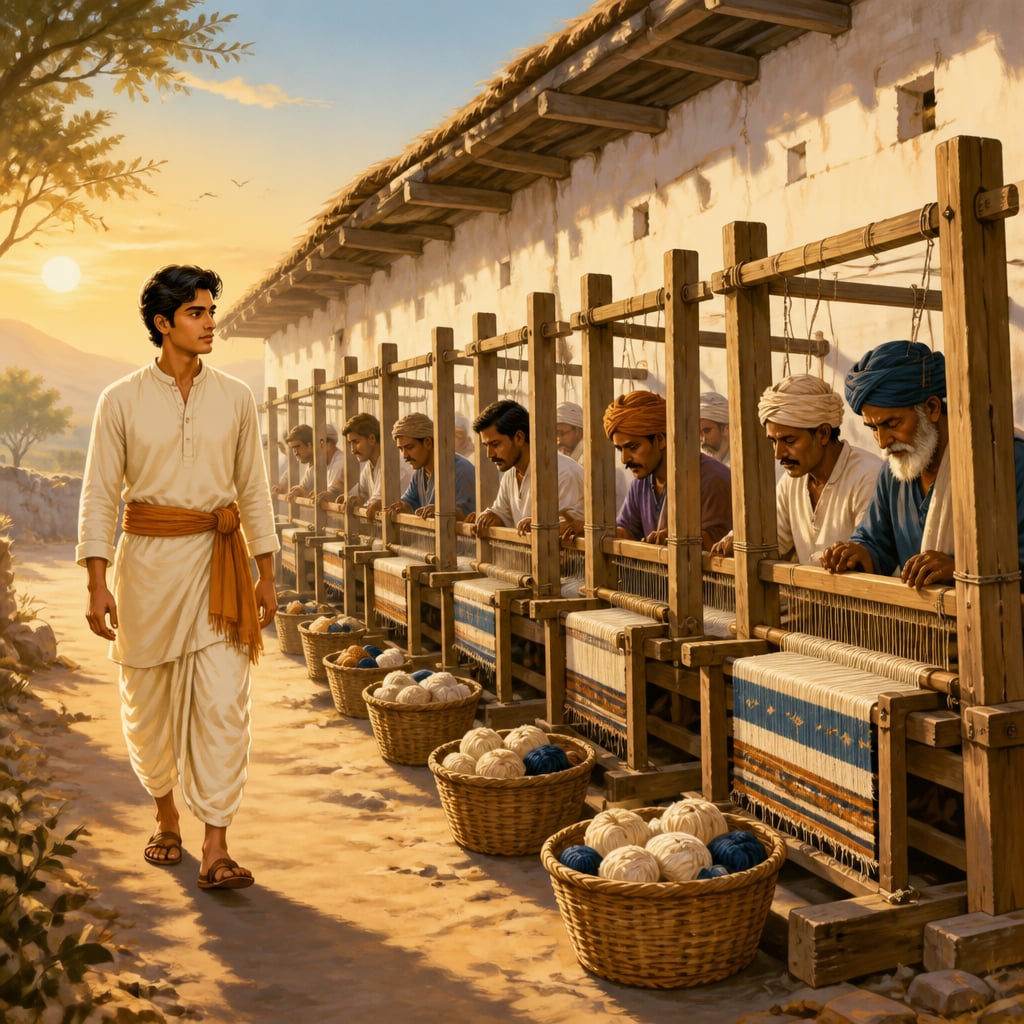
Nand Kishore Chaudhary walking past his first nine hand looms in 1978

On a cool morning in early 1978, in a small Rajasthani town on the northern edge of the Thar Desert, a young man in his mid-twenties named Nand Kishore Chaudhary walks to a row of nine hand looms he has just set up with borrowed money. The looms are simple wooden frames, strung with taut white cotton warp threads. In front of each loom sits a weaver. Most of them are from the region's traditional marginalised weaver communities. All of them have, until now, earned a modest piece-rate from middlemen who collected the finished cotton durries at the end of each week and sold them in the towns for many times the weaver's cut.

Chaudhary has a different plan. He will buy the durries directly from the weavers at a fair price, without the middleman. He will handle the design, the quality control, the urban retail, and the export himself. His family thinks he is making a serious mistake. The caste politics of rural Rajasthan in 1978 do not easily accept a young man from a merchant family sitting down to work shoulder to shoulder with weavers from the region's marginalised communities. Chaudhary thinks his family is wrong.

A few decades later, the experiment that begins at these nine looms will have grown into a network of tens of thousands of weavers across several Indian states, and the company it becomes will be called Jaipur Rugs. The durries, the kilims, and the knotted pile carpets produced in the Jaipur Rugs network will be sold in urban Indian stores, in international home-goods retail, and through some of the best-known luxury home brands in the world. Chaudhary himself will later be recognised with the Padma Shri for his work in reviving the handmade Indian rug sector.

The Jaipur Rugs story, though, is only the most recent chapter in a much longer history. Long before Chaudhary set up his first nine looms, the flatweave cotton durrie was already one of the most widely made household textiles in northern India. Royal workshops in nineteenth-century Jaipur under Maharaja Sawai Ram Singh II had produced some of the finest durries ever woven in the country. Agra Central Jail, a colonial-era prison on the banks of the Yamuna, had turned out huge durries and carpets for government buildings across the British Indian Empire. And in Warangal, a town in the southern state of Telangana, a separate tradition of punja-woven cotton durries had been held for generations by a small community of specialist weavers, a tradition that would eventually receive its own Geographical Indication registration in 2018.

This lesson walks through all four chapters of the durrie story: the royal karkhana of nineteenth-century Jaipur, the prison looms of Agra, the Warangal GI, and the village network of Jaipur Rugs in the twenty-first century.

यो यज्ञो विश्वतस्तन्तुभिस्तत एकशतं देवकर्मेभिरायतः। इमे वयन्ति पितरो य आययुः प्र वयाप वयेत्यासते तते॥

yo yajño viśvatas tantubhis tata ekaśataṃ devakarmebhir āyataḥ ime vayanti pitaro ya āyayuḥ pra vayāpa vayety āsate tate

The sacrifice, stretched out on threads on all sides, extended with a hundred and one divine rites, is woven by the fathers who came before. They sit by the stretched loom and call: weave forward, weave back.

Rig Veda 10.130.1

The Rig Veda takes the image of a loom and the voice of the weaver and turns them into a description of the cosmic order itself. The hymn is one of the oldest surviving examples of the weaving metaphor in Indian literature. By the time the first durrie loom was set up in the Jaipur royal karkhana, or inside the Agra Central Jail, the image of the world as a woven fabric had been part of Indian religious imagination for more than two thousand years. A durrie, a simple flatweave cotton rug made on the most minimal of hand looms, is one of the purest material expressions of that ancient image.

What Is a Durrie?

The word durrie (in Hindi dari) means a flat-woven, pile-less rug or floor covering, usually made of cotton though sometimes of wool or jute. A durrie is not a knotted pile carpet. In a knotted pile carpet or kalin, each tuft of coloured wool is tied individually into the warp and then trimmed to form a thick pile on the surface. In a durrie, there are no knots at all. The design is made entirely by weaving the coloured weft threads back and forth through the warp in the same way as any other flat-woven cloth, with the pattern formed by the order in which different colours are picked up and beaten down. Both sides of a finished durrie look almost identical. A durrie is reversible in a way a knotted carpet is not.

The loom is simple. A frame of two parallel wooden beams, stretched with cotton warp threads, held at tension on a pit-loom arrangement or a raised frame, and worked with a small set of basic weaving tools. The most characteristic of these tools is a metal claw called the panja, used in parts of Rajasthan, Telangana, and Haryana to beat the weft threads tightly down against the previous row. The panja gives the durrie its tight, clean, slightly corded surface, and its name gives the whole technique the common nickname punja weave in some regions.

The raw material in northern India is almost always cotton, spun into sturdy weft yarn and dyed in traditional vegetable and mineral colours. Reds from lac-madder and alizarin. Blues from indigo. Yellows from turmeric and pomegranate. Browns from myrobalan and iron. Greens from indigo layered over turmeric. The most common patterns are bold geometric grids. Diamonds. Stripes. Checkerboards. Mihrab arches for prayer mats. Large borders around a plain central field. The durrie is, by design, a practical textile. Strong under furniture. Cleanable. Foldable. Cool on the floor in summer and warmer than bare stone in winter. And, when it is well made, remarkably beautiful.

The Royal Karkhana of Sawai Ram Singh II

Maharaja Sawai Ram Singh II inspecting the royal Jaipur durrie karkhana

In the middle of the nineteenth century, the Maharaja of Jaipur, Sawai Ram Singh II, who reigned from 1835 to 1880, set about modernising his capital in ways that went well beyond the usual courtly patronage of earlier kings. Ram Singh II built Jaipur's first colleges, its first modern hospitals, its first printing press, and its first photographic studios. He also reorganised the royal karkhana system, the traditional network of palace workshops in which court artisans produced textiles, jewellery, weapons, and furnishings for royal use.

Under Ram Singh II, the Jaipur royal karkhana included a dedicated carpet and durrie workshop. Master weavers from Rajasthan, Punjab, and parts of Persia were brought to Jaipur to train local artisans in both knotted pile carpets in the Persian style and flatweave cotton durries in the Rajasthani style. The royal workshop's durries were used throughout the City Palace, the Amber Fort, and the various royal residences of the Jaipur court. Some of the finest pieces from this period are still preserved in the City Palace Museum today, with their tight cotton weaves, their vegetable-dyed colours, and their carefully balanced geometric borders.

The royal karkhana system did two things that would shape the Jaipur durrie tradition for the next century and a half. It set a very high technical standard, which forced later commercial weavers to match palace-grade quality to sell into the Jaipur market. And it created a cluster of skilled weaving families in and around Jaipur who, after the royal workshops were gradually dismantled through the colonial consolidation of princely states, moved into village workshops and commercial trade networks, carrying the royal technique out into the wider economy of Rajasthan.

Agra Central Jail and the Prison Looms

A few hundred kilometres to the east, on the banks of the Yamuna near the Taj Mahal, a very different kind of durrie workshop was growing up inside the walls of Agra Central Jail. The prison had been established in the mid-nineteenth century under British colonial rule as a large central jail for the North-Western Provinces. From the 1860s onwards, the British jail administration introduced a range of labour-rehabilitation programmes for the inmates, and carpet and durrie weaving was one of the most successful.

The Agra jail weaving sheds quickly became famous. Prisoner-weavers, working under the supervision of a small number of master trainers, produced durries and knotted carpets of unusual size and quality. A single durrie woven at Agra Central Jail could be thirty feet long, large enough to cover the floor of a British-era drawing room or a municipal hall. The pieces were exhibited at the great colonial exhibitions in Delhi, Calcutta, Madras, and London. They were purchased by Indian princely states and by British officials, and they covered the floors of government buildings across the subcontinent.

The ethics of the prison workshop were complicated then and are complicated now. On one hand, the weavers were people imprisoned by a colonial legal system whose definitions of crime often had more to do with colonial law and colonial policy than with any honest idea of justice. On the other hand, the workshop gave many of them a trade they could use after release, and several ex-prisoners set up independent weaving workshops in Agra and nearby towns after serving their sentences. The Agra jail workshop continued into the twentieth century, and its descendants still operate in some form today.

The Agra durrie tradition that grew up around the jail has a clear character. Large. Highly geometric. Cotton-heavy. Strong under the weight of heavy furniture. Designed to be shipped long distances and to last for decades in a room that was not always gentle with its floor covering.

The Warangal GI of 2018

A Telangana woman weaver pressing the punja beater on a Warangal durrie

More than a thousand kilometres south of Agra, in the town of Warangal in the Telangana state of southern India, a separate tradition of cotton punja durries has been held for generations by a small community of weavers. The Warangal durrie uses the same basic panja tool and the same basic flatweave technique as the northern traditions, but with a distinctive local design vocabulary drawn from the older Kakatiya-era stone carvings of the region. Lotus grids. Interlocking diamonds. Deep border patterns that are unmistakably southern Indian even when they appear on a cotton durrie.

By the early 2000s, the Warangal punja durrie was under serious pressure from machine-made imports and from generic Indian durries sold under Warangal's name. In 2018, the Government of India registered Warangal durries as a Geographical Indication under the 1999 Indian GI Act. The registration gave the town and its surrounding artisan cluster the exclusive right to use the name Warangal durrie for cotton flatweave rugs made using the traditional punja technique in the registered geographical area. Factories elsewhere in India or abroad can no longer legally label machine-made copies as Warangal durries in Indian markets.

The Warangal GI is the single clearest legal protection currently held by any Indian durrie tradition. Agra and Jaipur do not yet have their own dedicated durrie GIs, though individual Rajasthani and Uttar Pradesh weaving clusters have received broader handloom protections. The Warangal case is now studied in Indian craft policy as the baseline example of how a small regional durrie tradition can use the 1999 GI Act to defend its name and its market.

Jaipur Rugs and the Village Network

Back in Jaipur, the experiment Nand Kishore Chaudhary began at nine looms in 1978 has become the largest direct-to-weaver rug and durrie network in India. Jaipur Rugs now works with tens of thousands of weavers across several states, paying them directly through a cluster-manager system that keeps most of the retail margin inside the village. The company's design team works with modern Indian and international designers to translate contemporary ideas into the vocabulary of the traditional flatweave and knotted-pile looms, and the finished rugs are sold through its own stores, through urban Indian home-goods retailers, and through luxury home brands in Europe and North America.

The Jaipur Rugs Foundation, the non-profit arm of the company, runs literacy, health, and skill-training programmes for the weaver communities. Chaudhary's decision in 1978 to work directly with marginalised weaver communities has become the structural logic of the whole network. The weaver is not a supplier of raw labour to a middleman. She is the direct economic anchor of the enterprise.

Modern Echoes

The durrie looms of Rajasthan, Uttar Pradesh, and Telangana are still running. In a village near Jaipur, a Jaipur Rugs weaver is beating down the last row of a cotton durrie with a panja. In a workshop in Agra, a descendant of the old prison-workshop lineage is finishing a large geometric durrie for a Delhi showroom. In Warangal, a punja weaver is working a bold Kakatiya diamond grid into a durrie that will carry the protected GI name to a home a thousand kilometres away.

The Rig Veda's image of the hundred-and-one-threaded fabric of the world is still the right image. Every durrie on every loom is a small version of that larger weaving. The master weaver calls forward, the weft goes back, and the pattern grows a few more rows. The floor of an Indian home, from the Jaipur City Palace to a Delhi apartment to a Mumbai duplex, is still, on the best days, a hand-woven field of colour.

Key figures

Nand Kishore Chaudhary

A Rajasthani entrepreneur and the founder of Jaipur Rugs, the largest direct-to-weaver rug and durrie network in India. Chaudhary began his working life in the mid-1970s with a small loan and a strong conviction that the traditional Indian carpet and durrie trade was failing its weavers by keeping most of the retail margin in the hands of middlemen. In 1978, in a small town on the northern edge of Rajasthan, he set up nine hand looms and began working directly with weavers from the region's traditional marginalised weaver communities. Over the following four decades, the initial nine-loom experiment grew into a network of tens of thousands of weavers across several Indian states, producing flatweave durries, kilims, and knotted pile carpets for urban Indian and international markets under the Jaipur Rugs name. Chaudhary is one of the best-known Indian craft social entrepreneurs of the current generation.

Maharaja Sawai Ram Singh II of Jaipur

The Maharaja of the princely state of Jaipur, who reigned from 1835 to 1880 and is remembered as one of the most consequential modernising rulers of nineteenth-century Rajasthan. Ram Singh II built Jaipur's first modern colleges, hospitals, printing press, and photographic studios, and he reorganised the royal karkhana system of palace workshops along lines that supported both traditional craft production and a careful engagement with contemporary European design and science. Under his rule, the Jaipur royal carpet and durrie karkhana produced some of the finest knotted pile carpets and flatweave cotton durries woven anywhere in India, training the generations of Jaipur weavers whose descendants still run the town's durrie trade today.

Ritu Sethi

An Indian craft researcher, editor, and policy advocate. She is the founder of the Craft Revival Trust and the founding editor of Asia InCH, an online encyclopedia of the crafts and textiles of South Asia. She has been one of the most consistent voices in Indian craft policy for more than two decades, advising the Ministry of Textiles, UNESCO, and several state governments on the legal and economic protection of traditional crafts, including the durrie and carpet traditions of Jaipur, Agra, and Warangal.

Case studies

Sawai Ram Singh II and the Jaipur Royal Karkhana

In the middle of the nineteenth century, Maharaja Sawai Ram Singh II of Jaipur, who reigned from 1835 to 1880, set about modernising his capital in ways that went well beyond the usual courtly patronage of earlier rulers. He built Jaipur's first modern colleges, hospitals, printing press, and photographic studios. He also reorganised the royal karkhana system, the traditional network of palace workshops in which court artisans produced textiles, jewellery, weapons, and furnishings for royal use. Under his rule, the Jaipur royal karkhana included a dedicated carpet and durrie workshop that brought together master weavers from Rajasthan, Punjab, and parts of Persia, and produced both knotted pile carpets in the Persian style and flatweave cotton durries in the Rajasthani style for the floors of the City Palace, the Amber Fort, and the various royal residences of the Jaipur court.

From the perspective of Indian craft history, Ram Singh II's royal karkhana was an expression of a very old Indian idea about the relationship between a ruler and the crafts of his realm. The Arthashastra of Kautilya, written more than two thousand years ago, already describes the ruler as having a formal duty to maintain craft workshops, protect master artisans, and ensure that the highest quality of every craft is available for court and public use. The Mughal karkhana system inherited this idea and extended it across a much larger geography. Ram Singh II's Jaipur karkhana was a nineteenth-century Rajput expression of the same inherited idea: the ruler maintains the workshop, the master weavers maintain the technical ceiling, and the court becomes the guaranteed buyer of the finest output. The system worked for as long as the royal court remained the economic centre of the region, and it set a standard that later commercial weavers had to match.

The Jaipur royal carpet and durrie karkhana produced some of the finest knotted pile carpets and flatweave cotton durries woven anywhere in India during the second half of the nineteenth century. Several of the best surviving pieces are still preserved in the City Palace Museum, Jaipur. When the royal workshops were gradually dismantled through the late nineteenth and early twentieth centuries, during the colonial consolidation of princely states and the weakening of royal courts, the weavers who had trained in them moved into village workshops and commercial trade networks. They carried the royal technique out into the broader economy of Rajasthan. The modern Jaipur durrie tradition, including the Jaipur Rugs direct-to-weaver network, inherits its technical standard directly from the generation of weavers whose training goes back through an unbroken line to the Ram Singh II karkhana.

Royal patronage of a craft rarely ends with the royal court. Its most important legacy is almost always the technical ceiling it sets and the generation of master craftspeople it trains, both of which outlast the patron by decades or centuries. Ram Singh II's nineteenth-century karkhana is still shaping the quality of a twenty-first-century durrie woven in a village outside Jaipur, even though no one in either the modern weaver's workshop or the modern buyer's home is thinking about the Maharaja when the durrie is made. For any craft tradition, identifying the generation of patronage that set the technical ceiling is often the key to understanding why the current craft looks the way it does.

The Ram Singh II karkhana is now studied in Indian craft history alongside the Mughal imperial karkhana, the Tanjore Maratha court, and the Travancore royal workshops as one of the principal nineteenth-century royal craft institutions of the subcontinent. For modern craft policy, the lesson is that a concentrated, well-funded, high-standard workshop maintained for a few decades can shape a regional tradition for more than a century after the workshop itself has closed.

Maharaja Sawai Ram Singh II of Jaipur reigned from 1835 to 1880. His royal karkhana included a dedicated carpet and durrie workshop that produced pieces for the City Palace, the Amber Fort, and other royal residences. Several of the best surviving nineteenth-century Jaipur royal durries are preserved today in the City Palace Museum, Jaipur.

The Agra Central Jail Durrie Workshop

On the banks of the Yamuna near the Taj Mahal, inside the walls of the Agra Central Jail, a very different kind of durrie workshop was operating through the second half of the nineteenth century and well into the twentieth. The prison had been established in the mid-nineteenth century under British colonial rule as a large central jail for the North-Western Provinces. From the 1860s onwards, the British jail administration introduced a range of labour-rehabilitation programmes for the inmates, and carpet and durrie weaving became one of the most successful. Prisoner-weavers, working under the supervision of a small number of master trainers, produced durries and knotted carpets of unusual size and quality. A single durrie woven in the Agra jail sheds could be thirty feet long, large enough to cover the floor of a British-era drawing room or a municipal hall, and the pieces were exhibited at the great colonial exhibitions in Delhi, Calcutta, Madras, and London.

The Agra Central Jail workshop is one of the most morally complicated case studies in Indian craft history. On one hand, the weavers were real craftspeople, producing genuine work of exceptional quality, trained in a traditional technique, and often leaving the prison with a real trade in their hands. From the perspective of the Indian craft tradition's respect for jnana (knowledge) and shilpa (skilful work), the technical achievement of the Agra jail pieces is undeniable. On the other hand, the workshop existed inside a colonial prison system whose definitions of crime and punishment were themselves shaped by colonial law and colonial policy, and the labour of the prisoner-weavers was not fully free in any honest sense. Any traditional lens on this case has to hold both truths at once: the craft was real and deserves respect, the institution that produced it was built on a logic modern India has rejected, and the history of the tradition has to include both facts.

The Agra jail weaving programme produced some of the largest and most technically impressive flatweave durries and knotted pile carpets of the late colonial era. Its pieces covered the floors of government buildings and official residences across British India, were purchased by Indian princely states, and were displayed at the great colonial exhibitions at the turn of the twentieth century. Several ex-prisoners set up independent weaving workshops in Agra and nearby towns after serving their sentences, and the tradition that grew up around the jail eventually spilled out into a broader Agra commercial rug industry that continued into and beyond Indian independence. The modern Agra rug and durrie trade, including the private workshops and export houses still operating in the city today, traces part of its technical lineage back to the jail workshop.

A craft tradition can carry both pride and shadow in the same memory. The Agra durrie industry is real, serious, and technically impressive, and it also grew out of a colonial prison system whose moral logic was flawed. The honest way to carry such a tradition forward is to acknowledge both sides at once. Celebrate the craft. Acknowledge the history. Do not let either fact quietly erase the other. This is a discipline that serves well in any craft, institution, or community whose modern pride rests on an older foundation the modern descendants would not build the same way today.

For any modern study of colonial-era Indian craft, the Agra Central Jail workshop is now one of the standard case studies in the complicated intersection of colonial prison labour, craft production, and national reputation. It is taught in Indian craft and history courses alongside similar case studies of prison and institutional weaving programmes in Mirzapur, Srinagar, and other regional centres.

Agra Central Jail was established in the mid-nineteenth century under British colonial rule. Its carpet and durrie weaving programme, introduced in the 1860s, produced pieces of unusual scale and quality, including flatweave durries up to thirty feet in length, and these pieces were displayed at the major colonial exhibitions at the end of the nineteenth and beginning of the twentieth centuries.

The 2018 Warangal Durrie Geographical Indication

In Warangal, a town in the Telangana state of southern India, a small community of punja weavers has been producing cotton flatweave durries for generations. The Warangal durrie uses the same basic panja tool and the same basic flatweave technique as the northern traditions, but with a distinctive local design vocabulary drawn from the older Kakatiya-era stone carvings of the region, including lotus grids, interlocking diamonds, and deep border patterns that are unmistakably southern Indian even on a cotton durrie. By the early 2000s, the Warangal tradition was under serious pressure from machine-made imports and from generic Indian durries sold loosely under the Warangal name. In 2018, the Government of India registered Warangal durries as a Geographical Indication under the 1999 Indian GI Act, with the Warangal punja weaver community and the Telangana government as joint applicants.

From a dharmic perspective, the Warangal GI is a modern legal expression of a very old Indian idea: a craft belongs not only to the individual weaver but also to the community and the place that together hold the technique. The Indian classical texts on craft, from the Shilpa Shastras onwards, describe a craft tradition as a shared lineage in which the master, the apprentice, the village, and the raw material all participate. The GI Act takes this idea and gives it legal force. It says that the name of a craft is a shared asset of the place and the community, not a private possession of any individual or any outside factory, and that outsiders cannot use the name unless they are making the craft in the right place in the right way. For Warangal, this is the legal version of a principle the town has understood by itself for generations.

The 2018 Warangal durrie GI gave the town and its surrounding artisan cluster the exclusive right to use the name Warangal durrie for cotton flatweave rugs made using the traditional punja technique in the registered geographical area. Factories elsewhere in India or abroad can no longer legally label machine-made copies as Warangal durries in Indian markets. The registration has encouraged Telangana state craft policy to invest in the Warangal cluster through training, design support, and marketing help, and it has given urban Indian buyers a legally verifiable way to purchase a genuine Warangal durrie. The GI is currently the single clearest dedicated legal protection of any Indian durrie tradition.

A small regional craft tradition can be saved, or at least meaningfully stabilised, by the targeted use of a legal tool like the Geographical Indication Act. The Warangal durrie case is now one of the clearest examples in the country of a small cluster using the 1999 GI Act to defend its name and its market against generic imitation. For any other Indian craft community considering similar protection, Warangal is one of the most instructive modern case studies, and the Agra and Jaipur durrie traditions would almost certainly benefit from similar dedicated GI registrations of their own.

The Warangal durrie GI is cited alongside the Bidar Bidriware GI, the Channapatna toy GI, the Kanchipuram silk GI, and the Madhubani painting GI as a clear example of how the 1999 GI Act has been used over the last two decades to protect traditional Indian crafts from generic imitation. For any small craft community considering similar protection, Warangal is now one of the standard reference cases in Indian craft policy.

Warangal durries were registered as a Geographical Indication in 2018 under the 1999 Indian Geographical Indications of Goods (Registration and Protection) Act, with the Telangana state government and the Warangal punja weaver community as joint applicants. The registration covers the traditional cotton punja-woven flatweave rug tradition of the Warangal cluster in Telangana.

Nand Kishore Chaudhary and the Nine Looms of 1978

In 1978, a young Rajasthani entrepreneur named Nand Kishore Chaudhary set up nine hand looms in a small town on the northern edge of Rajasthan, borrowed a modest amount of capital to pay for the raw materials, and began working directly with weavers from the region's traditional marginalised weaver communities. His insight was simple. The traditional durrie trade of Rajasthan was failing its weavers because most of the retail margin was captured by middlemen between the village loom and the urban buyer. If he could pay the weaver directly and handle the design, quality control, and retail himself, he could return a much larger share of the final price to the village and build a business that worked for both the maker and the buyer at the same time. His family thought the experiment was a mistake. The caste politics of rural Rajasthan in 1978 did not easily accept a young man from a merchant family sitting down to work shoulder to shoulder with weavers from the region's marginalised communities.

Chaudhary's 1978 experiment is a very clear modern expression of the classical Indian craft principle that the maker deserves the value of his work. The Shilpa Shastra tradition of pre-modern India repeatedly describes the master craftsman as a holder of jnana (knowledge) whose work is a direct contribution to the dharma of the community, and who should be supported accordingly. The Mughal and Rajput karkhana systems of earlier centuries paid master weavers regular wages and maintained them as recognised court artisans. The colonial and post-independence middleman trade had, in many places, hollowed out this relationship and left the weaver as a piece-rate subcontractor at the bottom of a long commercial chain. Chaudhary's experiment restored the older principle in a modern institutional form: the weaver at the centre, the urban market at the edge, and the middleman eliminated in favour of a direct link managed by the company itself.

Forty-plus years after the nine-loom start, Jaipur Rugs is the largest direct-to-weaver rug and durrie network in India. The company works with tens of thousands of weavers across several Indian states, paying them directly through a cluster-manager system that keeps most of the retail margin inside the village. The design team works with Indian and international designers to translate contemporary ideas into the vocabulary of the traditional flatweave and knotted-pile looms, and the finished rugs sell through its own stores, through urban Indian home-goods retailers, and through luxury home brands in Europe and North America. The Jaipur Rugs Foundation, the non-profit arm of the company, runs literacy, health, and skill-training programmes for the weaver communities. Chaudhary himself has been recognised with the Padma Shri for social entrepreneurship and is now one of the best-known Indian craft entrepreneurs of his generation.

A single stubborn founder, acting on one clear principle at the start of a long career, can reshape the economics of a whole traditional craft. Chaudhary did not invent any new weaving technique. He simply refused to accept that the middleman chain was the only way to run an Indian rug business, and he built a company around paying the weaver directly. That single commitment, held across four decades, has changed the lives of tens of thousands of rural Indian weavers and has built a model that other Indian craft enterprises are now copying. For any aspiring craft social entrepreneur, the Jaipur Rugs case is one of the most instructive modern examples in the country of what a long, patient, principle-driven career can achieve.

The Jaipur Rugs direct-to-weaver model is now cited in Indian craft policy, social entrepreneurship case studies, and international craft literature as one of the clearest examples of a private enterprise built around fair payment to traditional artisans. The model has been adapted, in various forms, by cooperatives and designer brands across several Indian craft traditions, and Jaipur Rugs itself continues to be one of the most visible modern Indian craft enterprises both at home and abroad.

Nand Kishore Chaudhary founded what would become Jaipur Rugs in 1978 with nine hand looms in a small Rajasthani town. The company today works with tens of thousands of weavers across several Indian states, operating a direct-to-weaver payment system and selling through its own physical and online retail channels in India and abroad. Chaudhary has been recognised with the Padma Shri for his contribution to social entrepreneurship in the Indian handmade rug sector.

Historical context

The durrie tradition of Jaipur runs from its institutional beginnings in the mid-nineteenth-century royal karkhana of Maharaja Sawai Ram Singh II, through the late-nineteenth and twentieth-century transition from royal to commercial production, and into the present direct-to-weaver network model exemplified by Jaipur Rugs. The Agra durrie tradition runs from the 1860s onwards through the British colonial-era prisoner-weaver programme at Agra Central Jail, through a long twentieth-century trade history, and into the present descendant workshops of the city. The Warangal punja durrie tradition runs through many generations of southern Telangana household and cluster weaving and received its 2018 Geographical Indication registration as the first formal legal protection of any Indian durrie tradition at that level.

Jaipur, Agra, and Warangal represent three very different regions of the Indian durrie story. Jaipur is the royal capital of the old princely state of Rajasthan, where courtly patronage of a dedicated carpet and durrie karkhana in the nineteenth century set the technical ceiling of the tradition. Agra is the old Mughal capital of Uttar Pradesh on the banks of the Yamuna, where a large British colonial prison workshop scaled the tradition up into industrial volumes in the nineteenth and early twentieth centuries. Warangal is a town in the Telangana hills of southern India, far from both northern centres, where a separate punja weaver community developed its own distinctive Kakatiya-inspired design vocabulary on the same basic flatweave loom. The three traditions together represent the main regional, institutional, and stylistic poles of the Indian durrie craft.

Flatweave rug traditions exist across the wider Asian carpet world, including the kilim traditions of Turkey, Iran, the Caucasus, and Central Asia, as well as the Berber flatweave traditions of north Africa. The Indian durrie belongs to this broader flatweave family but differs in its preference for cotton over wool, in its distinctive panja beating tool, and in the specific geometric vocabulary of its Indian regional design traditions. Compared with the kilim, the durrie is generally lighter, more clearly a warm-climate household textile, and more closely tied to a cotton rather than a wool agricultural economy. The Indian kalin (knotted pile carpet) sits alongside the durrie as the thicker, more luxurious, and more explicitly Persian-influenced cousin of the flatweave tradition.

Estimates place the number of active durrie weavers across the Jaipur, Agra, and Warangal clusters at several tens of thousands, with Jaipur Rugs alone working with tens of thousands of weavers across several Indian states. The Warangal durrie Geographical Indication was registered in 2018 under the 1999 Indian GI Act, and it remains the single clearest dedicated legal protection of any Indian durrie tradition to date. The average large cotton durrie from any of the three traditions takes several weeks of loom time to complete, depending on size, complexity of pattern, and the number of weavers working together on the piece.

The durrie is one of the most widely used household textiles in India, and its weaving tradition is one of the most economically important handloom sectors in the country. The Jaipur royal karkhana, the Agra Central Jail workshop, and the Warangal GI together cover the three main institutional forms that Indian craft has taken in the modern period: royal patronage, colonial-era state institution, and post-independence legal protection. The Jaipur Rugs direct-to-weaver model represents a fourth form: a private enterprise built around the idea that the weaver should be paid directly and that the middleman should be paid only for the value he adds. For any student of Indian craft, the durrie story is one of the clearest single case studies of how a traditional handloom can survive across very different political, economic, and institutional environments over nearly two centuries.

Living traditions

The modern legacy of the Indian durrie tradition runs through the Jaipur royal karkhana, the Agra Central Jail workshop, the 2018 Warangal Geographical Indication, and the Jaipur Rugs direct-to-weaver network. Together, these four institutions cover the full institutional range of Indian craft: royal patronage, colonial-era state workshop, post-independence legal protection, and modern private social enterprise. Each has left its mark on the current durrie market, and each supplies a piece of the framework on which the contemporary Indian flatweave rug industry now stands.

Reflection

More in Sthula Shilpa (स्थूल शिल्प) - Carpets, Leather & Stone

All lessons in Sthula Shilpa (स्थूल शिल्प) - Carpets, Leather & Stone · Traditional Crafts & Textiles course