Marble & Soapstone: Carving Traditions of Rajasthan

One white calcite quarry in a Nagaur district village that has supplied the Dilwara Jain temples, the Taj Mahal, the Ranakpur Chaumukha, BAPS Akshardham, and the Ayodhya Ram Mandir. The Sompura silpi families who have carved it for a thousand years. And the softer Aravalli soapstones that still feed the Jaipur murti bazaars.

In a drawing studio in Ahmedabad in 2020, Chandrakant Sompura, seventy-seven years old and the grandson of the silpi who restored Somnath, sets three small samples of Makrana marble on his drawing board next to an elevation of the Ayodhya Ram Mandir. He is choosing the stone for the garbhagriha. The same Makrana quarries in Nagaur district of western Rajasthan have supplied the Vimal Vasahi at Dilwara (1031), the Chaumukha at Ranakpur (1437), the Taj Mahal (from 1632), the Victoria Memorial, the BAPS Akshardham temples at Gandhinagar, Delhi, and Robbinsville, and now the Ram Mandir consecrated in January 2024. The stone is a pure white calcite with unusually low porosity that does not yellow with age. The silpi lineage that has carved it for nearly a thousand years is the Sompura community, whose guilds designed Somnath, Ambaji, Akshardham, and the Ayodhya sanctum. This lesson walks into the Makrana pits, the Dilwara ceilings, the Ranakpur forest of pillars, the marble jali screens of Rajput Rajasthan, the softer soapstone murti bazaars of Jaipur, the 2015 Geographical Indication for Makrana Marble, and the Sompura drawing boards that connect Vimal Shah's minister in 1031 to Chandrakant Sompura's elevation for Ayodhya in 2024.

A Studio on C.G. Road
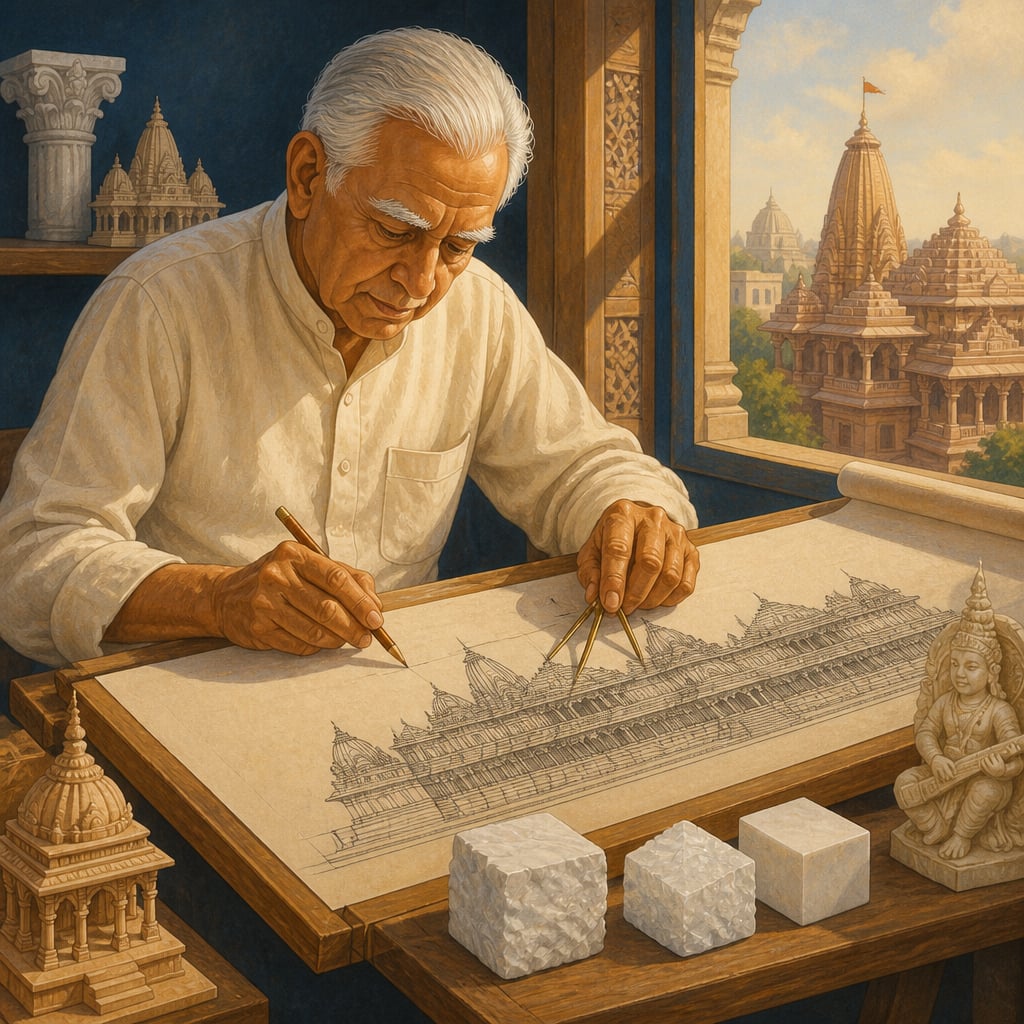
Chandrakant Sompura choosing Makrana samples for the Ayodhya Ram Mandir

On a summer afternoon in 2020, in a second-floor drawing studio on C.G. Road in Ahmedabad, Chandrakant Sompura is leaning over a long wooden drawing board. He is seventy-seven years old. On the board is a large sheet of tracing paper with the east elevation of the proposed Ayodhya Ram Mandir drawn in fine pencil, the shikhara rising above the garbhagriha in the Nagara style his family has used for centuries. Next to the sheet sit three small polished samples of white marble, each about the size of a matchbox, each with a handwritten label in Gujarati: Makrana Doongri, Makrana Albeta, Makrana Kumari. These are three grades of pure white calcite marble, all from the same small town in Nagaur district of western Rajasthan, and one of them will become the floor and the sanctum screen of a temple that India has waited almost five hundred years to build.

Chandrakant Sompura's grandfather, Prabhashankar Sompura, rebuilt the Somnath temple in the 1950s after Sardar Patel decided to restore the shrine Mahmud of Ghazni had sacked in 1026. His father, Balvantrai Sompura, passed the silpi tradition on to him as a boy. For thirty years, ever since the first design briefs for a possible temple at Ayodhya were circulated in the early 1990s, Chandrakant has waited. The Supreme Court cleared the site in 2019. The foundation stone was laid in August 2020. In January 2024 the consecrated image of Ram Lalla took its place inside the garbhagriha whose elevation is being finalised on this drawing board. The screen that separates the inner sanctum from the pradakshina path will be a Makrana marble jali, perforated in a pattern the Sompura silpis have been drawing since the eleventh century.

This lesson is about the two Rajasthan stones that have carried the Sompura tradition and the wider Rajasthani carving economy for close to a thousand years. The first and most famous is Makrana marble, the pure white calcite that has supplied almost every great temple and tomb in the subcontinent. The second is a family of softer stones, grouped here as soapstone and its Rajasthan cousins, that feed the everyday murti bazaars of Jaipur and the temple workshops of Karauli and Dungarpur.

The Village that is a Recipe

Makrana is a small town in Nagaur district of western Rajasthan, about a hundred and twenty kilometres northeast of Jodhpur. Its quarries have been worked for at least a thousand years. The local hill face holds one of the purest calcite marble deposits in the world, more than ninety-eight per cent calcium carbonate, unusually dense and low in porosity, which means it does not drink in rain and does not yellow with age. At thin edges it becomes slightly translucent, so a carved Makrana jali in strong sunlight glows from within. It takes a fine polish that holds for centuries.

The oldest surviving major use of Makrana marble is the Vimal Vasahi at Dilwara on Mount Abu, consecrated in 1031 under the patronage of a Jain minister named Vimal Shah. The most famous is the Taj Mahal, whose exterior cladding and interior inlay panels were hauled from Makrana between 1632 and 1653. The Mughal procurement was administered by the Bhandari family of Makrana, Jain mine managers whose descendants are still active in the town. When the British planned the Victoria Memorial in Calcutta in the early twentieth century, they specified Makrana again. So did Birla for the Birla Mandirs. So did the BAPS swaminarayan order for the Akshardham complexes at Gandhinagar, Delhi, and Robbinsville in New Jersey. And so did the Shri Ram Janmabhoomi Teerth Kshetra Trust when it began procurement for the Ayodhya Ram Mandir sanctum in 2020. The village that supplied the Solanki kings and the Mughals still supplies the republic.

यतः प्रवृत्तिर्भूतानां येन सर्वमिदं ततम्। स्वकर्मणा तमभ्यर्च्य सिद्धिं विन्दति मानवः॥

yataḥ pravṛttir bhūtānāṃ yena sarvam idaṃ tatam svakarmaṇā tam abhyarcya siddhiṃ vindati mānavaḥ

From whom all beings arise, by whom all this is pervaded. By worshipping Him through one's own work, a person attains perfection.

Bhagavad Gita 18.46

This is the single passage Sompura, Vishwakarma, and other Indian craft communities quote most often to describe what a carver is actually doing when he sits down with a chisel. The work itself, done with full attention and skill, is the worship. The word for it in the Shilpa Shastra tradition is svakarma-puja, the worship that is your own craft.

Dilwara 1031: The First Great Marble Ceiling

A Sompura silpi carving the central dome of the Vimal Vasahi at Dilwara

To see what a master Sompura silpi could do with Makrana marble nine hundred years ago, climb to Mount Abu in the Aravalli range of southern Rajasthan and walk into the Vimal Vasahi. Vimal Shah had the marble brought by elephant up the mountain road, a logistical operation that took years. The carving was done on site over an estimated fourteen years.

The central dome ceiling of the Vimal Vasahi is considered by many art historians to be the finest marble carving ever produced in India. Lotus petals open in concentric rings. Dancing figures, musicians, and vidyadharas float between the rings. The marble is cut so thin in places that it passes light. The pillars around the mandapa are each carved with a different figure. The second great Dilwara temple, the Luna Vasahi, was added by the brothers Vastupala and Tejapala, also Jain ministers, in 1230. Its central ceiling is a pendant lotus that hangs from the dome like a dropped flower carved out of the air. The two ceilings together set the standard every Sompura silpi lineage has measured itself against for the last eight centuries. When a modern Sompura apprentice begins training, his master takes him to Dilwara early in the curriculum and simply points at the ceiling. That is the benchmark.

Ranakpur 1437: The Forest of Pillars

Four hundred years after Vimal Shah, another Jain merchant named Dharna Shah decided to build a marble temple of his own, in a forested valley on the western slope of the Aravalli range near the village of Ranakpur. He hired a silpi named Deepa from the Sompura community and told him to build a Chaumukha, a four-faced temple in which the central Adinatha image would look out in all four directions. Construction began in 1437 and continued for half a century.

The forest of 1,444 marble pillars inside the Ranakpur Chaumukha

The Ranakpur Chaumukha has 1,444 carved marble pillars, no two alike. No matter where a visitor stands, the view in at least one direction is a receding colonnade of carved marble. The Sompura tradition credits the entire carving to the guild, not to the master alone. But the architectural drawings for Ranakpur were handed down through the Sompura families, and a version of them was still in the family archives of Prabhashankar Sompura in the twentieth century when he was designing the Somnath restoration.

Jali: The Marble Screen that Breathes

Outside the Jain temple context, the second great use of Makrana and other Rajasthan marbles was the jali screen. A jali is a perforated stone panel that admits light and air into a room while blocking direct line of sight. In the hot dry climate of western Rajasthan, the jali is both a climate device and a privacy device. It cools the room by forcing air through narrow channels. It shields the women's quarters and royal audience halls from casual view.

The Rajput palace architecture of Amber, Jaipur, Jodhpur, and Udaipur uses jali work extensively, in marble and more often in local sandstones. The most famous marble jalis are those of the Taj Mahal, carved in Makrana by silpis trained in the Sompura and adjacent lineages. Around the central cenotaphs of Mumtaz Mahal and Shah Jahan, an octagonal marble screen carved in a fine floral pattern encloses the grave in a cage of white light. It is a single continuous piece of carved Makrana work with no wooden or metal reinforcement. A jali panel of moderate size, about a square metre, can take a skilled silpi two to four months of continuous work: scoring, drilling at every intersection, hand-cutting with narrow chisels, and polishing on both faces.

Soapstone and the Jaipur Murti Bazaar

Not every Rajasthan stone carving project uses Makrana marble. For everyday temple murtis and household icons, the silpis of Rajasthan also use softer stones that take fine detail more easily: the soapstones and chloritic schists of the southern Aravalli fringe near Dungarpur and Udaipur, the pale limestones of the Bundi area, and the greenish serpentine stones of the Karauli region. Grouped loosely, these softer carving stones are called makku patthar or sang-e-rakham in the local trade.

The working centre for this everyday murti economy is the Khajanewalon ka Rasta and Chandpol moorti bazaar in the walled old city of Jaipur. Walk down either lane on a working day and the sound is the same all the way along: a constant tap of small chisels on stone, interrupted by the higher ring of a file. In ground-floor workshops, silpis sit cross-legged in front of half-finished murtis of Ganesha, Krishna, Durga, Lakshmi, Rama, Hanuman, and the Jain tirthankaras, in white marble and softer greenish and reddish stones. A plain polished white marble Ganesha of moderate size sells for a few thousand rupees. A finely detailed soapstone Krishna with flute, garland, and peacock feather takes weeks of work and sells for tens of thousands. An image commissioned here can end up in a village shrine in Haryana, a BAPS temple in New Jersey, or a home altar in Dallas.

The Sompura Silpi Lineage

The Sompura community is a silpi caste of Gujarat and Rajasthan that traces its descent from the architects who built the Somnath temple. Traditional Sompura training follows the Shilpa Shastra texts: the Mayamata, the Aparajitaprccha (attributed to Bhuvanadeva and composed in Gujarat in the twelfth century), and the later Kshirarnava and Shilparatna. A Sompura silpi studies proportion, orientation, iconography, and the ritual rules that govern the placement of every element in a Nagara temple. The drawings are still produced by hand on long tracing sheets.

The twentieth century lineage ran through Prabhashankar Sompura (1896 to 1978), who designed the reconstruction of the Somnath temple commissioned by Sardar Patel in 1951. His son Balvantrai and grandson Chandrakant Sompura (born 1943) carried the tradition forward. Chandrakant's sons, Ashish Sompura and Nikhil Sompura, now run the practice from Ahmedabad. The office does the design and the temple-wide drawings. The actual carving is done by teams of silpis on site at Makrana, Bansi Paharpur, or the temple itself. The Sompura office designed the Ambaji temple renovation, the Swaminarayan temples in Gujarat, the BAPS Akshardham complexes at Gandhinagar (1992) and Delhi (2005), and the Ayodhya Ram Mandir consecrated in January 2024. Nine hundred years of silpi drawings sit behind the elevation on Chandrakant Sompura's drawing board.

GI Protection and the Modern Economy

In 2015, Makrana Marble was granted Geographical Indication protection under the 1999 GI Act. The registration recognises the geological, technical, and community features of the Makrana quarries and gives producers a legal basis on which to market their stone as the authentic, provenance-traceable original against cheaper Italian Carrara and Vietnamese calcite imports. The other side of the modern economy is the large-scale marble industry of the Kishangarh region near Ajmer, where Marwari Bhandari and Patni trading families have built companies like R.K. Marble into some of the largest marble miners in the world. This industrial side exists alongside the traditional Sompura temple economy and in many ways subsidises it.

The challenges are real. Quarry dust causes silicosis. Mechanised cutting competes with hand carving. Younger men drift into salaried work. But the orders keep coming. The BAPS order alone, across Gandhinagar, Delhi, Robbinsville, and Abu Dhabi, has kept thousands of silpis in work for forty years. The Ayodhya order has done the same since 2020. For as long as India keeps building temples in the Nagara style, Makrana will keep sending white marble east.

Back in the Ahmedabad studio, Chandrakant Sompura picks up the Makrana Doongri sample and turns it in the afternoon light. The stone is white, cool, and faintly translucent at the polished edge. Tomorrow the order will go to Makrana. The block will be cut. The jali screen for the sanctum will begin to take shape under the chisels of silpis who learned the work from their fathers, who learned it from theirs, all the way back to Vimal Shah's minister on Mount Abu in 1031. The stone is the same stone. The tradition is the same tradition. Only the temple is new.

Key figures

Chandrakant Sompura

A Sompura silpi and temple architect based in Ahmedabad, born in 1943, and the grandson of the twentieth century Sompura master Prabhashankar Sompura who rebuilt the Somnath temple in 1951. Chandrakant Sompura is the principal designer of the Ayodhya Ram Mandir consecrated in January 2024, and his family practice has also designed the BAPS Akshardham complexes at Gandhinagar and Delhi, the Ambaji temple renovation, and several major Swaminarayan temples in Gujarat and elsewhere. He works with his sons Ashish and Nikhil Sompura from a studio on C.G. Road in Ahmedabad, using the traditional Sompura drawing style on long tracing sheets.

Vimal Shah

An eleventh century Jain minister in the court of the Solanki king Bhima I of Gujarat, who commissioned the Vimal Vasahi temple at Dilwara on Mount Abu in 1031. Vimal Shah financed the carving of the temple in Makrana marble, had the stone brought by elephant up the mountain road, and oversaw an estimated fourteen years of on-site carving by Sompura silpis. The Vimal Vasahi is named after him and is the oldest and one of the most celebrated of the Dilwara Jain temple complex.

Deepa the Sompura silpi

The fifteenth century Sompura silpi who designed and supervised the construction of the Chaumukha (four-faced) Jain temple at Ranakpur, commissioned in 1437 by the merchant Dharna Shah. Deepa led the carving of the temple's 1,444 marble pillars, no two alike, arranged in a grid that produces the famous forest-of-pillars effect inside the mandapa. Construction began in 1437 and continued for roughly half a century under his direction and that of his immediate successors in the Sompura silpi guild.

Prabhashankar Sompura

The twentieth century head of the Sompura silpi lineage, born in 1896 in Palitana in Saurashtra and died in 1978. Prabhashankar Sompura was the chief architect of the reconstruction of the Somnath temple, commissioned in 1951 by Sardar Vallabhbhai Patel as one of the first major civil projects of independent India. He rebuilt the temple in the traditional Solanki-period Nagara style using Makrana marble and regional sandstones, following the Shilpa Shastra proportions that his family had carried for centuries. He is the grandfather of Chandrakant Sompura and the progenitor of the modern Sompura practice.

Case studies

Vimal Shah and the Dilwara Ceiling of 1031

In the early eleventh century, a Jain minister named Vimal Shah served in the court of the Solanki king Bhima I of Gujarat. Vimal Shah had both political authority and personal wealth, and he wished to leave behind a religious monument that would honour the Jain tirthankaras and carry his family name. He chose Mount Abu, a small hill at the southern end of the Aravalli range on the border between Gujarat and Rajasthan, as the site. Mount Abu was a pilgrimage spot already sacred to multiple Indian religious traditions. He commissioned a temple to Adinatha, the first tirthankara. For the material, he chose pure white Makrana calcite marble, which was already known for its durability and its translucent polish, and he ordered the blocks brought by elephant up the mountain road from the quarries in Nagaur district. The carving was given to a team of Sompura-style silpis from Gujarat and Rajasthan, who worked on site at Mount Abu for an estimated fourteen years. The temple was consecrated in 1031. It is now known as the Vimal Vasahi, the first of the Dilwara temples.

From the perspective of the Shilpa Shastra and Jain temple traditions, Vimal Shah's commission was an ideal alignment of patron, silpi, material, and site. The patron was wealthy and devout. The silpi guild was experienced in Nagara and Solanki temple architecture. The material was the best available white marble in the subcontinent. The site was a sacred mountain already venerated by pilgrims. The Aparajitaprccha and related texts specify that a temple should ideally unite all four of these, and the Vimal Vasahi is one of the clearest historical instances of the full combination. The slow pace of the carving (fourteen years for a single temple) was also traditional: Shilpa Shastra temples were never rushed, because the carving itself was understood as a form of worship, and speed was considered spiritually suspect.

The Vimal Vasahi became the reference standard for marble carving in the Indian tradition. Its central dome ceiling, with concentric rings of lotus petals, dancing figures, and vidyadharas carved so thin that the marble becomes translucent, is still considered by many art historians to be the finest marble ceiling ever produced in India. The temple withstood the various disruptions of the medieval and early modern periods, including the campaigns of Alauddin Khilji and Mahmud of Ghazni in the region, with only partial damage. It was restored by the Jain community in the centuries that followed. Today it is the centrepiece of the Dilwara complex and a key stop on any serious Indian marble carving pilgrimage.

The Vimal Vasahi shows what is possible when a patron gives a silpi guild a long time horizon, an unlimited budget for material, and a sacred site. Fourteen years of continuous carving on a single temple is unthinkable in a modern commercial logic. But the result is a building that has been doing its work for almost a thousand years without any major re-surfacing or loss of craft quality. Vimal Shah is long gone. His political career is a footnote in the history of the Solanki court. What survives is the ceiling, and the fact that every Sompura apprentice for the last nine hundred years has been brought to Mount Abu and told, simply, that this is the standard.

The Vimal Vasahi is still the working benchmark for Indian marble ceiling carving. Contemporary Sompura silpis train on it. Modern temple projects, including the BAPS Akshardham complexes and the Ayodhya Ram Mandir, measure their carving ambitions against it. The idea that a traditional temple should be carved slowly, with full attention, over many years, in Makrana marble, and against the Dilwara reference, is the living inheritance of Vimal Shah's eleventh century commission.

The Vimal Vasahi at Dilwara was consecrated in 1031 under the patronage of Vimal Shah, a Jain minister in the court of the Solanki king Bhima I of Gujarat. The carving was done on site over an estimated fourteen years using Makrana marble hauled by elephant up the Mount Abu road. The temple is part of the Dilwara Jain temple complex on Mount Abu in Sirohi district of southern Rajasthan, and is administered today by the Dilwara Jain temple trust.

Dharna Shah, Deepa the Silpi, and the Forest of 1,444 Pillars

In the early fifteenth century, a Jain merchant named Dharna Shah, from a trading family in southern Rajasthan, had a religious vision that instructed him to build a Chaumukha, a four-faced temple in which the central Adinatha image would look out in all four directions. He located a forested valley on the western slope of the Aravalli range, near the village of Ranakpur in what is now Pali district of southern Rajasthan, and obtained the blessing of the local ruler Rana Kumbha of Mewar. For the architect, he hired a silpi named Deepa from the Sompura community, showed him the site, and gave him a brief that was unusually ambitious even by the standards of medieval Jain temple patronage: a temple with 1,444 carved marble pillars, no two alike, all in white Makrana marble and local pale limestone, set in the forest on a plinth that would orient it to the four directions. Construction began in 1437 and continued for roughly half a century under Deepa's direction and that of his immediate successors in the Sompura silpi guild.

From the Shilpa Shastra perspective, Ranakpur is one of the clearest historical demonstrations of the Sompura guild system operating at full scale. A single silpi did not carve 1,444 pillars. A guild did. The master (Deepa) set the proportions, designed the overall layout, specified the iconography of the main ceiling panels, and trained the senior silpis on the pattern variations. Junior silpis carved individual pillars under senior supervision. The tradition that no two pillars are identical is not a marketing claim. It reflects the Shilpa Shastra principle that every element of a Nagara temple should have its own specific identity within the overall proportion system, so that the temple as a whole is a living composition rather than a repetitive grid.

The Ranakpur Chaumukha is today one of the five most important Jain temples in India, alongside the Dilwara complex, Palitana in Saurashtra, Shikharji in Jharkhand, and the Kulpakji temple in Telangana. Its interior, with the forest effect created by 1,444 unique marble pillars, is one of the most distinctive architectural experiences in Indian religious architecture. The temple withstood the various medieval disruptions of the region and was restored and maintained by the Jain community over the centuries. Deepa's name has been preserved through the Sompura family archives and through Gujarati-language histories of the temple. A copy of the Ranakpur drawings, or a version derived from them, was still in the family archives of Prabhashankar Sompura in the twentieth century.

Ranakpur is the clearest historical proof that a Sompura guild operating under a single master silpi could execute a project of extreme scale and extreme variation within a consistent architectural proportion system. The lesson for any large-scale traditional or modern project is the same. Scale requires a guild. A guild requires a master who can set the rules, train the team, and hold the proportions steady across many hands. Individual variation within a consistent framework is not a contradiction. It is the signature of a mature craft guild working well. The 1,444 pillars of Ranakpur are one of the greatest demonstrations of this principle in world architectural history.

The Ranakpur guild model is now studied by contemporary Indian architectural schools and temple trusts as a reference case for how large-scale traditional stone carving projects can be organised. The BAPS Akshardham complexes, the Ayodhya Ram Mandir, and other modern Sompura-supervised temple projects use an updated version of the same guild approach: a master silpi family sets the proportions and trains the team, junior silpis execute individual elements within a controlled variation framework, and the whole temple emerges as a living composition rather than a repetitive production run. Ranakpur is the medieval prototype for this contemporary approach.

The Ranakpur Chaumukha was commissioned in 1437 by the Jain merchant Dharna Shah and designed by the Sompura silpi Deepa. It contains 1,444 carved marble pillars, according to temple tradition no two alike, arranged in a grid around a central four-faced Adinatha image. Construction continued for approximately fifty years. The temple is located near the village of Ranakpur in Pali district of southern Rajasthan, about sixty kilometres northwest of Udaipur, and is administered today by the Ranakpur Jain temple trust.

BAPS Akshardham and the Largest Marble Commission of the Modern Era

In the late twentieth century, the Bochasanwasi Akshar Purushottam Swaminarayan Sanstha (BAPS), a Gujarati Hindu religious order in the Swaminarayan tradition, under its fifth spiritual successor Pramukh Swami Maharaj, decided to build a major new temple complex at Gandhinagar in Gujarat that would showcase the full Nagara temple tradition at an unprecedented modern scale. The design work was given to the Sompura silpi community, with senior design input from the BAPS sadhus and master craftsmen connected to the order. The first Akshardham complex at Gandhinagar was inaugurated in 1992. An even larger Akshardham was planned for the national capital, and after years of planning, drawing, and stone procurement, the Swaminarayan Akshardham at Noida Mor in New Delhi was inaugurated in 2005. It is today the largest Hindu temple complex in India by built area. A third Akshardham, in Robbinsville, New Jersey, was inaugurated in 2023. The main structural stone for all three is Rajasthan pink sandstone from the Bansi Paharpur and adjoining quarries of Bharatpur district. The carved image work and key sanctum elements are Makrana marble. Together, the three complexes constitute the largest continuous Makrana marble and Rajasthan sandstone commission in modern history.

From the traditional Nagara temple perspective, the BAPS Akshardham commissions are a straight continuation of the guild model that Deepa used at Ranakpur in 1437 and that the Dilwara silpis used in 1031. The Sompura design office sets the proportions and the drawings. Carving teams drawn from Sompura and related silpi communities in Gujarat and Rajasthan execute the work under master silpi supervision. The Shilpa Shastra texts (Mayamata, Aparajitaprccha, Kshirarnava) are consulted at every major stage for proportion, orientation, and iconography. The only thing that has changed is the scale of the project and the addition of modern engineering for foundations, seismic bracing, and plumbing. The stone, the chisels, the drawings, and the silpi lineage are the same as they were a thousand years ago.

The BAPS Akshardham complexes have employed thousands of silpis at peak, drawn from Sompura, Prajapati, Vishwakarma, and related Rajasthani and Gujarati carving communities, continuously from the late 1980s to the present. They have kept the Makrana quarry belt, the Bansi Paharpur sandstone quarries, and the Sompura silpi training system in active work at a scale that the twentieth century had not seen. The Delhi Akshardham alone consumed approximately 6,000 tonnes of Rajasthan pink sandstone and 300,000 cubic feet of Rajasthan marble. The Gandhinagar, Delhi, and Robbinsville complexes together have revived the idea of the monumental Nagara temple as a living contemporary art form, not a museum or a tourist attraction. They have also trained a new generation of silpis who have gone on to work on other major projects, including the Ayodhya Ram Mandir.

Akshardham is the clearest modern proof that a traditional craft lineage can execute work at industrial scale without losing its character, if the patron is serious, the design authority is drawn from a living silpi community, and the timeline is long. BAPS worked with the Sompura silpi community for decades, not for months. It allowed the traditional drawing, carving, and training systems to operate at their own pace, with modern engineering as a supplement rather than a replacement. The result is a contemporary Hindu temple architecture that can plausibly stand next to Dilwara and Ranakpur as a continuation of the same tradition rather than as a pastiche of it. Akshardham is a lesson for any modern religious, cultural, or civic project that wants to be built in a traditional idiom. Give the lineage time. Trust the guild. Do not substitute machine production for hand carving at the sanctum level. The scale can be modern. The carving must not be.

The BAPS Akshardham model is now the main reference case for how a traditional Indian silpi lineage can take on a modern monumental temple commission without losing the craft. The Ayodhya Ram Mandir, consecrated in January 2024, is in many ways a smaller, more politically visible continuation of the same approach. For any future temple, cultural centre, or heritage project that aims to work in a traditional Indian idiom at scale, the Akshardham commissions are the baseline case study. They show that the Sompura silpi system still works, that Makrana marble still carves well, and that the guild is still capable of executing at a scale that matches anything the medieval Solanki or Mewar courts produced.

The BAPS Akshardham at Gandhinagar was inaugurated in 1992 after roughly a decade of design and construction. The Swaminarayan Akshardham at Noida Mor in Delhi was inaugurated in 2005 after approximately five years of construction, and employed several thousand silpis at peak. It used approximately 6,000 tonnes of Bansi Paharpur pink sandstone and 300,000 cubic feet of Makrana marble. The Robbinsville Akshardham in New Jersey was inaugurated in 2023 and is the largest Hindu temple in the Western hemisphere. The design authority for all three complexes was drawn from the Sompura silpi community of Gujarat and Rajasthan, in close collaboration with BAPS sadhus and master craftsmen.

Chandrakant Sompura and the Ayodhya Ram Mandir

In the early 1990s, the Vishva Hindu Parishad (VHP) approached Chandrakant Sompura, then in his late forties and running his family's Sompura silpi practice in Ahmedabad, with a request. They wanted an initial temple design for the Ayodhya site, which had been the subject of a long legal and political dispute. Chandrakant Sompura, working with his father Balvantrai Sompura and his grandfather's family archives, produced a traditional Nagara-style elevation for a possible Ram Mandir. The drawings went into the family office and waited. For three decades, the Ayodhya case moved through the Indian courts. In November 2019, the Supreme Court of India issued its final judgment settling the dispute and clearing the way for the temple. The foundation stone was laid by Prime Minister Narendra Modi in August 2020. The Shri Ram Janmabhoomi Teerth Kshetra Trust, the body overseeing the construction, retained Chandrakant Sompura and his sons Ashish and Nikhil Sompura as the principal design team. Over the next three and a half years, the family office in Ahmedabad updated the drawings to modern seismic and structural standards, supervised the procurement of Bansi Paharpur pink sandstone from Bharatpur district for the main structure and Makrana marble from Nagaur district for the sanctum floor and jali screen, and trained and supervised a new generation of silpis on site at Ayodhya. The temple was consecrated on 22 January 2024.

From the Sompura and Shilpa Shastra perspective, the Ayodhya Ram Mandir is the logical continuation of a thousand years of family practice. Prabhashankar Sompura rebuilt Somnath in 1951. Chandrakant Sompura designed Akshardham and Ayodhya. The underlying logic is the same. A silpi lineage, descended from the architects of the original Somnath temple in the medieval period, trained in the Shilpa Shastra texts, and working in Makrana marble and Rajasthan sandstone, is the right institution to design a contemporary Nagara temple. The Supreme Court's legal settlement of the Ayodhya case in 2019 was the political precondition. The Sompura family practice was the cultural and technical precondition. The two came together in the 2020 foundation stone and the 2024 consecration.

The Ayodhya Ram Mandir was consecrated on 22 January 2024 in a ceremony attended by the Prime Minister, senior sadhus of multiple Hindu traditions, and millions of viewers across India and the diaspora. The temple is built in the traditional Nagara style, with a shikhara rising above a garbhagriha that houses the consecrated Ram Lalla image. The main structural stone is Bansi Paharpur pink sandstone from Bharatpur district in eastern Rajasthan. The garbhagriha floor and the inner sanctum jali screen are Makrana marble. The carving work has employed thousands of silpis on site over the construction period, drawn largely from Rajasthan and Gujarat, under the supervision of the Sompura family office. Construction is ongoing on the outer mandapas and subsidiary shrines, with the full complex expected to be completed over the next several years. The Sompura office is now also handling design consultation for several other major temple projects across India and the diaspora.

The Ayodhya Ram Mandir shows what can happen when a patient silpi lineage, a patient legal system, and a patient patron all line up. Chandrakant Sompura drew the first version of the temple in the early 1990s. He was seventy-six when the foundation stone was laid and eighty-one when the consecration happened. His father and grandfather both spent their lives waiting for commissions of this scale. The family did not stop training silpis, archiving drawings, and working on smaller temple commissions during the thirty years of waiting. When the moment finally came, the institution was ready. The lesson is simple and hard. Lineages that outlast political and legal delays are the institutions that can take on generational projects when the time comes. If you want to do generation-scale work, you need lineage-scale patience.

The Ayodhya Ram Mandir has made the Sompura silpi lineage nationally visible in a way it had not been since the Somnath reconstruction of 1951. It has also re-established the model of a living traditional silpi family running the design of a major contemporary Indian temple, using Shilpa Shastra texts alongside modern engineering, working in Makrana marble and Rajasthan sandstone, and supervising carving on site by traditionally trained silpi teams. Several other major temple projects across India and the Hindu diaspora are now being planned or built under the same Sompura model. The Ayodhya consecration is therefore not just the endpoint of a particular political and legal case, but the beginning of a new chapter in the contemporary Sompura practice and in the wider revival of the Nagara temple tradition.

The Ayodhya Ram Mandir was consecrated on 22 January 2024 under the supervision of the Shri Ram Janmabhoomi Teerth Kshetra Trust. The principal architect is Chandrakant Sompura (born 1943) of Ahmedabad, assisted by his sons Ashish and Nikhil Sompura. The initial temple drawings were produced in the early 1990s and updated from 2020 onwards. The main structural stone is Bansi Paharpur pink sandstone from Bharatpur district in eastern Rajasthan. The garbhagriha floor and inner sanctum jali screen are Makrana marble from Nagaur district in western Rajasthan. The Sompura silpi family traces its lineage back to the architects of the original Somnath temple in the medieval period, through a continuous transmission of Nagara-style temple design.

Historical context

The Rajasthan marble carving tradition begins with the early medieval Solanki and Chauhan patronage (eleventh to twelfth centuries), reaches its first peak at the Vimal Vasahi at Dilwara in 1031 and the Luna Vasahi in 1230, extends through the Chaumukha temple at Ranakpur in 1437, is absorbed into Mughal patronage from 1632 under Shah Jahan for the Taj Mahal, continues under Rajput palace patronage at Amber, Jaipur, Jodhpur, and Udaipur, is adapted by colonial-era projects like the Victoria Memorial, and enters its modern phase with the Somnath reconstruction of 1951, the BAPS Akshardham complexes from 1992, and the Ayodhya Ram Mandir consecrated in January 2024. The underlying material (Makrana calcite) and the underlying silpi community (Sompura) have been continuous across this entire span.

Makrana is in Nagaur district of western Rajasthan, part of the historical Marwar region, on the eastern edge of the Thar desert and the western slope of the Aravalli range. Dilwara is on Mount Abu in southern Rajasthan, on the southern end of the Aravalli range, close to the Gujarat border. Ranakpur is in Pali district of southern Rajasthan, in a forested Aravalli valley about sixty kilometres northwest of Udaipur. The Sompura silpi community is historically anchored in the Prabhas Patan (Somnath) region of Saurashtra in Gujarat, with branch lineages in Ahmedabad, Palitana, and across Rajasthan. The soapstone and softer carving stones come from the Dungarpur, Udaipur, Karauli, and Bundi regions of southern and eastern Rajasthan. The Jaipur moorti bazaar sits in the walled old city of Jaipur in the Khajanewalon ka Rasta and Chandpol areas. These locations together define a stone-carving corridor that runs from the western desert edge through the Aravalli range into Gujarat, and that has been continuously active for at least a thousand years.

Makrana marble is often compared to the Carrara marble of Tuscany in Italy, which supplied Michelangelo's David and most of the great Renaissance and Baroque marble sculpture of Europe. Carrara is a metamorphic white marble with a slightly warmer tone and higher porosity than Makrana. The two quarries have been in trade competition since the nineteenth century, and much modern temple construction in India now evaluates the two against each other by price, durability, and translucency. The Sompura silpi tradition is comparable in structure to the European cathedral mason guilds of the medieval period, with similar guild organisation, master-apprentice transmission, and closely guarded proportion systems. The jali screen tradition has close cousins in the mashrabiya wooden screens of the Arab world and the qafes lattice screens of Persia, though the Indian marble jali is distinctive in its use of a single continuous carved stone panel without wooden or metal reinforcement.

Makrana marble is more than ninety-eight per cent calcium carbonate and has a density and porosity profile that allows it to last for centuries without re-surfacing. The Vimal Vasahi ceiling at Dilwara is just under a thousand years old and has never been re-polished. The Ranakpur Chaumukha contains 1,444 carved marble pillars, no two alike. The Taj Mahal consumed several thousand tonnes of Makrana marble between 1632 and 1653. The BAPS Akshardham at Delhi used approximately 6,000 tonnes of Rajasthan pink sandstone and 300,000 cubic feet of Rajasthan marble. The Ayodhya Ram Mandir's garbhagriha uses Makrana marble for the floor and the inner sanctum jali screen, with the main structural stone provided by the pink Bansi Paharpur sandstone of Bharatpur district. The 2015 Makrana Marble Geographical Indication covers the calcite marble of the Makrana, Borawar, Kumhari, and Devi Mines quarry belt in Nagaur district of Rajasthan.

The Makrana marble and Sompura silpi tradition is one of the clearest examples in Indian civilisation of a craft lineage that has survived every major political, religious, and economic rupture of the last thousand years. It was patronised by the Solanki Jain ministers of the eleventh century, by the Rajput kings of Mewar and Marwar, by the Mughal emperors, by the British colonial administration, and by the modern Indian republic, without ever changing its core technique or its underlying stone. The tradition shows what a living craft lineage looks like when it is anchored to both a specific material (the Makrana calcite) and a specific community (the Sompura silpis), and when each generation takes on the responsibility of training the next. The Ayodhya consecration in January 2024 is the most visible recent proof of this continuity: the same family lineage that produced the Vimal Vasahi at Dilwara in 1031 designed the Ram Mandir sanctum in 2024, working the same stone from the same quarries.

Living traditions

The 2015 Makrana Marble Geographical Indication, the continuous Sompura office practice in Ahmedabad and Palitana, the BAPS Akshardham commissions, and the Ayodhya Ram Mandir consecration of January 2024 have together given the Rajasthan marble carving tradition a visibility in the contemporary Indian republic that it has not had since the Mughal period. Institutional anchors include the Makrana Marble Association, the Indian National Trust for Art and Cultural Heritage (INTACH) which documents the Dilwara and Ranakpur ceilings, the Archaeological Survey of India's conservation work at these sites, and the Shri Ram Janmabhoomi Teerth Kshetra Trust which oversees the ongoing Ayodhya project. The Sompura silpi community, numbering a few thousand active households across Gujarat and Rajasthan, remains the main transmission channel for the living craft.

Reflection

More in Sthula Shilpa (स्थूल शिल्प) - Carpets, Leather & Stone

All lessons in Sthula Shilpa (स्थूल शिल्प) - Carpets, Leather & Stone · Traditional Crafts & Textiles course