Kolhapuri & Mojari: Footwear as Art
Two Thousand Years of Charma and Paduka in the Deccan and the Mughal Court
Indian traditional footwear is not one craft. It is the Maratha Kolhapuri chappal, a flat leather sandal stitched from a single piece of vegetable-tanned leather without nails, glue, or metal, and it is the Persianate mojari or jutti, a curled-toe embroidered slipper covered in silver thread and mirrors. This lesson walks from the Charmakar workshops of Subhashnagar in Kolhapur, where Shahu Maharaj broke caste conventions in 1902, to the palace workshops of Mughal Agra and Rajput Jaipur, through the 2019 Geographical Indication battle, the 2025 Prada Milan controversy, and the Bhagavad Gita's teaching that any work done as worship attains perfection.
A King, a Cobbler, and a Runway
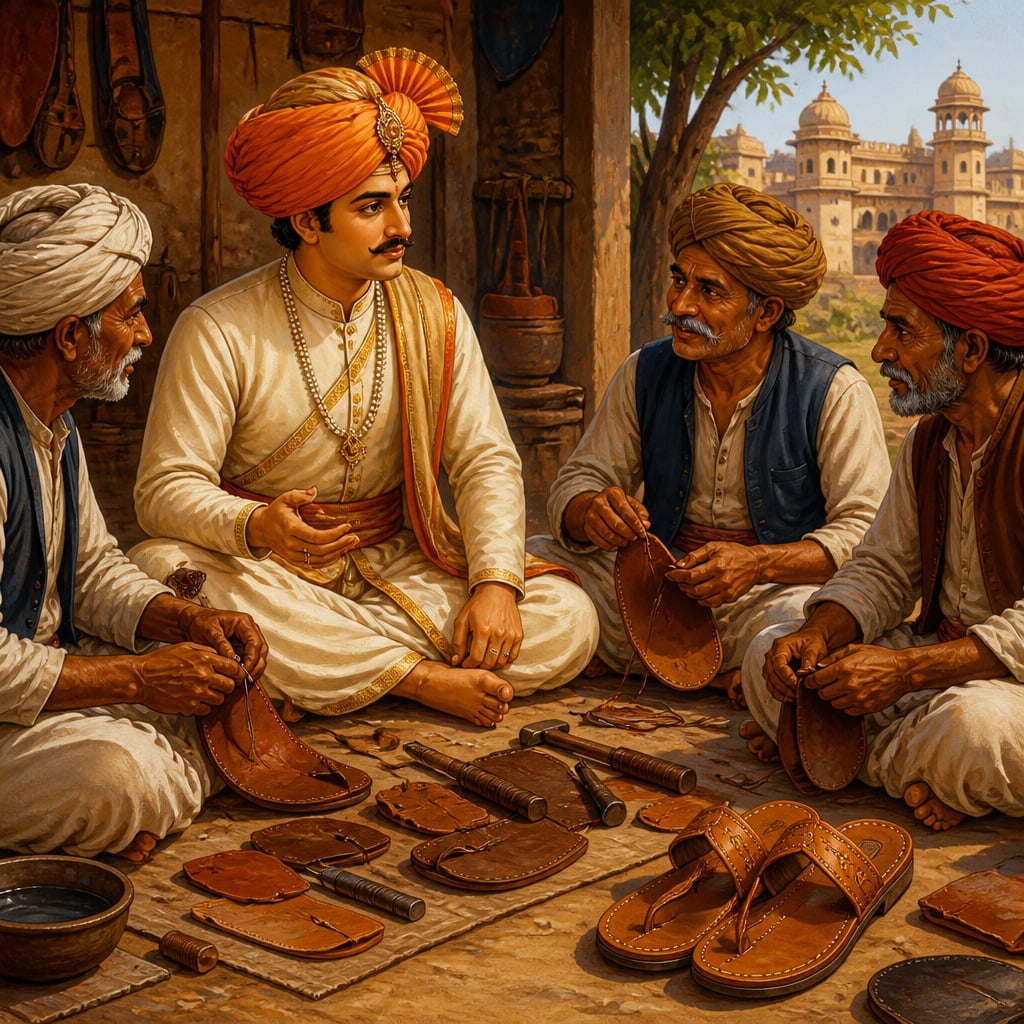
In 1902, the same year he signed the first Reservation Act in Indian history, the young Maratha king Shahu Chhatrapati of Kolhapur began doing something his fellow kings considered unthinkable. He walked into the Charmakar leather workshops of Subhashnagar and sat down on the packed-earth floor next to cobblers while they worked. He watched an old craftsman pull a strip of vegetable-tanned buffalo leather across his knee and stitch it, without nails or glue, into the T-strap of a Kolhapuri chappal. He placed a state order for several hundred pairs. He announced, loud enough that everyone in the lane could hear, that the craft was the pride of his kingdom.
One hundred and twenty-three years later, in June 2025, the Italian fashion house Prada walked a pair of brown leather sandals down a Milan runway for its Spring/Summer 2026 men's show. The sandals were unmistakably Kolhapuri chappals: the braided T-strap, the single-piece sole, the hand-stitched edges. The show notes did not mention Kolhapur. Within forty-eight hours the Maharashtra Chamber of Commerce and the Kolhapur artisan cooperatives had filed formal protests. Within a week Prada had issued a public acknowledgement of the craft and opened talks with Kolhapur cobblers. The Charmakars of Subhashnagar, who had been making these sandals for eight hundred years, suddenly had the world's attention. Shahu Maharaj's old idea, that the craft was the pride of the kingdom, had become, for one news cycle, the pride of the planet.
Two Traditions Under One Word
Indian traditional footwear is not one craft. It is at least two. The Kolhapuri chappal is a flat leather sandal stitched from a single piece of vegetable-tanned hide, still made in the districts around Kolhapur in Maharashtra and across the border in northern Karnataka. The mojari, also called jutti or mojdi, is a curled-toe embroidered slipper covered in gold thread, mirrors, or silk, still made in Jaipur, Jodhpur, Delhi, Amritsar, and Lucknow. They sit on opposite ends of the Indian footwear spectrum. The chappal is a working person's craft descended from village tanneries. The jutti is a court craft descended from Mughal palace workshops. Both are art. Both almost died in the twentieth century. Both are being rebuilt in the twenty-first.
The Kolhapuri chappal is simple on purpose. A pair uses four or five different leathers tanned with the bark of the myrobalan tree, the pods of the babul, and other plant sources. Tanning alone takes three to four weeks. The sole, midsole, and upper are cut from the tanned sheets, stitched together with leather thread, and shaped on a wooden last. There are no nails. There is no glue. There is no metal anywhere in the finished sandal. A single craftsman makes between one and two pairs a day. The chappal is historically unisex and traditionally has no left or right foot. The wearer's foot slowly shapes the leather until each sandal becomes uniquely his or her own.

The mojari is ornate on purpose. Its roots go back to the Persian court, where curled-toe leather shoes were worn by the Achaemenid nobility, and it arrived in India with the early sultanates and then the Mughals. By the sixteenth century, royal workshops in Agra and Delhi were producing juttis embroidered by specialist zardozi craftsmen using silver and gold thread, small mirrors, pearls, and even emeralds for imperial commissions. The technique moved outward from the Mughal court into regional capitals. Jaipur and Jodhpur juttis are known for bold floral zardozi on jewel-toned leather. Lucknow juttis are covered in delicate white-on-white chikan-style thread. Patiala juttis carry heavy gota-patti work at the toe. Every Rajput bride in a photograph from the last hundred years is wearing a pair.
What the Shloka Says
यतः प्रवृत्तिर्भूतानां येन सर्वमिदं ततम्। स्वकर्मणा तमभ्यर्च्य सिद्धिमविन्दति मानवः॥
By worshipping, through one's own work, that One from whom all beings flow and by whom all this is pervaded, a human attains perfection.
Bhagavad Gita 18.46
This is one of the most quoted verses in modern Indian reform literature. Swami Vivekananda cited it to argue that a sweeper sweeping with devotion is performing a rite as sacred as a priest chanting. Mahatma Gandhi quoted it to defend the hand-spinner at the charkha. In the workshop of a Charmakar in Kolhapur, or at the wooden frame of a zardoz in Jaipur threading silver into a jutti upper for six hours at a single sitting, the verse is not abstract. The work is the rite. The pair of sandals is the offering. Perfection, the verse promises, does not depend on whether the world calls the work high or low. It depends on whether the craftsman treats it as worship.
The Paduka as a Seat of Dharma

Classical Indian literature treats the sandal, the paduka, as one of the most charged objects in the religious imagination. In the Ayodhya Kanda of Valmiki's Ramayana, the exiled Rama removes his two golden sandals, places them on the forest ground, and gives them to his younger brother Bharata, who has walked into the wilderness to beg Rama to return and rule Ayodhya. Rama refuses to come back. He sends the paduka in his place. Bharata carries the two sandals on his own head all the way back to Ayodhya, installs them on the empty throne, and rules the kingdom in their name for fourteen years. It is one of the oldest dramatisations in any civilisation of the idea that authority lives in a symbol rather than a person. The symbol the Ramayana chose to represent dharmic rule is not a crown. It is a pair of shoes.
Indian tradition has never treated footwear as disposable. A paduka offered to a guru at initiation, a pair of wedding juttis gifted from a groom to a bride, a Kolhapuri chappal inherited from a grandfather and reshaped by his grandson's foot, all belong to the same cultural idea. Shoes are made by hand, carry a specific person, and become something close to a physical record of the relationship between the maker, the wearer, and the earth underneath.
Why They Almost Died
By the 1970s, cheap mass-produced footwear from Indian and foreign factories had begun to undercut the market for both crafts. Tanneries in Kolhapur shrank as synthetic rubber sandals flooded retail. Jaipur zardozi households moved into tourist-bazaar mojari with mass-printed uppers to survive the season. The Charmakar community, which had long faced social exclusion, found that the formal abolition of untouchability in independent India's 1950 Constitution did not come with market protection for the craft that had defined them. Many traditional families moved out of cobbling entirely within one generation.
The turning point came late. Kolhapuri chappal received its Geographical Indication tag in 2019, after a ten-year dispute between Maharashtra and Karnataka over which state could claim the name. The GI was eventually granted jointly to four districts in Maharashtra and four districts in Karnataka, formalising the legal protection zone across the Deccan. Around the same time, a new wave of India-based premium brands, led by Mumbai-founded Fizzy Goblet (Shilpa Yarlagadda, 2013), began to work directly with jutti and mojari artisans in Jaipur and Rajasthan, paid them two to four times bazaar rates, and sold the finished shoes to urban Indian customers and the Indian diaspora abroad. Kolhapuri cooperatives followed with their own direct-to-consumer lines. The 2025 Prada controversy, at the end of this arc, put global eyes on a craft that had spent its last century fighting simply to be seen.
What the Crafts Teach
A Kolhapuri chappal is a reminder that a good object does not need to be complicated. Four or five vegetable-tanned leathers, one wooden last, one cobbler's needle, one full day of careful work, and no metal at all, will produce a sandal that outlasts a factory shoe using ten times the material and a tenth of the attention. A jutti is a reminder that beauty is not optional, that even a piece of footwear meant to touch dust and dung deserves silver thread, a curled toe, and six hours of embroidery. Put the two crafts side by side and they argue the same point from opposite directions. The lowest-status object in your wardrobe, the thing you stand on and take off at the door, is worth making as carefully as the highest-status object you own.
Back on the packed-earth floor of the Subhashnagar workshop where Shahu Chhatrapati sat down among the cobblers in 1902, the stitching has not stopped. Eight hundred years of Kolhapuri hands, one reforming king, one 2025 Milan runway, and the needle is still moving.
Key figures
Bharata of Ayodhya
The younger brother of Rama in Valmiki's Ramayana, who ruled the kingdom of Ayodhya for fourteen years not in his own name but in the name of Rama's sandals, which he installed on the empty throne after Rama refused to return from exile.
Shahu Chhatrapati of Kolhapur
Maharaja of the princely state of Kolhapur from 1894 to 1922, pioneering social reformer of the Maratha Deccan, and the royal patron who formalised and dignified the Kolhapuri chappal industry.
Shilpa Yarlagadda
Indian designer and entrepreneur who founded Fizzy Goblet in Mumbai in 2013 while still an undergraduate at Harvard, and whose work is credited with reviving the mojari and jutti tradition for urban Indian consumers and the global Indian diaspora.
Case studies
Jaipuri Juttis and Rajput Court Patronage
When Raja Sawai Jai Singh II founded the new city of Jaipur in 1727, he moved the Kachhwaha court from the hill-fortress of Amber into a planned grid city designed on the principles of the Vastu Shastra. Part of the move involved relocating the Kachhwaha royal workshops, the karkhanas, into dedicated craft quarters inside the new walled city. One of those karkhanas was a jutti workshop, inherited from the Mughal zardozi tradition and adapted to Rajput taste. The court required large numbers of embroidered juttis every year for weddings, festivals, state gifts, and diplomatic exchanges with other Rajput houses and with the declining Mughal court in Delhi. A senior jutti master in the Kachhwaha karkhana supervised hereditary cobbler and zardozi families who worked on a single pair for weeks, layering silver thread on red or green leather uppers, curling the toe by hand, and stitching the finished shoe onto a leather sole without any metal fitting.
The traditional Rajput court understood footwear as a diplomatic object. A pair of juttis sent from one royal house to another carried as much meaning as a pair of embroidered shawls or a sword. The craft was sustained by a feudal patronage system in which a hereditary artisan community served a hereditary patron household, and the quality of the work was protected by the fact that the patron's own reputation depended on it. The model was fragile, because the collapse of the patron ended the craft. But for as long as the Rajput court system functioned, it produced some of the finest embroidered footwear ever made anywhere in the world.
The Jaipur jutti tradition survived the absorption of the princely states into the Indian Union in 1947 and the gradual disappearance of the old karkhana system, but it survived in a diminished form, dependent on tourist-bazaar retail rather than royal commissions. The old hereditary families who had served the Kachhwaha court transitioned over two generations into independent cobbler households in the Bapu Bazaar and Nehru Bazaar quarters of the old Pink City. When premium modern brands like Fizzy Goblet arrived in the 2010s, they found a surviving network of several hundred jutti households in and around Jaipur. The twenty-first century revival rebuilt the patron on a new foundation: not a single feudal court, but an urban consumer market with global reach.
Courtly patronage is a powerful way to sustain a high-value craft, but only for as long as the court lasts. The long-term survival of a craft tradition depends on whether the relationship between the artisan and the patron can be rebuilt under new economic conditions when the old conditions disappear. The Jaipur jutti survived because a network of independent cobbler households outlasted the Kachhwaha court by three centuries and could still accept a new form of patron when one arrived.
A full-zardozi bridal jutti from a hereditary Jaipur workshop typically takes six to eight weeks of combined work from a cobbler and one or more zardozi embroiderers, can contain several grams of real silver or gold thread, and is priced today in the range of 8,000 to 40,000 Indian rupees depending on the pattern density. The same pair in the Kachhwaha royal workshop in the eighteenth century would have been paid for by grain and land grants rather than cash.
Shahu Maharaj and the Kolhapur Tanneries
Shahu Chhatrapati came to the throne of the princely state of Kolhapur in 1894, at the age of twenty. By 1902, he had come to a conclusion that almost no other Indian king of his generation was willing to reach: the rigid social practice of his time was a direct cause of their poverty and he would use his royal authority to dismantle it inside his own state. That year he passed a Reservation Order reserving fifty percent of Kolhapur government posts for backward classes, the first affirmative action law in modern Indian history. He also formalised a policy of state patronage for the Charmakar leather-working community of Subhashnagar and the surrounding tanning villages. He subsidised loans for cobbler households, placed standing state orders for Kolhapuri chappals, waived the discriminatory taxes they had paid to previous regimes, and, most radically, personally visited their workshops and sat next to them while they worked. He was photographed eating meals alongside Dalit families. He funded the higher education of Dalit children, including the early studies of Dr B. R. Ambedkar, whom he met in 1920 and whose political career he actively supported.
By the early twentieth century, rigid social practice in much of India had excluded the Charmakar community from the ritual mainstream because their work required them to handle the carcasses of dead animals. The same tradition, however, contained within itself the opposite teaching. The Bhagavad Gita's declaration that any work offered as worship leads to perfection, the Ramayana's treatment of the paduka as the seat of dharma, and the bhakti traditions' celebration of sant cobblers like Ravidas and Chokhamela all provided the philosophical foundation for a king to argue that the caste ban on Charmakars was a betrayal of the deeper tradition. Shahu Maharaj stood squarely inside that alternative reading. His public gesture of sitting next to a cobbler was not a modern liberal act grafted onto an unwilling tradition. It was an older tradition correcting a younger and meaner one.
Shahu Maharaj died in 1922 at the age of forty-eight. His reform programme outlived him. Kolhapur continued to run affirmative action policies through the twentieth century, and the Charmakar leather industry of Subhashnagar survived as one of the few hereditary leather-craft clusters in India that could trace a continuous institutional relationship to a pre-independence royal patron. That institutional memory mattered. When the 2019 Geographical Indication process required evidence of continuous craft tradition in a defined region, Kolhapur had the documentation, the cooperatives, and the community structure to meet the legal standard. The GI was granted jointly to Maharashtra and Karnataka in 2019, covering eight districts, and the decision is in direct historical continuity with Shahu's 1902 policy. Without the king who sat on the workshop floor, it is unlikely the craft would have survived long enough to receive the protection.
A tradition does not survive on its own. It survives because a specific person, usually at significant personal cost, is willing to do the unsymbolic thing that the symbolic tradition pretends to celebrate. The symbolic tradition will say that the cobbler's craft is a form of worship. The person who actually saves the tradition is the one who sits next to the cobbler while he works and orders five hundred pairs. Never confuse the two.
Kolhapur in 1902 became the first state in modern India to legislate fifty percent reservation for backward classes in government posts. The policy precedes the All-India Reservation framework of the 1950 Constitution by forty-eight years and is considered the direct institutional ancestor of Indian affirmative action.
Prada, Milan, and the Kolhapuri Chappal, June 2025
On 22 June 2025, the Italian fashion house Prada walked its Spring/Summer 2026 men's collection at Milan Fashion Week. Among the looks on the runway was a pair of simple brown leather sandals with a braided T-strap, a single-piece sole, and hand-stitched edges. The show notes described them as "leather sandals" and gave no further attribution. Within hours, Indian fashion journalists, craft researchers, and artisan body representatives were circulating side-by-side comparison images on social media showing that the Prada design was indistinguishable from a traditional Kolhapuri chappal. The Maharashtra Chamber of Commerce, Industry and Agriculture filed a formal letter of protest to Prada. The Kolhapur Chappal Cluster, a GI-registered cooperative, issued a public statement. The deputy chief minister of Maharashtra publicly demanded acknowledgement. The news went global within 48 hours and was covered by the BBC, Reuters, Vogue India, and the New York Times.
The traditional complaint about European luxury houses borrowing Indian craft elements without credit is a century old. The Paisley pattern is a Kashmiri boteh. Many silk weaves in Milan are descended from Indian brocades. The old pattern was for the borrowing to happen quietly, with no attribution and no economic reciprocation, and for the Indian tradition to be left out of the commercial benefit. The GI tags, the cooperative structures, and the direct-to-consumer brands of the 2010s and 2020s changed the institutional position of the Indian side. By 2025, Kolhapur had a legal identity, documented provenance, and the ability to mobilise national-level political and media attention within a single news cycle. What was traditionally a quiet extraction had become a public confrontation.
On 28 June 2025, six days after the show, Prada issued a public statement acknowledging that the sandals were inspired by the Indian Kolhapuri tradition, expressed regret at the omission in the show notes, and opened direct communication with the Maharashtra government and the Kolhapur Chappal Cluster. The Italian house subsequently committed to a formal partnership with Kolhapuri cooperatives, including sourcing agreements and a credited collection. The affair became the first global fashion-week controversy in which an Indian traditional craft body successfully defended its identity in real time, without waiting for a legal process or a diplomatic channel. The precedent has been cited by other craft bodies, including the Pashmina cluster of Kashmir and the Banarasi weavers' cooperatives, as a model for future confrontations.
Intellectual property protection for a traditional craft is not only about law. It is about whether the craft community can organise a fast, credible, public response the moment its identity is borrowed without credit. The GI tag is the legal weapon. The cooperative is the political body. The journalists and the diaspora are the amplifier. In June 2025, for the first time, an Indian craft had all three working in parallel, and the effect was visible within a week. The lesson for other craft clusters is that the weapons are available. They have to be organised before the controversy arrives, not after.
The Kolhapuri Chappal GI tag, granted jointly to Maharashtra and Karnataka in 2019, covers four districts in each state: Kolhapur, Sangli, Satara, and Solapur in Maharashtra, and Belagavi, Dharwad, Bagalkot, and Bijapur in Karnataka. The registered cooperatives inside this zone were the legal basis for the 2025 protest against Prada.
Fizzy Goblet and the Direct Artisan Model
In 2013, a second-year Harvard undergraduate named Shilpa Yarlagadda founded Fizzy Goblet from a small studio in Mumbai. She had been struck by the gap between the quality of traditional Indian juttis and their invisibility in modern urban Indian wardrobes. Her thesis was simple: the jutti was not out of date, but the design and distribution were. She travelled to Jaipur and surrounding craft villages, identified hereditary jutti artisan households, and established direct sourcing relationships that paid them two to four times the bazaar rates most tourist shops offered. She then redesigned the traditional jutti upper using contemporary colour palettes, printed leather, modern patterns, and lighter insoles, and sold the finished shoes through an online store and a handful of premium Indian retail outlets. The brand's first collection sold out within weeks. By 2020, Fizzy Goblet was stocked in major Indian cities, at international airport retail locations, and in direct-to-consumer channels reaching the global Indian diaspora.
The traditional jutti tradition had always depended on a patron who could afford to pay a premium. The Mughal court, the Rajput karkhana, and the Sikh nobility all played that role at different moments. When those patrons vanished, the artisans had no one to pay them a fair wage for the real number of hours a hand-embroidered jutti required. Tourist retail filled the gap with mass-produced juttis on printed leather and drove prices down. Fizzy Goblet's innovation was to restore the patron relationship in a new form: the urban consumer as patron, mediated by a brand that could guarantee design quality and fair pricing to both sides. This is the twenty-first century version of a very old arrangement.
Fizzy Goblet has partnered with several hundred artisans across Rajasthan and paid them premiums far above bazaar rates. Its commercial success triggered a wave of similar brands, including Needledust, Paaduks, and several smaller direct-to-artisan labels, all working on the same model of fair-sourced traditional footwear for modern urban buyers. The combined effect has been to rebuild a viable economic base for jutti and mojari artisan households that had been near collapse a decade earlier. Shilpa Yarlagadda has publicly credited the artisans themselves in the brand's marketing and has consistently described the business as a revival partnership rather than a simple retail brand. The model is now cited as one of the clearest examples of how a premium modern brand can strengthen rather than exploit a traditional Indian craft community.
A traditional craft does not need pity. It needs a patron with money, taste, and speed. The twentieth century model of preserving craft through government subsidy and museum display was not enough, because it treated the craft as a dying thing that needed life support. The twenty-first century model, led by brands like Fizzy Goblet, treats the craft as a living business that needs a better market. Both models have their place. The direct artisan model is usually the faster and more durable of the two because it pays the artisan enough to keep their children in the craft.
Fizzy Goblet was founded in Mumbai in 2013 and has grown to supply juttis and mojaris to urban Indian customers and the global diaspora across dozens of countries. Direct artisan brands in the traditional Indian footwear space are collectively estimated to pay premium wages to several thousand hereditary cobbler and zardozi households across Rajasthan, Punjab, and Uttar Pradesh.
Historical context
From Vedic references to charma and paduka through Mughal court mojari, Shahu Maharaj's 1902 reforms, the 2019 Geographical Indication and the 2025 Prada controversy (c. 1200 BCE to 2025 CE)
Indian traditional footwear straddles a cultural fault line that no other craft in this course has to carry. The object is sacred in classical literature: the paduka is the seat of dharmic rule in the Ramayana, the touch of a guru's sandals is the culmination of initiation, and the Bhagavad Gita celebrates any work offered as worship as a path to perfection. The same object is, in traditional Indian social hierarchy, made by the Charmakar, whose work with hides and dead animals had, over time, placed them outside the ritual mainstream of much of India. The tension between the sacredness of the shoe and the marginalisation of the shoemaker is the cultural knot at the centre of Indian footwear. Shahu Maharaj in 1902 was one of the first public figures to refuse the knot by sitting next to the cobbler while he worked. Dr Ambedkar, whose early education was funded by Shahu, continued the refusal. The modern revival of Kolhapuri chappals and mojaris, now dignified by GI tags, premium brands, and global fashion-week controversies, is the long tail of that refusal working itself out in the market.
Living traditions
Kolhapuri Chappal received its Geographical Indication tag in 2019, jointly held by four districts in Maharashtra and four in Karnataka. The legal protection opened a decade of premium cooperative supply into Indian and international retail. Mumbai-founded Fizzy Goblet (2013), Delhi-based Needledust, and several other direct-to-artisan brands built urban markets for mojari and jutti. The June 2025 Prada SS26 Milan controversy, in which the Italian house debuted an uncredited Kolhapuri sandal and was pressured into public acknowledgement within a week, became the first global fashion-week moment in which an Indian traditional craft body successfully defended its identity in real time. Charmakar cooperatives are currently negotiating direct partnerships with several European and American houses as a result.
- Kolhapuri Chappal Making: A Charmakar cobbler in Subhashnagar, Kolhapur begins with raw buffalo or cow hide that has been vegetable-tanned over three to four weeks using the bark of myrobalan, the pods of the babul tree, and other plant sources. He cuts the sole, midsole, and upper from the tanned leather, fits them on a wooden last, and stitches the pieces together with leather thread using a curved cobbler's needle. He shapes the characteristic T-strap or Kapshi braided strap by hand, ties it into the sole through punched holes, and finishes the edges without nails, glue, or any metal fittings. A single pair takes most of a working day. Master pairs for special clients can take two days.
- Jaipur Mojari Making with Zardozi: A jutti maker in Jaipur begins by shaping the leather sole and upper on a wooden last, curling the characteristic pointed toe by hand. The upper is then passed to a zardozi specialist who stretches it on an adda frame, draws the pattern by eye, and embroiders it with real silver or gold thread, mirrors, pearls or gota-patti ribbon. The embroidered upper returns to the cobbler who stitches it onto the leather sole. A fine pair of wedding juttis can involve three or four different specialists and take six to eight weeks from tanned leather to finished shoe.
- Vegetable Tanning and the Charmakar Workshop: Traditional Indian leatherworking uses no chromium and no synthetic chemicals. Raw hides are soaked in pits with myrobalan bark, babul pods, pomegranate rind, and other plant tannins for three to four weeks. The resulting leather is firm, golden brown, and biodegradable, with none of the toxic waste footprint of modern industrial tanning. The Charmakar workshops of Subhashnagar and surrounding villages are among the last large clusters in India still producing this traditional vegetable-tanned leather at scale for a living footwear craft.
- Subhashnagar, Kolhapur: The historical heart of the Kolhapuri chappal tradition. Subhashnagar and its surrounding lanes still house working Charmakar family workshops where pairs are cut, stitched, and finished entirely by hand. Many cooperatives welcome respectful visitors and sell directly from the workshop.
- Bapu Bazaar, Jaipur: One of the most famous jutti markets in India, located inside the walled Pink City of Jaipur. Hundreds of shops stock mojaris ranging from simple daily-wear pairs to full-zardozi wedding juttis. Many of the older shops are supplied directly from hereditary workshops in the surrounding craft villages.
- New Palace Museum, Kolhapur: The former royal residence of the Chhatrapatis of Kolhapur, now a museum. It preserves objects from Shahu Maharaj's reign including documentation of his social reform programmes and photographs of court events honouring master craftsmen of the Charmakar community. A visit here explains why the chappal in his name is one of the most dignified objects in Indian craft.
Reflection
- The Bhagavad Gita's verse 18.46 promises perfection to any human being who worships, through their own work, the source from which all beings flow. What is the work in your life that you are most tempted to dismiss as low, ordinary, or beneath your status? What would change in how you did that work tomorrow if you treated it, for one week, as a rite offered to that source?
- Bharata ruled Ayodhya for fourteen years in the name of Rama's sandals, refusing to make himself the source of authority. What are you currently holding in trust for something or someone larger than yourself? If you treated your own role as the seat-holder for a paduka rather than as the permanent owner of your position, what would you do differently today?
- A Maratha village makes the thing you stand on as carefully as a Rajput court makes the thing you dance in. Name three foundational things in your own life, the things you literally or metaphorically stand on every day, that you have never treated with the care the Kolhapuri tradition treats a chappal. What would it look like to give them that care for a month?