Galicha Kala: India's Carpet & Rug Heritage
Akbar at Fatehpur Sikri
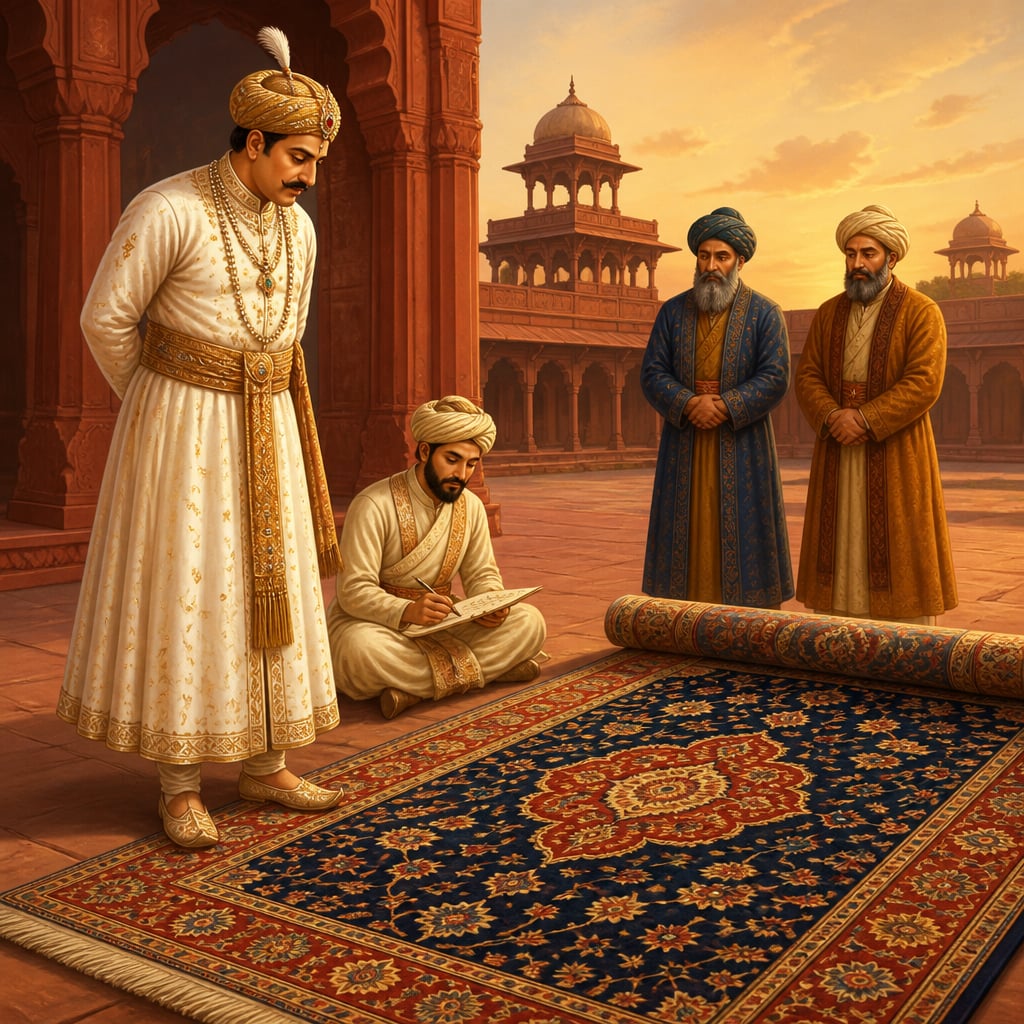
Akbar stands at the edge of the newly laid courtyard at Fatehpur Sikri. It is 1585. Two attendants walk the carpet out before him, holding its ends, and let it drop. The knots catch the afternoon light. The pile is deep wool, the field a burning crimson, the border a chain of lotus medallions in gold and indigo. Thirty Persian master weavers, brought from Herat and Kashan at the emperor's own expense, have spent two years at their looms in the new karkhana he built for them just outside the city.
Akbar is forty-two. He bends down, runs a fingertip across the warp, and feels the count of knots under his thumb. He is a man who can neither read nor write, but he can feel two hundred knots per square inch the way a banker feels the weight of gold. He nods once.
His scribe, Abu'l Fazl, writes a line in his notebook. It will eventually grow into the chapter on Galicha-bafi in the Ain-i-Akbari, the enormous administrative gazetteer that catalogues every workshop in the empire. Four hundred years later, the same knots, copied and recopied through twenty generations of Indian weavers, will cover the floors of Buckingham Palace, the Oval Office, and the Rashtrapati Bhavan banquet hall. None of it would have happened without this afternoon.
Before Akbar: A Kashmir Sultan's Invitation
The story does not actually begin with Akbar. It begins a hundred and fifty years earlier, with Zain-ul-Abidin, the eighth sultan of Kashmir, who ruled the valley from 1420 to 1470. Kashmiri folk memory still calls him Budshah, the Great King. He ended his predecessor's persecution of Hindus, rebuilt destroyed temples, commissioned Sanskrit translations of the Mahabharata and Kalhana's Rajatarangini, and, most consequentially for this lesson, sent envoys to Samarkand and Herat asking for master artisans.
Among those who came back with the envoys were shawl weavers, papier-mache artists, wood carvers, and knotted-carpet weavers from the great Timurid workshops of Central Asia. Zain-ul-Abidin settled them in Srinagar and gave them royal protection. Their skills married with local Kashmiri wool and Kashmiri aesthetics, and by the time Akbar was born in 1542, the Kashmir valley had already been hand-knotting carpets for four generations.

Akbar simply did for the plains what Zain-ul-Abidin had done for the valley. He built royal workshops, karkhanas, at Agra, Lahore and Fatehpur Sikri, imported Persian masters, paid them generously, and let their Indian apprentices carry the tradition forward long after the Persian teachers had gone home.
What Is A Galicha
A galicha is a knotted-pile carpet. That is the technical definition that separates it from a dari, a flatwoven rug without pile. The difference matters because it shapes everything downstream: the tools, the time, the price, the artisan's body.
- The loom. A tall vertical wooden frame. Warp threads, usually cotton, stretched taut from top to bottom. The weaver sits in front of it on a plank that rises by a few inches each day as the carpet grows.
- The knot. The weaver takes a short length of dyed yarn, loops it around two warp threads, pulls it tight, and shears it off with a hooked cutting knife. Persian (Senneh) or Turkish (Ghiordes) knots differ in how the yarn wraps the warp. Indian workshops use both.
- The talim. The pattern is not in the weaver's head. It is chanted. A senior artisan called the talim writer encodes the design into a shorthand of coloured boxes on graph paper, and a singer sits beside the loom calling out the next row of knots in a continuous chant. The weavers' fingers follow the voice.
- The time. A four-by-six-foot wool galicha with a hundred knots per square inch takes one master weaver around six months. A silk Kashmir galicha with nine hundred knots per square inch can take a year or more, sometimes two.
Every carpet is, in the end, a calendar of one person's patience.
The Five Cradles Of The Indian Carpet
India's carpet tradition is a map of five places where the Persian seed grew into something local.
Kashmir is the oldest cradle and, by common agreement, the finest. Srinagar's master weavers still knot silk on silk at densities European collectors cannot quite believe. Kashmiri designs remain closest to the old Kashan and Isfahan prototypes: hunting scenes, tree-of-life fields, arched mihrab forms.

Mirzapur and Bhadohi, adjacent towns in eastern Uttar Pradesh on the Ganga plain, became the heart of the Mughal plains tradition after Akbar and are now the largest hand-knotted carpet cluster on earth. More than half a million weavers work in the belt. Around ninety per cent of India's carpet exports ship from Bhadohi.
Agra produced the heaviest and most sumptuous Mughal court carpets in the 1600s and 1700s. The great surviving Mughal carpets in the Victoria and Albert Museum and the Jaipur City Palace were woven in and around Agra for royal halls and durbar courts.
Jaipur is a newer centre. It was built up across the twentieth century as Rajasthan's maharajas patronised craft revival, and in the last forty years it has become the creative laboratory of Indian carpet design, where contemporary artists and weavers collaborate on pieces now sold through galleries in Milan, London and New York.
Warangal and Panipat do not weave galichas at all. They weave daris: flatwoven cotton rugs, light, washable, often striped in vegetable-dyed blues and reds. The dari is older in India than the knotted carpet. Every middle-class Indian household owned daris long before it could dream of a galicha.
The Scandal And The Recovery
By the early 1990s, the Indian carpet industry was in crisis. Bhadohi had become the world's largest centre, but it had also become one of the world's most shameful labour markets. Journalists and human-rights investigators documented tens of thousands of children, some as young as six, tied to looms in unlit sheds, knotting for twelve hours a day. The exposure was brutal, and it was fair.
The scandal forced change. In 1994 the Rugmark Foundation, now GoodWeave International, launched the first ethical certification label for hand-knotted carpets. Every certified rug carried a numbered tag that traced it back to a specific loom that had been inspected and confirmed free of child labour. European and American retailers began demanding the label. Within a decade the industry had restructured itself.
Three forces worked in parallel.
- Certification. GoodWeave inspected looms, rescued children, funded their schooling, and built a consumer-facing label buyers could trust.
- Ethical brands. Obeetee, a century-old Mirzapur house, and Jaipur Rugs, founded in 1978 by Nand Kishore Chaudhary, rebuilt their supply chains from the ground up to pay weavers fairly and source only from inspected looms.
- Export market recognition. As the certified Indian rug earned its premium, sweatshop economics no longer made sense. Ethics and market finally aligned.
By the 2020s the Bhadohi belt was shipping certified hand-knotted carpets to more than seventy countries and employing over five hundred thousand weavers in a regulated system. Jaipur Rugs alone had grown into a network of forty thousand rural artisans across several states. The children were back in school. The looms were still singing.
Modern Echoes
Akbar at Fatehpur Sikri in 1585 was doing something almost no other Indian ruler before him had attempted on this scale. He was importing a foreign craft, paying foreign masters generously, giving them room and tools and time, and trusting that the local apprentices watching from the back of the karkhana would one day make it Indian. He was right.
The galicha was Persian when it arrived in Kashmir with Zain-ul-Abidin's envoys. It was Persian when Akbar laid it out in his courtyard. But by the time the British East India Company reached Agra, the carpets leaving Indian looms were no longer Persian. They were Indian in their colour sense, their floral vocabulary, their knot, their soul.
Somewhere in Bhadohi right now, a weaver is following a talim chant across his loom, tying knots at the pace of a slow heartbeat. His great-great-great-grandfather tied knots to the same kind of chant under a Mughal governor's inspector. The inspector is gone. The chant is not.
Key figures
Zain-ul-Abidin
Kashmir sultan, founder of the Indian carpet tradition
The eighth sultan of Kashmir, remembered as Budshah (the Great King). He sent envoys to Samarkand and Herat to invite master artisans of the Timurid workshops, and settled the Persian shawl weavers, papier-mache artists, wood carvers and knotted-carpet weavers who returned with them in Srinagar under royal protection. Kashmir's carpet-making tradition, the oldest in India, is the direct result of his policy. Akbar, a century later, copied the model for the Mughal plains.
Akbar
Mughal emperor and patron of the Agra-Lahore karkhana system
Akbar built royal workshops at Fatehpur Sikri, Agra and Lahore in the 1580s, imported Persian master weavers from Herat and Kashan at imperial expense, and put the new karkhanas under direct palace supervision. The Ain-i-Akbari records his personal obsession with carpet quality. Within two generations, Indian apprentices in those karkhanas had absorbed the Persian technique completely, and the Mughal plains tradition of knotted carpets had become a self-sustaining industry that would outlast the empire itself by three hundred years.
Abu'l Fazl
Court historian of Akbar and author of the Ain-i-Akbari
Akbar's closest adviser and the compiler of the Akbarnama and the Ain-i-Akbari, the three-volume administrative gazetteer of the Mughal empire. The Ain-i-Akbari contains the first written catalogue of Indian carpet karkhanas, listing the workshops, the master weavers, the wools and dyes used, and the court's quality standards. It is the single most important primary source for the early history of Galicha Kala in India.
The bunkar weaver communities of the Bhadohi-Mirzapur belt
Hereditary carpet weavers of eastern Uttar Pradesh
The weaver families of the Ganga plain took the Persian technique that Akbar's karkhanas had introduced and kept it alive for four centuries through Mughal decline, British rule, partition, and the near-collapse of the 1990s. Today more than half a million bunkar weavers in the Bhadohi-Mirzapur belt knot approximately ninety per cent of all hand-knotted carpets exported from India. Without their unbroken lineage the Mughal tradition would be a museum object, not a living industry.
Case studies
Akbar's Agra Karkhanas: Importing A Craft For Four Hundred Years
In the 1580s, Akbar faced a problem familiar to every patron of a rising empire. He wanted Persian carpets for his palaces, but the overland caravan trade from Iran was expensive, slow, and politically uncertain. Importing finished goods would drain the treasury for one generation and leave the empire no better off the next. Akbar chose the harder path. He imported the makers.
The Arthashastra instructs a ruler to establish state workshops for every strategic craft and to settle foreign masters inside the kingdom on generous terms so that their skills can be absorbed by local apprentices within a generation. Akbar was not inventing the policy. He was executing Kautilya's advice with Mughal resources, at imperial scale.
Akbar built karkhanas at Fatehpur Sikri, Agra and Lahore, brought Persian master weavers from Herat and Kashan at state expense, paid them well, and placed the workshops under direct palace supervision. Abu'l Fazl catalogued every workshop in the Ain-i-Akbari. Within two generations, Indian apprentices in those karkhanas had absorbed the Persian technique completely. Four hundred years later, the industry is still alive in Bhadohi, Mirzapur and Jaipur, and every hand-knotted carpet made in India today carries a direct lineage back to those 1580s looms.
The most durable way to acquire a foreign skill is not to import its products. It is to import its teachers, pay them well, and give their students time.
c. 1580s: Akbar's karkhanas at Fatehpur Sikri, Agra and Lahore. Catalogued in Abu'l Fazl's Ain-i-Akbari, c. 1590s. Direct lineage to 500,000+ Bhadohi weavers today.
Jaipur Rugs: A Flat Organisation For Forty Thousand Weavers
Nand Kishore Chaudhary founded Jaipur Rugs in 1978 with nine weavers and two looms in a village outside Jaipur. He was working against the grain of the industry. In the 1970s and 1980s, Indian carpet exports were controlled by layered middleman chains that took most of the margin and left rural weavers with subsistence wages. The question Chaudhary set himself was whether a carpet company could be built as a direct, flat relationship between the village weaver and the international buyer, cutting out the middle entirely.
The classical Indian shreni, the craft guild described in the Arthashastra and the Jataka tales, was designed to connect village workshops directly to urban and export markets while protecting the artisan's livelihood. It was a flat, relational structure, not a hierarchy. Jaipur Rugs rebuilt the shreni for the modern era.
Jaipur Rugs has grown into a network of more than forty thousand rural weavers across several Indian states, paying them directly and providing looms, wool, design training, healthcare and schooling support. The company distributes through international design retailers and has received multiple international awards for its supply chain model. The weavers, most of them women, own their looms and work from their own homes on schedules compatible with family life.
Scale and dignity are not opposites. A forty-thousand-person craft company can still pay every maker directly, if the relationship is designed that way from the start.
Founded 1978 in Jaipur. 40,000+ active weavers by the 2020s. Distribution through international design retailers. Weavers mostly women, owning their own looms.
Obeetee: A Century-Old Mirzapur House With A Palace Client List
Obeetee was founded in 1920 in Mirzapur by three British partners (Oakley, Bowden and Taylor, whose initials give the company its name) and has been hand-knotting carpets in the Ganga plain for over a century. In the 1990s, when the Bhadohi child labour scandal threatened the reputation of the entire Indian carpet industry, Obeetee faced a defining choice. It could continue to source from unvetted looms and accept the reputational risk, or it could rebuild its supply chain village by village and accept the cost.
The ancient Indian concept of sreyas, long-term good, set against preyas, short-term pleasure, is the framework for this choice. The Bhagavad Gita and the Kathopanishad both teach that a maker who chooses sreyas over preyas loses in the short run and wins in the long run. Obeetee's decision in the 1990s was effectively a sreyas bet against the market.
Obeetee aligned itself with the Rugmark/GoodWeave certification from its earliest days, rebuilt direct relationships with inspected village looms across the Bhadohi-Mirzapur belt, and invested in weaver welfare programmes. The company's hand-knotted carpets now furnish a long list of palaces, presidential residences and heritage hotels around the world, including Rashtrapati Bhavan in New Delhi. More than a century after its founding, Obeetee is still hand-knotting in the same villages.
A craft brand's oldest asset is trust. Trust is not built in boom years. It is built in scandal years, by the decisions you make when the short-term case and the long-term case disagree.
Founded 1920 in Mirzapur. Over 100 years of continuous hand-knotted carpet production in the Bhadohi-Mirzapur belt. Client list includes Rashtrapati Bhavan and major heritage residences.
Reflection
- Akbar was illiterate, yet he was a fanatical quality inspector of his own carpet workshops. What does that tell you about the difference between literacy and expertise? Where in your own life does expertise come from touch rather than text?
- Zain-ul-Abidin invited foreign artisans and made their craft permanent in Kashmir. Akbar did the same in Agra. Can you think of a foreign practice or skill that should be deliberately invited into India today, the way the Persian loom once was?
- The GoodWeave certification movement in the 1990s tied a hand-knotted carpet's beauty to the question of who made it. Do you think about the maker when you buy a handmade object? What would change in your purchases if you did?