Charma Kala: The Art of Leather Craft
From the tanning vats of medieval Varanasi to the export sheds of modern Kanpur, the story of India's most stigmatised and most underrated craft.
A Shoemaker Who Sang
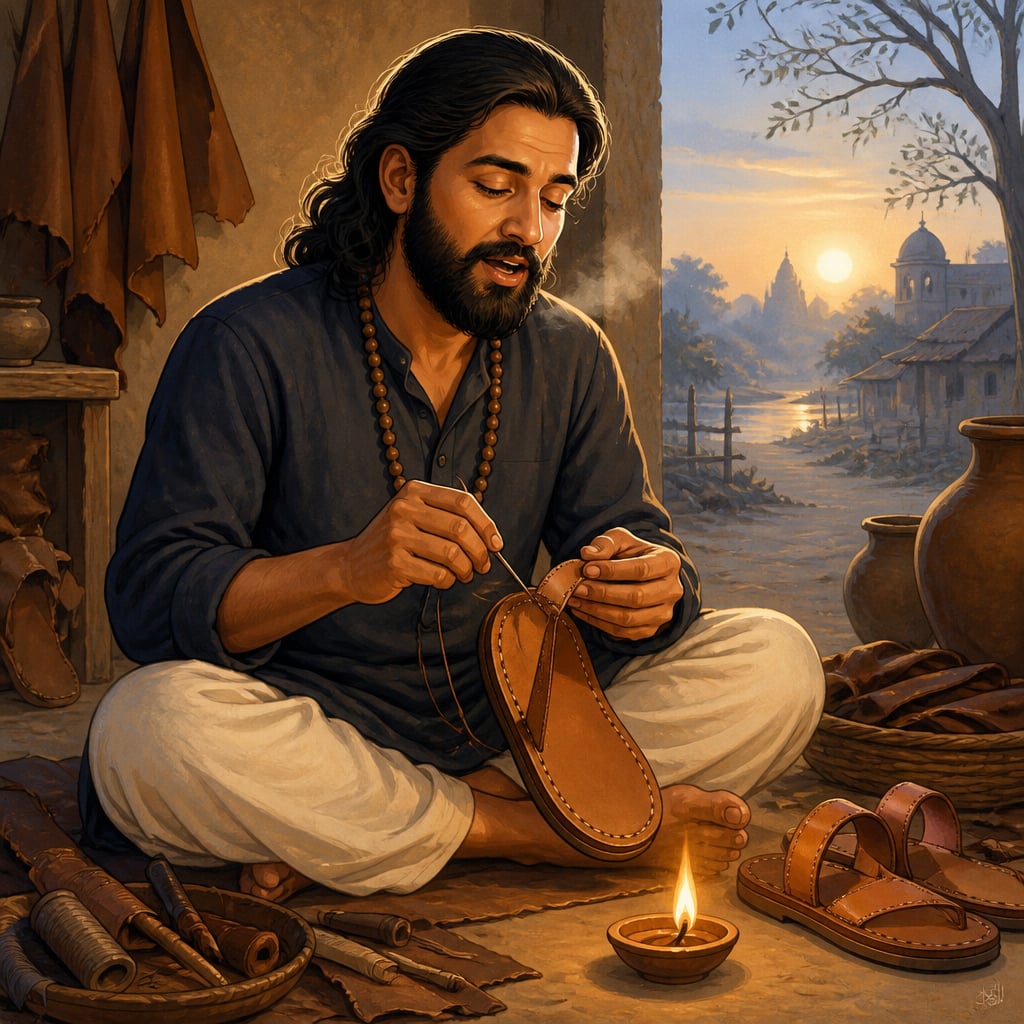
It is a cold winter dawn in Seer Govardhanpur, a small settlement on the southern edge of Varanasi, sometime in the late fifteenth century. A man sits on a low wooden bench in front of his one-room workshop. His name is Ravidas. On his knees lies a strip of buffalo leather, soaked the night before and softened by morning. In his right hand is a thin iron awl. A small bronze bowl of water, kept for softening his jute thread, catches the first light from the east.
Ravidas is making a sandal for a farmer from the next village. The farmer has already paid in a small measure of rice, and he will come back before the sun is high. The work itself is ordinary. Cut the sole, punch the holes, draw the thongs through, trim the edges. Ravidas has done this a thousand times. His fingers do not need to think.
What makes this morning different is the verse forming on his lips. A few Brahmins have stopped on the path outside his workshop. They are watching him. Their faces carry the polite distance that orthodox Varanasi reserved for a charmakara, a leather worker. Ravidas does not look up. Instead, he begins to sing softly. The verse he sings that morning, and hundreds of others like it, will eventually travel far beyond his workshop. Some will be written down. Some will enter the Guru Granth Sahib, the central scripture of the Sikhs. One line, known across north India even today, claims that if the mind is clean, then the Ganga itself flows inside a charmakara's tanning vessel. The sandal in his lap, the awl in his hand, and the verse on his lips are all the same offering.
Why Leather Deserves Its Own Chapter
India's leather tradition is probably the oldest organised craft on the subcontinent. It is also the most stigmatised. For thousands of years, a single practical problem sat at the heart of Indian village life. Every time a cow, buffalo, goat, or sheep died, somebody had to take the hide, clean it, preserve it, and turn it into something useful. That somebody was almost always a charmakara. From the tanning pit came the sandal, the saddle, the water bag, the drum head, the temple book binding, the warrior's shield, the shadow puppet that told the Ramayana at night, and the shoes on the king's feet.
Charma is the Sanskrit word for skin or hide. Charma kala is the art of working with it. This lesson is about that art, about the communities who kept it alive, and about how it survived centuries of religious taboo, colonial exploitation, and modern machine pressure to remain one of India's most important living crafts.
What Tanning Actually Does
A raw animal hide is almost useless. Left alone, it stiffens, rots, and cracks within days. Tanning is the chemical process that turns that hide into leather, a material that is soft, strong, waterproof, and long-lasting. Traditional Indian tanning is what today we call vegetable tanning, because it uses bark, seeds, and plant extracts rather than industrial chemicals.

The basic steps are simple to describe and very hard to do well. The tanner first soaks the hide in water to clean it. He then uses a lime bath to loosen the hair and scrape it off with a curved iron blade. The cleaned hide is washed again, then placed in a series of pits filled with solutions made from babul bark, myrobalan fruit, harda seeds, and other plants. The hide soaks in these tannins for weeks or months. Over time, the plant molecules bind with the proteins in the skin, turning it into leather. After tanning, the hide is oiled, stretched, dried, and finally cut into usable pieces.
The whole cycle takes anywhere from three weeks to six months depending on the leather's intended use. A soft book-binding leather needs different treatment from a hard saddle leather. A thin puppet skin for shadow theatre needs different treatment again. Every traditional tanning cluster in India developed its own recipes, often guarded as family secrets.
The Village Tanner and His Many Products
In a traditional Indian village, the tanner did not make only footwear. He was the village's entire leather economy. The mashak, a buffalo-hide water bag, carried the village's drinking water in regions where clay pots were too fragile. Leather buckets lifted water from stepwells. Buffalo-hide dhol and mridangam drumheads filled the temple courtyard. Harness straps and bridles kept the bullock cart moving. The village priest's palm leaf manuscripts were bound in soft goat leather to keep them flat. Wrestling akhadas used leather thongs to hang punching bags. Even the barber's strop for sharpening his razor came from the same workshop.

Across India, regional traditions specialised. Punjab and Uttar Pradesh became famous for the jutti, the pointed, embroidered leather shoe. Rajasthan developed the mojari and, in its desert districts, the camel-leather lamp and water bottle. South India refined the art of tanning goat skin so thin it could be stretched like parchment for tholu bommalata shadow puppets. Maharashtra gave the country the rugged Kolhapuri chappal. Kerala and Tamil Nadu preserved temple bronze workshops needed the leather bellows used in the lost-wax casting process. In every region, when you scratched the surface of another craft, you found a leather worker standing quietly beside it.
The Sanskrit Word and the Social Weight
Sanskrit texts refer to leather work matter-of-factly. The Rig Veda mentions the hide-worker. Dharmashastra literature lists tanning among recognised village occupations. Ayurvedic texts discuss the medicinal use of charmic oils. Temple architecture manuals explain how leather bellows should be built for blowing the bronze-casting furnace.
But over the centuries, a heavy social stigma attached itself to leather work. Because the craft involved handling dead animals, it was treated as ritually polluting. Communities that specialised in it, including the charmakaras, the chamars of north India, the madigas of the Deccan, and the arundhatiyars of Tamil Nadu, were excluded from the social mainstream and denied the dignity their craft deserved. This is one of the saddest contradictions in Indian craft history. The communities who made the king's shoes were not allowed to walk into the temple wearing them.
It is inside this contradiction that voices like Sant Ravidas grew. He was a charmakara who refused to see his workshop as impure. He sang instead of a clean mind making the Ganga flow inside a tanning vessel. Centuries later, Dr. B. R. Ambedkar would complete the argument in constitutional language, and the Indian Republic would abolish untouchability in 1950. But the craft itself had already survived every insult that history had thrown at it, because families kept tanning, kept stitching, and kept passing skill from parent to child.
The Colonial Break
The nineteenth century changed Indian leather forever. The British army needed vast quantities of boots, harnesses, saddles, belts, and cartridge pouches. In 1863, the British opened the Government Harness and Saddlery Department in Kanpur, a Gangetic town with plenty of hides, fresh water, and cheap labour. Over the next few decades, Kanpur filled up with private tanneries. The scale was something no pre-colonial Indian city had ever seen. Tens of thousands of hides moved through Kanpur's pits every month. The craft shifted from small village pits with babul bark to large factory sheds that slowly adopted industrial chrome tanning from the early twentieth century onward.
This colonial industrial system created jobs but it also broke older village economies. Village tanners found it harder to sell their slower, more careful work against cheap factory leather. Many charmakara families moved from independent craft into wage labour inside tannery sheds. The craft did not die, but it was restructured, and the wealth of the industry flowed far above the communities who actually turned hide into leather.
Kanpur Today and the Clean-Ganga Question
Kanpur is still India's largest leather city, exporting finished leather, saddles, and products to more than fifty countries. But it now carries another heavy burden. Tannery effluents, especially from chrome tanning, have been a major source of pollution in the Ganga river. In the last decade, the government has forced Kanpur tanneries to close during major religious gatherings, to install effluent treatment plants, and to relocate some units away from the river. Every solution creates a new debate. Thousands of families depend on the tanneries for work. The river depends on the tanneries shutting down. No one has yet found a clean answer that honours both sides.
The Hidesign Counter-Story
In 1978, a young man named Dilip Kapur set up a small workshop in Auroville, just outside Pondicherry in Tamil Nadu. He wanted to revive traditional vegetable-tanned leather and turn it into contemporary bags, belts, and accessories for a global audience. His brand, Hidesign, is now sold in over twenty countries. It became the first Indian leather brand with genuine international shelf presence, and it quietly proved something important. Indian leather, tanned slowly with plant extracts and stitched by hand, could compete with European luxury leather on quality. The Hidesign story shows that the craft does not have to choose between chrome-tanned mass production and village-scale poverty. A third path exists, built on patient tanning, well-paid artisans, and design respect for the material.
What You Carry Home
The next time you buckle a belt, slip on a sandal, or open a leather-bound book, remember that you are handling a material with one of the longest, most troubled, and most creative histories in India. Leather is the Ramayana told by a goatskin shadow at night, a bhakti verse sung over an awl in Varanasi, a British army boot sewn in Kanpur, and a carefully oiled Hidesign bag sold in a Paris boutique. All of it is charma kala. And all of it is the quiet work of Indian hands that have been refusing to let the craft die for more than three thousand years.
Key figures
Sant Ravidas
A charmakara from Seer Govardhanpur near Varanasi who became one of the most important bhakti saints of north India. Ravidas composed devotional verses in a simple Hindi dialect while working at his leather bench. Forty-one of his compositions were later included in the Guru Granth Sahib, the central scripture of the Sikhs. His teaching that a pure heart makes the Ganga flow inside a tanning vessel gave generations of leather workers a language of dignity.
Dilip Kapur
The founder of Hidesign, the Pondicherry-based leather goods brand started in 1978. Dilip Kapur built India's first globally-retailed leather label by insisting on vegetable-tanned leather, traditional stitching techniques, and a commitment to artisan employment. His work helped prove that Indian leather craft could compete directly with European luxury brands at the same quality tier.
Dr. B. R. Ambedkar
The chief architect of the Constitution of India and the most important twentieth-century voice for the dignity of the charmakara, mahar, and other communities historically stigmatised through leather and hide work. Ambedkar's legal and political work culminated in the abolition of untouchability in Article 17 of the Indian Constitution in 1950, a decisive break with centuries of social exclusion that had attached itself to the leather craft.
Case studies
Sant Ravidas and the dignity of the tanning vessel
Sant Ravidas, born in the fifteenth century at Seer Govardhanpur near Varanasi, was a charmakara who spent his working life at a leather bench making sandals for local villagers. Varanasi at that time was a stronghold of ritual orthodoxy, and charmakaras were treated as ritually polluting. Ravidas did not leave the craft. He continued to tan hides, cut leather, and stitch sandals while composing devotional verses in a simple Hindi dialect. His verses argued that God lives in a pure heart rather than in ritual status, and they often used his own craft for metaphor. One of his most famous lines claims that if the mind is clean, then the Ganga itself flows inside the charmakara's tanning vessel. Over time, his verses spread across north India through bhakti singing traditions, and forty-one of them were later incorporated into the Guru Granth Sahib, the central scripture of the Sikhs.
India's craft traditions are not only technical. They carry their own philosophies about work, caste, and devotion. Sant Ravidas is one of the clearest examples. He did not run from the leather bench. He did not ask to be reborn as a priest. Instead, he insisted that his charmakara workshop was already a holy place because his mind was clear inside it. That insistence was a quiet revolution, because it moved spiritual value out of the temple and into the hands of the worker. The lesson for us is that Indian craft traditions have their own internal theologies of dignity, and we should read them as seriously as we read the scriptures of the Brahmin priesthood.
Ravidas is today revered as one of the founding saints of the Ravidassia religious tradition and is honoured across Sikh, Hindu, and Dalit communities. His birthplace at Seer Govardhanpur in Varanasi is a major pilgrimage site, and his verses remain in daily recitation across north India, giving Indian leather craft a spiritual voice that has outlived every stigma attached to it.
Before any constitution or law could protect the charmakara, a working leather craftsman sang his own dignity into Indian scripture. Devotional literature can carry social reform more deeply than any policy document.
Forty-one compositions of Sant Ravidas are preserved in the Guru Granth Sahib, making him one of the most scripturally honoured leather-working saints in world religious history.
Tholu Bommalata and the leather shadow theatre of Andhra
The villages of Andhra Pradesh and Telangana have practised the leather shadow puppet tradition known as Tholu Bommalata for centuries. The word itself means the dance of leather dolls. A Tholu Bommalata family prepares each figure from goat or deer skin by scraping it until it is thin enough to let light through, then cutting the outline of a character with a small chisel, and finally painting it in vivid natural pigments, usually red, yellow, black, and green. A full troupe carries dozens of figures representing characters from the Ramayana, the Mahabharata, and regional stories. At night, the puppeteers set up a large white cloth in a village courtyard, light oil lamps behind it, and manipulate the figures while chanting the story and singing devotional songs. A single performance can last from dusk to dawn and draws the entire village.
Most Indians think of leather as footwear, saddles, or bags. Tholu Bommalata shows us another face of charma kala. Here the leather is the stage itself. A translucent goat skin, painted in vivid natural pigments, becomes the body of Rama, Sita, Hanuman, or Ravana. Held between an oil lamp and a white cloth, the figure throws a moving coloured shadow that the whole village watches for a full night. The Andhra puppeteer is simultaneously a tanner, a painter, a storyteller, and a priest of the Ramayana. This is a powerful reminder that Indian crafts rarely stay inside neat categories. A single goat skin, tanned and painted with care, can carry the weight of an entire epic tradition.
Tholu Bommalata is now recognised as a protected folk art form of Andhra Pradesh and Telangana. Although the number of practising families has dropped sharply in the television era, state cultural boards, UNESCO-linked folk arts programmes, and urban festivals have helped the craft survive. Contemporary troupes are also being invited to perform at museums, design festivals, and international cultural events.
When leather is treated as a storytelling surface instead of a product, it carries epic literature, village memory, and spiritual imagination together. Losing Tholu Bommalata would mean losing a whole way of transmitting the Ramayana at night, not just losing a craft.
A full Tholu Bommalata troupe may carry more than fifty individually prepared and painted leather puppets, each one hand-tanned and hand-cut, and a single all-night performance can last eight hours or more.
Hidesign and the vegetable-tanned comeback
In 1978, Dilip Kapur, a young man raised in Auroville near Pondicherry, set up a small leather workshop after returning from studying abroad. He was committed to using only vegetable-tanned leather, the traditional Indian process that uses plant tannins instead of chrome chemicals. He trained local artisans in hand stitching, edge finishing, and hardware assembly, and he designed bags and accessories aimed at a contemporary urban audience rather than a tourist souvenir market. The brand he founded, Hidesign, slowly grew from a single Pondicherry workshop into a national retail chain, and then into an international brand with stores in the United Kingdom, Europe, Australia, and Asia. At every stage, Hidesign kept its commitment to vegetable tanning, hand stitching, and artisan employment, positioning itself as proof that India could build a global leather brand on traditional values.
For most of the twentieth century, the Indian leather story was told as a simple binary. Either you bought slow, stigmatised village leather or you bought cheap factory leather. Hidesign added a third option. Dilip Kapur saw that Indian vegetable tanning, stitched by hand and designed with contemporary taste, could stand next to European luxury labels. He did not try to compete on price. He competed on patience, smell, grain, and ageing. That choice put Indian craft values at the centre of a modern global brand. The lesson for us is that traditional Indian processes are not nostalgia. They can be the foundation of a serious contemporary business, provided we believe in the material enough to design around it.
Hidesign today operates across more than twenty countries, and it is widely credited as the first Indian leather brand to achieve a genuine international retail presence. It has also become a case study in Indian design schools for how traditional craft processes can scale into a contemporary business without abandoning the techniques that gave them meaning.
Traditional Indian processes, when treated as a quality asset rather than a cost, can compete at the top of global markets. The craft does not need to be simplified for the modern buyer. The modern buyer needs to be educated about the craft.
Hidesign was founded in 1978 as a single workshop and now retails in over twenty countries, making it one of the oldest and most internationally present craft-led leather brands to emerge from independent India.
The Kanpur cluster and the Ganga question
Kanpur in Uttar Pradesh has been India's largest leather manufacturing cluster since the British opened the Government Harness and Saddlery Department there in 1863. Over the twentieth century, the Jajmau area along the Ganga filled up with hundreds of private tanneries processing buffalo and cow hides for the export market. Kanpur's saddles, shoes, belts, and finished leather now ship to more than fifty countries, and the cluster provides livelihoods to hundreds of thousands of workers, many from communities with historic ties to leather craft. But the same cluster has also become one of the biggest sources of chromium and organic pollution in the Ganga. In the last decade, the National Green Tribunal and state governments have forced partial closures during major religious gatherings such as Kumbh Mela, required tanneries to install effluent treatment plants, and begun relocating some units away from the river. The debate is ongoing and often bitter. Workers fear losing jobs. Pilgrims and ecologists demand clean water. Exporters demand policy stability.
Indian craft history is not always a gentle story of families and gurus. Sometimes it is a hard story about scale, labour, and pollution. Kanpur is the clearest example. A colonial industrial decision in 1863 reshaped Indian leather forever. Today, the same cluster that feeds export orders to fifty countries also pumps effluent into the holiest river in Hindu imagination. This contradiction is not easy to resolve. Thousands of working families depend on the tanneries for their daily livelihood. The Ganga depends on the tanneries cleaning up or shutting down. Traditional Indian thought teaches that work must honour life, including the life of the river. The Kanpur cluster is where that teaching is being tested in real time, and our generation has a duty to pay attention.
The Kanpur leather cluster remains India's biggest leather hub and continues to operate under tightened environmental regulation. Several tanneries have adopted partial water recycling and switched portions of production to vegetable tanning, but a long-term balance between export scale, worker livelihood, and Ganga ecology has not yet been fully achieved.
A craft economy built during the colonial period carries colonial debts into the present. Modern India has to rebuild Kanpur without either destroying its workers or destroying its river, and that task is as much a moral problem as an engineering one.
Kanpur houses several hundred tanneries and exports leather products to more than fifty countries, while also being one of the most studied industrial pollution sites along the Ganga river.
Living traditions
- Vegetable tanning with babul bark
- Tholu Bommalata puppet making
- Kanpur industrial leather finishing
Reflection
- Sant Ravidas kept working at his leather bench even as his verses made him famous across north India. What does his choice tell you about the relationship between spiritual life and daily work?
- Vegetable tanning is slow and less profitable but cleaner and more durable. If you had to choose leather goods for your own home, would you pay more for a slower, traditional process? Why or why not?
- India's leather industry today must balance export jobs with environmental protection of the Ganga. If you had to advise a government committee, how would you weigh these two concerns against each other?