Kashmir Carpets: Knotted Dreams of the Valley
A six-hundred-year-old hand-knotted carpet tradition that a Kashmiri sultan imported from Persia in the 1440s, that Mughal emperors collected in their karkhanas, that almost died in the 1990s, and that a British textile historian named Jenny Housego walked back into a Srinagar courtyard to rebuild in 1998.
The Kashmir hand-knotted carpet tradition is one of the oldest and finest in the world. It was founded in the 1440s when Sultan Zain-ul-Abidin (remembered in Kashmir as Budshah, the Great King, reigned 1420 to 1470) invited Persian and Central Asian master weavers from Samarkand, Bukhara, and Herat to settle in Srinagar on the banks of the Jhelum river. Within a generation Kashmir had its own hand-knotted carpet industry, built on Ladakhi wool, valley walnut and madder dyes, and the Persian ghiordes knot. Under the Mughal emperors Akbar and Jahangir in the sixteenth and seventeenth centuries, the Srinagar workshops produced some of the finest silk carpets in the world, pieces of which now hang in the Jaipur City Palace, the Victoria and Albert Museum in London, and the Metropolitan Museum of Art in New York. Kashmir's signature contribution to the Persian-rooted tradition is the talim, a coded script in which every knot of a carpet is notated, chanted out loud by a designer called the naqash, and tied by weavers who work in rhythm like an orchestra following a conductor. The tradition almost died in the 1990s under the pressure of insurgency, tourist collapse, and a flood of Iranian and Chinese machine-made imitations. In 1998, the British textile historian Jenny Housego and the Kashmiri textile producer Asaf Ali founded Kashmir Loom Company in Srinagar, which rebuilt the craft at the highest level of quality for the global design market. In 2008, Kashmir hand-knotted carpets received a Geographical Indication tag from the government of India. This lesson walks into a Srinagar courtyard workshop in 1998, back to Budshah's court in the 1440s, and forward again to the looms still working on the banks of the Jhelum today.
A Courtyard in Srinagar
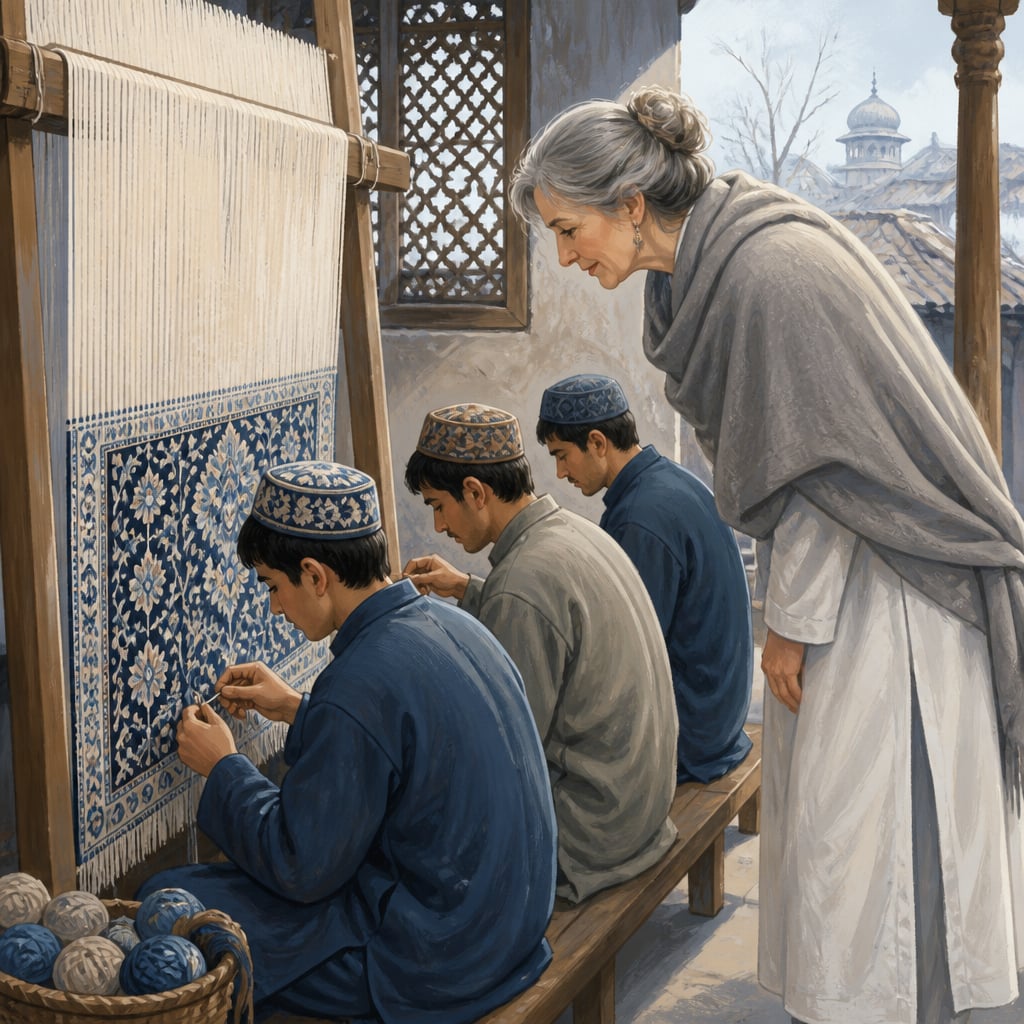
On a grey morning in 1998, in a courtyard workshop in the old quarter of Srinagar, Jenny Housego bent over a wooden frame loom and watched a master weaver tie the first knot of a new pashmina carpet. Rain pattered on the tin roof. The workshop smelled of wet wool, walnut dye, and woodsmoke from the kangri braziers the weavers kept near their feet. Housego was a British textile historian in her late fifties. She had spent decades studying tribal rugs across Iran, Afghanistan, and Central Asia, and she had walked into Srinagar because she wanted to see whether one of the oldest hand-knotted carpet traditions in the world was still alive. It was. Just. The workshop had seven looms. Five were empty. The two that were working belonged to a family whose grandfather had woven for the Jaipur court. Housego and her co-founder, a Kashmiri textile producer named Asaf Ali, were about to spend the next twenty years trying to keep that family and several dozen others at their looms.
A Sultan Brings The Weavers In
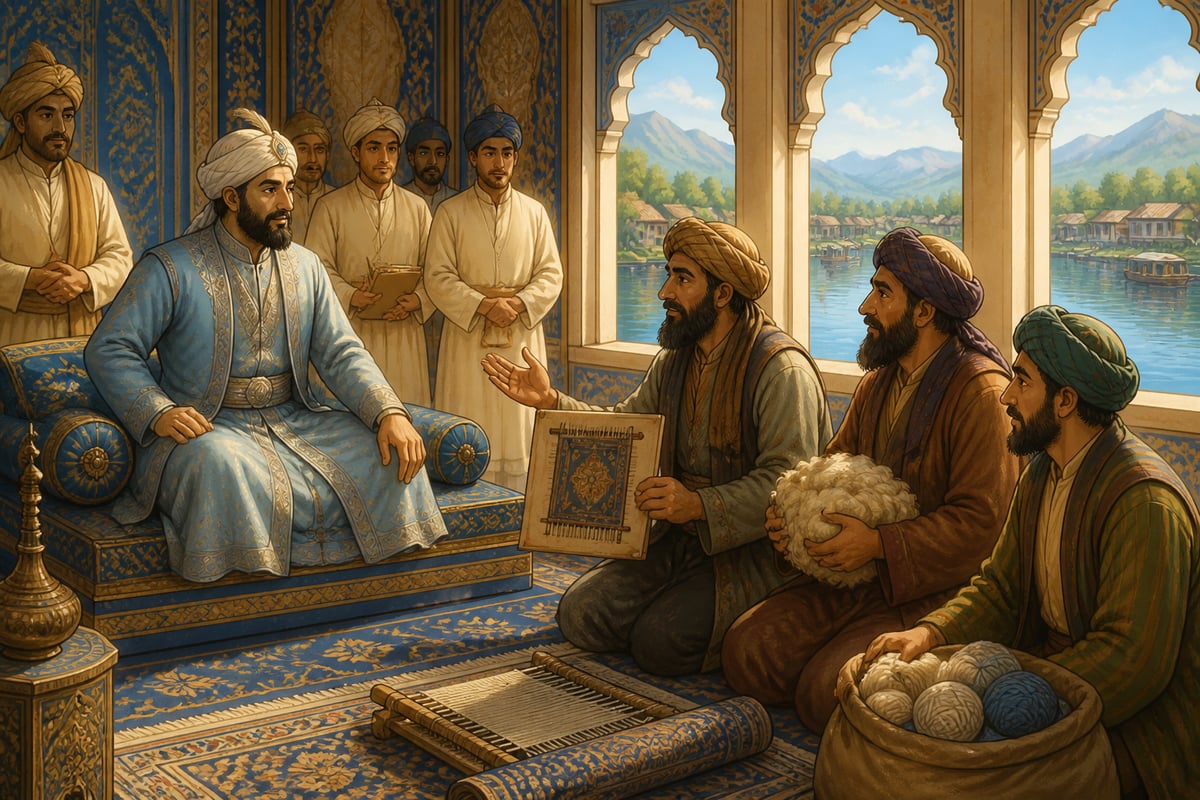
The story of Kashmir carpets begins almost six hundred years earlier, with a Kashmiri sultan who is still remembered in the valley as Budshah, the Great King. Sultan Zain-ul-Abidin ruled Kashmir from 1420 to 1470, fifty years of peace, reform, and craft-building in a valley that had been wrecked by earlier invasion and famine. Budshah invited master artisans from Persia and Central Asia to settle in Srinagar: paper-makers from Samarkand, shawl weavers from Turkestan, tile-workers from Kashan, and carpet-weavers from Bukhara, Khorasan, and Herat. The Persian weavers he brought to Srinagar set up their first looms on the banks of the Jhelum river and began teaching young Kashmiris the Persian technique of the ghiordes and senneh knots. Within a generation, Kashmir had its own hand-knotted carpet industry, built on the wool of Ladakhi sheep, the water of the Jhelum, and the dyes of the valley's walnut, madder, and saffron fields.
The Talim: A Carpet As Sheet Music

Kashmir's signature contribution to the Persian-rooted knotted carpet tradition is not a motif or a colour. It is a notation system called the talim. A talim is a coded script, written on long strips of paper, in which every single knot of the finished carpet is marked by a character that specifies its colour and its position in the row. A talim for a full-sized carpet can run to several hundred pages. During the weaving, a single designer called the naqash sits at the head of the workshop and chants the talim out loud. The chant is rhythmic, sung, and pitched like a slow prayer. The weavers at their looms knot as they hear the instructions: two red, one blue, one ivory, three red, one gold. The talim turns the carpet into sheet music. The naqash is the composer and the conductor. The weavers are the orchestra.
No other hand-knotted carpet tradition in the world uses this system. In Persia, the designer draws a full-size graph-paper cartoon and the weavers read it visually. In Turkey, the designer sits next to the loom and points. Only in Kashmir is the entire design held as a chanted score, passed through the ears of the weavers, and knotted in rhythm to a human voice.
The Mughal High Point
By the reign of Akbar (1556 to 1605), the Kashmir carpet had become a Mughal court object. Akbar built an imperial karkhana in Lahore and another in Agra, and he used Kashmir's wool and dye traditions as the raw material base for his most prestigious commissions. His son Jahangir (1605 to 1627) was in love with Kashmir and spent his summers there. Jahangir ordered large silk carpets with naturalistic flower and animal designs from Kashmiri workshops, and several of those carpets still survive in the collections of the Jaipur City Palace, the Victoria and Albert Museum in London, and the Metropolitan Museum of Art in New York. The finest Mughal-era Kashmir silk carpets had knot counts of a thousand or more per square inch. A single carpet could take four or five weavers three years to complete. By the seventeenth century, Kashmir was making some of the finest hand-knotted carpets anywhere on earth.
Decline And Endurance
The eighteenth and nineteenth centuries were hard on the valley. Afghan and Sikh invasions disrupted the workshops. The Kashmir shawl industry absorbed much of the valley's best weaving talent, because a fine pashmina shawl could earn in a month what a carpet took a year to earn. British colonial buyers preferred the cheaper Amritsar carpets and the mill-woven Persian-style rugs of the Bokhara trade. By the early twentieth century, the Srinagar workshops were surviving on small orders from Indian princely states and on British tourist buyers who arrived on house-boats in the summer. Production continued, but barely.
The post-independence decades added new shocks. The 1947 partition cut off the old trade routes through Lahore and Amritsar. The 1965 and 1971 wars disrupted exports. The insurgency that began in 1989 drove foreign buyers out of Srinagar for more than a decade. By the mid 1990s, the carpet workshops of the old city were smaller, poorer, and fewer than they had been in centuries. This was the valley Jenny Housego walked into in 1998.
Kashmir Loom And The Global Turn
Kashmir Loom Company was founded in 1998 by Jenny Housego and her Kashmiri partner Asaf Ali, a producer whose family had been in the Srinagar textile trade for generations. Housego brought her scholarly eye for historical rug design, her international network of museum curators and collectors, and her insistence on natural dyes, hand-spun yarn, and authenticated talim scripts. Ali brought the weaver relationships, the workshop infrastructure, and the quiet patience that running a business in Kashmir requires. The company rebuilt old Mughal-era carpet designs from museum photographs, commissioned new designs from contemporary artists, and sold through design galleries in London, New York, Milan, and Paris.
By the 2000s, Kashmir Loom carpets were on the floors of the world's most serious private collectors, on the walls of museum exhibitions, and in the pages of international design magazines. The company's work became the reference point for what a contemporary hand-knotted Kashmir carpet could look like at the highest level of the craft. Other Srinagar workshops began imitating the Kashmir Loom approach, which quietly raised the quality floor for the entire valley. A returning scholar and a local producer had turned two working looms into a functioning global craft.
The GI Tag And The Fight Against Fakes
In 2008, Kashmir hand-knotted carpets received a Geographical Indication tag from the government of India. The tag was meant to protect the real Srinagar product against a rising flood of cheap imitations: Iranian machine-loomed carpets trimmed to look hand-knotted, Chinese tufted rugs finished with Kashmiri-style fringes, and Indian mill products labelled as Kashmiri at the point of sale. The fight is not yet won. Walk into any tourist carpet shop on the Jhelum today, and at least half the pieces on display were not knotted in Srinagar. But the GI tag gave the real artisans a legal footing. Organisations like Kashmir Loom Company and the Indian Institute of Carpet Technology in Srinagar have continued to insist on verifiable knot counts, documented dye sources, and authenticated talim scripts. A carpet that has all three is the real thing. A carpet that has none is a souvenir pretending to be one.
The Loom Of The Gods
यो यज्ञो विश्वतस्तन्तुभिस्तत एकशतं देवकर्मेभिरायतः। इमे वयन्ति पितरो य आययुः प्र वयाप वयेत्यासते तते॥
yo yajño viśvatas tantubhis tata ekaśataṁ devakarmebhir āyataḥ ime vayanti pitaro ya āyayuḥ pra vayāpa vayety āsate tate
The sacrifice is stretched out on every side with threads, drawn out by a hundred and one divine acts. These Fathers who have come weave it. They sit beside the stretched warp and call: weave forward, weave back.
Rig Veda 10.130.1
The oldest Indian image of the universe is a woven fabric on a loom. Rig Veda 10.130 treats the whole of sacrificial action as a carpet being knotted by the ancestors, with the gods chanting the design out loud and the priests tying the knots to the rhythm of the chant. A Kashmir carpet workshop in Srinagar is three thousand years younger than this hymn, but the structure is identical. The naqash chants the talim. The weavers tie the knots. The carpet grows one row at a time, a hundred and one divine acts at a time, on a wooden frame of Himalayan walnut wood. The Vedic image is not a metaphor for the Kashmir carpet. The Kashmir carpet is an instance of the Vedic image.
Step back into the courtyard workshop in downtown Srinagar today, and Jenny Housego is no longer there in person. She stepped back from Kashmir Loom's day-to-day work in the 2010s and passed away in 2021. The looms she saw working in 1998 are still working, and more of them are working now than were working then. The family whose grandfather wove for the Jaipur court still has a son at a loom in the old city. Somewhere in that workshop, a naqash is chanting a talim for a new pashmina carpet, the weavers are tying knots in rhythm to the chant, and a three-thousand-year-old hymn is being worked out one knot at a time on a frame of walnut wood beside the Jhelum.
Key figures
Sultan Zain-ul-Abidin (Budshah)
The Shah Mir sultan of Kashmir, reigned 1420 to 1470, remembered in Kashmir valley tradition as Budshah, the Great King. He is one of the most important rulers in Kashmir's history and one of the most successful craft-building kings in medieval South Asia. His fifty-year reign was a period of peace, religious tolerance, agricultural recovery, and active state patronage of arts and crafts. He invited master artisans from Persia and Central Asia to settle in Srinagar and set up workshops along the Jhelum, including paper-makers from Samarkand, shawl weavers from Turkestan, tile-workers from Kashan, and the carpet-weavers from Bukhara, Khorasan, and Herat who founded the Kashmir hand-knotted carpet tradition.
Jahangir
The fourth Mughal emperor, Nur-ud-din Muhammad Salim Jahangir, reigned 1605 to 1627. He was the son of Akbar and the father of Shah Jahan, and the most personally devoted of all the Mughal emperors to the Kashmir valley. He spent his summers in Srinagar and famously said of Kashmir that 'if there is paradise on earth, it is this, it is this, it is this.' He was also a serious connoisseur of painting, metalwork, jewellery, and carpet-weaving, and kept detailed accounts of his craft commissions in his Tuzuk-i-Jahangiri memoir.
Jenny Housego
British textile historian and rug scholar, 1940 to 2021. Housego was one of the most respected Western specialists on the tribal rug traditions of Iran, Afghanistan, and Central Asia, and author of the standard scholarly introduction 'Tribal Rugs' (Scorpion Publications, 1978). In 1998, after decades of field research across the wider Persian-rooted carpet world, she walked into Srinagar, saw the state of the surviving workshops, and co-founded Kashmir Loom Company with the Kashmiri textile producer Asaf Ali. Over the next twenty years she worked closely with Srinagar master weavers to rebuild old Mughal-era carpet designs, insist on hand-spun yarn and natural dyes, and reach international museum-grade collectors and design galleries through her network in London, New York, and Milan.
Case studies
Sultan Zain-ul-Abidin and the 1440s Importation of Persian Weavers to Srinagar
In the early fifteenth century, the Kashmir valley was recovering from a period of invasion, famine, and political instability. The Shah Mir dynasty had taken over the valley in 1339, and the first decades of its rule had been turbulent. In 1420, a young Shah Mir prince named Zain-ul-Abidin inherited the throne. He would reign for fifty years, until 1470, and his reign would later be remembered in the Kashmiri tradition as the golden age of the valley. Zain-ul-Abidin was a reformer, a religiously tolerant king who protected the local Hindu Pandit community alongside the Muslim majority, an agricultural improver who rebuilt the irrigation canals, and the most active craft-building ruler in medieval Kashmir's history. He is still remembered in the valley as Budshah, the Great King. In the 1440s, he began systematically inviting master artisans from Persia and Central Asia to settle in Srinagar. The list of disciplines he imported is long: paper-makers from Samarkand, shawl weavers and carpet weavers from Bukhara, Khorasan, and Herat, tile-workers from Kashan, bookbinders and calligraphers, wood carvers for the Khanqah shrines, and metal workers. He set up workshops for them on the banks of the Jhelum, paid them from the royal treasury, and gave them apprentices from the local Kashmiri population. Within a generation, all of these crafts had taken root in the valley, and Kashmir had a craft economy that would sustain the region for the next six hundred years.
Zain-ul-Abidin's 1440s programme is one of the clearest examples in Indian history of the silpa-shastra and Arthashastra principle that a king who wants a craft to take root in his territory must bring the masters, give them institutional security, and build the teaching channel in which they can train local apprentices. The medieval Indian craft texts are very specific about this. A king who merely imports the finished product has only a market. A king who imports the masters and sets up workshops has a tradition. Budshah followed the second path, and the result is visible six hundred years later in every Srinagar courtyard workshop that still has a working loom. The Arthashastra also emphasises that the patron must protect the artisan community from disruption, and Budshah's fifty-year reign of peace, religious tolerance, and agricultural recovery provided exactly the stable ground that the imported weavers needed to teach and transmit.
The carpet weavers Budshah imported from Bukhara, Khorasan, and Herat in the 1440s founded the Kashmir hand-knotted carpet tradition that still exists today. Within a generation of the original importation, Kashmir had its own working carpet workshops using local Ladakhi wool, valley walnut and madder dyes, and Persian knotting techniques. By the sixteenth century the tradition had reached a quality level that attracted Mughal imperial patronage. By the seventeenth century, under Akbar and Jahangir, Kashmir workshops were producing silk carpets of more than a thousand knots per square inch for the imperial karkhanas, and these carpets still survive today in the Jaipur City Palace, the Victoria and Albert Museum, and the Metropolitan Museum of Art. Every modern Kashmir carpet woven in a Srinagar workshop traces its technical lineage back through the weavers Budshah brought to the banks of the Jhelum in the 1440s.
If you want to plant a new craft, discipline, or field in a place that does not yet have it, bring the masters, not the finished product. Give them workshops. Give them salaries. Give them apprentices. Give them institutional protection. And then trust the craft to survive beyond your own lifetime. A patron with a generational horizon can transplant an entire discipline into a new territory in a way that ordinary market forces never will. Budshah did this six hundred years ago in Srinagar, and the result is still working.
The Budshah pattern of bringing masters, endowing institutions, and training local apprentices remains the standard template for planting a new discipline in a new territory. The same pattern produced Bangalore's software industry in the 1980s and 1990s, when returning Indian engineers trained in American universities planted the discipline through institutions like the Indian Institute of Science, the International Institute of Information Technology, and a generation of early startups. UNESCO's craft-safeguarding programmes, the Iznik Foundation's tile revival in Turkey, and the Herat blue-tile revival in Afghanistan all use versions of the same approach. Contemporary craft policy discussions in India regularly cite Zain-ul-Abidin's 1440s Kashmir programme as the template for how a sovereign patron should plant a craft in a new place.
Sultan Zain-ul-Abidin (Budshah) ruled Kashmir from 1420 to 1470. He imported master carpet weavers from Samarkand, Bukhara, Herat, and Khorasan to Srinagar in the 1440s and set up workshops for them on the banks of the Jhelum. Within a generation, Kashmir had its own hand-knotted carpet industry. By the seventeenth century, under Mughal patronage, Kashmir workshops were producing silk carpets of more than a thousand knots per square inch for the imperial court.
Jenny Housego, Asaf Ali, and the 1998 Founding of Kashmir Loom Company
By the mid 1990s, the Kashmir hand-knotted carpet tradition was close to collapse. The insurgency that had begun in 1989 had driven foreign buyers out of Srinagar for most of a decade. Tourist revenue had disappeared. Many of the courtyard workshops of the old city had shut down, and the remaining ones were working on small, poor-quality orders with chemical dyes and machine-spun yarn. The master weavers who still remembered the full classical repertoire were elderly, and few of them had apprentices. In 1998, a sixty-year-old British textile historian named Jenny Housego walked into a Srinagar workshop in the middle of the insurgency decade. Housego was one of the most respected Western scholars of Persian and Central Asian tribal rugs and had written the standard introduction 'Tribal Rugs' in 1978 after years of field research across Iran, Afghanistan, and Central Asia. She had walked into Srinagar because she wanted to see, with her own eyes, whether one of the oldest hand-knotted carpet traditions in the world was still alive. What she found was a workshop with seven looms, five of them empty, and two families still working at the highest classical level. That year, together with a Kashmiri textile producer named Asaf Ali whose family had been in the Srinagar trade for generations, she co-founded Kashmir Loom Company. The partnership combined her scholarly knowledge, her international network of museum curators and design galleries, and her insistence on natural dyes and hand-spun pashmina with Ali's ground-level weaver relationships, workshop infrastructure, and local patience. Over the next twenty years, the two of them rebuilt the craft at the highest level of quality.
The Housego-Ali partnership is the twentieth-century equivalent of the silpa-shastra three-person revival structure: a patron with vision and networks (Housego), a local producer with ground-level relationships (Ali), and the surviving craftsmen at the loom itself. The Indian craft tradition has always emphasised that a dying craft cannot be saved by one person alone and cannot be saved without a local insider who already carries the community relationships. The 1998 Srinagar founding meets both conditions. Housego brought the scholarly eye and the international networks that the Srinagar workshops needed to reach the global high-end market. Ali brought the ground-level Kashmiri relationships that no outside scholar could have built alone. The surviving weavers brought the technique itself. None of the three could have succeeded without the other two, and the Kashmir Loom Company is what the three together produced.
By the 2000s, Kashmir Loom Company carpets were on the floors of the world's most serious private collectors, on the walls of museum exhibitions, and in the pages of international design magazines. The company rebuilt old Mughal-era carpet designs from museum photographs of pieces in the Jaipur City Palace, the Victoria and Albert Museum, and the Metropolitan Museum of Art, and commissioned new designs from contemporary artists. The quality of the work became the reference point for what a Kashmir hand-knotted carpet could look like at the highest level of the craft, and other Srinagar workshops began imitating the Kashmir Loom approach, which quietly raised the quality floor for the entire valley. The 2008 Geographical Indication tag for Kashmir hand-knotted carpets gave the real artisans legal protection against Iranian and Chinese machine-made imitations, and Kashmir Loom became one of the principal institutional voices in the authentication and GI verification process. Jenny Housego stepped back from day-to-day work in the 2010s and died in 2021. The company she co-founded continues today under Asaf Ali and a new generation of Kashmiri partners and weavers.
A dying tradition is most reliably revived by a scholar-practitioner pairing in which outside knowledge and inside relationships are combined in two people working together. The outside partner brings the comparative scholarly framework, the international network, and the quality reference. The inside partner brings the local relationships, the ground-level infrastructure, and the patience that only someone from the place can supply. Neither partner can do the work alone. The Kashmir Loom Company is a clean twenty-first-century example of this pattern, and the pattern is directly transferable to any dying craft, discipline, or community practice anywhere in the world.
The Kashmir Loom Company model of a scholar-practitioner partnership with a local producer is now cited in craft policy writing as a reference case for high-end craft revival. The same structure has been applied to other Indian craft traditions including the Ajrakh revival in Kutch, the Chanderi revival in Madhya Pradesh, and the Bagh block-print revival in central India. Internationally, the model has parallels in the Iznik Foundation's Turkish tile revival, the Herat blue-tile revival in Afghanistan, and the Tenganan double-ikat revival in Bali. Contemporary Indian craft revivalists increasingly plan for a partnership structure in which an outside scholar or designer works with a local producer over a fifteen to twenty year horizon, on the model of the Housego-Ali founding of Kashmir Loom.
Jenny Housego (1940 to 2021) and Asaf Ali co-founded Kashmir Loom Company in Srinagar in 1998, during the final decade of the Kashmir insurgency. Housego was the author of the standard introduction 'Tribal Rugs' (Scorpion Publications, 1978). The company rebuilt old Mughal-era carpet designs from museum photographs and sold through international design galleries in London, New York, Milan, and Paris. Kashmir hand-knotted carpets received their Geographical Indication tag in 2008, partly as a result of the authentication work led by Kashmir Loom and the Indian Institute of Carpet Technology.
Historical context
The Kashmir hand-knotted carpet tradition runs from the 1440s importation of Persian and Central Asian weavers under Sultan Zain-ul-Abidin (Budshah), through the Mughal high point of the sixteenth and seventeenth centuries under Akbar, Jahangir, and Shah Jahan, through the eighteenth and nineteenth century decline under Afghan and Sikh rule and British colonial trade preferences, through the near-collapse of the 1990s insurgency decade, through the 1998 founding of Kashmir Loom Company by Jenny Housego and Asaf Ali, and into the 2008 Geographical Indication tag and the 2020s rebuilding of the valley's workshops under a mix of local and international patronage.
The hand-knotted carpet is not an indigenous Indian craft. It was introduced to the subcontinent from Persia and Central Asia, and Kashmir is the oldest and most important Indian centre for the tradition. Sultan Zain-ul-Abidin's 1440s importation of master weavers from Samarkand, Bukhara, Herat, and Khorasan is the founding event. The Mughal imperial karkhanas of Lahore, Agra, and Delhi then drew heavily on Kashmir's wool, dye, and weaver resources for their highest-end commissions, and Kashmir became the principal source of the Mughal court's silk carpets. The tradition declined through the eighteenth and nineteenth centuries under Afghan, Sikh, and British pressure, survived on tourist and princely state orders through the early twentieth century, and nearly collapsed during the 1989 to 2002 insurgency period when Srinagar lost its foreign buyers. The 1998 founding of Kashmir Loom Company by Jenny Housego and Asaf Ali rebuilt the craft at the highest level of quality and reopened the global design market. The 2008 Geographical Indication tag gave the real artisans a legal footing against a flood of Iranian and Chinese machine-made imitations. The Indian Institute of Carpet Technology at Srinagar, founded in 1998 and funded by the Ministry of Textiles, continues to train new weavers and designers in the tradition.
Kashmir's closest living cousins are the Persian hand-knotted carpet traditions of Isfahan, Tabriz, Qom, and Kashan in Iran, from which the Kashmir tradition directly descends. The Ottoman hand-knotted tradition of Hereke in Turkey, also descended from the same Persian root, is the other great surviving high-end Islamic carpet tradition. The Chinese Ningxia and Mongolian knotted carpets share the knot technique but use a very different motif vocabulary. The Caucasian tribal rug traditions of Azerbaijan, Armenia, and Dagestan are cousins of the Kashmiri tradition through the same late-Timurid Central Asian root. Kashmir, Hereke, Isfahan, and Tabriz together form the four principal living heirs of the old Persian hand-knotted carpet world, and they measure themselves against each other by knot count, dye authenticity, and design fidelity to the classical repertoire.
Sultan Zain-ul-Abidin ruled Kashmir from 1420 to 1470 and imported Persian and Central Asian master weavers to Srinagar in the 1440s. The Mughal emperor Jahangir (1605 to 1627) commissioned silk carpets of more than a thousand knots per square inch from the Kashmiri and Lahore karkhanas, several of which still survive in the Jaipur City Palace, the Victoria and Albert Museum, and the Metropolitan Museum of Art. Jenny Housego and Asaf Ali founded Kashmir Loom Company in Srinagar in 1998. Kashmir hand-knotted carpets received their Geographical Indication tag from the government of India in 2008.
The Kashmir hand-knotted carpet is one of the oldest and finest craft traditions in India and one of the four great surviving heirs of the Persian knotted carpet world. Its history is a six-hundred-year case study in how a craft can be imported by a single far-sighted king, patronised to its peak by an imperial court, driven to near-extinction by political disruption, and rebuilt by a returning scholar working with a local partner. The talim notation system is the unique contribution of the Kashmir tradition to the world of hand-knotted carpets, and has no parallel anywhere else. The story matters because it shows how one of the most sophisticated craft disciplines ever developed by human hands was nearly lost in a single decade and then saved by two people sitting in a Srinagar courtyard in 1998.
Living traditions
Kashmir hand-knotted carpets are among the most sought-after craft objects of contemporary India. Kashmir Loom Company is the leading high-end studio and reaches international collectors through galleries in London, New York, Milan, and Paris. The Indian Institute of Carpet Technology in Srinagar trains new weavers and designers and maintains the documentation record of historical patterns. Several hundred families in the Srinagar old city continue to work in the craft, and the post-2020 period has seen a measurable recovery in both the number of working looms and the quality floor of the surviving workshops. The 2008 Geographical Indication tag has given the real artisans legal protection against Iranian and Chinese machine-made imitations, and the combination of GI authentication with verified knot counts, natural dyes, and surviving talim scripts has become the industry standard for distinguishing a real Kashmir carpet from a souvenir. The Kashmir carpet remains, four hundred years after Jahangir's imperial commissions, one of the finest hand-knotted carpet traditions in the world.
- Talim chanting and rhythmic hand-knotting: Every Kashmir hand-knotted carpet is produced by a team of weavers working in rhythm to a chanted talim script. A single naqash designer sits at the head of the workshop on a raised platform with the talim script on his lap and chants the colour and position of every knot in the row. The weavers at the loom below tie the knots in rhythm to the chant. The knots are tied by wrapping short lengths of coloured pashmina, wool, or silk yarn around two adjacent warp threads using the symmetric ghiordes knot. The pace of the chant sets the pace of the carpet, and a team of four or five weavers will spend between one and three years on a single finished piece.
- Natural dye preparation and pashmina hand-spinning: Traditional Kashmir carpets are dyed with natural plant and mineral colours prepared in the workshop. The classical palette draws on walnut husks for brown, madder root for red, indigo for blue, saffron stamens and turmeric for gold, and pomegranate rind for yellow. Kashmir Loom Company and a handful of other high-end workshops have insisted on returning to the natural dye palette after most Srinagar workshops drifted to chemical dyes in the twentieth century. The yarn itself, for the finest carpets, is hand-spun pashmina drawn from the undercoat of Changthangi goats in Ladakh, a thread so fine that four strands can pass through a standard needle eye.
- Geographical Indication authentication and knot count verification: Since the 2008 Geographical Indication tag for Kashmir hand-knotted carpets, the real Srinagar product has been authenticated through a combination of GI registration, verified knot counts per square inch, documented dye sources, and authenticated talim scripts. The Indian Institute of Carpet Technology in Srinagar and the Kashmir Loom Company maintain the highest-end verification protocols, and international collectors have learned to look for these authentication signals when buying Kashmir carpets. A GI-registered Kashmir carpet with a verified knot count above four hundred per square inch, documented natural dyes, and a surviving talim script is the real thing. A carpet with none of these is a souvenir pretending to be a Kashmir carpet.
Reflection
- Sultan Zain-ul-Abidin's 1440s decision to import master weavers from Central Asia seeded an entire craft tradition that still exists six hundred years later. What missing skill or discipline would you import into your own community, city, or family if you had Budshah's patience and authority? And who would you import it from?
- Jenny Housego rebuilt the Kashmir carpet tradition in 1998 because she combined deep scholarly knowledge of Persian rugs with an international network and a personal willingness to spend twenty years in a hard place. Is there a tradition, field, or community where you have scholarly knowledge and outside networks but where you have never returned to do the ground-level work? What would it take for you to walk in?
- The Kashmir talim is a chanted notation system that turns a carpet into sheet music and a workshop into an orchestra. It is also the single feature that made the craft possible to revive four hundred years after its Mughal peak. What craft, skill, or practice in your own world currently lives only in the bodies of its practitioners and has no notation system? And what would a notation for it look like?