Pietra Dura: Agra's Stone Inlay Marvel
A Mughal craft that hides lapis lazuli from Afghanistan, carnelian from Gujarat, malachite from the Urals, jade from Khotan, and coral from the Red Sea inside a single marble flower on a cenotaph in Agra. The Taj Mahal is a trade map carved in stone.
In a small workshop in the Taj Ganj quarter of Agra, across the Yamuna from the tomb of Mumtaz Mahal, a parchin kari karigar sits cross-legged on a stone floor, pressing a hair-thin sliver of Cambay carnelian into a groove cut in a slab of Makrana marble. He has been working on this single poppy motif for six weeks. The motif is a copy of a flower on Mumtaz Mahal's own cenotaph. This lesson walks into the craft that Mughal Persian calls parchin kari (driven-in work) and that Europeans call pietra dura. It tracks the technique from Itmad-ud-Daulah's tomb (1622 to 1628), built by Nur Jahan for her father, through the Taj Mahal (1632 to 1653) under Shah Jahan, to the Orpheus panel of the Red Fort Diwan-i-Am. It looks at the trade routes that brought lapis lazuli from Afghanistan and malachite from the Urals to a single flower in Agra. It tells the story of the Austrian Mughal art historian Ebba Koch and her demolition of the colonial claim that parchin kari was imported from Florence. And it closes with the living workshops of the Shamsuddin and other multi-generation families in Taj Ganj, and the direct-to-buyer online retailers that are now one of their few paths to a fair urban market.
A Workshop in Taj Ganj
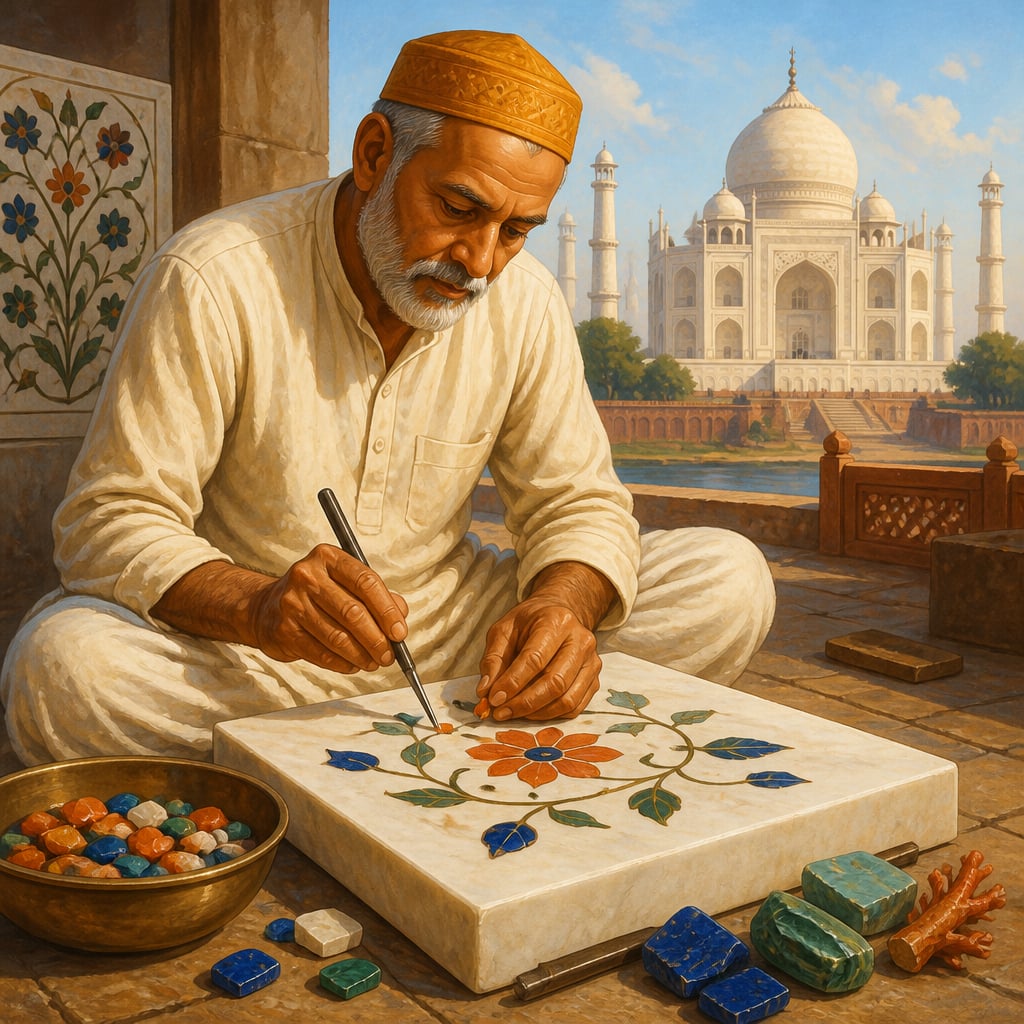
In a small workshop on a dusty lane in the Taj Ganj quarter of Agra, on a summer afternoon in the early 2020s, a parchin kari karigar of one of the hereditary Taj Ganj families (a composite figure, drawn from the working lives of Agra's multi-generation karigar households in Taj Ganj and Gokulpura) sits cross-legged on a cool stone floor. On his lap is a slab of white Makrana marble about the size of a dinner plate. Cut into the surface is a shallow groove in the shape of a poppy. On a small wooden tray beside him are a dozen tiny splinters of stone, each no larger than a grain of rice. One is the deep red of Gujarat carnelian. One is the dawn orange of jasper from the hills of Punjab. One is the blue of lapis lazuli from the Badakhshan mountains in northern Afghanistan. One is the pale green of malachite from the Ural mountains in Russia.
His hands move slowly and without pause. He picks up a sliver of carnelian with a pair of iron tweezers, touches the back of it to a small dab of lime paste, and sets it into the groove in the marble. He taps it flat with a wooden mallet no bigger than a thumb. The stone sits flush with the marble surface. From a foot away, there is no gap, no edge, no glue line. It looks as if the red of the carnelian has simply grown out of the white marble itself.
He has been working on this one poppy motif for six weeks. When he finishes it, he will begin the next petal. When that flower is done, he will begin the vine that connects it to the next flower. The panel he is making is a full-scale copy of a poppy from the cenotaph of Mumtaz Mahal inside the Taj Mahal, which stands about a kilometre away on the far bank of the Yamuna river. The original was cut by a parchin kari master in the 1640s, under the patronage of the Mughal emperor Shah Jahan, using exactly the same technique this karigar is using now. The technique has not changed in nearly four hundred years.
This lesson walks into the craft the Mughal Persian called parchin kari, the Europeans later called pietra dura, and the English have generally called stone inlay. It is one of the most demanding handcrafts on the subcontinent. It is also one of the most widely misunderstood, because a long colonial myth has tried to sell it as an Italian import, and because a modern factory industry has tried to pass off resin-and-stone-powder imitations for the real thing. The real parchin kari is still held in a few dozen small workshops in the Taj Ganj and Gokulpura quarters of Agra, by a few multi-generation karigar families who have refused to leave the work.
The Word and the Technique
The word parchin kari is Persian. Parchin means driven-in, set-in, inlaid. Kari means work or craft. Parchin kari is literally the work of driving stone into stone. The name is a plain description of what happens in the workshop. A design is first drawn on a slab of white marble, almost always the fine Makrana marble quarried in the Nagaur district of Rajasthan. The design is then incised with a fine chisel to a depth of two to three millimetres. Each section of the design that needs a particular colour is cut as a shallow recess in exactly the shape of the intended stone piece.
The semi-precious stones are sliced into thin wafers, barely thicker than a coin, using a wet string charged with emery powder. Each wafer is then ground by hand against a stone wheel until it fits the recess perfectly. The tolerance is less than half a millimetre. The stone is set in lime paste, tapped flush with the marble, and polished until the surface of the whole panel is glass-smooth. A single flower with forty or fifty individual stone pieces can take a skilled karigar a week of work. A full cenotaph panel can take a team several months.
किं स्विद् वनं क उ स वृक्ष आस यतो द्यावापृथिवी निष्टतक्षुः। मनीषिणो मनसा पृच्छतेदु तद्यदध्यतिष्ठद्भुवनानि धारयन्॥
kiṃ svid vanaṃ ka u sa vṛkṣa āsa yato dyāvāpṛthivī niṣṭatakṣuḥ manīṣiṇo manasā pṛcchatedu tad yad adhyatiṣṭhad bhuvanāni dhārayan
What was the wood, what was that tree, out of which they fashioned heaven and earth? Ask with your minds, you wise ones, on what he stood when he held up the worlds.
Rig Veda 10.81.4, the Vishvakarma Sukta
The question is the right question for a parchin kari karigar. Out of what material is a flower made? Out of Afghan lapis and Gujarati carnelian and Russian malachite. Out of what material is a cenotaph made? Out of half the Mughal world. Out of what material is heaven and earth made? The Vedic poet has asked the same question twenty-eight centuries earlier, and has left it for the karigar in Taj Ganj to answer every afternoon in a quiet workshop near the river.
A Map of the Mughal World Carved Into One Flower
The stone list of a high-grade parchin kari panel is a piece of seventeenth century global trade history compressed onto a slab of marble the size of a doorway. A full inventory of the Taj Mahal cenotaph flowers includes at least the following materials.
- Lapis lazuli from the Sar-i-Sang mines of Badakhshan, in what is now northern Afghanistan, the only source of true lapis in the old world.
- Carnelian from the agate mines around Ratanpur and Cambay in Gujarat, the great hardstone source of western India since antiquity.
- Jasper from the Gangetic plains and the hills of Punjab.
- Malachite from the Ural mountains in what was then Tsarist Russia.
- Turquoise from the mines of Khorasan in eastern Persia and from Tibet.
- Jade from the Khotan oases of the southern Silk Road, in what is now Xinjiang.
- Onyx and agate from the Deccan.
- Coral from the Red Sea and the Mediterranean, carried by Arab traders through the ports of Gujarat.
- Mother of pearl from the Persian Gulf pearl banks.
- Yellow marble from Jaisalmer and black slate from the Jabalpur region.

A single poppy flower on Mumtaz Mahal's cenotaph can hold stones drawn from nine different regions across four thousand kilometres. The flower is pretty. The flower is also a customs ledger. To build the Taj Mahal, the imperial workshops of Shah Jahan had to keep open supply lines to Afghanistan, Persia, Russia, Central Asia, Gujarat, the Red Sea, and the Persian Gulf, simultaneously, for more than twenty years. Parchin kari is not a decorative craft. It is an administrative proof that the Mughal trade network actually worked.
Three Monuments That Made the Craft
Three buildings in north India together contain almost everything you need to know about the history of Mughal parchin kari.
The first is the tomb of Itmad-ud-Daulah in Agra, built between 1622 and 1628 by the empress Nur Jahan for her father Mirza Ghiyas Beg. Itmad-ud-Daulah means Pillar of the State, the title Jahangir gave his father-in-law. The tomb sits on the east bank of the Yamuna, a short distance upstream from where the Taj Mahal would later rise. It is the first full parchin kari monument in India, and it is the reason art historians sometimes call it the Baby Taj. Nur Jahan directed the work personally. Every wall of the tomb is covered in inlaid flowers, vines, wine flasks, and geometric stars. The vocabulary that would later cover the Taj is already fully formed in her tomb, a decade earlier.

The second is the Taj Mahal itself, built by Shah Jahan for Mumtaz Mahal between 1632 and 1653. The chief architect is traditionally named as Ustad Ahmad Lahauri, and the chief calligrapher of the Quranic inscriptions is the documented master Amanat Khan Shirazi. The parchin kari work on the cenotaphs, the spandrels, and the dado panels of the main chamber is the high water mark of the craft in India. The workshops drew master inlay karigars from Kanauj, Delhi, and Lahore, working alongside stone cutters from Makrana and lapidaries from the hardstone guilds of Cambay.
The third is the Diwan-i-Am of the Red Fort in Delhi, completed under Shah Jahan in the late 1640s. Behind the emperor's throne, set high into the back wall, is a single large pietra dura panel showing Orpheus playing his lyre to a circle of animals. It is the one panel in all of Mughal parchin kari that appears to have been made in Italy and imported, not made in Agra. The Orpheus panel will matter in a moment, because it is the key exhibit in a long scholarly argument about whether parchin kari was an Indian craft at all.
The Italian Origins Myth and Ebba Koch
Through the nineteenth and twentieth centuries, a series of British colonial historians, including James Fergusson and E. B. Havell, advanced a claim that Mughal pietra dura had been introduced to India by a French jeweller from Bordeaux named Austin de Bordeaux, who was supposedly at the court of Shah Jahan and had trained the local craftsmen in the Florentine technique of commesso di pietre dure. The claim was repeated so often that it entered the standard guidebooks and the popular imagination. The Taj Mahal, on this view, was basically a Florentine ornament executed by Indian hands.
The Austrian Mughal art historian Ebba Koch, in her 2006 book The Complete Taj Mahal and in several earlier papers, systematically took this claim apart. She showed that Austin de Bordeaux is documented as a goldsmith and a miniature painter at the Mughal court, not as a pietra dura master, and that there is no primary source placing him in any stone inlay workshop. She showed that the parchin kari technique differs materially from Italian commesso di pietre dure: the Indian wafers are far thinner, the adhesives are different, and the motifs come from the Mughal herbal book tradition and the Persian carpet tradition, not from European cabinet work. She showed that the Itmad-ud-Daulah tomb already contained fully formed parchin kari work in 1628, a decade before any Italian presence at Shah Jahan's court could be documented. And she showed that the Orpheus panel at the Red Fort Diwan-i-Am is not proof of Italian origins for the technique; it is an imported ornament that Shah Jahan displayed behind his throne as a diplomatic curiosity, exactly because it was different from the Indian work around it.
Koch's argument has now been accepted by most serious Mughal scholars, though the colonial myth still survives in the tourist literature. The practical point is this. Parchin kari was developed in India, by Indian and Persianate karigars, drawing on an older subcontinental tradition of hardstone work that goes back through the Sultanate and Hindu temple traditions to the agate and carnelian lapidaries of the Indus Valley four thousand years earlier. It is an Indian craft. The Italian work is a distant cousin, not a parent.
The Workshops of Taj Ganj Today
A short walk from the south gate of the Taj Mahal lies Taj Ganj, the old service quarter that housed the craftsmen and labourers who built the mausoleum, and that still holds most of the city's working parchin kari families. A second cluster sits in the Gokulpura mohalla nearby. Together these two quarters contain perhaps a few dozen active family workshops. The most visible lineage is the Shamsuddin family, one of several multi-generation karigar families whose ancestors have been cutting stone in Agra since at least the colonial period.
A working parchin kari workshop today looks almost exactly the way a seventeenth century Mughal workshop would have looked. Two or three karigars sit cross-legged on a stone floor. A master cuts the marble recess with a fine chisel. A senior craftsman slices the hardstones into wafers with a wet string and emery powder. An apprentice grinds each wafer to shape against a small stone wheel. The tools fit on a tray the size of a dinner plate. The whole technology holds in one small room.
The economic pressure on these workshops is severe. Factories in other states, and in some parts of Agra itself, now produce fake parchin kari using a resin paste loaded with coloured stone powder, poured into silicone moulds and glued onto machine-cut marble. A tourist walking out of the Taj Mahal cannot easily tell the difference between a resin fake and a real parchin kari panel, and the fake sells for a tenth of the price. Most of the margin in the honest workshops has been squeezed by this imitation market and by the middlemen who supply the big emporium chains.
The surviving real workshops now depend on three things. First, the old relationships with high-end clients and historical restoration projects, including the Archaeological Survey of India's own Taj Mahal conservation work. Second, the craft mela system of Dilli Haat and the state handicrafts outlets. And third, increasingly, the direct-to-buyer online retailers like Jaypore and iTokri, which photograph real parchin kari pieces in Agra, list them online with the karigar's name attached, and ship them to urban Indian homes in Bangalore, Mumbai, Delhi, and Chennai within a week. This last channel is the quietest, but it is also the one that returns the largest share of the final price to the workshop in Taj Ganj. For most of the honest karigars, it is now the main thing keeping the tradition alive.
The Flower on the Cenotaph
Back in the small workshop in Taj Ganj, the karigar sets the last sliver of Cambay carnelian into the last petal of the poppy. He presses it flush. He wipes the surface clean. The flower is complete. Across the Yamuna, the original poppies on Mumtaz Mahal's cenotaph still catch the late afternoon light the way they caught it on the day Shah Jahan first saw them set in 1643. Lapis from Badakhshan. Carnelian from Cambay. Malachite from the Urals. Jade from Khotan. Coral from the Red Sea. One flower, nine geographies, four centuries, and a single pair of hands in a workshop that is still holding on.
Key figures
Nur Jahan
The Mughal empress, twentieth and favourite wife of the emperor Jahangir, and the most politically powerful woman in Mughal imperial history. Born Mihr-un-Nisa in 1577, she married Jahangir in 1611 and became his effective co-ruler until his death in 1627. She was the daughter of Mirza Ghiyas Beg, titled Itmad-ud-Daulah (Pillar of the State), and directed the construction of his tomb in Agra between 1622 and 1628. The Itmad-ud-Daulah tomb is the first full parchin kari monument in India.
Shah Jahan
The fifth Mughal emperor, son of Jahangir, who ruled from 1628 until he was deposed by his son Aurangzeb in 1658. Born Khurram in 1592, he took the throne after a disputed succession and ruled during the period usually described as the high water mark of Mughal architecture. His great building projects include the Taj Mahal (1632 to 1653), the new imperial city of Shahjahanabad with the Red Fort and the Jama Masjid in Delhi (1638 to 1648), the Moti Masjid inside the Agra Fort, and the Jama Masjid of Thatta in Sindh. Parchin kari reached its peak under his patronage, particularly on the cenotaphs of his wife Mumtaz Mahal and later his own, inside the main chamber of the Taj Mahal.
Ustad Ahmad Lahauri
The chief architect of the Taj Mahal, documented in Mughal court sources as the master builder who planned and supervised the construction of the mausoleum for Shah Jahan between 1632 and 1653. He is also credited with the design of the Red Fort in Shahjahanabad (Delhi). His name is given in the official chronicles of Shah Jahan's reign, though little is known about his training before he entered imperial service, beyond the tradition that he came from Lahore, which gives him his name Lahauri.
Ebba Koch
An Austrian Mughal art and architectural historian, professor at the University of Vienna and a leading authority on Mughal art. She has worked on Mughal imperial architecture, the Taj Mahal, the Mughal gardens of Agra, and the iconography of the Mughal court for several decades. Her major books include 'Mughal Art and Imperial Ideology' (2001) and 'The Complete Taj Mahal and the Riverfront Gardens of Agra' (Thames and Hudson, 2006, revised 2012), the latter of which is widely considered the definitive scholarly study of the Taj Mahal.
Case studies
The Parchin Kari Atelier of the Taj Mahal (1632 to 1653)
In 1632, a year after the death of Mumtaz Mahal, the emperor Shah Jahan broke ground on the Taj Mahal on the south bank of the Yamuna at Agra. The chief architect was Ustad Ahmad Lahauri. The chief calligrapher was Amanat Khan Shirazi. The workforce, over the following twenty-two years, included roughly twenty thousand craftsmen, a thousand elephants, and supply trains from Makrana in Rajasthan, Badakhshan in northern Afghanistan, Cambay in Gujarat, Khotan in Central Asia, the Ural mountains in Russia, Khorasan in Persia, the Red Sea, and the Persian Gulf. Within this enormous project, a specialised parchin kari atelier was assembled to produce the floral inlay work on the cenotaphs of Mumtaz Mahal, on the inner chamber dado panels, and on the spandrels of the arches. The masters were drawn from the imperial workshops at Agra and Lahore, from the hardstone lapidary guilds of Cambay, and from the older stone-cutting families of Kanauj, Delhi, and Lahore. Each karigar specialised in a narrow phase of the work: tracing the design, cutting the recesses, slicing the hardstones, shaping the wafers, or setting them into the marble. A single poppy flower could take a team one week. The main cenotaph chamber contains many hundreds of such flowers.
From a dharmic perspective, the Taj atelier is a direct descendant of the Shilpa Shastra tradition. The classical Sanskrit treatises on craft and architecture, including the Mayamata, the Manasara, and the Shilparatna, lay out the principles of stone cutting, image making, and monument building, and trace the craftsman's authority back to Vishvakarma, the divine maker of the Rig Veda's Vishvakarma Sukta. The Taj atelier worked in a Persianate Mughal register, with Islamic inscriptions and Persian floral motifs, but the organising structure of the workshop (a master, senior craftsmen, apprentices, specialised phases, and transmission through guild families) is the same structure the Shilpa Shastra tradition described many centuries earlier. The Mughal emperor paid the bills. The Vishvakarma lineage held the craft.
The Taj Mahal was completed in 1653. The parchin kari work on the cenotaphs is the high water mark of the craft in India and arguably in the world. The atelier that produced it dispersed after the project, but its key families settled in what became the Taj Ganj quarter immediately south of the monument, and their workshops have held the tradition continuously, even as Mughal imperial patronage collapsed through the eighteenth and nineteenth centuries. In 1983, the Taj Mahal was inscribed on the UNESCO World Heritage list, partly on the strength of the parchin kari work.
The greatest craft projects in history are usually the output of a working atelier system, not of a single genius. The Taj Mahal is not the work of one architect. It is the work of twenty thousand craftsmen and a hundred master karigars organised inside a structured workshop. Every tradition that wants to reach this scale must first solve the atelier problem: how to organise specialised skills, how to transmit them across apprenticeships, and how to keep the workshop alive between commissions. The monument is what you see. The atelier is how it was made.
The atelier system that produced the Taj Mahal is the direct ancestor of the family workshop system that still operates in Taj Ganj today. Every working parchin kari family in modern Agra traces its organisational structure (a master, senior craftsmen, apprentices, specialised phases, transmission through family lineages) back to the imperial atelier that assembled under Shah Jahan in 1632. The technique has barely changed. The workshop structure has barely changed. What has changed is the patron, and the work of the last four hundred years has been the long process of finding new patrons (conservation contracts, craft melas, direct-to-buyer retailers) to replace the original imperial one.
The Taj Mahal was built between 1632 and 1653 by a workforce estimated at roughly twenty thousand craftsmen and a thousand elephants, including the specialised parchin kari atelier that produced the floral inlay on the cenotaphs and dado panels. The monument was inscribed on the UNESCO World Heritage list in 1983.
Ebba Koch and the Demolition of the Italian Origins Myth
Through the second half of the nineteenth century and well into the twentieth, the standard colonial story about Mughal parchin kari was that it had been imported from Florence. The story, advanced in different forms by James Fergusson, E. B. Havell, and several other British historians, claimed that a French jeweller known as Austin de Bordeaux had come to the court of Shah Jahan and had taught the Indian craftsmen the Italian commesso di pietre dure technique, which they then applied, under European direction, to the Taj Mahal. The claim was repeated so often that it entered the standard guidebooks, the school textbooks, and the popular imagination. Many educated Indians came to believe it. The Austrian Mughal art historian Ebba Koch spent several decades examining this claim. In her 2001 book Mughal Art and Imperial Ideology, and most fully in her 2006 book The Complete Taj Mahal and the Riverfront Gardens of Agra, she set out the evidence against the Italian origins story and in favour of an indigenous Indian tradition with Persian and subcontinental roots.
From a dharmic perspective, Koch's work is exactly the kind of careful archival scholarship that the classical Indian tradition of pramana (valid means of knowledge) has always required. The Nyaya school of Indian philosophy laid out rigorous tests for what counts as evidence: direct perception, inference, analogy, and reliable testimony. A claim without a primary source is not knowledge. Koch's method is the method the tradition already prescribed. Ask for the primary source. Compare the actual techniques. Trace the motif vocabulary. Date the precedents. Look at what the monuments themselves say, not at what the colonial historians wanted them to say. The tradition does not ask you to trust an argument because it is popular. It asks you to trust an argument because the evidence holds up.
Koch showed four things. First, the Mughal court records document Austin de Bordeaux as a goldsmith and miniature painter, not as a stone inlay master, and there is no primary source placing him in any parchin kari workshop. Second, the Indian technique differs materially from Italian commesso di pietre dure: the wafers are far thinner, the adhesives are different, and the motif vocabulary comes from the Persian and Mughal herbal book tradition rather than from European still-life painting. Third, the Itmad-ud-Daulah tomb, built by Nur Jahan between 1622 and 1628, already contained fully developed parchin kari work more than a decade before any Italian presence at Shah Jahan's court can be documented. Fourth, the one panel in a Mughal monument that is genuinely of Italian pietra dura manufacture, the Orpheus panel at the Red Fort Diwan-i-Am, is an imported ornament displayed as a diplomatic curiosity, not evidence of a local technique. The Italian origins story collapsed.
Inherited stories about the origins of great traditions deserve much harder scrutiny than they usually receive. A claim that is repeated in the guidebooks for a hundred years is not evidence of truth. It is evidence of repetition. The patient archival work of one careful scholar can, over time, overturn a century of confident assertion and restore the actual authorship of a craft, a science, or a philosophy to the people who actually made it. This work is slow, unglamorous, and almost always lonely. It also matters more than almost any other kind of history writing.
The Ebba Koch case is now used as a teaching example in Indian art history for how colonial historiography can be taken apart through rigorous primary-source scholarship. Similar work is in progress for Indian mathematics, Indian astronomy, Indian metallurgy, Ayurveda, and several temple architectural traditions. The general principle is the same. A claim of foreign origin deserves exactly as much scrutiny as a claim of indigenous origin, and that scrutiny almost always reveals more continuity and more Indian innovation than the colonial story was willing to admit.
Ebba Koch's The Complete Taj Mahal and the Riverfront Gardens of Agra was first published by Thames and Hudson in 2006, with a revised edition in 2012. It is now widely considered the definitive scholarly study of the Taj Mahal and is the primary source for the modern rejection of the Italian origins claim for Mughal parchin kari.
The Shamsuddin Family and the Living Workshops of Taj Ganj
By the late twentieth century, the parchin kari tradition of Agra was in serious trouble. Imperial patronage had collapsed three centuries earlier. The colonial restoration economy that had sustained a handful of karigar families through the late nineteenth and early twentieth centuries was uneven and often underpaid. Factory imitations made of resin and stone powder, cast in silicone moulds, were flooding the tourist market around the Taj Mahal and undercutting the real workshops by a factor of ten. Most young men in the karigar families were leaving for salaried jobs in Delhi and Mumbai. Inside this decline, a small number of multi-generation family workshops in the Taj Ganj and Gokulpura quarters of Agra refused to leave the work. One of the best-known is the Shamsuddin family, a lineage of parchin kari karigars who have been cutting stone in Agra for many generations, training sons and nephews under senior relatives, and taking commissions for both private buyers and Archaeological Survey of India conservation contracts on the Taj Mahal itself and on the Itmad-ud-Daulah tomb.
From a dharmic perspective, the Shamsuddin workshop is doing what the Shilpa Shastra tradition has always asked of its master karigars. It is holding the jnana (knowledge) of the craft, teaching it to the next generation, and anchoring it back to its monumental source in the Taj Mahal itself. The classical Sanskrit treatises on craft describe the master as a transmitter first and a maker second. His commercial output supports the workshop economically, but his real responsibility is to make sure that when he dies, there is at least one apprentice in the family who can cut lapis lazuli to the same tolerance, shape a carnelian wafer to the same curve, and set a poppy petal into Makrana marble so that the joint disappears. The Shamsuddin family, and the other multi-generation Taj Ganj lineages beside them, are the reason the technique is still alive at all.
The Taj Ganj and Gokulpura family workshops together still employ perhaps a few hundred active karigars across thirty to sixty households. They survive today on a combination of historic conservation contracts with the Archaeological Survey of India, craft mela appearances at Dilli Haat organised by the Dastkari Haat Samiti, and an increasing share of direct-to-buyer online sales through retailers like Jaypore, iTokri, and GoCoop. The factory imitation industry has not gone away, but the real workshops now have enough urban and international buyers who understand the difference to keep the work economically viable. The next generation of karigars is still being trained. The technique is still being transmitted.
A craft tradition is almost always saved by a small number of stubborn family workshops in one critical generation. The wider structures, the cooperatives, the GI registrations, the conservation contracts, the designer collaborations, the online retailers, are all downstream of what those workshops do. They are the foundation. The most important intervention in any dying craft is almost always the one you cannot see from a distance: a handful of masters who refuse to leave the work and who keep teaching their sons and nephews to cut stone to the same tolerance their great-grandfathers did four generations earlier.
For any buyer interested in supporting the living parchin kari tradition, the clearest single lever is to buy direct from a Taj Ganj family workshop or through a reputable direct-to-buyer online retailer that lists the karigar's name. The factory imitation industry depends on confusion. The real workshops depend on a small number of informed buyers. Every informed purchase is a vote for the continuation of the technique, and at current scale it takes only a few thousand such buyers a year to keep the Taj Ganj workshops economically viable into the next generation.
Current estimates put the total number of active parchin kari family workshops in Taj Ganj and Gokulpura at between thirty and sixty households, with each workshop employing two to six working karigars plus one or two apprentices. The Archaeological Survey of India regularly commissions Taj Ganj karigars for conservation work on the Taj Mahal cenotaphs themselves, providing one of the few steady income streams for the surviving workshops.
Jaypore and iTokri: A Taj Ganj Workshop in a Bangalore Living Room
The traditional supply chain for parchin kari in modern India ran through a long line of middlemen. A Taj Ganj karigar would sell his panel to a local Agra wholesaler, who would sell it to a Delhi or Mumbai emporium, who would sell it to a retail customer at a price many times what the karigar had received. The share of the final price that actually reached the workshop was often less than a tenth. The karigar had no direct contact with the buyer, and the buyer had no way to verify that the piece was real Taj Ganj work rather than a resin imitation. Into this gap stepped a new kind of craft retailer: the direct-sourcing online store. The Bangalore-founded online craft retailer Jaypore (launched around 2012, later acquired by Aditya Birla Fashion and Retail) and the Gwalior-based online craft retailer iTokri (founded by Nitin Pamnani and colleagues in the early 2010s) both built direct relationships with Indian artisan communities, including the parchin kari workshops of Taj Ganj.
From a dharmic perspective, the direct-to-buyer channel restores something the traditional village economy always had and that the industrial-era handicraft supply chain lost. In the older economy, the craftsman and his direct buyer (the temple, the court, the local patron) knew each other and negotiated face to face. The supply chain was short, the relationship was direct, and the buyer's payment reached the craftsman without being diluted by many middlemen. The colonial and early post-independence emporium system broke this direct relationship and inserted five or six layers between the workshop and the urban buyer. The direct-sourcing online retailer is a modern instrument that rebuilds the short supply chain of the traditional economy, using the internet as the medium instead of a road to the local temple.
Over the past decade, Jaypore and iTokri have both become consistent direct buyers of parchin kari panels, tabletops, trays, and boxes from Taj Ganj family workshops. The Taj Ganj karigars receive commissions in advance, produce the pieces at their own workshops on their own schedule, and ship them to the retailer's warehouse. The pieces are then photographed, listed online with the karigar's name or family name attached, and sold to urban buyers in Bangalore, Mumbai, Delhi, Chennai, Hyderabad, and smaller cities, as well as to international buyers. A buyer who wants a Taj Ganj parchin kari tabletop no longer has to travel to Agra and navigate the emporium market. She finds it online, pays online, and receives it within a week. The karigar's share of the final price, through these channels, is substantially higher than it ever was through the emporium chain.
Online direct-sourcing is one of the most effective modern tools for supporting traditional craft economies, not because it is glamorous or high-tech, but because it radically shortens the supply chain between the workshop and the urban buyer. A craft tradition that survives the collapse of its historical patronage almost always survives by finding a new, shorter path to its buyers. For Taj Ganj parchin kari in the 2020s, Jaypore and iTokri are currently two of the main such paths. The principle is always the same. Cut out the middlemen. Pay the karigar directly. Let the urban buyer pay a price that reflects the real skill of the maker.
For a buyer interested in supporting parchin kari directly, the direct-sourcing online retailer is currently the clearest single lever. A single tabletop or tray purchased through Jaypore or iTokri with the karigar's name attached returns a meaningful share of the price to the Taj Ganj workshop, in a way that the traditional emporium supply chain rarely did. The same model is now being applied to dozens of other endangered Indian craft traditions, from Pembarthi brass to Bidri to Bastar Dhokra to Patola silk. The parchin kari case is a good template for how it works in practice for a high-end hardstone tradition, and a good reminder that the survival of the Taj Ganj workshops in the next generation depends less on monument conservation policy than on the buying choices of a few thousand urban Indian families every year.
Jaypore was founded in Bangalore in 2012 and acquired by Aditya Birla Fashion and Retail in 2019. iTokri was founded in Gwalior in the early 2010s and has grown into one of the larger online Indian craft retailers, working with hundreds of artisan communities across the country. Both platforms now list parchin kari pieces from Taj Ganj family workshops with the karigar or family name attached.
Historical context
The parchin kari story begins in the early seventeenth century under the Mughal emperor Jahangir (reigned 1605 to 1627) and his powerful wife Nur Jahan, who built the Itmad-ud-Daulah tomb in Agra between 1622 and 1628 and first put the full hardstone inlay technique on an Indian monument. It reaches its high point under Shah Jahan (reigned 1628 to 1658) with the Taj Mahal (1632 to 1653), the Red Fort Diwan-i-Am in Delhi (late 1640s), and the Moti Masjid in the Agra Fort. It contracts sharply under Aurangzeb (1658 to 1707) as imperial patronage for decorative arts declined, and nearly disappears during the eighteenth and nineteenth centuries as Mughal political power collapses. It is revived in the twentieth century through colonial-era conservation work at the Taj Mahal, through the Archaeological Survey of India's continuing restoration projects, and through the small number of multi-generation karigar families in Taj Ganj who refused to leave the work.
The parchin kari tradition belongs specifically to Mughal north India, centred on Agra and on the imperial workshops that moved between Agra, Lahore, and Shahjahanabad (Delhi). Its base material, Makrana marble, comes from the Nagaur district of Rajasthan. Its hardstones come from a wider trade network that stretches from Badakhshan in northern Afghanistan to Cambay in Gujarat to Khotan in Central Asia to the Ural mountains in Russia to the Red Sea and the Persian Gulf. But the craft itself is a north Indian urban workshop tradition, held historically in the Mughal imperial karkhanas and now in the family workshops of Taj Ganj and Gokulpura in Agra. The tradition draws on an older subcontinental hardstone lineage that goes back through the Sultanate and Hindu temple traditions to the agate and carnelian bead lapidaries of the Indus Valley Civilisation (Harappa and Mohenjo-daro, roughly 2500 BCE), and through the classical Shilpa Shastra tradition of Sanskrit treatises on craft and architecture.
The closest European cognate of parchin kari is the Florentine commesso di pietre dure, developed at the Medici court in the sixteenth century and associated with the Opificio delle Pietre Dure workshop that Cosimo I de' Medici founded in 1588. The two crafts share a general principle (cutting shaped pieces of hardstone and setting them into a ground to form a picture) but differ materially: the Florentine work uses thicker slabs set into wood or stone grounds and draws on European still-life and architectural vocabulary, while the Mughal work uses far thinner wafers inlaid into Makrana marble and draws on the Persian and Mughal herbal book tradition. The Ottoman Turks developed a related but distinct mother-of-pearl inlay tradition for wooden furniture. China has its own long tradition of jade and hardstone carving. The hardstone bead lapidaries of the Indus Valley Civilisation, working carnelian and agate at Harappa and Mohenjo-daro nearly four thousand years before parchin kari, are the earliest documented subcontinental ancestors of the technique. The GI protection model used for Indian craft geographies is comparable to the French Appellation d'Origine Contrôlée and the European Protected Designation of Origin frameworks.
The Taj Mahal was built between 1632 and 1653, a period of twenty-two years, by a workforce estimated at roughly twenty thousand craftsmen, including the parchin kari karigars who cut and set the hardstone flowers on the cenotaphs and dado panels. A single poppy flower on Mumtaz Mahal's cenotaph may contain forty to fifty individual stones drawn from as many as nine distinct regional sources, stretching from Badakhshan in northern Afghanistan to the Ural mountains in Russia to the Red Sea coast. Modern Taj Ganj contains a few dozen active parchin kari family workshops, and a skilled karigar can spend three to six months on a single tabletop-sized panel.
Parchin kari is one of the clearest examples in Indian craft of how imperial patronage, global trade, and local workshop skill can combine for a brief period to produce something that almost nobody else in the world could match. It is also one of the clearest cases of how a colonial narrative can misattribute an indigenous craft to a foreign source, and of how careful scholarly work (in this case by the Austrian historian Ebba Koch) can recover the real authorship. And it is a living case study in how a tradition survives the collapse of its original patronage. The Mughal empire is gone. The imperial karkhanas are gone. The twenty thousand craftsmen of the Taj Mahal are gone. But a few dozen family workshops in Taj Ganj and Gokulpura, sustained today by conservation contracts, craft melas, and direct-to-buyer online retailers like Jaypore and iTokri, are still cutting the same flowers into the same Makrana marble four centuries later. They are one of the quieter proofs that a great craft does not need its original patron to survive. It just needs a small number of karigars who refuse to leave the work.
Living traditions
The contemporary Taj Ganj parchin kari workshops are sustained by a combination of historic conservation contracts with the Archaeological Survey of India, state handicrafts outlets, craft melas organised by the Dastkari Haat Samiti, and an increasing share of direct-to-buyer online sales through retailers like Jaypore, iTokri, and GoCoop. The 2006 publication of Ebba Koch's The Complete Taj Mahal reframed international scholarly understanding of the craft and restored its Indian authorship. Designer collaborations with contemporary lifestyle brands have opened new object formats for the technique, including tabletops, trays, boxes, and occasional wearable pieces. National recognitions through the National Awards for Master Craftspersons and the Shilp Guru program have placed individual karigar families on the national map. The combined effect has been to stabilise a tradition that nearly disappeared in the early twentieth century.
- Parchin kari workshop practice in Taj Ganj: A working parchin kari workshop in Taj Ganj runs on a daily rhythm of design, marble preparation, stone slicing, shaping, and setting. In the early morning, the master plans the panel, traces the design onto the Makrana marble with a fine pencil, and marks the recesses to be cut. Through the middle of the day, the senior karigars cut the recesses with fine steel chisels and slice the hardstones into thin wafers with a wet string charged with emery powder. In the afternoon, the apprentices grind each wafer to shape against a small stone wheel, checking the fit against the recess every few seconds. The master then sets each stone with a dab of lime paste, taps it flush, and cleans the joint. A full flower with forty to fifty stones may take a week of steady work. A full cenotaph-style panel may take three to six months.
- Visiting the cenotaph chamber of the Taj Mahal: Inside the main chamber of the Taj Mahal, underneath the dome, stand the cenotaphs of Mumtaz Mahal and Shah Jahan. The cenotaphs are the high water mark of Mughal parchin kari. Every surface is covered with inlaid floral motifs (poppies, tulips, irises, lilies) executed in lapis lazuli, carnelian, jasper, malachite, jade, turquoise, and mother of pearl, set flush into Makrana marble. A close visual inspection, especially in the raking morning light, shows the individual stone wafers and the joints between them. The cenotaph chamber is the one place in the world where a visitor can see the full vocabulary of the craft at its peak, in situ, and compare it directly with the work coming out of the Taj Ganj workshops a kilometre away.
- Annual Vishvakarma Puja and workshop observances: The parchin kari karigars of Taj Ganj, like most Indian craft communities, observe the annual Vishvakarma Jayanti in September, dedicated to the divine craftsman of the Rig Veda. On this day, the karigars wash their chisels, hammers, grinding wheels, and trays, decorate them with flowers and turmeric, and offer a small prayer to Vishvakarma, the first maker of heaven and earth. Most workshops do not begin any new commercial cutting on this day. Many of the older parchin kari families in Taj Ganj are Muslim lineages, but the Vishvakarma workshop observance has often continued as a craft tradition older than the religious identity of the families who now hold it.
Reflection
- Pick up one complicated object in your home. A phone, a laptop, a watch, a piece of jewellery, a coffee mug, a packet of medicine. Try to list every material inside it and, if you can, every country or region those materials might have come from. Then try to imagine every supply line that had to be open for this object to reach your hand. What does the object look like after you have read it as a trade map?
- Think of one tradition, craft, art form, scientific idea, or philosophical school from your own background or culture that you have been told was borrowed or imported from somewhere else. How well is that claim actually supported? Have you ever seen the primary sources? Would it change how you feel about the tradition if, like parchin kari, it turned out to be indigenous after all?
- Shah Jahan, Mumtaz Mahal, and Ustad Ahmad Lahauri are long dead. The imperial workshops are long gone. What survives of the parchin kari tradition is held today in a few dozen small family workshops in Taj Ganj and Gokulpura. Is there any tradition, skill, or knowledge system in your own life that depends on a small number of living practitioners rather than on any grand building or institution? What would it take to keep that small number alive?