Vidya-Vidhvansa: Destruction of Knowledge Systems

Educational Collapse

Colonial education policy didn't just change curriculum - it systematically destroyed indigenous knowledge systems, from village schools to advanced universities. This lesson examines how Macaulay's education policy and institutional destruction created intellectual subordination with lasting economic consequences.

The Man Who Created 'Brown Englishmen'

Macaulay drafting his Education Minute by candlelight in 1835

In 1835, Thomas Babington Macaulay delivered the most consequential education policy document in Indian history. His 'Minute on Indian Education' argued that the goal of British education should be:

"To form a class who may be interpreters between us and the millions whom we govern; a class of persons, Indian in blood and colour, but English in taste, in opinions, in morals, and in intellect."

Macaulay's minute led to the English Education Act of 1835, which:

This wasn't educational reform - it was vidya-vidhvansa (destruction of knowledge). The goal wasn't educating Indians but creating intellectual subordinates who would administer colonial extraction.

What Was Destroyed: Pre-Colonial Education

Contrary to colonial claims, pre-colonial India had widespread education:

The Numbers

Dharampal's research (using British survey data from 1820s-30s) found:

Compare this to England in 1800: 1 school for every 1,000-1,500 people.

India was more literate than England when colonialism began.
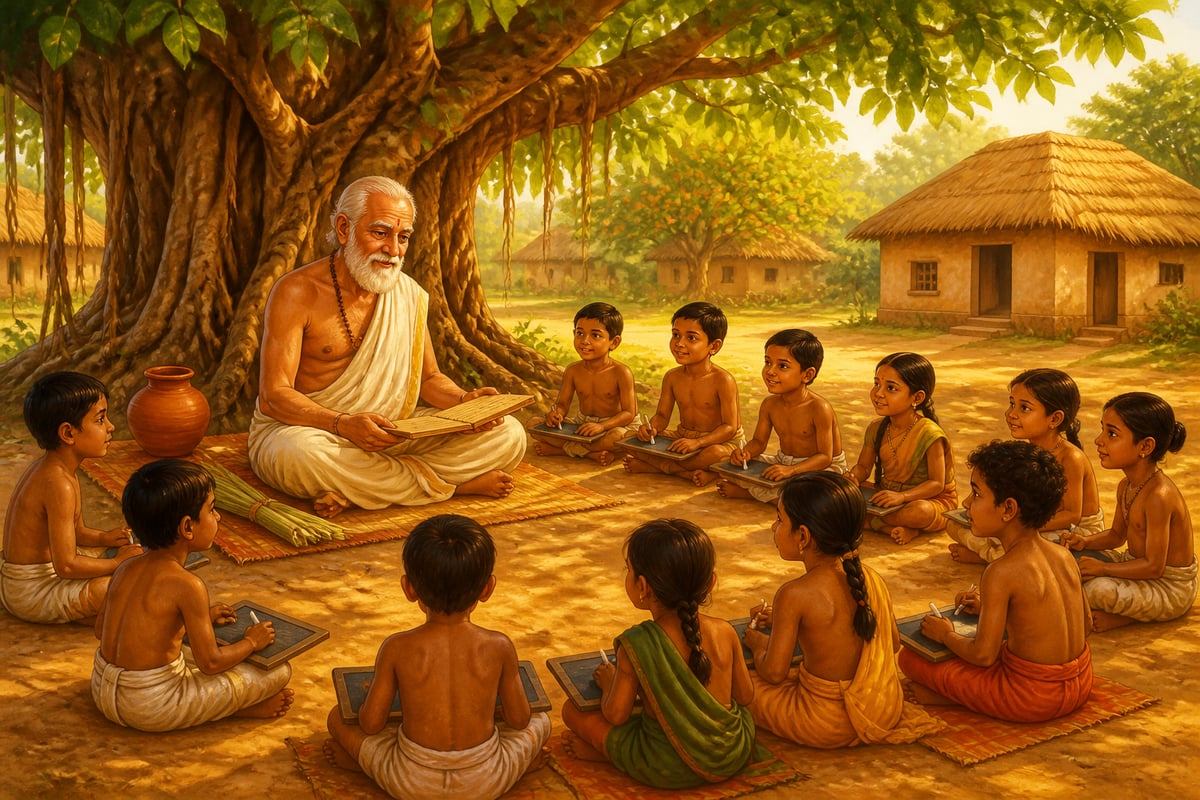
A traditional village pathshala under a banyan tree in 1820

The System

Indian education operated at multiple levels:

1. Village Pathshalas (Primary schools)

2. Tols and Chatuspathis (Higher learning)

3. Madrasas (Islamic education)

4. Advanced Institutions

"Vidya vihinah pashubhih samanah" - One without knowledge is like an animal.

Education was a dharmic imperative, not a government program. Communities funded schools because learning was considered sacred duty.

How Destruction Happened

1. Defunding Indigenous Education

The British systematically withdrew financial support:

Without funding, schools closed. By 1857, Adam's Reports documented the collapse:

Madras Presidency schools: From 12,498 (1820s) to approximately 2,000 (1857)

This wasn't reform - it was defunding to destruction.

2. Delegitimizing Indian Knowledge

Macaulay's minute declared:

"A single shelf of a good European library was worth the whole native literature of India and Arabia."

This wasn't ignorance - it was strategy. If Indian knowledge was 'worthless,' then:

The psychological impact was devastating. Indians were taught that their own traditions were inferior - creating the 'colonial mentality' that persists.

3. Creating a New Elite

The new education system served colonial needs:

The result: a small English-educated elite disconnected from their own society, and a vast majority denied even basic education.

Literacy rate in 1947: approximately 12% - lower than many pre-colonial estimates.

The Economic Cost of Knowledge Destruction

Knowledge destruction had direct economic consequences:

1. Loss of Technical Knowledge

With traditional schools closed:

The destruction of shilpa-vidya (craft knowledge) documented in the previous lesson was accelerated by educational collapse. Without schools to train new craftspeople, industries died faster.

2. Human Capital Destruction

Modern economists emphasize that human capital (skills, knowledge, health) drives economic growth. Colonial education policy:

The 12% literacy rate at independence meant 88% of the population lacked basic skills that modern economies require.

3. Creating Intellectual Dependency

Macaulayan education created graduates who:

This intellectual subordination had economic effects: Indians were trained to consume British ideas and products, not produce their own innovations.

Dharampal's Recovery of History

Historian Dharampal recovering village school records in the London archives

Dharampal (1922-2006) was a Gandhian historian who recovered pre-colonial Indian history from British archives. His research overturned colonial narratives:

'The Beautiful Tree: Indigenous Indian Education in the Eighteenth Century' (1983) documented:

Dharampal's research proved that Indian 'backwardness' was created, not inherited. The colonial destruction of education was documented in British surveys - but those surveys were buried until Dharampal recovered them.

Global Perspectives on Colonial Education

Thinkers from across the colonized world have analyzed how education became a tool of mental subjugation.

Paulo Freire (1921-1997), Brazilian educator, wrote Pedagogy of the Oppressed (1968), arguing that colonial education creates 'banking' - treating students as empty vessels to be filled with the colonizer's knowledge. Macaulay's minute exemplifies this: Indian minds were considered empty, needing British knowledge deposited in them. Freire argued that true education must be dialogical, drawing on learners' own knowledge - exactly what the pathshala system did.

Ngũgĩ wa Thiong'o (1938-present), Kenyan writer, documented in Decolonising the Mind (1986) how colonial education in Africa destroyed indigenous languages and knowledge systems - paralleling India's experience exactly. Ngũgĩ ultimately renounced writing in English, choosing his native Gikuyu. His analysis shows that India's vidya-vidhvansa was part of a global colonial pattern.

Edward Said (1935-2003), Palestinian-American scholar, in Orientalism (1978) showed how Western scholarship constructed the 'East' as inferior, requiring Western tutelage. Macaulay's dismissal of 'all native literature' as worthless exemplifies Orientalism. Said demonstrated that colonial knowledge production was about power, not truth.

Ashis Nandy (1937-present), Indian political psychologist, in The Intimate Enemy (1983) analyzed how colonialism created psychological subjugation - Indians who internalized colonial contempt for their own culture. Nandy showed that decolonization requires psychological liberation, not just political independence.

Thinker Key Insight Application to India
Paulo Freire Colonial education treats learners as empty vessels Macaulay viewed Indian minds as needing British content
Ngũgĩ wa Thiong'o Language is the carrier of culture and identity English medium destroyed vernacular learning
Edward Said 'Orientalism' constructs the East as inferior Justified dismissing Indian knowledge as worthless
Ashis Nandy Colonialism creates psychological subjugation 'Colonial mentality' persists after political freedom

These global perspectives confirm that India's educational destruction was part of a worldwide colonial pattern - and that decolonization requires both institutional and mental transformation.

Continuing Effects: The 'Colonial Mentality'

Beyond institutions, Macaulayan education created psychological effects:

This 'colonial mentality' has economic effects:

The decolonization of the mind that thinkers like Ashis Nandy describe is prerequisite for full economic independence.

Why This Matters for Viksit Bharat

India's education challenges today trace to colonial destruction:

  1. Rebuilding from 12%: Independence inherited a country where 88% couldn't read. Universal literacy took decades.

  2. Language Medium Debates: English vs. vernacular debates continue from Macaulay's time

  3. Traditional Knowledge Revival: NEP 2020's emphasis on Indian knowledge systems attempts to restore what was lost

  4. Confidence Building: Economic success requires confidence in one's own capabilities - precisely what colonial education undermined

NEP 2020 (National Education Policy) explicitly addresses colonial educational legacy, emphasizing:

Your Turn

Macaulay wanted to create people 'Indian in blood but English in intellect.' Has this project fully ended? What remnants of 'colonial mentality' do you observe in contemporary Indian attitudes toward education, language, and success?

In the next lesson, we examine how contemporary scholars like Shashi Tharoor have synthesized the economic case against colonialism, creating the foundation for informed discussion about historical justice.

Human Capital Development and Educational Philosophy

Modern debates about 'liberal education' vs. 'vocational training' echo ancient Indian discussions. Research shows that broad education produces more adaptable workers and innovative entrepreneurs than narrow vocational training.

The traditional Indian model - combining knowledge with values, theory with practice - is now recognized as superior for producing innovative thinkers. NEP 2020's emphasis on multidisciplinary education returns to these principles.

Countries with holistic education systems (including character development) consistently outperform those focused only on technical skills. Finland's education success draws on principles Indian pathshalas practiced centuries ago.

Development economists like Dani Rodrik emphasize that successful development requires 'policy space' - freedom to try indigenous solutions. This requires intellectual confidence that colonial mentality undermines.

India has among the world's oldest continuous intellectual traditions. Recovering confidence in this heritage enables innovation that draws on both Indian and global knowledge - synthesis rather than subordination.

Key terms

Vidya-Vidhvansa
Destruction of knowledge - the systematic dismantling of indigenous educational institutions, knowledge traditions, and intellectual confidence through colonial policy.
Pathshala
Traditional Indian village school providing primary education in vernacular languages, funded by community contributions and teaching reading, writing, arithmetic, and basic values.
Aupaniveshik-Manasikta
Colonial mentality - psychological internalization of colonial values, including belief in the superiority of Western knowledge, culture, and institutions over indigenous ones.
Gurukul
Traditional Indian residential school where students lived with the teacher (guru), receiving holistic education that combined academic learning with character development, practical skills, and spiritual growth.

Verses

विद्या ददाति विनयं विनयाद् याति पात्रताम्

Vidya dadati vinayam vinayad yati patratam

Knowledge gives humility, from humility comes worthiness.

The dharmic education model produced well-rounded individuals capable of judgment and innovation. Macaulayan education produced clerks capable of following orders. The economic difference matters: clerks administer existing systems; innovators create new ones. India's need for entrepreneurs and innovators requires recovering the educational philosophy colonial rule destroyed.

Subhashita, Traditional Sanskrit verse (Classical compilation)

अनभ्यासे विषं विद्या

Anabhyase visham vidya

Knowledge without practice becomes poison.

This verse captures the economic problem with Macaulayan education: it created people who could quote English literature but not improve Indian agriculture or manufacturing. Knowledge without application is economically sterile. The emphasis in modern 'skill India' programs on practical application reflects belated recognition of this principle.

Hitopadesa, Introduction (Traditional version)

Key figures

Dharampal

1922-2006

Thomas Babington Macaulay

1800-1859

K. Kasturirangan

1940-present

Case studies

NEP 2020's Mother-Tongue Initiative: Decolonizing Education

NEP 2020's emphasis on mother-tongue instruction in early years represents India's most significant policy departure from Macaulay's English-only approach, with profound implications for educational equity and cognitive development. Macaulay's 1835 policy made English the medium of instruction, disconnecting Indian children from their linguistic heritage and creating barriers to learning. Research consistently shows children learn better in their mother tongue during foundational years, yet English-medium education remained a prestige marker, a classic example of 'colonial mentality.' NEP 2020 directly challenged this by mandating mother-tongue or regional language instruction at least till Grade 5, with preference up to Grade 8. The economic stakes are substantial: students learning in unfamiliar languages show 20-40% lower comprehension rates, affecting skill development. India's education system produces millions of graduates with degrees but lacking employable skills. Mother-tongue instruction improves foundational literacy, enabling better outcomes in later English acquisition and overall learning. The policy targets improving learning outcomes for 250+ million school children, potentially transforming human capital development.

This case demonstrates the continuing struggle to reverse Macaulay's educational legacy and the colonial vidya-vidhvansa (destruction of knowledge systems). NEP 2020 represents explicit policy acknowledgment that colonial education severed Indians from their linguistic and intellectual heritage. The Dharmic principle of vidya as sacred, not merely utilitarian, demands that learning happen in languages that connect students to their cultural roots. Recovery requires reconnecting Indians with their own knowledge traditions, and decolonization is an ongoing process rooted in swadeshi education values, not a single historical event.

By 2025, multiple states have begun implementing mother-tongue instruction in primary grades. Engineering and medical courses are being offered in Hindi and regional languages for the first time. NCERT textbooks are available in 22 scheduled languages. Early implementation data shows improved comprehension and reduced dropout rates in pilot programs. The initiative faces resistance from parents who view English as essential for success, demonstrating how deeply colonial attitudes persist.

Decolonizing education requires both policy change and mindset transformation. The resistance from parents demonstrates that 'colonial mentality' is real and must be addressed alongside institutional reforms. Success requires demonstrating that mother-tongue education leads to better outcomes, not limiting opportunities, essentially proving Macaulay wrong with evidence.

UNESCO research consistently shows that children learn foundational skills 30-50% better in their mother tongue. As India scales mother-tongue instruction, it joins a global movement: Ethiopia, Tanzania, and the Philippines have all shifted to local-language primary education with measurable learning improvements.

Students learning in unfamiliar languages show 20-40% lower comprehension rates. NEP 2020 targets 250+ million school children with mother-tongue instruction, and NCERT textbooks are now available in all 22 scheduled languages.

IIT/IIM Ecosystem: World-Class Excellence from Indian Roots

The Indian Institutes of Technology (IITs) and Indian Institutes of Management (IIMs) represent India's most successful post-independence educational institutions, demonstrating that Indian-built institutions can achieve world-class excellence. After independence, India faced a stark choice: rely on foreign institutions for higher education (continuing intellectual dependency) or build indigenous institutions of excellence. The first IIT was established at Kharagpur in 1951, explicitly positioned as a nation-building exercise. IIMs followed in 1961. These institutions drew on global best practices while developing distinctly Indian approaches, including the rigorous JEE examination system and case-study pedagogy adapted to Indian contexts. The economic impact has been transformative. IIT/IIM graduates have become global leaders in technology and business. Silicon Valley has a significant 'IIT mafia': founders and executives who built billion-dollar companies. Satya Nadella (Microsoft), Sundar Pichai (Google), and countless other global tech leaders are IIT alumni. The institutes produce entrepreneurs who created Infosys, Flipkart, Ola, and thousands of other companies. Conservative estimates suggest IIT alumni have created over $2 trillion in market value globally.

The IIT/IIM story directly counters the colonial narrative that Indians required British institutions for intellectual development. These institutions, built by Indians for Indian needs, produced world-class talent. They demonstrate that vidya-vidhvansa (destruction of knowledge systems) can be reversed, that India can rebuild educational excellence by combining global standards with swadeshi innovation rather than merely imitating Western models. The Dharmic concept of vidya as self-empowerment, not dependence on external authority, is embodied in the IIT model. The challenge now is extending this success from elite institutions to universal education through Antyodaya principles.

By 2025, India has 23 IITs and 21 IIMs, with ambitious expansion continuing. IITs rank among the top 200 global universities despite a fraction of the funding of Western peers. The 'IIT brand' has become globally recognized, with graduates commanding premium salaries worldwide. More importantly, an increasing number of graduates are staying in India or returning, applying their skills to Indian challenges rather than contributing to brain drain.

Post-colonial nations can build world-class institutions by combining meritocratic selection, institutional autonomy, and confidence in indigenous capability with global best practices, without merely imitating Western models.

IIT alumni now lead major global companies including Google, IBM, and Micron. This brain drain is reversing as India's startup ecosystem grows, with IIT graduates increasingly choosing to build in India rather than emigrate, proving that institutional excellence eventually recirculates talent back home.

IIT alumni have created over $2 trillion in global market value. By 2025, India has 23 IITs and 21 IIMs, with IITs ranking in the top 200 globally at a fraction of Western university funding levels.

Historical context

Colonial Education Period (1835-1947)

Pre-colonial India had widespread education - British surveys documented schools in virtually every village. The pathshala system provided primary education, while tols and chatuspathis offered higher learning. Education was community-funded and universally valued.

Japan (Meiji Restoration) and Germany (19th century) built education systems that preserved national traditions while adopting modern content. India's colonial education destroyed traditions without building equivalent modern institutions. The contrast explains different development trajectories.

Literacy rate in India: Estimated 15-20%+ pre-colonial (based on Dharampal's research) → 12% in 1947 → 77% by 2022. The colonial period saw decline, not improvement.

Education determines long-term economic capability. The destruction of Indian education created human capital deficits that persisted for generations. India's current educational challenges trace directly to colonial policy.

Living traditions

NEP 2020 explicitly addresses colonial educational legacy. Key provisions include: mother tongue instruction in early years, Indian knowledge systems in curriculum, multidisciplinary education, vocational integration, and reduced emphasis on rote learning. The policy represents India's most comprehensive attempt to decolonize education since independence.

Reflection

More in Colonial Devastation: The Great Decline

All lessons in Colonial Devastation: The Great Decline · Viksit Bharat: India's Development Journey course