Durbhiksha-Rajniti: Famines as Economic Policy

Manufactured Starvation

Between 1770 and 1943, famines killed an estimated 35-60 million Indians - not due to crop failure but due to colonial economic policies that continued food exports while millions starved. This lesson examines how famine became an instrument of extraction.

The Year One-Third of Bengal Died
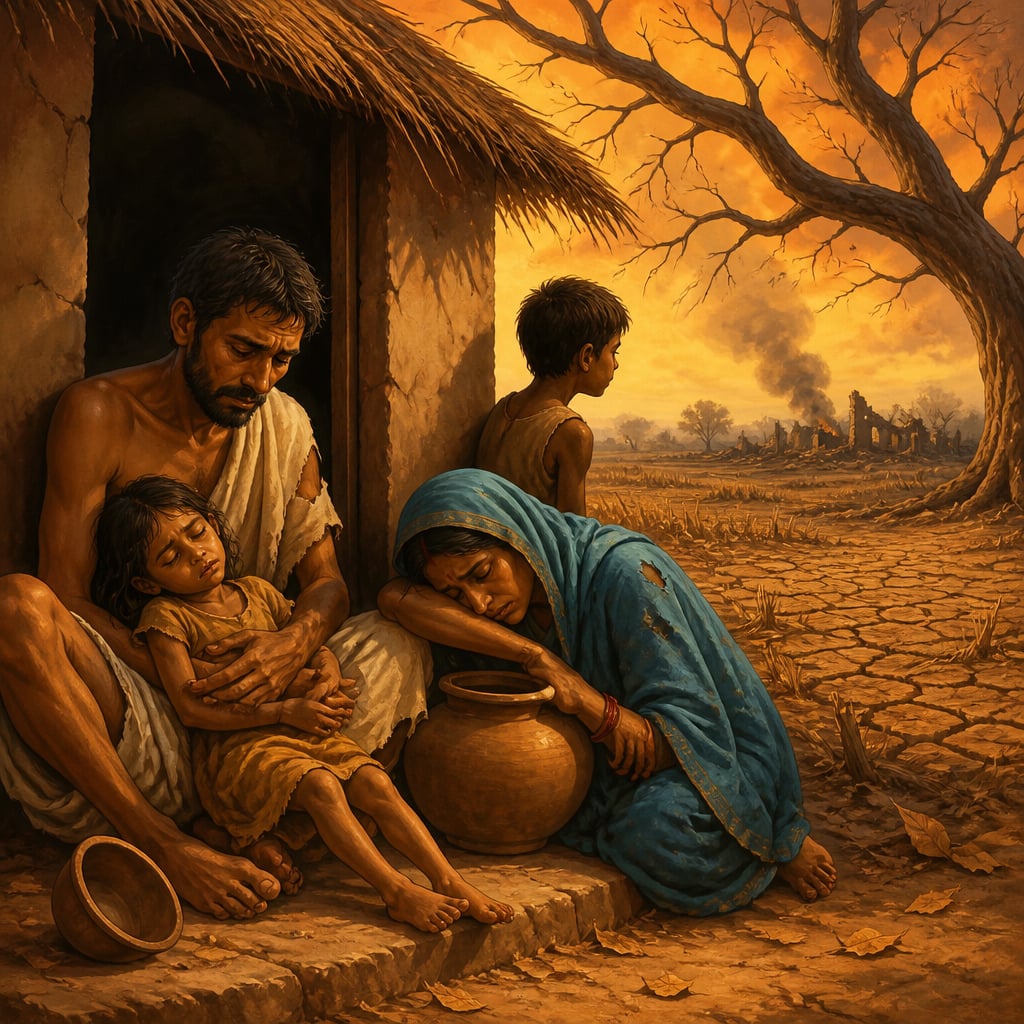
A starving Bengali family at the doorway of their hut, 1770 famine

In 1770, one-third of Bengal's population - approximately 10 million people - starved to death. The crops had failed partially, but that alone couldn't explain such catastrophe. Bengal had survived droughts before.

What had changed was the new ruler. Five years earlier, the British East India Company had gained diwani - revenue collection rights - over Bengal. Their response to the drought revealed colonial economics at its most lethal: while Bengalis starved, rice exports from Bengal continued.

Company officials, concerned about revenue targets rather than human lives, actually increased land taxes during the famine to 60% of produce - forcing farmers to sell grain they needed to survive.

This wasn't a natural disaster. It was durbhiksha-rajniti - famine as governance.

The Pattern of Colonial Famine

Before British rule, famines were rare in India. After 1757, they became endemic:

Period Major Famines Deaths (millions)
1770-1800 3 15-18
1800-1850 5 5-7
1850-1900 18 20-25
1900-1947 6 10-15

Total: 32 major famines killing 35-60 million people in 190 years of rule.

For comparison, the Mughal period (1526-1707) saw only 3 significant famines over 181 years - and none approached the mortality of colonial famines.

The question isn't why crops sometimes failed - that happens everywhere. The question is: why did crop failure lead to mass death only under British rule?

The Economic Mechanisms of Famine

1. Commercialization of Agriculture

Colonial policies forced farmers to switch from food crops to cash crops:

When drought struck, farmers growing cash crops had no food reserves. And they couldn't buy food because the market had failed.

2. Export Continuation During Famine

This is the most damning evidence of policy choice:

"Na bhavati yatra anna, tatra sarva-vinasha" - Where there is no grain, there is total destruction.

A Madras goods train exporting wheat during the 1876 famine

During the 1876-78 Madras famine (5.5 million deaths), India exported 6.4 million hundredweight of wheat - the largest wheat export in Indian history.

During the 1896-97 famine (5 million deaths), grain exports continued.

During the 1943 Bengal famine (3 million deaths), rice was being exported to British troops elsewhere while Bengalis died.

Amartya Sen, Nobel laureate economist, documented that famines are never simply food shortages - they are failures of entitlement: the inability to access food that exists. Colonial India proved his thesis catastrophically.

3. The Railway Paradox

British propagandists claimed railways would end famine by moving food to affected areas. The reality was the opposite.

Railways moved food out of famine zones to ports for export. They commercialized local markets, replacing traditional village granaries (which stored reserves) with market-based systems (which didn't).

Mike Davis, historian, calculated that railways actually increased famine mortality by enabling faster extraction and destroying local resilience.

Lord Lytton and the Ideology of Starvation

Viceroy Lord Lytton signing famine policy at his Calcutta desk

Lord Lytton, Viceroy from 1876-1880, presided over the Great Famine that killed 5.5-10 million people. His policies reveal the ideology behind colonial famine:

  1. Anti-charitable Contributions Act (1877): Made private famine relief illegal, fearing it would disrupt labor markets

  2. 'Temple Wage': Set relief wages deliberately below starvation level - workers received fewer calories than Nazi concentration camp inmates

  3. Distance Tests: Required starving people to walk miles to receive relief - many died en route

  4. No Free Food: Even when people were dying, Lytton refused free distribution, insisting on labor in exchange

Lytton wasn't a monster by his own standards - he was implementing free-market economics as understood by Victorian Britain. The problem was the theory: letting people die to preserve 'market efficiency.'

The 1943 Bengal Famine: Colonialism's Final Crime

The last great famine occurred in 1943, killing approximately 3 million Bengalis. By now, the mechanisms were well-understood:

Madhusree Mukerjee's book Churchill's Secret War (2010) documented how Churchill's cabinet actively blocked food shipments to Bengal while Indians starved.

Global Perspectives on Famine Policy

Western thinkers provided the ideological framework that colonial administrators used to justify non-intervention during famines.

Thomas Malthus (1766-1834), in his Essay on the Principle of Population, argued that famines were nature's way of correcting overpopulation. Colonial administrators cited Malthus to justify non-intervention: if India was 'overpopulated,' famine was inevitable and even beneficial. This ignored that India's population density was lower than England's, and that famines occurred in regions with food surplus.

Adam Smith (1723-1790), though writing before colonial famines peaked, provided the free-market ideology applied during them. His arguments against government intervention in grain markets were cited to justify continuing exports during famine. Smith himself might have objected - he acknowledged government's role in preventing 'dearth' - but his followers were more doctrinaire.

Florence Nightingale (1820-1910), surprisingly, was a fierce critic of colonial famine policy. Using her statistical expertise, she documented how British policies caused unnecessary deaths. Her 1878 paper 'The People of India' argued that famines were not acts of God but acts of government. She was largely ignored by colonial administrators.

Thinker Position Impact on Famine Policy
Thomas Malthus Famine is natural population control Used to justify non-intervention
Adam Smith Markets allocate efficiently Cited to continue food exports
Florence Nightingale Famines are policy failures Criticized colonial response, ignored

The Arthashastra's approach - mandatory state intervention during famine - directly contradicted the ideology colonial administrators imported from Britain.

Pre-Colonial Famine Prevention

Why were famines rare before colonialism? Ancient Indian kingdoms had sophisticated famine prevention:

  1. Grain Reserves: Arthashastra mandates government granaries for crisis
  2. Tax Relief: Dharmashastra requires tax suspension during natural disasters
  3. Price Controls: Kings controlled grain prices during shortages
  4. Migration Support: Affected populations were relocated, not abandoned

The Kautilyan principle was clear: "Durbhikshe cha raja prajanam bija-bhaktam dadati" - During famine, the king provides seed and food to his people.

Colonial rule explicitly rejected this principle.

Why This Matters for Viksit Bharat

Independent India has had no famine since 1947 - despite several droughts worse than those that caused colonial famines. Why?

  1. Food Corporation of India: Maintains grain reserves (reviving Arthashastra principle)
  2. Public Distribution System: Ensures food access regardless of market prices
  3. Democratic Accountability: Governments that allow famine lose elections

The lesson: famine isn't natural disaster - it's policy choice. The same land that starved under colonialism feeds 1.4 billion today.

Your Turn

The colonial famine record raises uncomfortable questions: What policies today might be causing preventable death through 'market mechanisms'? Climate change will bring new agricultural challenges - will we respond with Lytton's ideology or Arthashastra's?

Next, we examine how the same economic logic destroyed not just lives but livelihoods through Shilp-Vinash - the systematic deindustrialization of India.

Keynesian economics (1930s) argued governments must intervene when markets fail. Sen's entitlement approach extends this to food access. Kautilya preceded both by millennia.

The dharmic framework doesn't debate whether to intervene during crisis - it mandates intervention. The question isn't markets vs. government but recognizing when market mechanisms cause harm.

India has had zero famines since independence despite droughts equal to or worse than colonial-era droughts. The difference: policy commitment to food access through FCI, PDS, and relief systems.

Modern economics often treats reserves as 'dead capital.' But strategic reserve theory recognizes that some redundancy is essential for system resilience.

The FCI's buffer stock system directly implements Arthashastra principles. India maintains 60-80 million tonnes of food grain reserves - expensive but essential for a nation that experienced 32 colonial famines.

Colonial India destroyed traditional village grain reserves in favor of market-based systems. Without reserves, any price spike became lethal.

Key terms

Durbhiksha-Rajniti
Famine governance - the deliberate use of famine conditions as instruments of economic and political control, whether through action or calculated inaction.
Anna-Adhikara
Right to food - the principle that access to nutrition is a fundamental right that governance must protect, not a market commodity to be rationed by price.
Dhanya-Kosha
Grain treasury - state-maintained reserves of food grains for distribution during shortage, a cornerstone of traditional Indian famine prevention.
Praja-Palana
Protective governance - the ruler's fundamental duty to protect and nurture subjects, especially during crisis. The legitimacy of governance derives from this protective function.

Verses

दुर्भिक्षे च राजा प्रजानां बीजभक्तं ददाति

Durbhikshe cha raja prajanam bija-bhaktam dadati

During famine, the king provides seed and food to his people.

This represents fundamentally different economic philosophies. Kautilya: the state exists to ensure people's welfare, including during crisis. Colonial view: the market allocates resources efficiently; interference causes harm. The 35-60 million dead vindicate Kautilya's approach.

Arthashastra, Book 4, Chapter 3 (R. Shamasastry translation)

आपद्गतं च यो राजा प्रजाः पालयति स्थिरः

Apad-gatam cha yo raja prajah palayati sthirah

A steadfast king protects his subjects especially when calamity strikes.

This verse establishes that governance legitimacy derives from protective capacity. Colonial famine response - increasing taxes, continuing exports, restricting relief - violated every dharmic principle of rulership.

Manusmriti, Chapter 7, Verse 134 (Patrick Olivelle translation)

Key figures

Amartya Sen

1933-present

Mike Davis

1946-2022

Romesh Chunder Dutt

1848-1909

Case studies

PM-GKAY: Feeding 800 Million During a Pandemic

When COVID-19 struck in March 2020, India faced an unprecedented crisis. The nationwide lockdown halted economic activity instantly, leaving hundreds of millions of daily wage workers without income. The spectre of colonial famines - where market disruption led to mass starvation - loomed large. The government's response was the Pradhan Mantri Garib Kalyan Anna Yojana (PM-GKAY), launched within weeks of lockdown. The scheme provided 5 kg of free foodgrains per person per month to 800 million beneficiaries - in addition to their existing PDS entitlements. This was the world's largest food distribution program, covering more people than the entire population of Europe. The Food Corporation of India's buffer stocks - the modern dhanya-kosha - made this possible. India had 77 million tonnes of grain in reserves when the pandemic began.

PM-GKAY represented the Arthashastra principle in action: 'Durbhikshe cha raja prajanam bija-bhaktam dadati' - during crisis, the state provides food to its people. Unlike colonial famine response (continue exports, restrict relief, let markets allocate), independent India chose praja-palana - protective governance. The dharmic framework asks: What is the purpose of accumulated reserves if not for crisis? The 77 million tonnes of grain stocks represented decades of investment in food security infrastructure - an 'inefficiency' by pure market logic but essential insurance by dharmic economics. Conventional Western economic advice during pandemic focused on cash transfers and market mechanisms. India's approach - direct food distribution through existing PDS infrastructure - reflected distrust of market solutions during crisis, informed by famine memory.

PM-GKAY ran for 28 months (April 2020 - December 2022), distributing approximately 1,100 lakh metric tonnes of foodgrains worth over ₹3.91 lakh crore ($47 billion). Despite the most severe economic disruption in decades, India recorded zero famine deaths during COVID-19. The scheme demonstrated that India had successfully rebuilt the food security infrastructure that colonialism destroyed. The same nation that lost 35-60 million to policy-induced famines under British rule fed 800 million during a global pandemic. International organizations, including the World Bank and IMF, studied PM-GKAY as a model for crisis food security. The scheme proved that state capacity for food distribution - dismissed as 'inefficient' by market economists - was essential resilience infrastructure.

The contrast between colonial famine response and PM-GKAY reveals two fundamentally different governance philosophies. Colonial rule prioritized market efficiency and revenue extraction; independent India prioritized praja-palana. The 'inefficient' investments in FCI, PDS, and buffer stocks - often criticized by economists - proved their worth when crisis struck.

The COVID-era food security debate resurfaced during the 2022 global food price crisis triggered by the Russia-Ukraine war. Countries with robust public distribution systems weathered the shock better than those relying entirely on market mechanisms, validating the Arthashastra principle that states must maintain grain reserves for crisis.

PM-GKAY provided free grain to 800 million people for 28 months - the largest food security program in human history. Colonial India, by contrast, exported 6.4 million hundredweight of wheat during the 1876-78 famine that killed 5.5 million.

The 2022 Wheat Export Ban: Food Security Over Global Markets

In May 2022, as global wheat prices surged following Russia's invasion of Ukraine, India faced a dilemma. India had a record wheat harvest and could profit enormously from exports - global prices had risen 40% since the war began. Traders and international buyers pressured India to export. The government chose differently. Citing domestic food security concerns and a sudden heatwave that reduced crop yields below initial estimates, India banned wheat exports on May 13, 2022. The decision prioritized Indian consumers over export revenue. International reaction was swift and critical. The G7 called the ban 'worrying.' The WTO raised concerns. Western media criticized India for 'worsening global food crisis.' The implicit message: India should export grain even if it risks domestic shortage.

The wheat export ban represented a conscious rejection of colonial-era priorities. During the 1876-78 famine, India exported record wheat while millions starved - because export revenue mattered more than Indian lives. In 2022, India chose the opposite: domestic food security over export earnings. The dharmic principle of praja-palana demands that a ruler prioritize subjects' welfare over external demands. The export ban was criticized internationally but aligned with this principle. The Arthashastra is clear: the king's first duty is to his people's survival, not to foreign traders. Interestingly, Western criticism echoed Victorian arguments: 'markets allocate efficiently,' 'export restrictions hurt global welfare.' The same ideology that justified exporting grain during famine now criticized India for keeping grain at home.

India's wheat stocks remained adequate through 2022-23 despite the heatwave. Domestic wheat prices, while elevated, remained affordable. The feared shortage never materialized precisely because the government acted preemptively. The ban was gradually relaxed as domestic supply stabilized. By 2023, India was again discussing wheat exports, but on its own terms. The episode demonstrated that India would prioritize food security over international pressure - a reversal of colonial dynamics. The criticism India faced revealed persistent assumptions: that developing nations should serve global markets even at domestic cost. India's willingness to reject this expectation marked a significant shift in post-colonial economic sovereignty.

The wheat export ban demonstrated that independent India has internalized famine lessons: food security is non-negotiable. Unlike colonial administrators who exported grain during starvation to maintain 'market efficiency,' modern India prioritizes praja-palana even when it means international criticism. The dhanya-kosha is for Indian food security first; exports come second.

India's 2022 wheat export ban drew criticism from free-trade advocates but was vindicated when domestic prices stabilized while global wheat prices surged 40%. The policy choice echoes ongoing debates about food sovereignty versus market integration, from Africa's grain dependency to Europe's agricultural subsidies.

In 1876-78, India exported 6.4 million hundredweight of wheat while 5.5 million Indians died of famine. In 2022, India banned wheat exports to protect domestic supply - and faced international criticism for prioritizing its own food security.

Historical context

Colonial Famine Period (1770-1943)

Pre-colonial India had effective famine prevention: state granaries, tax relief during disasters, price controls. Colonial rule systematically dismantled these systems, replacing them with market mechanisms that failed catastrophically.

Ireland's Great Famine (1845-52) followed similar patterns: food export during starvation, ideological opposition to relief, mass death amid available food. Colonial governance applied the same principles globally.

Pre-colonial India (1556-1757, 200 years): approximately 5 million famine deaths. Colonial India (1757-1947, 190 years): 35-60 million famine deaths. Rate increased roughly tenfold.

Understanding famine as policy rather than nature reveals colonial governance priorities: extraction over welfare, markets over lives. This understanding informs why independent India prioritized food security.

Living traditions

The National Food Security Act (2013) legally guarantees food access to 67% of India's population. PM-KISAN provides direct income support to 100 million farmers. When India distributed free grain to 800 million people during COVID-19 lockdowns, it demonstrated capabilities that colonial India lacked entirely.

Reflection

More in Colonial Devastation: The Great Decline

All lessons in Colonial Devastation: The Great Decline · Viksit Bharat: India's Development Journey course