Shashi Tharoor: Era of Darkness Economics

Modern Accounting of Colonial Crimes

In 2015, Shashi Tharoor's Oxford Union debate went viral, articulating the economic case against colonialism for a global audience. This lesson examines how contemporary scholars have synthesized the economic evidence and brought the reparations debate into mainstream discourse.

Eight Minutes That Changed the Debate
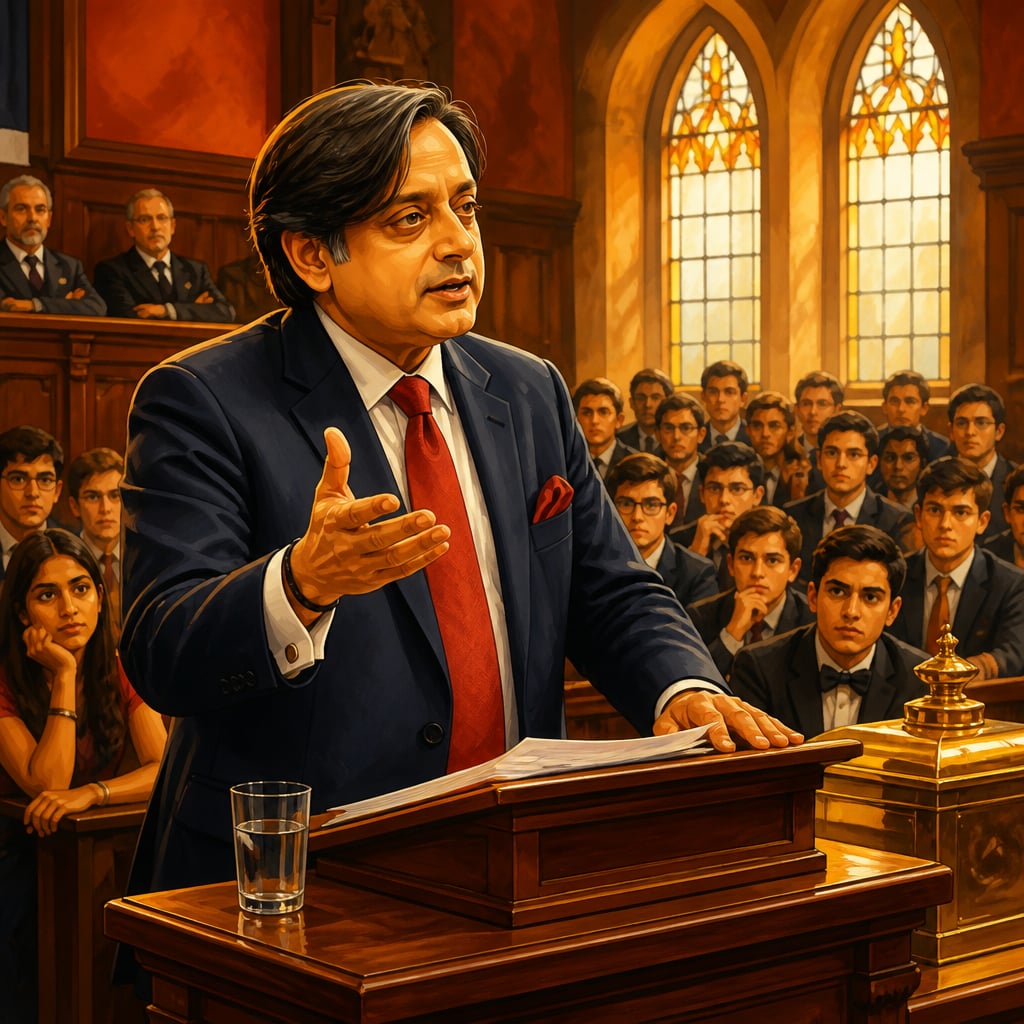
Shashi Tharoor at the Oxford Union lectern in July 2015

On July 28, 2015, Shashi Tharoor stood at the Oxford Union to argue that Britain owes reparations to its former colonies. He had eight minutes. What followed became the most-viewed Oxford Union video in history, with over 100 million views across platforms.

Tharoor's speech synthesized 150 years of economic scholarship - from Dadabhai Naoroji to Utsa Patnaik - into a devastating eight-minute indictment:

"India's share of the world economy when Britain arrived on its shores was 23 percent. By the time the British left, it was down to below 4 percent. Why? Simply because India had been governed for the benefit of Britain. Britain's rise for 200 years was financed by its depredations in India."

The debate was won, 185 to 56. More importantly, it brought colonial economic history into global public discourse.

The Book That Followed
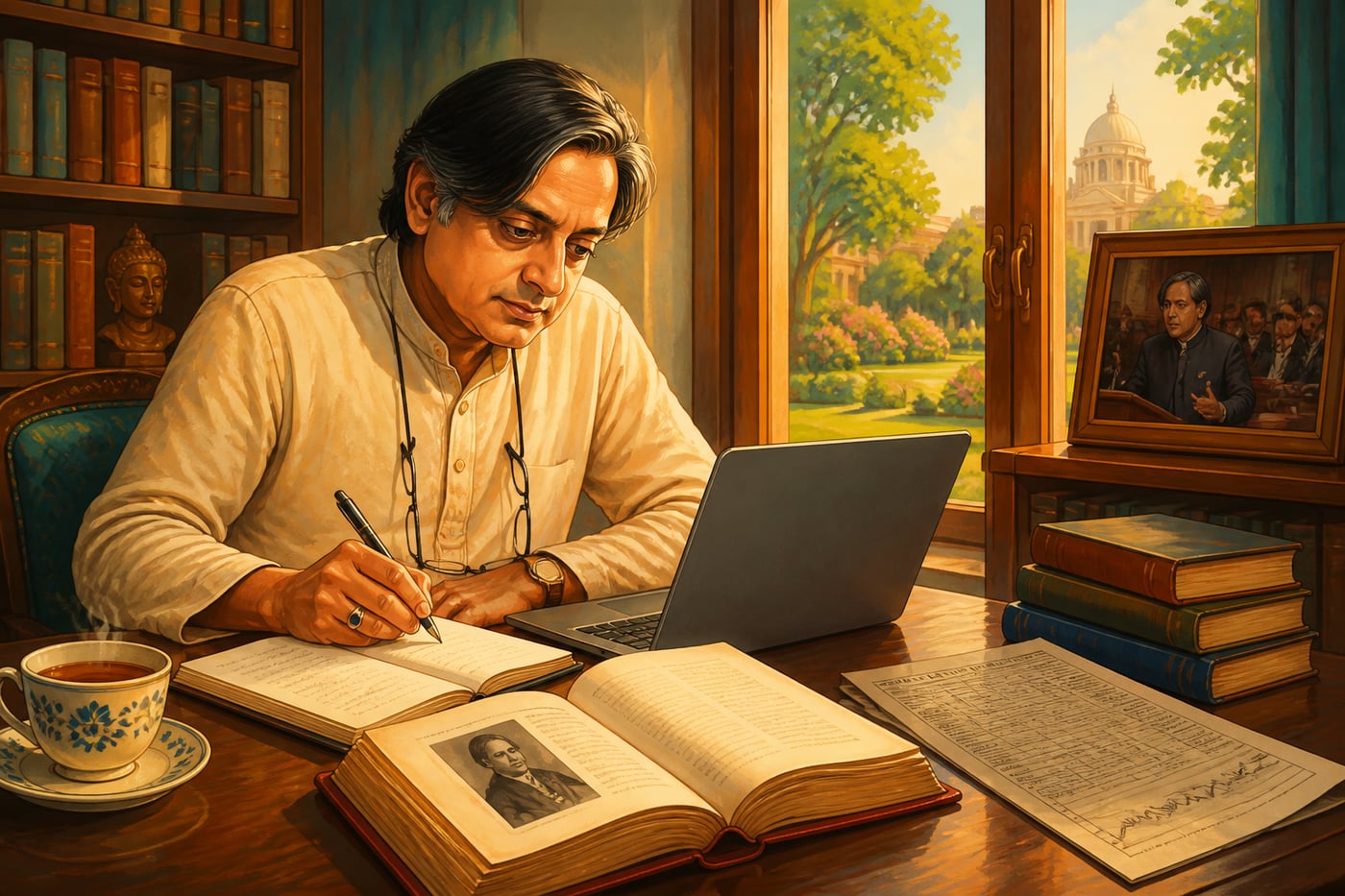
Shashi Tharoor in his Delhi study writing Inglorious Empire

Tharoor expanded his speech into Inglorious Empire: What the British Did to India (2016). The book systematically documented:

1. The Economic Destruction

2. The Social Devastation

3. The False Claims of Benefit

Railways? Built for extraction, not development:

"The railways were designed to carry resources from the interior to the ports, to be shipped to Britain. They weren't connecting Indian cities to each other - they were connecting India's resources to British markets."

Democracy? Indians fought for it despite British opposition:

"The British practiced democracy at home and denied it in India for 200 years."

Unity? Created through shared oppression:

"Indians were created by British oppression... The notion of Indian unity arose to oppose British rule."

The Reparations Argument

Tharoor's core argument isn't about money - it's about acknowledgment:

"We are not asking for vast sums of money to be transferred into our bank accounts... What we want is simply an acknowledgment that wrong was done, that apologies are owed, that there should be some sense of atonement."

His specific proposal: One pound per year for 200 years - purely symbolic, but acknowledging the historical debt.

"Satyam bruyat priyam bruyat" - Speak the truth, speak it pleasantly.

Tharoor's approach follows this principle: stating uncomfortable truths in measured language, with impeccable documentation, allowing audiences to draw their own conclusions.

Why This Matters: Historical Consciousness

Tharoor's intervention mattered because it reached audiences who had never encountered this history:

In Britain: Surveys show most British citizens believe colonialism was beneficial for colonies. This ignorance isn't natural - it's cultivated through educational omission.

In India: Younger generations, taught sanitized history or no history at all, learned the economic case against colonialism for the first time.

Globally: The debate provided a template for discussing colonial legacy without being dismissed as 'playing victim.'

The viral success proved appetite exists for this conversation - it just needed articulation.

The Scholarly Foundation

Tharoor's argument synthesized decades of academic research:

Scholar Contribution
Dadabhai Naoroji (1867) First drain calculation
R.C. Dutt (1901) Documented deindustrialization
Dharampal (1983) Recovered pre-colonial history
Amartya Sen (1981) Famine as policy failure
Mike Davis (2001) Colonial famines globally
Utsa Patnaik (2017) $45 trillion drain calculation

Each scholar built on predecessors. Tharoor's contribution was synthesis and communication - making academic research accessible to general audiences.

Global Perspectives on Colonial Reckoning

Thinkers from across the formerly colonized world have developed frameworks for understanding and addressing colonial legacy.

Frantz Fanon (1925-1961), the Martinique-born psychiatrist who worked in Algeria during its independence struggle, analyzed colonialism's psychological effects in The Wretched of the Earth (1961) and Black Skin, White Masks (1952). Fanon showed that colonialism creates psychological damage requiring active decolonization - not just political independence but mental liberation. His analysis of 'colonial mentality' directly parallels what Ashis Nandy and Tharoor describe in the Indian context.

Walter Rodney (1942-1980), the Guyanese historian, wrote How Europe Underdeveloped Africa (1972), documenting how European extraction actively reversed African development. Rodney's analysis parallels Patnaik's work on India: 'underdevelopment' wasn't a starting point but a condition created by colonial extraction. His framework - that colonizers didn't find poverty but manufactured it - is exactly Naoroji's argument applied to Africa.

Chinua Achebe (1930-2013), the Nigerian novelist, responded to colonial narratives through literature. His Things Fall Apart (1958) showed sophisticated pre-colonial African society that colonialism destroyed - paralleling Dharampal's recovery of pre-colonial Indian achievement. Achebe also critiqued Western literary representations of Africa, similar to Edward Said's 'Orientalism' critique applied to Asia.

Thinker Key Contribution Indian Parallel
Frantz Fanon Colonialism creates psychological damage Colonial mentality analysis (Nandy, Tharoor)
Walter Rodney Europe 'underdeveloped' colonies Naoroji/Patnaik drain calculations
Chinua Achebe Literature countering colonial narratives Dharampal recovering suppressed history

These global voices confirm that India's colonial experience was part of a worldwide pattern - and that demands for acknowledgment and restoration are emerging from the entire formerly colonized world.

Contemporary Debates: Beyond Reparations

The economic case against colonialism has sparked broader debates:

1. Museum Returns

The British Museum gallery displaying the Kohinoor and Indian artifacts

British museums hold approximately £30 billion worth of Indian artifacts. The Kohinoor diamond alone may be worth £400 million. Should these be returned?

Tharoor's position: "It's not about the objects - it's about acknowledgment that they were taken, not given."

2. Educational Curriculum

Should British schools teach colonial economic history? Currently, most don't. The argument that 'we shouldn't feel guilty about our ancestors' ignores that historical understanding isn't about guilt - it's about accurate knowledge.

3. Development Assistance

Britain provides approximately £50 million annually to India (which India has asked to stop). Compare this to Patnaik's $45 trillion extraction figure. Is 'aid' the appropriate framing when the historical flow was overwhelmingly the opposite direction?

Critics and Responses

Tharoor's arguments faced criticism:

"But India would have been poor anyway."

Response: India's 23% GDP share wasn't theoretical - it was measured. Poverty was created, not inherited.

"Colonialism brought modernization."

Response: Japan modernized without colonization - and faster. Colonialism wasn't necessary for development; it impeded it.

"You can't blame the past for present problems."

Response: Understanding causation isn't blame-seeking. A doctor diagnosing illness isn't 'blaming' the cause - they're enabling treatment.

"Britain already 'gave back' through development aid."

Response: Aid totaling billions doesn't compensate for extraction totaling trillions. And 'giving' what was taken isn't generosity.

The Dharmic Framework

Tharoor's approach embeds dharmic principles:

Satya (Truth): Documenting what actually happened, with evidence

Nyaya (Justice): Acknowledging wrongs, even if full restitution is impossible

Kshama (Forgiveness): Not seeking revenge or ongoing grievance, but closure through acknowledgment

This framework distinguishes Tharoor's approach from both victimhood narratives and denialism. The goal is accurate understanding enabling healthy relationships - not perpetual conflict.

Why This Matters for Viksit Bharat

Historical consciousness matters for development:

1. Accurate Self-Understanding: India isn't 'developing' toward something new - it's recovering from deliberate impoverishment. This changes target-setting.

2. Policy Confidence: Understanding that 'free trade' rhetoric served colonial interests enables skepticism about contemporary trade arrangements that may be similarly unbalanced.

3. Negotiating Position: In international forums, India's development challenges aren't failures requiring external guidance - they're consequences of historical injustice that other nations contributed to.

4. Mental Decolonization: Overcoming 'colonial mentality' requires understanding how that mentality was created. Tharoor's work contributes to this recovery.

Your Turn

Tharoor's speech succeeded because it combined rigorous evidence with compelling communication. The facts had existed for decades - what changed was their presentation to new audiences.

What uncomfortable truths about history - personal, national, or institutional - might benefit from similar synthesis and communication? And what is the responsibility of those who know to make that knowledge accessible?

In our final lesson, we examine how this understanding of colonial devastation informs India's path to Viksit Bharat by 2047 - turning historical consciousness into forward-looking strategy.

Thomas Kuhn's concept of 'paradigm shifts' describes how established views change: not through incremental evidence but through synthesizers who make new frameworks compelling.

India has deep traditions of debate (shastrartha) and public discourse (sabha). Tharoor drew on these traditions - presenting evidence, anticipating counter-arguments, and communicating accessibly.

Tharoor's Oxford speech received over 100 million views across platforms. The economic facts had existed for decades - what changed was their communication to new audiences.

South Africa's Truth and Reconciliation Commission showed that acknowledging historical wrongs enables moving forward. Germany's acknowledgment of Holocaust enables healthy German-Jewish relations today.

Tharoor explicitly asks for symbolic reparations (£1/year) rather than extractive compensation. This dharmic approach seeks closure, not perpetual conflict.

Countries that have acknowledged colonial wrongs (Germany regarding Namibia, Belgium regarding Congo) have found that acknowledgment enables rather than impedes moving forward.

Key terms

Punarsthapana
Restoration - the process of returning something to its original condition or establishing truth after a period of distortion. Applies to both physical assets and historical understanding.
Kshatipurti
Reparations - compensation for damage or injury. In colonial context, acknowledgment and restitution for historical economic extraction.
Itihasa-Bodha
Historical consciousness - awareness and understanding of historical processes that shaped the present. Essential for accurate self-understanding and effective future planning.
Samvada
Dialogue, discourse, meaningful exchange. In the context of colonial reparations, the approach of engaging in respectful but firm conversation rather than isolation or confrontation.

Verses

सत्यमेव जयते नानृतम्

Satyameva jayate nanritam

Truth alone triumphs, not falsehood.

Naoroji's drain calculations were dismissed for decades before becoming accepted. Tharoor's synthesis received viral attention because truth resonates. The colonial narrative of 'benevolent development' couldn't withstand scrutiny once the economic evidence was widely communicated. Truth triumphed - slowly, but decisively.

Mundaka Upanishad, 3.1.6 (Eknath Easwaran translation)

यदा यदा हि धर्मस्य ग्लानिर्भवति भारत

Yada yada hi dharmasya glanir bhavati bharata

Whenever dharma declines, O Bharata, then restoration arises.

Colonial propaganda created a 'dharmasya glani' - a decline in truthful understanding of economic history. The work of Naoroji, Dutt, Dharampal, and Tharoor represents 'dharma sthapana' - restoration of truth. Each generation adds to the restoration, building on predecessors' work.

Bhagavad Gita, Chapter 4, Verse 7 (Swami Sivananda translation)

Key figures

Shashi Tharoor

1956-present

William Dalrymple

1965-present

Madhusree Mukerjee

Contemporary

Case studies

The Kohinoor Diamond: Symbol of Colonial Extraction

The Kohinoor diamond, now in the British Crown Jewels, has become the most visible symbol of colonial artifact extraction and the ongoing debate about repatriation of cultural property. The Kohinoor ('Mountain of Light') is a 105.6-carat diamond with documented history in India dating to the 13th century. It passed through Mughal, Persian, Afghan, and Sikh hands before being 'presented' to Queen Victoria in 1849 after the British annexation of Punjab. The 'gift' was extracted from the 10-year-old Maharaja Duleep Singh after British forces had defeated the Sikh Empire. The diamond was recut (reducing its size by 40%) and set in the Crown Jewels, where it remains. Multiple countries (India, Pakistan, Afghanistan, and Iran) have claimed the diamond. In 2016, India's government initially stated the Kohinoor was a 'gift' before reversing position under public pressure, declaring it was taken and should be returned. While the Kohinoor's monetary value (estimated at over 400 million pounds) is significant, its symbolic value is incalculable. The diamond represents the broader pattern of colonial extraction: taking valuable assets through power, calling it legitimate acquisition, and resisting return.

Tharoor's argument that reparations are about acknowledgment, not money, applies directly to the Kohinoor. The diamond's continued presence in Britain represents continued non-acknowledgment of colonial extraction. Its return would be a concrete act of punarsthapana (restoration of what was wrongfully taken). The Dharmic principle of itihasa-bodha (historical consciousness) demands accurate acknowledgment of what happened. The ongoing British refusal perpetuates the colonial dynamic: the powerful define what counts as 'legitimate' acquisition, regardless of the powerless' experience. True kshatipurti (reparation) begins with satya (truth), not with monetary calculations.

As of 2025, the Kohinoor remains in London, displayed with the Crown Jewels. Britain has consistently refused return requests, arguing that the diamond was legally acquired and that return would set precedent emptying British museums. However, the debate has shifted public opinion: British polls now show increasing support for returns, especially among younger generations. The Kohinoor debate has catalyzed broader repatriation discussions. Germany has returned Benin Bronzes to Nigeria. France has returned artifacts to Benin and Senegal. The Smithsonian has returned items to indigenous peoples. Britain remains resistant, but pressure continues.

Symbolic issues matter in post-colonial relationships. India's request isn't driven by economic need but by the principle of itihasa-bodha, historical consciousness that demands accurate acknowledgment of what happened. Reparations begin with truth, not transactions.

The repatriation movement is accelerating. In 2022, the Smithsonian returned 29 artifacts to India, and the Met returned stolen antiquities worth millions. Over 350 Indian antiquities have been returned since 2014, signaling a global shift in how museums approach colonial-era acquisitions.

The Kohinoor is valued at over 400 million pounds. British museums hold an estimated 30 billion pounds in Indian artifacts. Germany, France, and the US have begun returning colonial-era artifacts, while Britain continues to resist.

Germany-Namibia Reparations: A Colonial Power Acknowledges

In 2021, Germany officially acknowledged its genocide of the Herero and Nama peoples in colonial Namibia (1904-1908) and agreed to pay EUR 1.1 billion in development aid, providing a precedent for colonial reparations that Britain has refused to follow. Between 1904 and 1908, German colonial forces killed approximately 65,000 Herero (80% of the population) and 10,000 Nama (50% of the population) in what historians consider the 20th century's first genocide. General Lothar von Trotha issued an extermination order; survivors were placed in concentration camps where thousands died. For over a century, Germany avoided using the word 'genocide.' But in 2021, after years of negotiations, Germany officially recognized the atrocities as genocide and agreed to a EUR 1.1 billion reparations package spread over 30 years, directed to development projects in affected communities. While the amount is a fraction of the economic damage caused, the agreement represents something unprecedented: a former colonial power officially acknowledging genocide and committing substantial funds as reparation.

This case demonstrates that the reparations debate Tharoor catalyzed isn't theoretical. Colonial powers are beginning to acknowledge and address historical wrongs. Germany's precedent increases pressure on Britain to at least acknowledge colonial economic devastation in India, even if full kshatipurti (reparations) remains complex. The Dharmic principle of prayaschitta (atonement) requires not just monetary payment but genuine acknowledgment of wrongdoing. Germany's use of the word 'genocide' reflects this deeper truth-telling that goes beyond financial calculation. For Viksit Bharat, the lesson is clear: nations that confront their past honestly are stronger than those that suppress it.

The Germany-Namibia agreement, while imperfect, establishes that colonial reparations are possible. Germany's acknowledgment used the word 'genocide,' a legal term with significant implications. The development funding, while not direct compensation to descendants, represents material commitment to addressing historical wrong. For other former colonial powers, particularly Britain, the German precedent creates pressure. If Germany can acknowledge genocide in Namibia, why can't Britain acknowledge the Bengal Famine's death toll? If Germany can commit billions, why does Britain resist even symbolic acknowledgment? The agreement's limitations (inadequate amount, government-to-government rather than victim-led, no personal compensation) also provide lessons. Tharoor's approach of seeking symbolic acknowledgment first may be strategically wiser than demanding specific amounts.

Colonial powers can acknowledge historical wrongs and provide reparations. The complexities of who receives payment and what amounts are appropriate show that Tharoor's emphasis on acknowledgment over specific monetary demands may be the wisest path forward.

Following Germany's Namibia agreement, the Netherlands acknowledged colonial violence in Indonesia (2022), and Belgium returned Patrice Lumumba's tooth to Congo (2022). The reparations conversation has moved from theoretical debate to concrete policy, with the Caribbean Community (CARICOM) demanding reparations from Britain, France, and the Netherlands.

Germany committed EUR 1.1 billion over 30 years to Namibia after acknowledging the genocide of 65,000 Herero (80% of population) and 10,000 Nama (50% of population) between 1904-1908.

Historical context

Contemporary Colonial Historiography (2015-present)

Tharoor's intervention came at a time when Indian economic confidence was rising. With India becoming the world's fastest-growing major economy, Indians were ready to reexamine historical narratives about poverty and development.

Similar debates about colonial legacy occurred regarding Belgium-Congo, Germany-Namibia, and France-Haiti. India's reparations debate is part of global reckoning with colonial economic impact.

Tharoor's Oxford speech: 8 minutes speaking time, 185-56 vote victory, 100+ million views. Demonstrates appetite for colonial economic history when communicated accessibly.

Public understanding of history shapes policy debates. Tharoor's intervention created space for discussing colonial legacy without dismissal as 'victimhood' - enabling informed conversation about development, reparations, and international relationships.

Living traditions

Tharoor's intervention spawned ongoing debates: Should British museums return Indian artifacts? Should British schools teach colonial economic history? Should symbolic reparations be paid? These debates continue in media, academia, and policy circles. PM Modi's references to colonial legacy and FM Sitharaman's budget speeches invoking colonial extraction show the discourse entering Indian policy communication.

Reflection

More in Colonial Devastation: The Great Decline

All lessons in Colonial Devastation: The Great Decline · Viksit Bharat: India's Development Journey course