Dhana-Nirgama: The Drain of Wealth Quantified

Systematic Extraction

Dadabhai Naoroji spent 50 years calculating exactly how much wealth Britain extracted from India - between $45 trillion in modern terms. This lesson examines the mechanisms of drain and the first Indian economist who dared to quantify colonial theft.

The Accountant Who Confronted an Empire
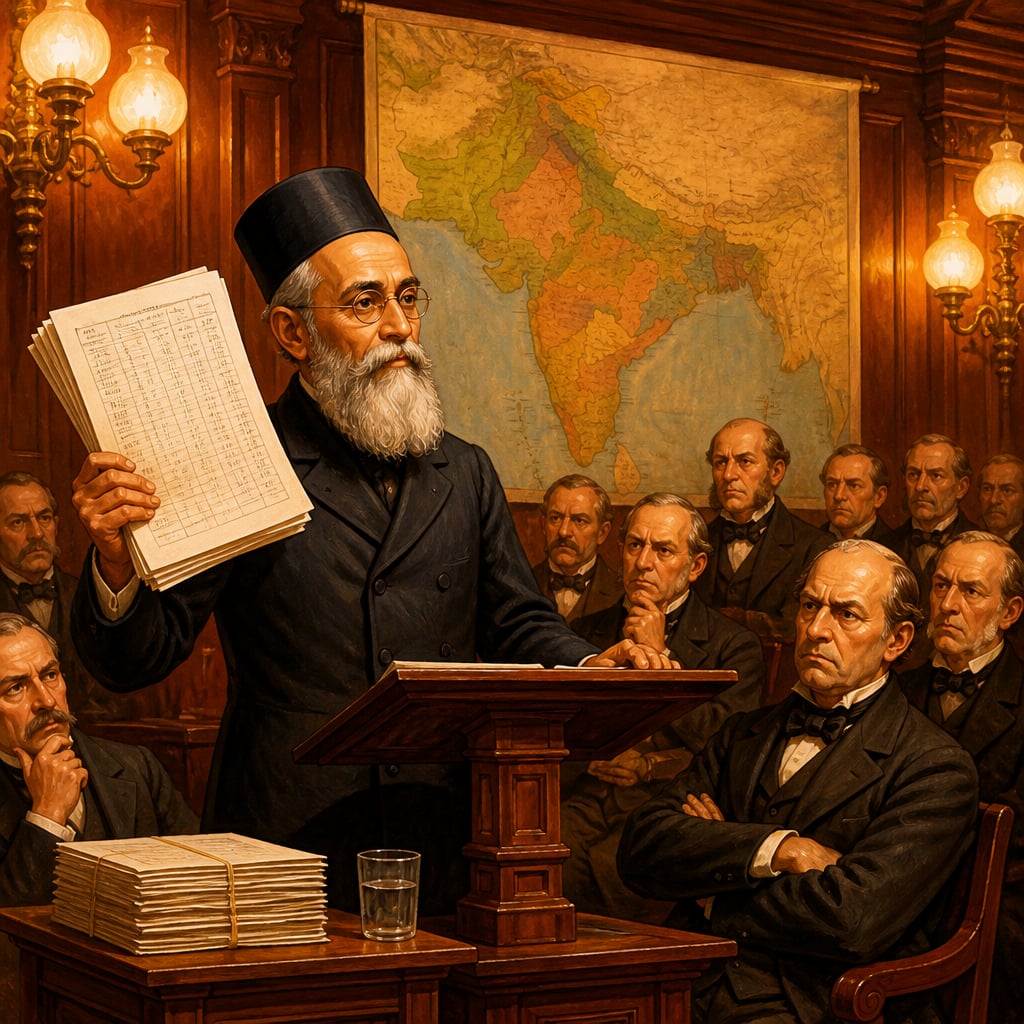
Dadabhai Naoroji at the East India Association lectern in 1867

In 1867, a thin Parsi businessman stood before the East India Association in London with a sheaf of papers. Dadabhai Naoroji had done something no Indian - and no Briton - had attempted before: he had calculated, line by line, exactly how much wealth was being drained from India to Britain.

The audience was skeptical. Surely the British were bringing 'development' to India? Railways, law courts, modern administration - weren't these worth the cost?

Naoroji's response was devastating: "The drain to England, in my estimate, is not less than £12,000,000 a year... India is being bled to death."

He would spend the next 50 years refining this calculation. By the time of his death in 1917, his work had become so irrefutable that even British administrators acknowledged the drain - while defending it as 'necessary.'

What Exactly Was the Drain?

The dhana-nirgama (drain of wealth) wasn't simple robbery. It was a sophisticated system of extraction that operated through multiple channels:

1. The 'Home Charges'

India was billed for its own colonization. Each year, the colonial government transferred funds to London as 'Home Charges' to pay for:

These charges amounted to £30-50 million annually by the early 1900s - roughly 30% of India's entire government revenue sent abroad with nothing in return.

2. The Trade Manipulation

Britain forced India into a trade relationship designed for extraction:

"Yena kena prakarena paradravyam haret" - By whatever means, he seizes another's wealth.

This ancient warning about predatory behavior describes the colonial trade system precisely:

A British clipper at Bombay harbour loaded with extracted Indian goods

3. The 'Unrequited Exports'

Economist Utsa Patnaik at her JNU desk recalculating the colonial drain

Economic historian Utsa Patnaik of JNU calculated the cumulative drain using a novel methodology: tracking India's 'unrequited exports' - goods that left India with no corresponding return of goods, services, or money.

Her calculation, published in 2017: $45 trillion extracted from India between 1765 and 1938, in 2017 dollars.

This single number explains everything - why India went from 24.4% of world GDP to under 4%, while Britain built the world's largest empire.

Naoroji's Method: The First Development Economics

Dadabhai Naoroji wasn't just complaining - he was doing rigorous economics decades before development economics existed as a field.

His methodology in Poverty and Un-British Rule in India (1901):

  1. Calculate total production: What did India produce annually?
  2. Subtract consumption: What did Indians consume?
  3. Track exports: What left India?
  4. Identify returns: What came back (goods, services, investment)?
  5. The gap is the drain: What left and never returned

The drain, he found, was approximately 6% of India's GDP annually - year after year, for nearly 200 years. Even a 2% annual drain would be catastrophic over time through compounding. At 6%, the devastation was absolute.

Naoroji made this concrete: if the drain were stopped, India could double its railway investment, eliminate famine, and educate every child - using money that was being extracted.

The British Response: Denial, Then Justification

British economists first denied the drain existed. When Naoroji's numbers proved irrefutable, they shifted to justification:

Lord Curzon (Viceroy, 1899-1905): "The drain is the price India pays for peace and good government."

This argument collapsed under examination:

R.C. Dutt, another pioneer economist, calculated that India paid more for 'administration' than Britain spent administering its entire domestic government - for a population 8 times larger.

The Multiplier Effect of Drain

The £30-50 million annual drain doesn't capture full damage. Economic extraction has multiplier effects:

  1. Lost Investment: Money drained couldn't be invested in Indian factories, infrastructure, or education
  2. Lost Compounding: 200 years of lost growth compounds devastatingly
  3. Lost Skills: With industry destroyed (next lesson), the knowledge base atrophied
  4. Lost Confidence: Generations grew up believing poverty was India's natural state

Modern calculation: If the drain had been invested domestically at even 3% annual returns, the compounded value by 1947 would exceed $100 trillion - enough to make India the world's wealthiest nation.

Global Perspectives on Colonial Extraction

Western scholars, writing after Naoroji, would develop broader theories that validated his pioneering analysis.

Andre Gunder Frank (1929-2005), the German-American economist, developed 'dependency theory' in the 1960s, arguing that 'underdevelopment' wasn't a starting point but a condition created by colonial extraction. His phrase 'the development of underdevelopment' perfectly describes what Naoroji had documented for India a century earlier - India didn't start poor; it was made poor.

Immanuel Wallerstein (1930-2019) expanded this into 'world-systems analysis,' showing how 'core' economies (Britain, Europe) systematically extracted from 'peripheral' economies (colonies) to fuel their own industrialization. India was the paradigm case: its wealth funded Britain's Industrial Revolution, while India was deliberately de-industrialized.

John Stuart Mill (1806-1873), ironically, provides the colonial justification perspective. As an East India Company employee for 35 years, Mill argued that colonial rule brought 'civilization' to 'backward' peoples. His utilitarian calculus conveniently ignored the extraction Naoroji documented. Mill's defense reveals how empire justified itself - and why Naoroji's empirical counter-argument was so revolutionary.

Thinker Key Insight Relation to Naoroji
Andre Gunder Frank Underdevelopment is created, not original Validated Naoroji's thesis with global theory
Immanuel Wallerstein Core-periphery extraction fuels industrialization India as paradigm case of his world-system
John Stuart Mill Colonial 'civilization' justifies rule The ideology Naoroji's data demolished

The difference? Naoroji had the data first. Western theorists later provided frameworks; Naoroji provided the receipts.

The Drain Continues? Modern Parallels

Naoroji's framework remains relevant for analyzing contemporary economic relationships:

The mechanisms differ, but the question Naoroji asked remains: is wealth flowing out without corresponding return?

In 2025, India's foreign exchange reserves (~$650 billion) and trade position are strong - a reversal of colonial patterns. India's new approach to taxing MNCs, requiring data localization, and scrutinizing FDI structures reflects lessons learned from drain analysis.

Why This Matters for Viksit Bharat

Understanding the drain serves two purposes:

1. Historical Accountability: The $45 trillion figure contextualizes modern India's development challenge. India isn't 'poor' due to some civilizational flaw - it was systematically impoverished.

2. Policy Framework: Naoroji's analytical approach - tracking value flows and identifying unrequited extraction - applies to any economic relationship. Is a trade deal fair? Is foreign investment beneficial? Naoroji's questions remain valid.

When PM Modi speaks of Atmanirbhar Bharat (self-reliant India), he's addressing the same concern Naoroji raised: ensuring India's economic relationships serve Indian interests.

Your Turn

Naoroji faced ridicule for 50 years before his analysis gained acceptance. He was called 'unpatriotic' (by British standards), 'ungrateful,' and 'economically illiterate' - before being proven completely correct.

The lesson: empirical truth, patiently documented, eventually prevails. This is the foundation of Satyameva Jayate - truth alone triumphs.

Next, we examine perhaps the cruelest mechanism of drain: how famines were used as instruments of economic policy in Durbhiksha-Rajniti.

Modern evidence-based policy making and randomized controlled trials (Banerjee, Duflo) follow the same principle: data trumps ideology. Naoroji pioneered this approach in an era of ideological economics.

Naoroji's genius was combining dharmic commitment to truth with Western empirical methods. He didn't appeal to emotions but to audited accounts. This synthesis - Indian values with rigorous methodology - remains powerful.

Naoroji spent 50 years collecting data before British administrators acknowledged the drain's existence. His patience produced irrefutable evidence that changed the narrative of colonialism forever.

Andre Gunder Frank's dependency theory (1960s) and Immanuel Wallerstein's world-systems analysis described how core economies extract from peripheries. Naoroji documented this pattern 60 years earlier for India.

Naoroji's analysis was concrete and quantified where later theorists remained abstract. His methodology - tracking actual flows - provides a practical tool for analyzing any economic relationship.

Naoroji's framework identified that 6% of India's GDP was extracted annually. Even 2% sustained extraction would be catastrophic over centuries; 6% explains why India collapsed from 24.4% to under 4% of world GDP.

Key terms

Dhana-Nirgama
The drain of wealth - systematic, unrequited transfer of resources from colonized to colonizer, leaving the source impoverished and the destination enriched.
Griha-Shulka (Home Charges)
The annual transfer payments India was forced to make to Britain, covering administrative costs of colonization - essentially billing the colonized for their own oppression.
Apratyutpadita-Niryata
Unrequited exports - goods and value that leave a country with no corresponding return of goods, services, or financial assets. The core mechanism of colonial drain.
Kara-Bhara
Tax burden - the weight of taxation on producers and earners. In colonial context, refers to the crushing tax rates (40-60% of agricultural output) that exceeded productive capacity and caused famines.

Verses

अधार्मिकं त्रिभिर्न्यायैर्हन्यात् राष्ट्रमवेक्षकम्

Adhārmikam tribhir nyāyair hanyāt rāṣṭram avekṣakam

An unrighteous ruler destroys the kingdom through three means: unjust taxation, seized property, and withheld wages.

The drain operated through precisely these mechanisms: (1) Taxation that exceeded productive capacity (40-60% land revenue), (2) Property seizures through legal manipulation (Permanent Settlement, Doctrine of Lapse), (3) Forced labor and suppressed wages in plantations and factories. Manu's analysis anticipated Naoroji's by millennia.

Manusmriti, Chapter 8, Verse 417 (Patrick Olivelle translation)

सर्वभूतहिते रतः

Sarva-bhūta-hite rataḥ

The ruler must be devoted to the welfare of all beings.

This principle exposes the fundamental illegitimacy of colonial economics. Every mechanism of drain - Home Charges, trade manipulation, deindustrialization - served British welfare at Indian expense. A dharmic analysis would have rejected colonial rule on first principles, without needing Naoroji's calculations.

Arthashastra, Book 7, Chapter 1 (R. Shamasastry translation)

Key figures

Dadabhai Naoroji

1825-1917

Utsa Patnaik

1944-present

Lord Curzon

1859-1925

Case studies

The Vodafone Tax Battle: India Closes Colonial-Era Loopholes

In 2007, Vodafone acquired Hutchison Essar's Indian telecom operations for $11.2 billion through a complex offshore transaction structured in the Cayman Islands and Netherlands. The deal transferred control of a major Indian company without a single rupee passing through India or triggering Indian capital gains tax. The Indian government argued this was a modern form of unrequited extraction - value created in India, captured abroad. Vodafone countered that the transaction was legally structured outside Indian jurisdiction. The case went to the Supreme Court, which ruled in Vodafone's favor in 2012 based on existing law. Rather than accept this as the final word, Parliament retrospectively amended the Income Tax Act in 2012 to close the loophole, asserting India's right to tax transactions involving Indian assets regardless of where they were structured. This triggered international arbitration, investor protests, and years of litigation.

Through Naoroji's analytical framework, the Vodafone case represents a modern drain mechanism: value generated in India (telecom customers, infrastructure, market access) being transferred without corresponding tax return. The offshore structure was legally sophisticated but economically identical to colonial-era mechanisms that extracted value while avoiding contribution to India. The dharmic principle of 'nyaya' (fairness) would ask: Is it just that a company can profit from Indian consumers, use Indian infrastructure, and employ Indian workers, yet structure ownership to avoid contributing to Indian treasury? Naoroji's methodology - tracking value flows and identifying unrequited extraction - applies directly. Conventional Western corporate law focused on technical legality. The dharmic lens asks a prior question: Is the arrangement fair to all stakeholders, including the nation?

After a decade of legal battles and international arbitration, India and Vodafone reached a settlement in 2021. India withdrew its retrospective tax demand, while implementing prospective reforms to prevent future avoidance. More significantly, India's stance influenced global tax reform: the OECD's 2021 global minimum tax agreement addressed exactly these structures. India's approach - asserting sovereign right to tax value created within its borders - reversed the colonial dynamic where foreign entities extracted value without contribution. The controversy also prompted India to strengthen its tax treaties and implement General Anti-Avoidance Rules (GAAR) in 2017, creating a comprehensive framework against modern drain mechanisms. By 2024, India's tax-to-GDP ratio had improved, and foreign companies increasingly structured investments to comply with both letter and spirit of Indian law.

Naoroji's framework for identifying drain remains relevant: track value flows, identify unrequited extraction, and assert sovereign right to fair treatment. The Vodafone case shows that modern drain mechanisms - while legally sophisticated - can be challenged when a nation applies Naoroji's analytical approach and has the institutional strength to enforce it.

The OECD's global minimum tax (Pillar Two, 2024) and India's equalization levy on digital services reflect the same insight Naoroji articulated in the 1870s: value generated in one country should not be taxed exclusively in another. Multinational tax avoidance costs developing nations an estimated $240 billion annually.

The Vodafone transaction avoided approximately ₹20,000 crore ($2.5 billion) in capital gains tax. India's subsequent GAAR implementation and tax treaty renegotiations have recovered or prevented similar avoidance worth an estimated ₹50,000+ crore since 2017.

Historical context

Colonial Economic Analysis (1867-1947)

By the mid-19th century, Indian intellectuals began systematic analysis of colonial rule. Naoroji, R.C. Dutt, M.G. Ranade, and others created 'economic nationalism' - using British empirical methods to expose British exploitation. This created the intellectual foundation for the independence movement.

No other colonized people produced such rigorous economic analysis of their own exploitation. African and Southeast Asian colonies lacked the institutional infrastructure and intellectual tradition that enabled Naoroji's work. This analysis remains unique in colonial historiography.

Naoroji calculated annual drain at £30-50 million by 1900. Adjusted for inflation and compounding, Utsa Patnaik's modern calculation reaches $45 trillion (1765-1938) - approximately 17 times India's current GDP.

The drain theory transformed Indian nationalism from emotional grievance to documented indictment. It continues to inform debates about colonial legacy, reparations, and development economics. Every discussion of 'why is India poor?' must engage with Naoroji's answer.

Living traditions

Finance Minister Nirmala Sitharaman explicitly referenced colonial extraction when presenting Union Budgets, connecting historical drain to contemporary development priorities. The 2017 Jallianwala Bagh centenary revived drain debates internationally. Shashi Tharoor's Oxford Union speech (2015), arguing for British reparations, drew directly on Naoroji and Patnaik's calculations. The drain theory remains intellectually alive and politically relevant.

Reflection

More in Colonial Devastation: The Great Decline

All lessons in Colonial Devastation: The Great Decline · Viksit Bharat: India's Development Journey course