India 1700: The World's Largest Economy
Before the Fall
In 1700, India commanded 24.4% of global GDP - larger than all of Europe combined. This lesson quantifies India's extraordinary economic position as the world's manufacturing powerhouse, and establishes the baseline from which colonial devastation would be measured.
The Emperor's Treasure Room
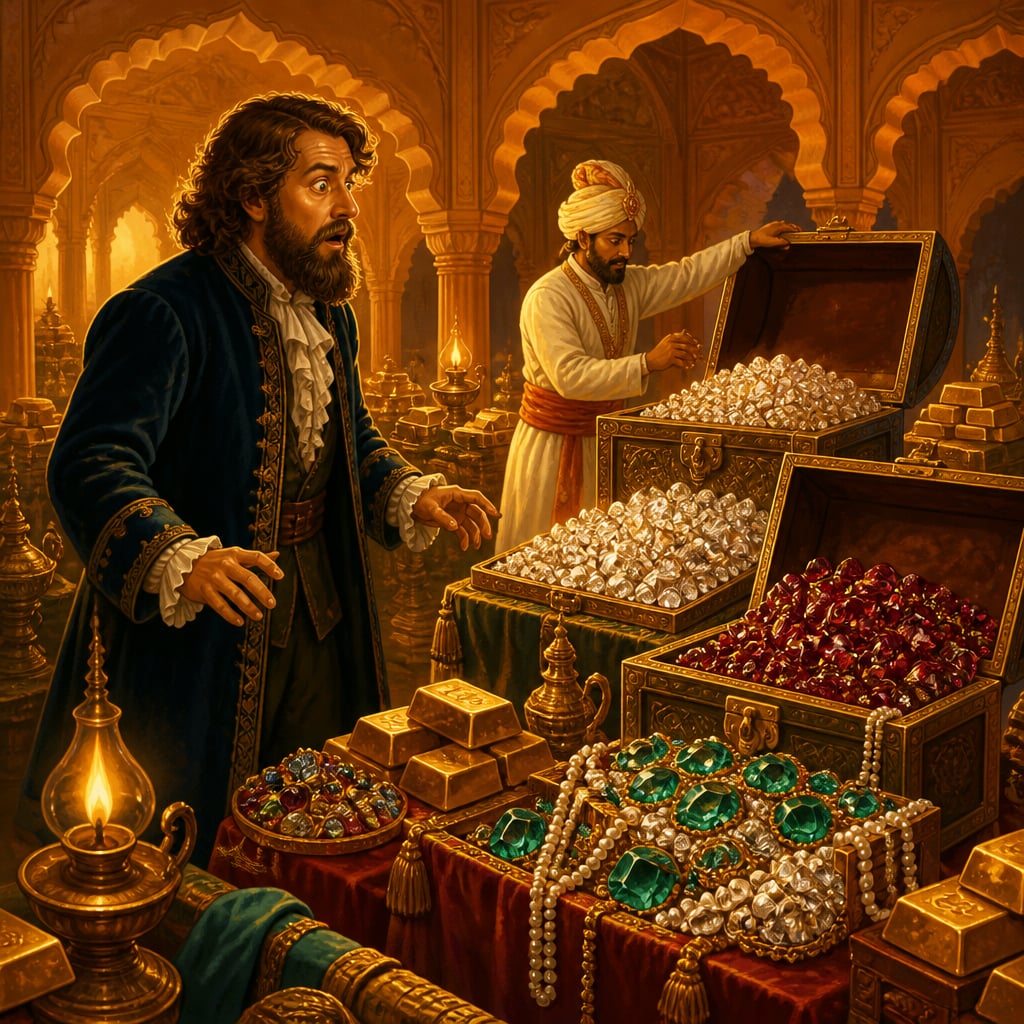
In 1665, French traveler Jean-Baptiste Tavernier stood speechless in the treasury of Mughal Emperor Aurangzeb at the Red Fort in Delhi. Before him lay the Koh-i-Noor diamond, the Peacock Throne encrusted with rubies and emeralds, and gold coins stacked floor to ceiling. Tavernier, who had visited the treasuries of Louis XIV and the Ottomans, wrote that he had never seen 'such wealth concentrated in one place in all my travels.'
This wasn't just royal extravagance. It was evidence of something far more significant: India was the richest nation on Earth.
The Numbers That Shocked Historians
When British economic historian Angus Maddison completed his landmark study The World Economy: A Millennial Perspective in 2001, his findings stunned even specialists. Using purchasing power parity calculations across centuries of data, Maddison demonstrated that in 1700:
| Region | Share of World GDP |
|---|---|
| India | 24.4% |
| China | 22.3% |
| Western Europe (all) | 21.9% |
| Britain | 2.9% |
India alone produced nearly a quarter of everything made on Earth. The tiny island nation that would colonize it contributed less than 3%.
This wasn't an anomaly. Maddison's data showed India had maintained roughly this share for nearly two millennia. In 1 CE, India and China together accounted for about 60% of global output. The 'rise of the West' was, in historical terms, a recent and temporary deviation from the norm.
The Workshop of the World
What made India so wealthy? Not gold mines or oil fields, but manufacturing excellence - what Sanskrit texts call shilpa (craftsmanship).
Textiles: The Original 'Made in India'
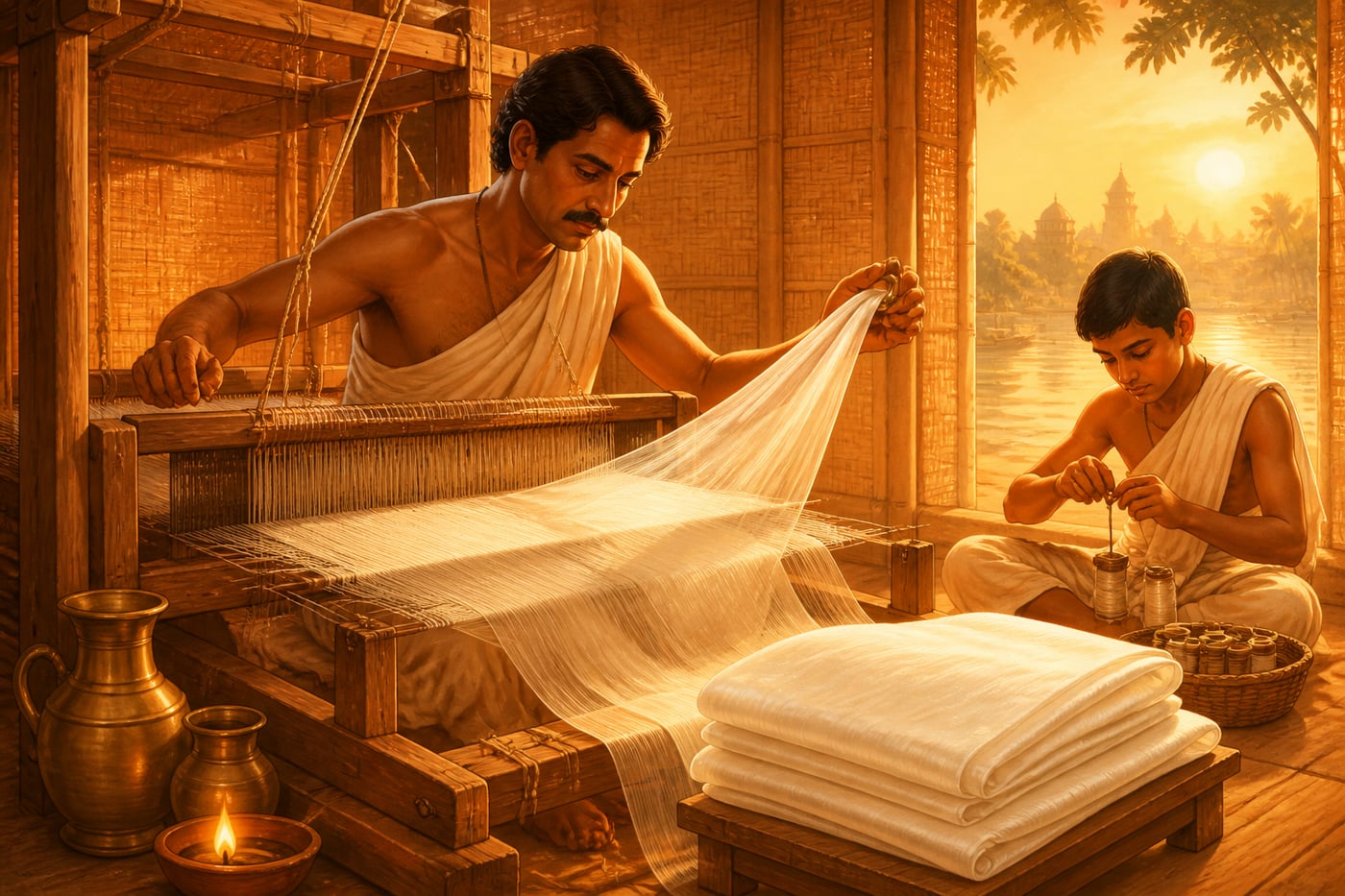
Indian cotton textiles were the most desired goods in the world. The names survive in European languages: calico (from Calicut), muslin (from Mosul, a trading hub for Indian cloth), chintz (from Hindi chint), dungaree (from Dongri in Mumbai).
The quality was legendary. Bengali muslin was so fine it was called abrawan ('flowing water') - a 20-meter sari could pass through a finger ring. Roman senator Pliny complained in 77 CE that Indian textiles were draining Rome's gold reserves. Sixteen centuries later, nothing had changed - except now it was British gold flowing east.
"Yatha deshi tatha veshi" - As the land, so the garment.
This ancient saying captures the regional diversity of Indian textile production - each area developing specialized techniques passed through generations.
Steel, Ships, and Spices
Textiles were just the beginning:
Wootz Steel: Indian crucible steel was the world's finest. Damascus swords, prized by Crusaders, were forged from Indian steel. The technique remained unmatched until the 19th century.
Shipbuilding: The Zamorin of Calicut's navy and Maratha Angre fleets were built in Indian shipyards. A 1,000-ton Indian vessel typically lasted 100 years; British ships of similar size lasted 12 years. The British East India Company bought Indian-built ships for their own fleet.
Spices: India controlled the global spice trade. Black pepper was so valuable that it was called 'black gold.' The entire European Age of Exploration was, at root, an attempt to bypass Arab middlemen and access Indian spices directly.
The Trade Surplus That Never Ended
India ran a perpetual trade surplus with the entire world. This is critical to understand: Indians didn't particularly want European goods. What could England offer that India needed? English wool? Indians had cotton and silk. English metalwork? Indians had Wootz steel.

So Europeans paid in gold and silver. The Spanish silver mines of Potosi, the gold of West Africa - all flowed eastward. Economic historian K.N. Chaudhuri estimated that between 1500 and 1750, 25% of the silver produced in the Americas ended up in India.
This is what economists call the 'silver sink' - India absorbed precious metals like a drain because it was the ultimate producer economy. The bullion never returned.
Global Perspectives on Pre-Industrial Wealth
Western economic thinkers, writing centuries later, would develop theories that India had already demonstrated in practice.
Thomas Mun (1571-1641), the English mercantilist, argued in England's Treasure by Forraign Trade that national wealth came from maintaining a positive trade balance - exporting more than importing. India had practiced this for millennia without theorizing it. Mun actually studied the East India Company's India trade to develop his theories, observing how bullion flowed eastward.
Adam Smith (1723-1790), writing The Wealth of Nations in 1776, emphasized the importance of division of labor and specialized manufacturing. Yet India's textile villages had perfected this centuries earlier - with weavers, dyers, printers, and merchants forming integrated production networks that outcompeted anything in Europe.
Karl Polanyi (1886-1964), in The Great Transformation, argued that pre-industrial economies were embedded in social relationships rather than abstract market logic. India's shilpa traditions - where craftsmen passed techniques through generations, maintained by shreni (guild) systems - exemplified exactly this embedded prosperity.
| Thinker | Key Insight | Indian Parallel |
|---|---|---|
| Thomas Mun | Trade surplus builds national wealth | India's perpetual bullion inflow |
| Adam Smith | Specialization drives productivity | Village textile production networks |
| Karl Polanyi | Economy embedded in social relations | Shreni guild systems, hereditary crafts |
The difference? These Western thinkers theorized what India had practiced for millennia.
How Do We Know This?
Skeptics might ask: are these numbers reliable? The evidence comes from multiple independent sources:
- Tax records: Mughal revenue documents show astonishing agricultural and trade productivity
- Foreign accounts: Travelers from Europe, Persia, and China independently described India's wealth
- Bullion flows: European shipping records track gold and silver movements
- Archaeological evidence: Hoards of Roman coins found across South India confirm ancient trade patterns
- Comparative analysis: Maddison triangulated across multiple data sources and methodologies
Sanjeev Sanyal, current Member of the Economic Advisory Council to the Prime Minister, has synthesized this research in The Ocean of Churn (2016), demonstrating how India's maritime trade networks underpinned global commerce for millennia.
Why This Matters for Viksit Bharat 2047
Understanding India 1700 isn't nostalgia - it's baseline establishment.
When we discuss India's economic development today, we must understand what was lost and why. India's current GDP share (approximately 7% in 2025, the world's fifth-largest economy at $4.2 trillion) isn't a 'rise' - it's a recovery from the devastation that followed 1700.
The questions this raises:
- How did a nation go from 24.4% to under 4% of world GDP by 1950?
- What mechanisms caused this collapse?
- What lessons does recovery hold for achieving Viksit Bharat 2047?
These aren't questions of victimhood but of strategic understanding. A doctor cannot treat a patient without diagnosis. India cannot chart its future without understanding its past.
Your Turn
The next time someone speaks of 'developing' India, remember: development implies reaching a new state. For India, the more accurate term might be restoration - returning to the economic prominence that was historically normal.
In the next lesson, we examine exactly how 24.4% became 4% through Dhana-Nirgama - the systematic drain of wealth that Dadabhai Naoroji first quantified in 1867.
David Ricardo's theory of comparative advantage (1817) suggested nations should specialize. Adam Smith praised division of labor. Both were describing what India had practiced for millennia.
India's advantage wasn't just theory - it was demonstrated reality. The trade surplus with every major civilization proved Indian manufacturing superiority wasn't propaganda but market verdict. European merchants didn't buy Indian textiles due to colonial pressure; they bought them because they were simply better.
In 1750, India produced 25% of global manufacturing output. By 1900, this had collapsed to 2%. This wasn't natural decline - it was deliberate destruction through tariffs, suppression, and trade manipulation.
Development economics traditionally measured progress from arbitrary starting points (often independence). Amartya Sen and others have challenged this, arguing historical context matters for understanding development trajectories.
Understanding that India was 24.4% of world GDP in 1700 fundamentally reframes 'development.' Current 7% isn't progress toward something new - it's partial recovery from catastrophic decline. This changes target-setting: Viksit Bharat 2047 becomes restoration, not aspiration.
If India had maintained even half its 1700 GDP share (12% rather than 24.4%), India's current GDP would be approximately $12 trillion instead of $4 trillion. The 'development gap' is actually a 'restoration gap.'
Key terms
- Dhana-Nirgama
- The 'drain of wealth' - systematic extraction of India's economic resources through colonial mechanisms including taxation, trade manipulation, and direct plunder.
- Kosha
- Treasury; the accumulated wealth of a state or household that provides security, power, and capability for future action.
- Vyapara-Adhikya
- Trade surplus - when exports exceed imports, resulting in net inflow of wealth. India maintained this position with the entire world for millennia.
- Shilpa
- Craftsmanship, artisanal skill, manufacturing expertise. The technical knowledge and skill required to create high-quality goods, passed through generations of craftsmen.
Verses
कोशमूलो दण्डः
Kosha-mulo dandah
The treasury is the root of all state power.
This principle explains both India's historical power and its vulnerability. The massive treasury that impressed Tavernier was the 'kosha' that made the Mughal state formidable. Colonial powers understood this - their first target was always the treasury. The sack of Bengal's treasury after Plassey (1757) netted £2.5 million for Clive alone.
Arthashastra, Book 2, Chapter 12 (R. Shamasastry translation)
பொருளென்னும் பொய்யா விளக்கம்
Poruḷeṉṉum poyyā viḷakkam
Wealth is the unfailing lamp that illuminates all paths.
India's cultural, scientific, and spiritual achievements - universities like Nalanda, temple complexes like Brihadeeswarar, mathematical discoveries - were funded by economic surplus. The 'unfailing lamp' of wealth enabled civilizational achievement. Colonial extraction didn't just take money; it extinguished the lamp that funded everything else.
Thirukkural, Chapter 76, Verse 756 (G.U. Pope translation)
Key figures
Angus Maddison
1926-2010
Sanjeev Sanyal
1971-present
Dadabhai Naoroji
1825-1917
Case studies
Tata Steel Acquires Corus: When India Reclaimed Its Steel Legacy
In January 2007, Tata Steel - founded in 1907 by Jamsetji Tata - acquired Anglo-Dutch steel giant Corus for $12.1 billion, creating the world's fifth-largest steel company. This was the largest overseas acquisition by an Indian company at the time. The acquisition included the former British Steel Corporation - the very entity that had once benefited from the destruction of India's indigenous steel industry. The symbolism was unmistakable. Corus traced its lineage to companies that had flourished as India's legendary Wootz steel production was systematically dismantled under colonial rule. British industrial policy had deliberately destroyed Indian steel manufacturing to create markets for British goods. A century later, the descendants of the colonized were acquiring the descendants of the colonizers. Ratan Tata faced fierce competition from Brazilian company CSN, but persisted through multiple bidding rounds. When asked why he was willing to pay a premium, Tata reportedly said it was about 'proving that Indian companies could compete and win on the global stage.'
From a dharmic economics perspective, the Tata-Corus acquisition represents 'Artha-Punarutthana' (wealth restoration) rather than mere business expansion. The Tata philosophy - 'What comes from the people must go back to the people' - reflects the dharmic principle that wealth creation should serve larger purposes. Conventional Western analysis focused on financial metrics: Was Tata overpaying? What were the synergies? The dharmic lens adds another dimension: This was restoration of a capability (steel manufacturing leadership) that had been wrongfully taken. The 'kosha' (treasury/capability) that Kautilya identified as the root of national power was being rebuilt. The acquisition also demonstrated 'Shreshthata' (excellence) - Tata Steel's operational expertise would later turn around struggling Corus plants, proving that Indian manufacturing capability had recovered.
The acquisition initially struggled - the 2008 financial crisis hit Corus hard, and Tata wrote down billions. Critics called it a vanity purchase. But by 2024, the integration had succeeded: Tata Steel Europe operates as a transformed entity with Indian management techniques improving productivity. More significantly, the acquisition triggered a wave of Indian global acquisitions: Hindalco-Novelis, Bharti-Zain, Mahindra-Ssangyong. Indian companies proved they could compete at the highest levels. India's crude steel production rose from 53 million tonnes (2007) to over 140 million tonnes (2024), making India the world's second-largest steel producer. The Tata-Corus deal symbolically closed a colonial chapter. The nation that once supplied the world's finest steel, was destroyed as a steel producer, and then re-emerged to acquire its destroyers' successor companies.
Economic restoration isn't just about numbers - it's about reclaiming capabilities and confidence. Tata Steel's acquisition of Corus demonstrates that the manufacturing excellence ('shilpa') that made India wealthy in 1700 can be rebuilt. The 'kosha' (treasury of capability) that colonial rule depleted is being restored - one acquisition, one factory, one innovation at a time.
Indian companies completed over $80 billion in overseas acquisitions between 2005 and 2024, spanning steel, automotive, pharma, and IT. Each acquisition reverses a specific colonial-era capability drain, rebuilding Indian ownership over industries that were systematically dismantled or extracted.
India was the world's largest steel producer until the 18th century (Wootz steel). By 1947, India produced less than 1 million tonnes annually. By 2024, India produces over 140 million tonnes - the world's second-largest producer. Tata Steel alone produces 35 million tonnes globally.
Historical context
Pre-Colonial India (c. 1700 CE)
India in 1700 was a manufacturing superpower exporting textiles, steel, and spices globally while running trade surpluses with every major trading partner. The Mughal economy, despite political tensions, maintained sophisticated banking (hundis), production networks, and trade routes. Regional economies (Bengal textiles, Malabar spices, Deccan steel) were globally integrated.
Britain in 1700 was a small economy (2.9% of global GDP) with modest manufacturing. The Industrial Revolution hadn't begun. Britain's main exports were wool and tin - neither competitive with Indian products. The British East India Company's profits came from trading Indian goods, not British ones.
According to Maddison's calculations, India's GDP in 1700 was approximately $90.8 billion (1990 international dollars), compared to Western Europe's total of $81.2 billion.
This data establishes the baseline for understanding colonial devastation. India's later poverty wasn't historical destiny but recent catastrophe. Without understanding 1700, we cannot comprehend 1947 or plan 2047.
Living traditions
India's 'Make in India' initiative (launched 2014) explicitly invokes this heritage - the goal isn't new industrialization but restoration of manufacturing prominence. The textile industry remains India's second-largest employer (45 million workers). Tata Steel's acquisition of Corus (2007) symbolically returned steel manufacturing leadership to Indian ownership. When PM Modi speaks of India becoming a '$5 trillion economy,' he's invoking recovery toward historical norms, not unprecedented achievement.
- Traditional Textile Production: Handloom weaving continues in Varanasi (silk), Kanchipuram (silk), and Bengal (cotton). These craftspeople are direct inheritors of the traditions that made India wealthy. Their struggle mirrors India's economic journey.
- Wootz Steel Revival Attempts: Metallurgists and archaeologists have attempted to recreate Wootz steel production. While not commercially viable, these efforts preserve knowledge of India's industrial heritage.
- Calico Museum of Textiles, Ahmedabad: Houses one of the world's finest collections of Indian textiles spanning 500 years. Demonstrates the sophistication that made Indian cloth globally dominant.
- Indian Museum, Kolkata (Economic History Gallery): Contains artifacts from India's trading past including ancient coins, trade documents, and manufacturing tools that evidence pre-colonial prosperity.
- Brihadisvara Temple: Built by Rajaraja Chola I in 1010 CE, this temple demonstrates the economic prosperity that enabled such massive construction, its inscriptions record detailed economic transactions that evidence the sophisticated temple economy of pre-colonial India
- Somnath Temple: Repeatedly destroyed and rebuilt, Somnath symbolizes both the wealth that attracted invaders and the resilience of Indian civilization, its reconstruction represents the modern restoration of India's economic and cultural heritage
Reflection
- Maddison's data shows India was 24.4% of world GDP in 1700 but under 4% by 1950. How does knowing this baseline change your understanding of India's 'development' challenge?
- India's 1700 wealth came from manufacturing excellence - producing goods the world wanted. What industries or capabilities could India develop today to create similar 'organic' demand for Indian products?