Shilp-Vinash: Deindustrialization of Manufacturing

Destruction of Indian Industry

In 1750, India produced 25% of global manufactured goods. By 1900, this had collapsed to 2%. This lesson documents the systematic destruction of Indian textiles, steel, and shipbuilding - industries that made India wealthy - through deliberate colonial policy.

The Weavers Who Cut Off Their Own Thumbs
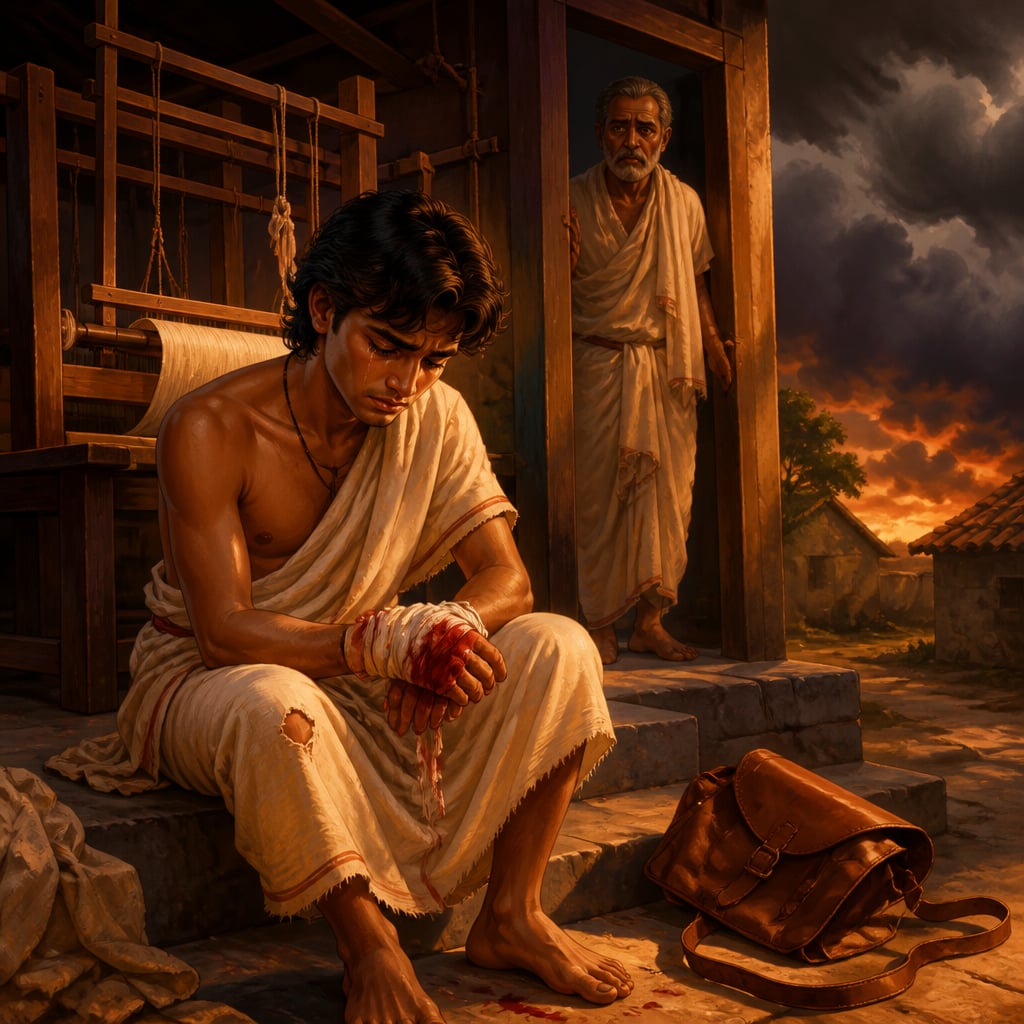
A Dacca weaver after his thumbs were severed, 1772

In 1772, the weavers of Dacca (modern Dhaka) did something almost unimaginable: they cut off their own thumbs. These were the world's finest craftsmen, whose muslin was so delicate that Europeans called it woven air. Why would they mutilate themselves?

The answer lay in the new colonial administration. The East India Company had established monopoly purchasing of Dacca muslin at prices below production cost. Weavers who tried to sell elsewhere faced imprisonment. Those who couldn't meet quotas were flogged. Some were literally tied to their looms.

Cutting off their thumbs was the only escape - they couldn't weave, so they couldn't be enslaved.

This wasn't an isolated incident. It was shilp-vinash - the systematic destruction of Indian manufacturing - and it transformed India from the world's workshop to a raw material supplier.

The Numbers of Destruction

The manufacturing collapse is captured in two statistics:

India's Share of World Manufacturing Output:

Year India's Share Britain's Share
1750 24.5% 1.9%
1800 19.7% 4.3%
1860 8.6% 19.9%
1900 1.7% 18.5%
1947 ~2% ~10%

India's manufacturing share didn't just decline - it collapsed by 93% in 150 years. This wasn't competition; this was destruction.

How They Did It: The Three Mechanisms

1. Tariff Manipulation

The most powerful weapon was trade policy:

This wasn't free trade - it was deliberately rigged trade. Indian cloth couldn't compete in British markets due to tariffs; British cloth flooded India duty-free.

"Yatha rajya tatha praja" - As the kingdom, so the people.

The kingdom was now run for British manufacturers, not Indian ones. The people followed into poverty.

2. Destruction of Artisan Networks

Traditional Indian manufacturing operated through shreni (guilds) that:

Colonial policy systematically destroyed these networks:

Without guild support, individual artisans were helpless against industrial competition.

3. Raw Material Extraction

India was transformed from manufacturer to raw material supplier:

Before colonialism:

A colonial-era Indian cotton field exporting raw cotton to Britain

After colonialism:

The value-addition that created Indian wealth was now captured by Britain. India supplied the input (cotton) at low prices and bought the output (cloth) at high prices.

The Textile Apocalypse

Textiles were India's largest industry, employing millions and generating the trade surplus that made India wealthy.

Dacca Muslin: Death of Excellence

Dacca, the Manchester of the East, specialized in ultra-fine muslin. A 50-yard piece could weigh less than 500 grams and pass through a ring. European royalty prized it above all fabrics.

By 1840, Dacca's population had fallen from 150,000 to 30,000 - an 80% collapse. The weavers didn't just lose their jobs; the knowledge of how to make Dacca muslin was lost. The techniques, passed through generations, died with the last weavers.

Today, despite modern technology, nobody can recreate true Dacca muslin. The knowledge was destroyed, not just the industry.

Bengal Handloom: Deliberate Destruction

Governor-General William Bentinck wrote in 1834: "The misery hardly finds a parallel in the history of commerce. The bones of the cotton-weavers are bleaching the plains of India."

This wasn't regret - it was boast. Bentinck was describing successful policy. The destruction was intentional.

Steel and Shipbuilding: Forgotten Industries

Wootz Steel: Superior Technology Suppressed

An Indian master smith working a wootz steel crucible at his forge

Indian crucible steel (Wootz) was the world's finest. Damascus swords, prized globally, were made from Indian steel. The process:

Colonial policy suppressed this industry by:

By 1900, India - which had invented superior steel - was importing steel from Sheffield.

Shipbuilding: Sinking an Industry

Indian shipyards built vessels that lasted 100 years (British ships lasted 12). The East India Company itself purchased Indian-built ships for its fleet.

Colonial policy destroyed this industry through:

By the late 19th century, India - surrounded by ocean, with millennia of maritime heritage - had no significant shipbuilding industry.

Global Perspectives on Industrial Policy

Western economists, writing much later, would develop theories that explain both what India had and what colonialism destroyed.

Friedrich List (1789-1846), the German economist, argued in The National System of Political Economy that 'free trade' benefits already-industrialized nations while trapping others in raw material production. His 'infant industry' argument - that developing nations need temporary protection to build manufacturing - describes exactly what Britain denied India. Britain protected its own industries for centuries before preaching 'free trade' to colonies.

Ha-Joon Chang (1963-present), Korean economist at Cambridge, documents in Kicking Away the Ladder how every wealthy nation industrialized through protection, subsidies, and state support - then advocated 'free trade' for others. His analysis of South Korea's industrial policy mirrors what India needed but was denied. Chang argues that the 'free trade' India was forced into was a tool of colonial extraction, not economic wisdom.

Dani Rodrik (1957-present), Turkish-American economist at Harvard, has documented 'premature deindustrialization' - how developing countries today are losing manufacturing before building industrial capacity. His analysis suggests that what colonialism did to India by force, globalization now does through markets. India's PLI schemes are, in his framework, a response to this structural challenge.

Thinker Key Insight Application to India
Friedrich List 'Free trade' favors the already-industrialized Britain's asymmetric tariffs destroyed Indian industry
Ha-Joon Chang All rich nations protected industries while developing India was denied the policy space every successful nation used
Dani Rodrik 'Premature deindustrialization' threatens development Colonial destruction was forced; modern policy must counter market forces

These Western economists validate what Indians experienced: manufacturing matters, protection can be legitimate, and 'free trade' rhetoric often serves power, not principle.

R.C. Dutt's Documentation

Romesh Chunder Dutt (1848-1909), ICS officer turned economic historian, documented deindustrialization in his two-volume Economic History of India (1901-03):

"India in the 18th century was a great manufacturing as well as a great agricultural country, and the products of the Indian loom supplied the markets of Asia and Europe. It is, unfortunately, true that the East India Company and the British Parliament... discouraged Indian manufacturers in the early years of British rule in order to encourage the rising manufactures of England."

Dutt's work provided ammunition for the independence movement by proving that Indian poverty was manufactured, not natural.

The 'De' in Deindustrialization

This wasn't underdevelopment - it was **de-**development. India had industrialized before Britain. The task was destroying what existed:

Modern India isn't industrializing for the first time - it's re-industrializing after deliberate destruction.

Why This Matters for Viksit Bharat

The 'Make in India' initiative isn't a new project - it's a restoration project. India was once 'Made in India' by default; it must become so again deliberately.

Key lessons:

  1. Manufacturing matters: Service economies are vulnerable; making things creates stable prosperity
  2. Value chains matter: Exporting raw materials while importing finished goods is economic subordination
  3. Skills and knowledge can be lost: The destruction of Dacca muslin techniques shows that capabilities, once lost, may never return
  4. Policy shapes outcomes: 'Free trade' that isn't actually free is exploitation

When India today negotiates trade agreements or builds PLI (Production Linked Incentive) schemes for manufacturing, it does so with historical awareness of what rigged trade cost.

Your Turn

The weavers of Dacca chose mutilation over slavery. What does their sacrifice teach us about economic dignity? And what industries today might face similar 'deindustrialization' through unfair trade practices, technology dependencies, or policy neglect?

Next, we examine how colonial policy destroyed not just factories but minds through Vidya-Vidhvansa - the systematic destruction of Indian knowledge systems.

Economists like Ha-Joon Chang argue that manufacturing matters more than services for sustained development. No country has become wealthy primarily through services without a manufacturing base.

India's IT services success is remarkable but can't replicate manufacturing's employment multiplier. The PLI schemes recognize this - they're not new policy but restoration of what colonialism destroyed.

Manufacturing contributes about 17% to India's GDP (2024) vs 30%+ in China. Viksit Bharat 2047 targets raising this to 25% - still below India's pre-colonial share.

Michael Polanyi's concept of 'tacit knowledge' - knowing how to do things that can't be fully articulated - explains why some capabilities can't be rebuilt from books alone.

The guru-shishya tradition recognized that some knowledge transfers only through direct transmission. The shreni system preserved this by ensuring continuous apprenticeship. When shrenis collapsed, the transmission ended.

Despite modern technology and strong interest, authentic Dacca muslin cannot be reproduced. The knowledge - maintained for centuries - was destroyed in decades and cannot be recovered.

Key terms

Shilp-Vinash
The destruction of crafts and manufacturing - the systematic elimination of Indian industrial capacity through colonial policy, converting a manufacturing economy into a raw material supplier.
Shreni
Traditional Indian trade and craft guilds that organized production, maintained quality, trained apprentices, and provided economic security - the institutional infrastructure of Indian manufacturing.
Shilpa-Vidya
Craft knowledge - the technical and tacit knowledge required to produce high-quality manufactured goods, often passed through generations within craft communities.
Shulka
Tariff, customs duty, or tax on trade. The weapon used to destroy Indian industry - British shulka on Indian goods was 70-80% while Indian shulka on British goods was forced to 3.5%.

Verses

शिल्पविद्या च कोशस्य मूलम्

Shilpa-vidya cha koshasya mulam

Craft knowledge is the root of the treasury.

This principle explains both India's pre-colonial wealth and colonial impoverishment. When 'shilpa-vidya' (craft knowledge) was destroyed through deindustrialization, the 'kosha' (treasury) necessarily collapsed. Modern policies like PLI schemes attempt to rebuild this foundation.

Arthashastra, Book 2, Chapter 12 (R. Shamasastry translation)

தொழிலென்னும் கூலிதூர்த்தாற்போல் களை

Tozhil ennum kuli thurthar pol kalai

Skill in craft brings earnings as surely as water flows to low ground.

This verse captures the economic logic that colonialism inverted. Normally, 'skill brings earnings.' But when skill is actively suppressed through tariffs, monopolies, and physical violence, the natural economic flow is blocked. Deindustrialization was the deliberate damming of this river.

Thirukkural, Chapter 109, Verse 1085 (G.U. Pope translation)

Key figures

Romesh Chunder Dutt

1848-1909

William Bentinck

1774-1839

Ha-Joon Chang

1963-present

Dani Rodrik

1957-present

Case studies

PLI Scheme in Electronics: Reversing Centuries of Deindustrialization

In 2014, India imported 78% of its electronics - phones, computers, components - while domestic manufacturing contributed barely 2% of global production. This was the legacy of deindustrialization: a nation that once made the world's finest goods now assembled products designed and manufactured elsewhere. In 2020, the government launched the Production Linked Incentive (PLI) scheme for electronics manufacturing, offering 4-6% incentives on incremental sales for companies manufacturing in India. The target was audacious: transform India from importer to global manufacturing hub. The results exceeded expectations. Apple, which had zero manufacturing in India in 2017, now produces over 14% of global iPhones in India (2024). Samsung's Noida factory became the world's largest mobile phone factory. Foxconn, Pegatron, and Wistron - the titans of electronics manufacturing - established major operations. By 2024, India had become the world's second-largest mobile phone manufacturer.

The PLI scheme represents 'shilpa-punaruthana' (craft restoration) - the deliberate rebuilding of manufacturing capability that was systematically destroyed. Where colonial tariffs destroyed Indian manufacturing to benefit British industry, PLI uses incentives to restore it. From a dharmic economics perspective, this isn't protectionism but restoration of balance. Friedrich List's 'infant industry' argument - that developing nations need support to build capabilities - applies with special force to India, which had mature industries deliberately destroyed. The PLI scheme provides the policy space India was denied under colonialism. The Arthashastra principle 'shilpa-vidya cha koshasya mulam' (craft knowledge is the root of treasury) directly applies: rebuilding manufacturing capability rebuilds economic sovereignty. When India makes phones rather than importing them, value stays in India - reversing the colonial pattern of value extraction.

By 2024-25, the electronics PLI scheme had attracted investments of ₹8,390 crore, with production of ₹8.25 lakh crore and exports of ₹1.15 lakh crore. Mobile phone exports alone reached $15.6 billion in 2023-24, up from nearly zero in 2017. More significantly, the scheme demonstrated that industrial policy works. Success in electronics led to PLI expansion across 14 sectors: textiles, automobiles, pharmaceuticals, semiconductors, solar panels, and more. Total PLI allocation across sectors exceeds ₹2 lakh crore. The transformation is both economic and psychological. India is no longer accepting the role of raw material supplier and finished goods importer that colonialism imposed. The 'shilp-vinash' of the 19th century is being reversed through deliberate policy in the 21st century.

Manufacturing capability doesn't return automatically - it requires active policy intervention. The PLI scheme demonstrates that India can rebuild 'shilpa-vidya' (craft knowledge) when government provides the framework that colonial rule destroyed. The lesson for Viksit Bharat 2047: industrial policy isn't optional luxury but essential restoration.

The global semiconductor shortage of 2021-23 exposed how manufacturing concentration in a few countries creates systemic risk. India's PLI scheme for semiconductors (2021, Rs 76,000 crore) and the US CHIPS Act ($52 billion) both reflect the same lesson: strategic manufacturing capability cannot be outsourced indefinitely.

India's mobile phone production: 2014 - 60 million units (imports dominated), 2024 - 330+ million units (world's #2 producer). This single sector reversal demonstrates that colonial-era deindustrialization can be undone through deliberate policy.

Historical context

Deindustrialization Period (1757-1947)

Pre-colonial India was the world's manufacturing leader, producing 25% of global output. Manufacturing employed millions in sophisticated industries: textiles, steel, shipbuilding, jewelry. These industries operated through shreni (guild) networks that maintained quality, trained workers, and provided economic security.

Britain's Industrial Revolution is often credited to technological innovation. The capital to fund that innovation came substantially from colonial extraction, including the destruction of competing Indian industry. Britain developed by destroying the competition.

India's share of world manufacturing: 24.5% (1750) → 1.7% (1900). A collapse of 93% in 150 years through deliberate policy.

Understanding deindustrialization reveals that India's economic challenge isn't development but restoration. 'Make in India' isn't creating something new - it's rebuilding what was deliberately destroyed.

Living traditions

The Production Linked Incentive (PLI) schemes (2020-) explicitly target manufacturing revival in sectors India once dominated. The ₹1.97 lakh crore allocated across sectors including textiles represents policy recognition that manufacturing matters. When Apple opens manufacturing in India or Samsung builds factories, this represents restoration of capability destroyed two centuries ago.

Reflection

More in Colonial Devastation: The Great Decline

All lessons in Colonial Devastation: The Great Decline · Viksit Bharat: India's Development Journey course