Relevance in 2026 and Beyond

From Historical Understanding to Viksit Bharat

How understanding colonial economic devastation - from the drain of wealth to deindustrialization - informs India's path to becoming a developed nation by 2047.

Why Does $45 Trillion Matter Today?
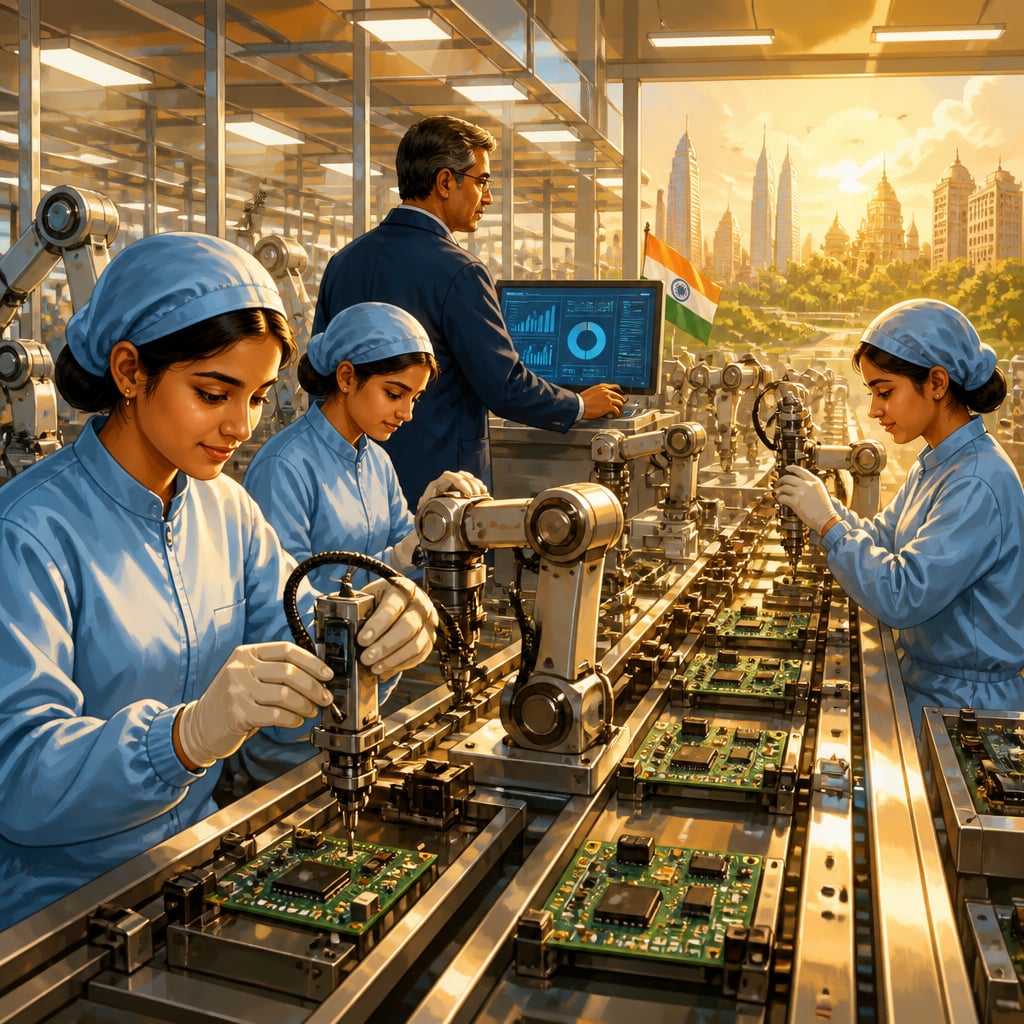
An Indian PLI-scheme electronics assembly factory in 2025

In December 2025, India became the world's fourth-largest economy, overtaking Japan. Headlines celebrated 'India Rising.' But beneath the celebration lies a question that shapes every development debate: Is India developing toward something new, or recovering something lost?

This isn't academic curiosity. The answer determines target-setting, policy design, and national confidence. A nation that believes it's inherently poor will set modest goals. A nation that understands it was impoverished will aim for restoration - with the confidence that prosperity isn't aspiration but restoration.

The Modern Challenge: Confidence and Ambition

India's development challenge isn't primarily technical - it's psychological. Consider these patterns:

Investment Hesitation: Indian companies often seek Western validation before scaling. When Tata Steel acquired Corus in 2007, it was treated as surprising - an Indian company buying British industrial heritage. Yet historically, Indian steel was the world's finest.

Brain Drain Persistence: Despite India's tech boom, the best graduates often leave. In 2024, approximately 400,000 Indian students studied in the US and UK. The assumption: 'real' achievement happens elsewhere.

Colonial Mentality in Consumption: Premium products in India often use English packaging and Western imagery. The implicit message: quality comes from outside.

These patterns aren't individual failures - they're residue of colonial education designed, in Macaulay's words, to create people 'Indian in blood but English in intellect.'

Understanding colonial devastation isn't dwelling on victimhood - it's diagnosis enabling treatment. You can't overcome a mentality you don't understand.

The Chapter's Core Teaching

This chapter documented a catastrophic transformation:

But the chapter also documented recovery: India's post-independence policies prevented famine, rebuilt education, and restored manufacturing capacity. The 'development' challenge is actually a 'restoration' challenge - and restoration is possible because it was achieved before.

The Bridge: History Informing Policy

Economic Policy

Understanding colonial extraction informs current policy debates:

Trade Negotiations: When India hesitates at 'free trade' agreements, historical awareness explains why. 'Free trade' rhetoric served colonial interests while protecting British manufacturing. India's careful approach to RCEP and other agreements reflects learned skepticism, not protectionism.

Manufacturing Focus: The PLI (Production Linked Incentive) schemes explicitly invoke manufacturing restoration. The ₹1.97 lakh crore investment isn't creating new capability - it's rebuilding what tariff manipulation destroyed. When Tata builds a semiconductor plant or Apple manufactures in Chennai, this represents historical restoration.

Food Security: India's massive food distribution system - PDS, FCI reserves, mid-day meals - directly addresses famine history. During COVID-19 lockdowns, India distributed free grain to 800 million people. Colonial India couldn't feed Bengal; modern India fed the nation during unprecedented crisis.

International Relations

Historical consciousness shapes diplomatic posture:

An Indian-hosted multilateral summit table in New Delhi, 2025

QUAD and Multipolarity: India's pursuit of strategic autonomy - working with the US, Russia, and multiple partners - rejects the colonial pattern of exclusive dependency. The lesson of extraction is: don't let any single relationship become extractive.

Reparations Discourse: Shashi Tharoor's framing - symbolic acknowledgment rather than massive compensation - shapes realistic expectations. The goal isn't extracting wealth back but ensuring relationships are equitable going forward.

Artifact Repatriation: Discussions about the Kohinoor and other colonial-era acquisitions carry meaning beyond the objects. They represent whether historical wrongs will be acknowledged.

Personal and Professional Application

The lessons apply beyond policy:

Addressing Skepticism

"Isn't this just dwelling on victimhood?"

No - it's diagnosis. A doctor identifying the cause of illness isn't 'dwelling' on the disease; they're enabling treatment. Understanding why India is where it is enables effective strategy for where it's going. Viksit Bharat 2047 requires understanding why Bharat was impoverished in the first place.

"Colonial history is contested - aren't you cherry-picking?"

The core facts aren't contested: India's GDP share fell from ~24% to ~4%; Britain gained what India lost; famines occurred under colonial rule at unprecedented scale. Maddison's data, Patnaik's calculations, and Sen's famine analysis are peer-reviewed scholarship. Details may be debated; the pattern is clear.

"Doesn't blaming colonialism excuse modern governance failures?"

No - it contextualizes them. Understanding that India started with 12% literacy in 1947 helps evaluate progress toward 77% today. Understanding the drain explains why capital formation was slow. Historical awareness enables fair assessment, not excuse-making. Modern governance should still be held accountable - but against realistic baselines.

Your Practice: Moving Forward with Historical Consciousness

This chapter's lessons translate into personal and professional practice:

1. Baseline Awareness: Before judging any organization's or nation's performance, understand starting conditions. What was inherited? What was the trajectory from?

2. Extraction Detection: Apply Naoroji's framework to your own relationships. Where is value flowing? Is the exchange mutual or extractive? What returns are you receiving for what you contribute?

3. Confident Contribution: India's historical achievements - in manufacturing, education, governance - weren't accidents. They can be rebuilt. Your work contributes to that restoration.

The goal isn't perpetual grievance but informed optimism. India was great, was impoverished, and is recovering. Understanding all three stages enables effective contribution to the third.

Viksit Bharat 2047 isn't just an economic target. It's the completion of a recovery that Naoroji began documenting in 1867, that independence made possible in 1947, and that this generation is positioned to achieve.

More in Colonial Devastation: The Great Decline

All lessons in Colonial Devastation: The Great Decline · Viksit Bharat: India's Development Journey course