The Thief's Son
At the holy well of Gaya, three hands rise to claim one son: the man who begot him, the man who raised him, and the thief who willed him into being. Whose son is he?
A dying thief, with no son to continue him, uses his wealth to arrange a child: he marries a girl, pays a brahman to father a son on her, and the boy is left at a childless king's gate and raised as a prince. Years later, at Gaya, three hands rise to receive the son's funeral offering, the thief's, the brahman's, and the king's. Whose son is he truly? You judge first, then the king does.
The Burning Ground
The corpse had slipped back to the tree, as it always did. The king brought it down once more, shouldered it, and set off across the ash. The Vetala settled behind his ear and told a tale of three fathers and one son.
The Three Fathers
In a city ruled by a childless king named Suryaprabha, a widow named Hiranyavati fled one night with her daughter Dhanavati, and in the dark she stumbled against a thief who hung dying, impaled upon a stake, but still just alive.
The dying thief spoke to her. He had gold, he said, buried away, and no son, and a man without a son cannot perform the rites the dead depend on, so the doors of the ancestral heavens would stay shut against him. So he made her an offer. Marry your daughter to me now, and whatever son she bears by my arrangement, whoever begets him, shall be counted my son, raised up to continue me. And he gave her a thousand gold pieces.
They agreed. The marriage rite was done there in the dark, with water poured over the dying thief's hand. And by his instruction, and with his gold, a young brahman named Manahsvamin was paid to father a child upon Dhanavati. In time she bore a son, marked with every auspicious sign.
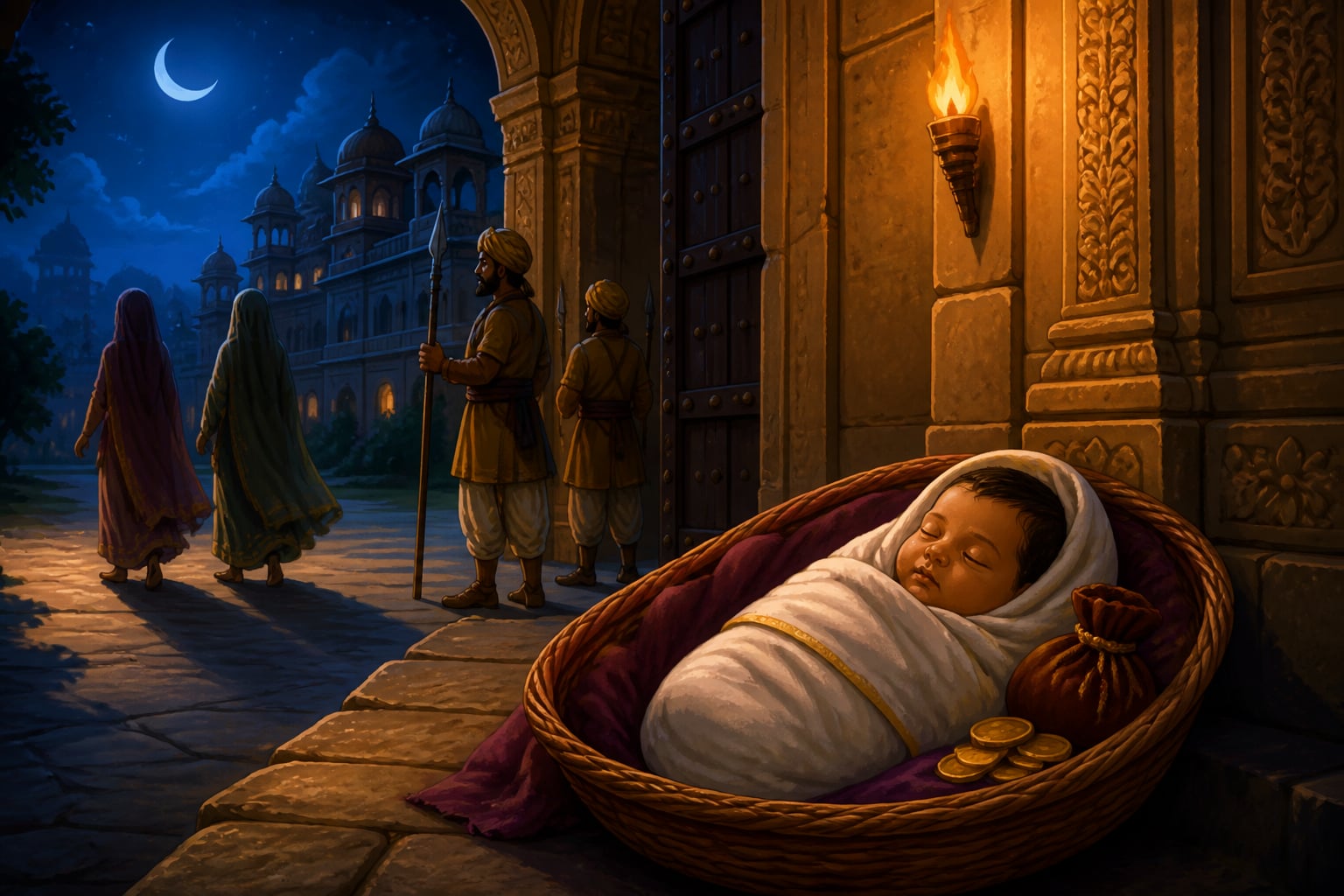
Then, bidden by a divine voice in a dream, the mother and grandmother laid the infant, with a thousand gold pieces beside him, at the gate of the childless King Suryaprabha. And the king, himself commanded in a dream, took the boy in, and raised him as his own, and named him Candraprabha; and in time the boy became king.
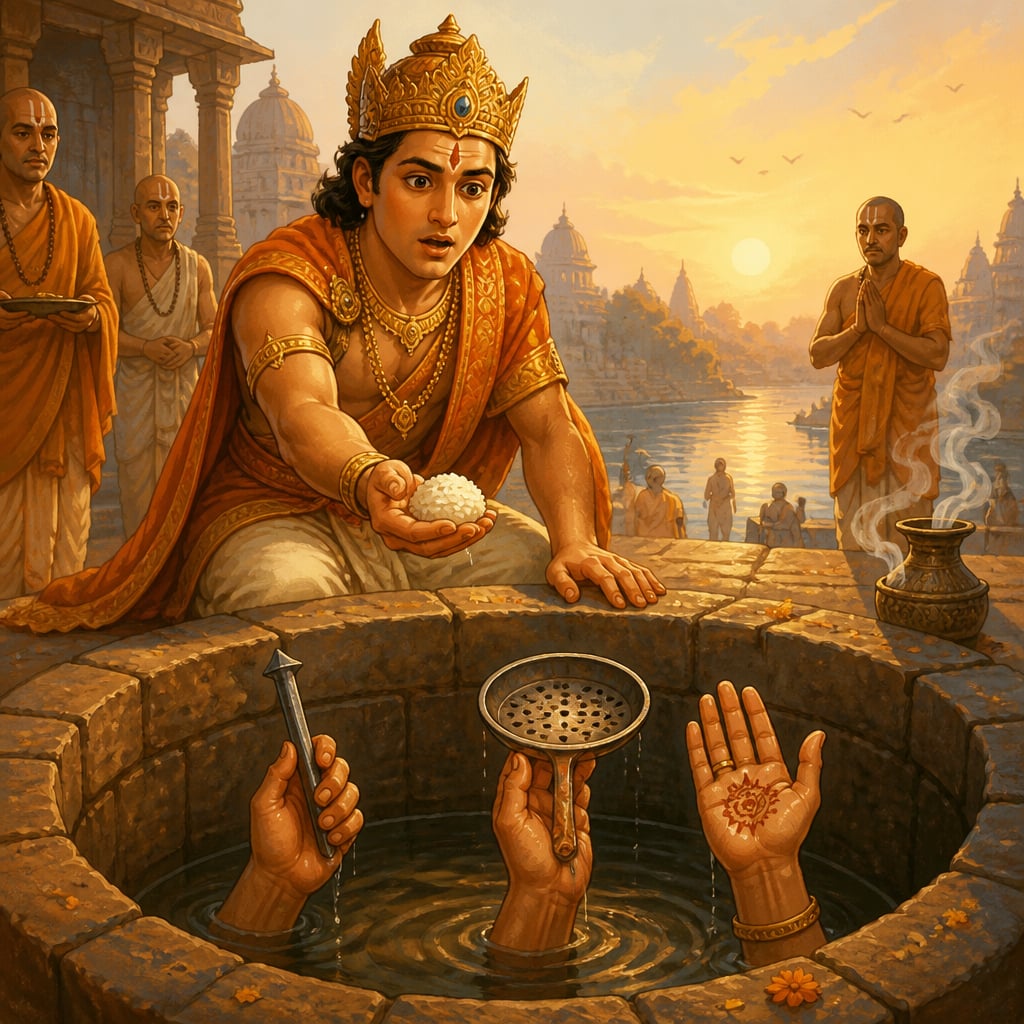
Many years later, after his royal foster-father had died, King Candraprabha went on pilgrimage, and at the holy city of Gaya he performed the shraddha, the offering of the sacred rice-ball to his father. But as he reached to set the offering down, three hands rose up out of the sacred well to receive it. One hand gripped an iron spike, the thief's. One held a strainer, the brahman's. And one bore a ring and the marks of royalty, the king's. Three men claimed to be his father. Into whose hand should he place the offering?
The Betaal's Riddle
"So, king," said the Vetala. "Three fathers, three hands. The thief, who arranged for him to be born. The brahman, who begot him. The king, who raised him. Into whose hand should the son place the offering for his father? Which of the three was truly his father?
Answer, if you know. You know the rules."
You Be the Judge
Stop and choose, before the king speaks. One man's body made him. One man's household raised him. One man's will and wealth arranged for him to exist at all. Which of the three is the father, when a son must choose only one hand?
Vikram's Verdict
"The thief," said Vikramaditya. "The offering belongs in the thief's hand. He, and neither of the other two, was the boy's true father.
"Consider the brahman first. Yes, he begot the child. But he did it for money, for a single night, hired and paid. A man who sells his part for a fee is a hired hand in the matter, not a father; he gave a service and took his price, and there his claim ends. And the king? He raised the boy with love, and gave him a throne, and for that he has earned deep gratitude. But remember, a thousand gold pieces were laid beside the child in the cradle, toward the cost of his keeping. The king too, in the reckoning of the thing, was recompensed for what he gave. He was the boy's guardian, and a fine one, but not his father.
"Now the thief. It was his intention that the child should exist at all, his command that set the whole of it in motion, his wealth that paid for every part of it, and his own lawful marriage to the mother that made the child his, raised up to continue his line. Everything, the begetting, the birth, the very gold that carried the boy to a king's gate, flowed from the thief's will and belonged to the thief's purpose. The other two were hands that he hired. He was the author of it all. The son is his."
No sooner had he spoken than the corpse slipped away, back to the branch.
The Dharma
This verdict overturns our first instinct, which reaches either for the man whose body made the child or the man who lovingly raised him. The king points past both of them, to a third thing: the intention that authored the whole. The thief lifted not a finger of the physical work; others begot the child, and others raised him. But it was his will that the child exist, his design that shaped how, and his wealth that drove every step. And that, the verdict says, is what makes a father, and more widely, what makes the author of anything: not the hand that does the work, but the intention that originates it and the ownership that carries it through.
The tradition takes intention with the utmost seriousness. Every rite begins with a sankalpa, a formal statement of intent, because the intention is held to be the true seed of the act; the deed is only the intention made visible. The Upanishad says it in a line: as is a person's deep desire, so is their will; as their will, so their deed; as their deed, so what they become. The dying thief's whole self bent upon a single desire, a son to continue him, and that desire, through his will and his wealth, became a living man. The son was the fruit of the thief's intention, and so the son was the thief's.
And there is a hard clarity in it about agents and authors. The brahman and the king were not wronged; each gave a real thing, and each was fairly paid for it. But being paid is exactly what marks them as agents rather than authors. The one who bears the originating intention, and the ownership, and the risk, is the principal. The hired hands, however skilled or loving, are not.
In Your World
Think of anything built by many hands: a company, a project, a work, a movement. Skilled people do the making; others tend and maintain it. And usually one person, or a few, bore the originating intention, and put their will and their resources and their risk behind it, and so are its authors, its principals, whatever the title on the door.
The tale asks you to know, honestly, which of the two you are in each thing you touch. If a thing is truly yours, if your intention and your ownership brought it into being, then own it and answer for it as a principal, not a bystander. Do not hide behind the hands you hired when it goes wrong, or hold yourself apart from what was done in your name; the author carries the whole of it, the failures along with the credit. And if you are the hand hired to build or tend another's vision, do your work with honour and take your fair reward, without mistaking the wage for ownership. The offering goes into the hand of the one whose intention made it all.
Reflection
- You judged the three fathers before the king spoke. Did you reach for the one who sired him or the one who raised him, before you considered the one whose will and wealth caused him to exist at all?
- In your own work, who is the true author of the things you have built, the hands that executed them, or the intention and resources that set them in motion?
- Where have you been the paid hand on someone else's vision, and where have you been the one whose intention truly authored the thing? Do you honour the difference?