Talapatram

The Brahman's Son and the Borrowed Power

A young man performs a great rite of magic flawlessly, word for word and step for step, and still the power is lost, and his teacher's power with it. Why does a perfect rite fail?

Candrasvamin seeks a magic science from a Pashupata ascetic. The rite is performed underwater amid twenty-four years of illusion, and he recites every word correctly. But at the final moment his mind wavers with doubt and attachment, the fire meant to complete the rite goes cold, and the power is lost to both pupil and teacher. Why did a flawless rite fail? You judge first, then the king does.

The Burning Ground

Again the corpse hung waiting in the branches. The king took it down, shouldered it, and walked. Behind his ear the Vetala stirred and told a tale of a rite done perfectly, that failed all the same.

The Rite That Failed

In the city of Ujjayini there lived a brahman's son named Candrasvamin, who had gambled away everything he had and been left half dead. At a temple of Shiva he met a wandering Pashupata ascetic, ash-smeared and matted-haired, who possessed a magic science, a vidya, that could grant any wish at all. Candrasvamin begged to be taught it, and at last, reluctantly, the ascetic agreed. But he gave a warning: this power is won under the water, and while you recite the charm submerged, the science itself will conjure illusions to bewilder you. You must endure them, and know them for what they are, and at the end I will call you back with a counter-charm.

Candrasvamin submerged in meditation amid illusory visions

So Candrasvamin went beneath the water and began to recite. And the illusion took him utterly. He seemed to live a whole new life: he was born again, grew up, studied, married, had children, and built an ordinary, happy life across twenty-four long years, forgetting entirely that any of it was a spell. Then his teacher's counter-charm reached him, and he remembered: none of this is real. The last step was to walk into a funeral fire, which the teacher had promised would not harm him, and would complete the rite.
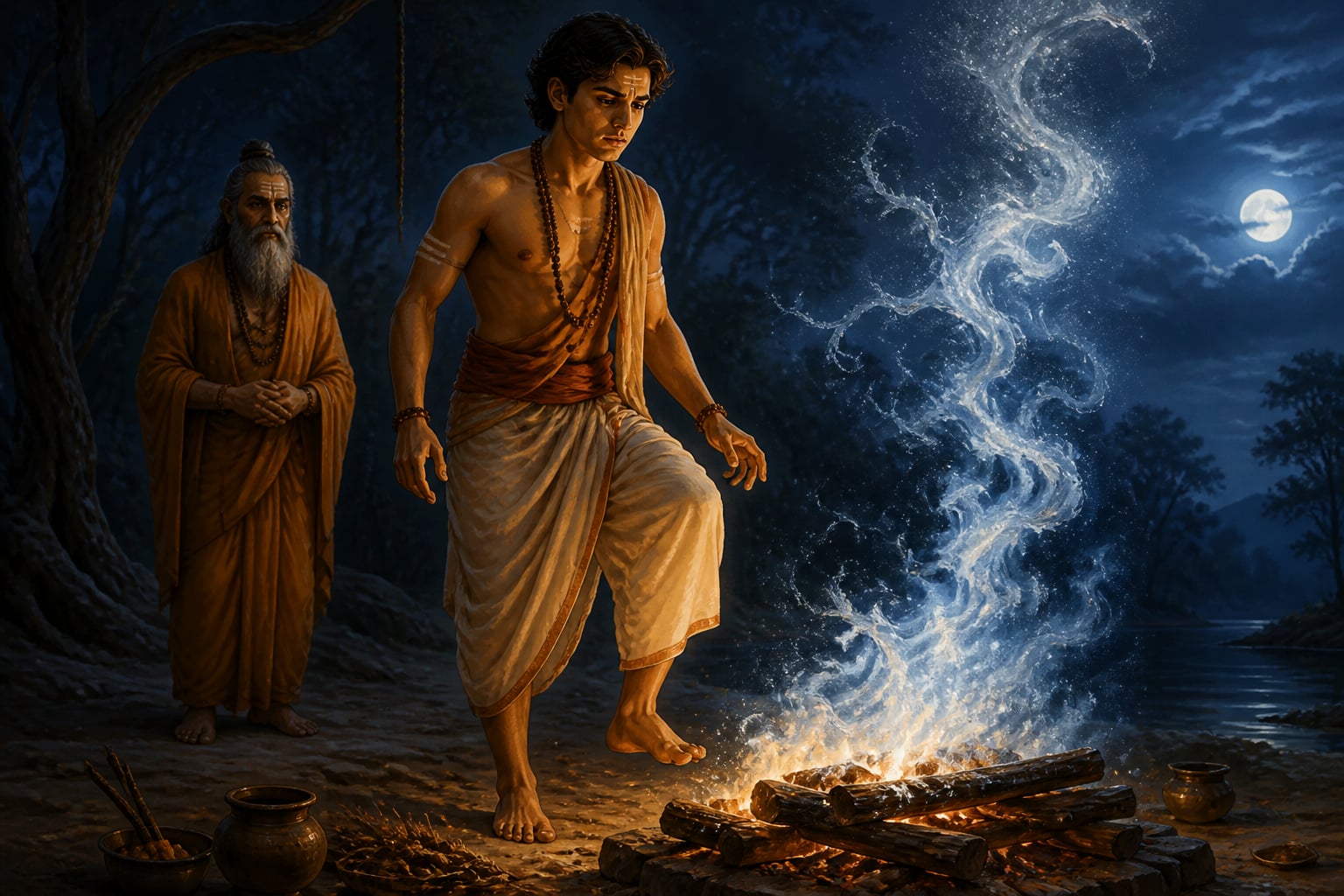
Candrasvamin hesitating as the trial fire turns cold

But at that final moment, his mind wavered. He looked at the aged parents, the weeping wife, the crying children of his illusory life, and thought: they will all die of grief if I enter the fire. And worse, he thought: I do not even know whether my teacher's promise is true. Doubt and attachment seized him together. He walked into the fire anyway, but the wavering had already done its work. The fire was cold to him, cool as snow, which is the sign that the rite has failed.

He rose and told the teacher, who was dismayed. The fire should never have been cold, he said; you must have wavered. And when the teacher reached inward for his own science, to prove it still worked, he found it gone as well. The pupil had lost the power he tried to gain, and the teacher had lost the power he already held. Both walked away with nothing.

The Betaal's Riddle

"So, king," said the Vetala. "The young man recited every word of the charm correctly, and did every step in its proper order, exactly as he had been taught. And still the science was lost, and lost not only to him but to his teacher as well. Why? Where does a rite performed perfectly go wrong?

Answer, if you know. You know the rules."

You Be the Judge

Pause here, before the king answers. He made no mistake in the words. He missed no step. By every outward measure the rite was flawless. And still it failed, and dragged his teacher's power down with it. If the method was perfect, where did the failure come from?

Vikram's Verdict

"The failure was in his mind, not in his method," said Vikramaditya. "A difficult rite like this is not won by getting the words and the steps right. Those are only the outside of it. It is won by the mind behind them, and that mind must be firm, unwavering, fearless, without a single crack of doubt in it. That is the real work, and the words are only its garment.

"And this young man's mind was not firm. At the very last moment, when everything he had endured came down to one act of pure conviction, he wavered. He was caught by attachment, grieving for a wife and children he knew were not even real, and he was caught by doubt, telling himself, I do not even know if my teacher spoke the truth. A mind split like that, hesitating and unsure at the decisive instant, cannot carry a great rite through, however perfect the recitation. The fire went cold because his resolve had already gone cold. That is why the science was lost to him.

"And it was lost to the teacher too, and justly. A master who hands so great a power to a mind not ready to bear it forfeits it himself. He misjudged the one thing that mattered most: not whether the pupil could recite the charm, but whether the pupil could stand firm."

The corpse was gone from his shoulder, back to the branch.

The Dharma

Here is the lesson, and it is one of the hardest to accept: that doing everything right is not enough. We believe, deep down, that if we prepare perfectly, learn the steps, say the right words, do it all by the book, then success must follow. This tale says no. There is a further thing, and it is not in the method at all. It is in the steadiness of the mind that carries the method out.

At the decisive moment, the enemy is almost never ignorance. Candrasvamin was not ignorant; he knew the rite cold. The enemy is samshaya, doubt, and its close companion, attachment. Doubt is no mild thing in the tradition's eyes. The Gita says flatly that the doubting soul is destroyed, that for the wavering mind there is neither happiness here nor anywhere. What conviction had almost won, a single moment of I am not sure can undo completely. The opposite of it, the thing the rite truly demanded, is vyavasaya: the resolute, one-pointed mind that does not split into branches at the crucial hour.

And there is a second, quieter lesson, for whoever holds the power to give. The teacher lost everything because he handed a great thing to one not inwardly ready to bear it. To give real power, real trust, real responsibility to someone whose mind will waver under it is to lose the thing for both of you.

In Your World

You have felt this. You prepared perfectly for the interview, the exam, the performance, the hard conversation, the crucial decision. You knew exactly what to do. And then, in the moment itself, something inside you wavered, a flash of doubt, a pang of fear, a pull toward the safe and familiar, and the whole thing you had built came apart, not because you did not know, but because you did not hold.

The tale points to where the real work lies. By all means learn the steps, prepare, master the words. But know that the steps are only the garment, and the decisive thing is the steadiness underneath: the mind that can meet the crucial instant without splitting into doubt, without being dragged off by attachment, without a crack of I am not sure. That steadiness can be trained, but it is a different training than learning the method, and most of us neglect it entirely. And if you are ever in the teacher's place, entrusting something powerful to another, look past whether they know the steps, and ask the harder question the teacher forgot to ask: when the fire comes, will their mind hold?

Reflection

  • You judged why the rite failed before the king spoke. Did you look for a flaw in the steps, before you considered that the failure was in the mind, not the method?
  • Where have you done everything right, prepared perfectly, and still failed at the decisive moment because your nerve or conviction wavered?
  • What makes your own mind waver when it counts, attachment, doubt, or fear? What would it take to meet the decisive moment unhesitating?

More in Marvels, and the Silence That Wins

All lessons in Marvels, and the Silence That Wins ยท Vikram & Betaal ebook course