The Magic Pill
One man marries a princess in secret, by stealth and a false face; another is openly given her before the sacred fire. Both call her wife. Whose is she?
With a magician's shape-changing pill, the brahman Manahsvamin disguises himself, slips unseen into a princess's chambers, and marries her in secret. Through the same tangle of tricks, the king later gives the princess openly, before the fire, to another man, Shashin. Two husbands, two claims. To which of them does she truly belong? You judge first, then the king does.
The Burning Ground
Back to the tree the corpse had flown, and once more the king climbed to bring it down. He settled it on his shoulder and walked on. The Vetala took its place behind his ear and told a tale of a marvel, and the tangle it left behind.
The Pill, the Secret, and the Fire
In the city of Shivapura there was a king named Yashahketu, whose daughter was the princess Shashiprabha. At a spring festival, a young brahman named Manahsvamin saved her from a rampaging elephant, and in that moment the two of them fell in love. But she was a princess, kept far from any young brahman, and he had no way to reach her.
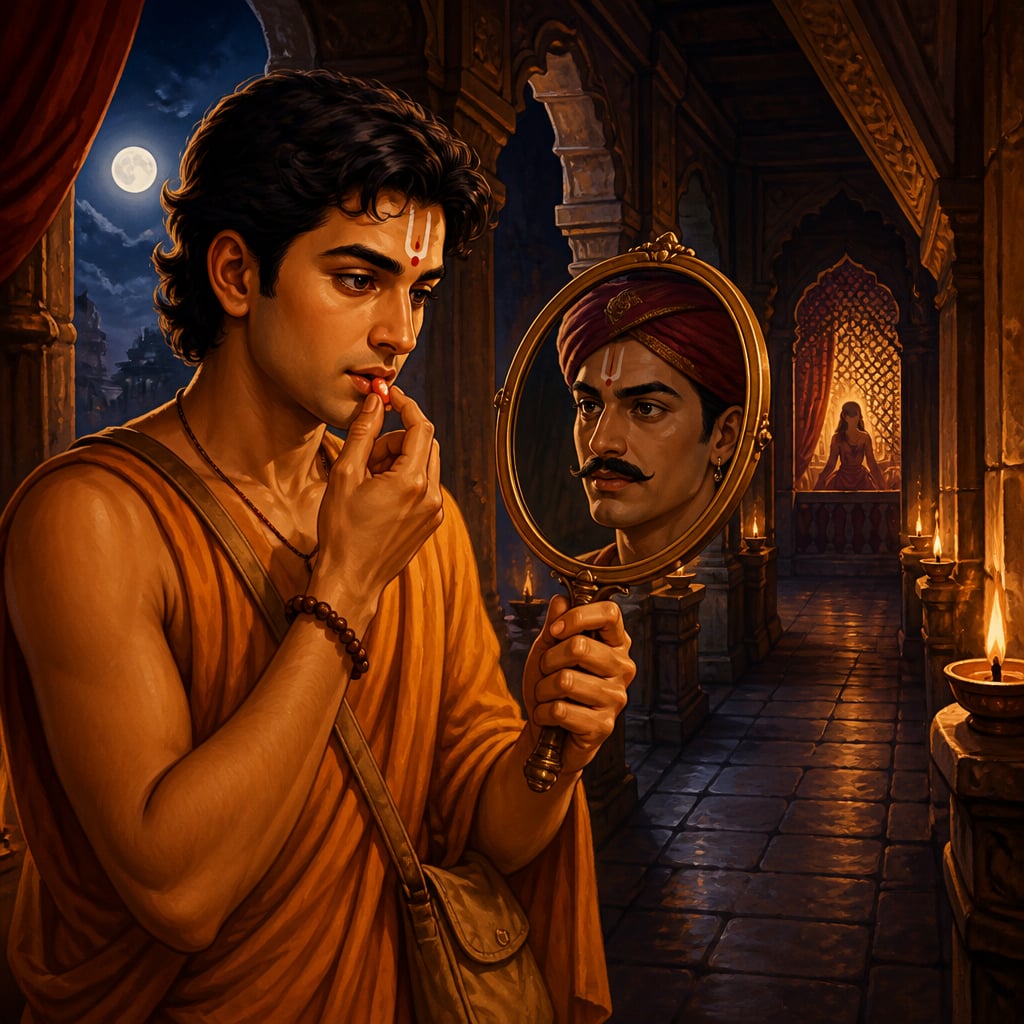
Now there lived in that land a famous trickster and magician named Muladeva, who owned a wonderful pill: held in the mouth, it changed a person's face and form into whatever shape was wished. With Muladeva's help and this pill, Manahsvamin put on a face that was not his own, and slipped, unseen and unrecognised, into the princess's chambers. There, in secret, the two were married by the gandharva rite, the marriage of lovers, with no witness at all and no one's knowledge but their own.
The magician's schemes tangled on from there, as such schemes do. Muladeva himself, disguised now as an aged and formidable brahman, came before King Yashahketu and demanded a bride for his own side, a girl to be given as daughter-in-law to his household. The king, afraid to refuse so powerful an ascetic and draw his curse down upon the kingdom, gave his own daughter. And so Shashiprabha was married a second time, openly and in due form, before the sacred fire and the whole gathered court, to a companion of the magician named Shashin.

So now the princess had two husbands. Manahsvamin said: she is mine, for I married her first, long ago, when she was a maiden, by the rite of lovers. And Shashin said: she is mine, for her father gave her to me in the lawful way, before the fire, in the sight of all. Each, in his own fashion, was telling the truth. The only question was whose wife she truly was.
The Betaal's Riddle
"So, king," said the Vetala. "One man married her first, in secret, by the rite of lovers. The other was given her openly by her father, before the fire and the court. Both call her wife. To which of the two does she truly belong?
Answer, if you know. You know the rules."
You Be the Judge
Weigh it yourself, before the king does. One claim rests on being first, and on a real, if secret, love. The other rests on an open ceremony, witnessed by the fire and the whole court. Which of the two bonds, when you weigh them, is the one that truly holds?
Vikram's Verdict
"She is Shashin's wife," said Vikramaditya. "The one to whom she was openly given.
"I do not doubt that Manahsvamin loved her, nor even that some rite passed between them. But consider how he came by her. He put on a false face, by the magician's pill, and crept into her chambers unseen and unknown, and took her in secret, with no witness and no sanction from anyone at all. Whatever else you call that, it was done in the manner of a thief: in the dark, by stealth, hidden from every eye that had a right to see. And a thief, however cleanly he takes a thing, gains no lawful title to it. What is seized in secret does not become truly yours, however real your wanting.
"But Shashin was given her openly, by her father, in the proper form, before the sacred fire and the assembled people. That bond was made in the full light, witnessed by all, sanctioned by those whose place it was to sanction it. It has a standing that a thing done in the dark can never have. The open and lawful bond holds; the secret one, for all its feeling, does not. She is Shashin's."
At once the corpse was gone from his shoulder, flown back to the tree.
The Dharma
The king's verdict rests on a distinction we are quick to forget: that legitimacy is public. A bond, a claim, a right becomes real not merely because it is felt, and not merely because it came first, but because it is made in the open, before witnesses, with the sanction of those whose place it is to give it. What is done in secret, however sincere, does not carry that standing, and cannot be defended when a rival claim arrives in the daylight.
And notice the sharper edge. How a thing is acquired decides whether the claim to it is legitimate. Manahsvamin's fault was not that he loved, nor even the private rite in itself. It was that he reached his end by stealth and a false face, taking in the dark what he had no open sanction to take. Those were a thief's means, and a thief's means confer no rightful title, whatever the goal. The old wisdom says it plainly, satyam eva jayate: truth alone triumphs, not the concealed and the false. The bond made openly and in truth is the one that stands.
This is not a small point, nor a merely legal one. It is why we insist that the things that matter, promises, agreements, unions, ownership, be witnessed, recorded, and done in the proper form, rather than left as private understandings in the shadows. Not because feeling does not matter, but because the open, witnessed, sanctioned bond is the only kind the world can be asked to honour and to defend.
In Your World
We are tempted, again and again, to rely on the thing quietly understood but never made open: the promise that was never written down, the arrangement no one else knows of, the claim we feel is surely ours but never established in the light. It feels like enough, especially when trust is high and the goodwill is real. And then a rival claim arrives, made openly and in proper form, and the private understanding, however sincere, finds it has nothing solid to stand on.
Learn the king's lesson. When something truly matters, do it in the open. Make the commitment where it can be witnessed; put the agreement in a form that others can see and honour; secure the sanction of those whose place it is to give it. And be wary of any end, however good it looks, that can only be reached by stealth and a false face, because the means you use to acquire a thing become part of your title to it. What you take in secret never fully becomes yours; only what you do in the open does.
Reflection
- You judged the two claims before the king spoke. Did the sincerity of the secret love tempt you, before you weighed how each bond was actually made?
- Where in your life do you rely on a private understanding or an unwritten arrangement that has never been made open or witnessed? How solid is it, really?
- When have you tried to reach a good end by a hidden or deceptive means? Did the concealment quietly weaken the legitimacy of what you gained?