Redirect the Burden (Tarka Khandana)

Break the Logic Chain

The third counter in the Shat-Khandana System. Most debates are lost the moment the dharmic side accepts a burden of proof that was never theirs. The opponent makes the assertion. The opponent owes the defence. Tarka Khandana is the Nyaya tradition's named technique for breaking the logic chain by sending the burden back where it belongs. This lesson teaches the three-question protocol: who made the claim, what is the chain of reasoning, and which link in that chain is undefended. When the load-bearing link cannot be defended, the conclusion collapses without a counter-claim from you.

The Court of King Janaka

In the great assembly hall of King Janaka of Videha, sometime around the seventh century BCE, a thousand cows stood in the courtyard with their horns tipped in gold. The king had announced a prize. Whichever scholar could prove himself the wisest among the brahmavadins gathered for the sacrifice would lead the cows home. The hall smelled of clarified butter from the morning fires. Servants moved between rows of seated scholars carrying water in copper jars. The afternoon light fell through high windows onto the polished stone floor.

Yajnavalkya had already, by simple authority, instructed his student to drive the cows away to his own ashram. The hall had erupted. Eight scholars in succession had risen to challenge him. He had answered each one. Now the ninth rose. His name was Vidagdha Shakalya. He was respected. He was not afraid. He came forward with a long list of questions.

'Yajnavalkya,' he said, 'how many gods are there?'

Yajnavalkya answered. 'Three thousand three hundred and six.'

Shakalya pressed. 'How many really?'

The sage answered again, and again, walking the count down through Shakalya's repeated demands, until they arrived at one. Shakalya kept asking. Yajnavalkya answered. The audience watched the questioner press the answerer for an entire afternoon.

Then the moment turned. Yajnavalkya, who had been answering, stopped answering. He looked at Shakalya and asked a question of his own. 'On what is the heart established?' Shakalya did not know. The sage waited. The hall waited. Shakalya's silence became visible to everyone in the room. The Brihadaranyaka Upanishad records what happened next in a single, terrifying line: Shakalya's head shattered, and his body was carried away by thieves on the road, who mistook it for something else.
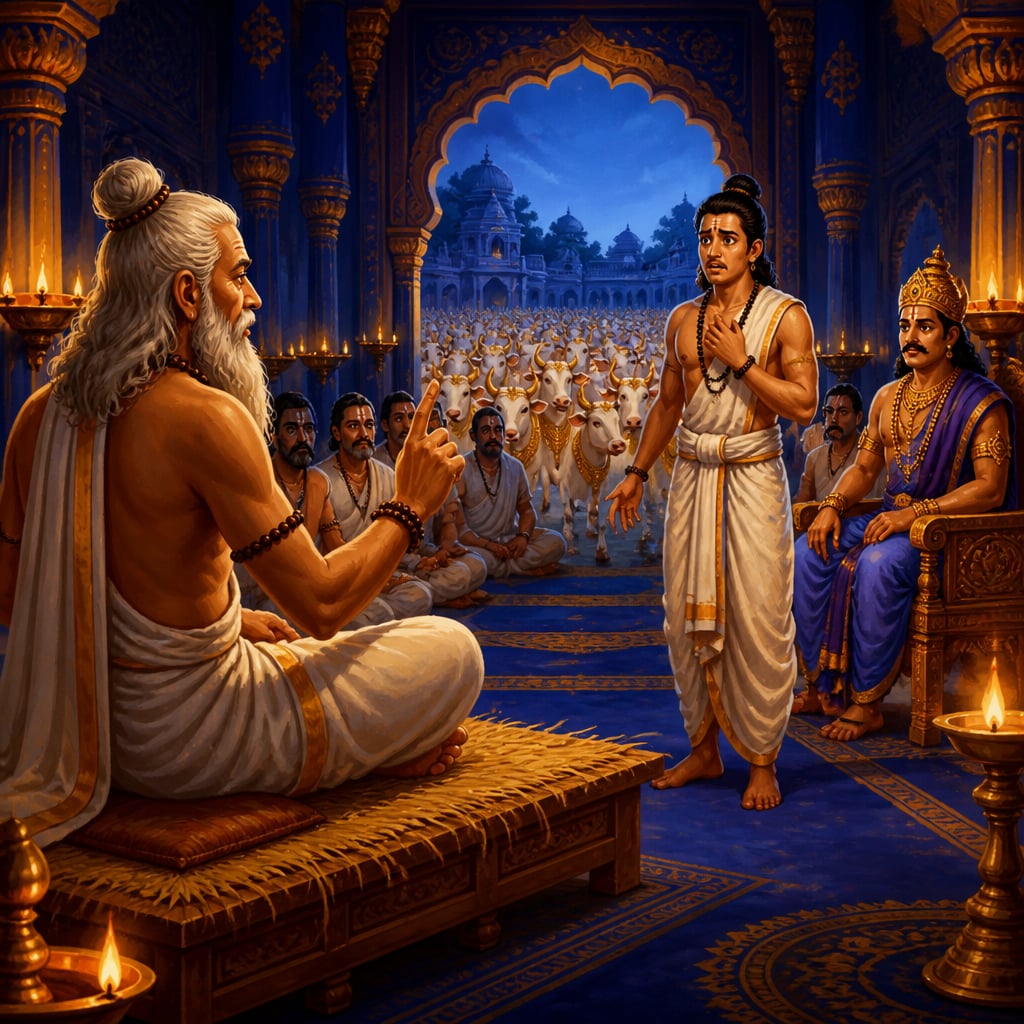
Yajnavalkya turns a question back on Shakalya at Janaka's court

The Sanskrit word for what Yajnavalkya did at the moment he stopped answering and started asking is Tarka Khandana. Break the logic chain. Redirect the burden. The questioner had been treating the sage as a defendant. The sage, in one move, returned the burden to the questioner. Shakalya could not carry it. The exchange was over.

The Trick The Opponent Is Pulling

The move Shakalya was running on Yajnavalkya is the same move running on you, every day, in much smaller rooms. It works like this.

The opponent makes a claim. Hindus are intolerant. Diwali ruins the air. The economy was destroyed in 2016. The temple was never there. The claim is asserted in a tone of established fact. Then the opponent pivots. They demand that you disprove it.

You now feel the pull. You start gathering data. You scroll for sources. You apologise for not having the right link ready. You do all the work. The opponent, meanwhile, has done none. The opponent simply made an assertion and watched you scramble.

Indian family debating a WhatsApp message at dinner

This is the burden trap. The Nyaya tradition saw it. The Sanskrit word for the trap is bharah, meaning a load, a weight, the cargo that has to be carried somewhere. In every debate, somebody is carrying the bharah. The first move of the dishonest debater is to put the bharah on you when, by the rules of honest reasoning, it was theirs to carry.

The whole chapter you are reading teaches the Shat-Khandana System, six precise counters in the dharmic tradition. Redirect the Burden is the third. The first counter, Expose the Pattern, names the tactic out loud. The second, Anchor the Frame, fences the battlefield. This third counter does something different. It does not refuse the debate and it does not redefine the words. It accepts the debate, looks at the opponent, and says, calmly: you spoke first. Defend it.

The Three-Question Protocol

When you feel the burden landing on your shoulders and the scramble starting in your chest, stop. Run three questions, in order, in your own head before you say anything.

Question 1. Who made the assertion? Whoever spoke first owns the bharah. If your uncle said the economy was destroyed, your uncle owes the defence. If a TV anchor said Hindus are intolerant, the anchor owes the defence. If a paper says the temple was never there, the paper owes the defence. You did not raise the topic. You are not the defendant. The first sentence in the debate decides who is.

Question 2. What is the chain of reasoning? Every claim, however confidently delivered, rests on a small ladder of sub-claims. The economy was destroyed rests on (a) a definition of the economy, (b) a chosen metric, (c) a chosen baseline year, (d) an attribution of cause. Four rungs. The opponent has handed you a tall confident sentence and is hoping you will not climb down to look at the rungs.

Question 3. Which link is undefended? Almost always, one rung is doing all the work. If the metric is GDP, why GDP and not employment, exports, or PPP-adjusted growth? If the baseline is 2014, why 2014 and not 2010 or 2004? Find that single rung. Point at it. Ask, in plain language, can you defend that one?

The opponent now has two options. They defend the rung, and the debate moves to the rung, where the conclusion either survives the scrutiny or visibly fails. Or they refuse to defend the rung, and the room sees that the tall confident sentence was carrying a weak link the speaker would not own.

You have not produced a counter-claim. You have not gathered a single statistic. You have done what Yajnavalkya did to Shakalya. You have stopped answering. You have started asking.

यो वै बृहन्तं प्रश्नं पृच्छति स्वयमप्रतिष्ठितः। पतत्येव स प्रष्टा यथा शाकल्यो जनकालये॥

yo vai bṛhantaṃ praśnaṃ pṛcchati svayam apratiṣṭhitaḥ | pataty eva sa praṣṭā yathā śākalyo janakālaye ||

The questioner who hurls a great question without first standing on his own ground falls of his own weight. So fell Shakalya in Janaka's hall.

Brihadaranyaka Upanishad commentarial summary, after 3.9

Tarka Khandana In The Nyaya Sutras

Gautama's Nyaya Sutras, composed around the second century BCE, name this counter as a category, not as a trick. The Sanskrit word tarka means hypothetical reasoning, the if-then chain. Khandana means breaking, refuting, dismantling. Tarka Khandana is the formal procedure for breaking the chain of reasoning at its weakest link.

Vatsyayana, the fifth-century commentator on the Sutras, supplies the worked vocabulary. He distinguishes between prashna (a question that seeks new information from the speaker), paryanuyoga (a question that demands the speaker defend a claim already made), and anuyoga (a question that holds the speaker to the claim at the next stage of the debate). The dharmic counter to a confident assertion is paryanuyoga, the demand for defence. The Western tradition has no single word for this distinction. It treats all questions as one kind of move. The Nyaya tradition treats the demand for defence as a separate technical instrument with its own rules.

The Sutras then list the conditions under which a paryanuyoga is binding. The questioner must be in good faith. The question must address a claim the speaker actually made. The defence must be admissible by the same evidence rules the speaker accepted when they made the claim. Inside these rules, the demand for defence is sacred. Refusing it is one of the Nigrahasthanas, the formal conditions of defeat. A speaker who will not defend their own assertion has lost the debate by the tradition's own scoreboard.

The Bhagavad Gita adds a different anchor. In Chapter 4, Krishna tells Arjuna that the wise are approached praṇipātena pariprashnena sevayā: with humility, with searching question, and with service. The middle word, pariprashna, is the same family as paryanuyoga. The honest seeker asks pressing questions. The honest teacher welcomes them. The Gita's vocabulary blesses the very move that the dishonest debater fears. When you redirect the burden, you are not being aggressive. You are being a pariprashnaka, the searching questioner the tradition honours.

Why Burden Redirection Is Not Whataboutism

A careful reader will notice the risk. Is this not whataboutism by another name?

It is not. The two moves look superficially similar and are structurally opposite.

Whataboutism Tarka Khandana
Changes the topic. Stays on the topic.
Brings in a different claim. Stays inside the same claim.
Demands defence of something the speaker did not say. Demands defence of what the speaker did say.
Adds a second debate. Refuses to start a new one.

The whataboutist, asked about Issue A, brings up Issue B and asks the opponent to address that instead. The Tarka Khandana practitioner, asked about Issue A, asks the opponent to defend the rung of Issue A that they skipped past. The first abandons the original question. The second insists on it.

The Sanskrit word for the whataboutist's move is different. It is vishaya-antara, changing the topic. The Nyaya Sutras list it as a separate Nigrahasthana, a separate condition of defeat. The two moves are tracked separately precisely because the tradition saw them as opposite. If you redirect the burden and the opponent calls you a whataboutist, the opponent is conflating two distinct moves. The defence is to point at the rung you are still asking about. I have not changed the subject. I have asked you to defend your own.

The Counter In Three Sentences

The whole technique compresses to three short sentences you carry in working memory.

  1. You made that claim.
  2. Walk me through the reasoning.
  3. Defend the link I point to.

Delivered calmly, in that order, the three sentences do the work of an entire week of preparation. They do not require you to have the data. They do not require you to have read the report. They require you to have noticed that the opponent has not.

The model counter, in the Nyaya register, is what Yajnavalkya did. He did not produce a competing list of gods. He asked the questioner where the heart was established. The questioner had no answer. The questioner had been the one carrying the bharah from the start. He had simply not realised it until the moment the sage made him see.

Modern Echoes

Russell's celestial teapot drifting in space

The legal world has rebuilt this protocol from scratch in the last hundred and fifty years, and given it a name in English: the burden of proof.

What the dharmic tradition treated as a debate technique, the Western tradition has rediscovered as the core of law, science, and rational discourse. The vocabulary is younger. The protocol is the same.

Back To Janaka's Hall

The gold-tipped cows had been driven away long before the day ended. The afternoon sun moved across the polished floor. Yajnavalkya, who had answered eight rounds of questions, asked one. The questioner could not carry it. The Brihadaranyaka does not say what the assembly did. It only says that Shakalya could not stand the weight of the question that had been pressed back into his hands. The bharah had been his all along. The sage, in one move, had only let him feel it.

In the next lesson, the counter changes shape again. Isolate the Weakness (Vyapti Khandana) finds the single load-bearing assumption a complex argument depends on, and pulls that one out, so that the entire edifice collapses without further work.

Case studies

Yajnavalkya and Shakalya at Janaka's Court

In the Brihadaranyaka Upanishad, Adhyaya 3, Brahmana 9, the sage Yajnavalkya is challenged in the assembly hall of King Janaka of Videha. The king has staked a thousand cows with their horns tipped in gold as the prize for the wisest brahmavadin in the hall. Yajnavalkya, by simple authority, has already had the cows driven away to his ashram. The hall has erupted. Eight scholars have risen in succession to question him on the nature of Brahman, the gods, the breath, and the Self. He has answered each one. The ninth scholar, Vidagdha Shakalya, rises with a long list. He presses the sage on how many gods there are, walks the count down through repeated demands from three thousand three hundred and six to thirty-three to six to three to two to one and a half to one. Yajnavalkya answers calmly each time. Then Yajnavalkya turns. He stops answering and asks Shakalya a single question of his own: on what is the heart established. Shakalya does not know. The Upanishad records that his head shattered at that moment. The tradition reads the line metaphorically: the questioner had been carrying the burden of his own undefended assumptions throughout the exchange, and the moment the burden was returned to him, he could not bear it.

This is the canonical Nyaya-Upanishadic instance of Tarka Khandana, recorded in primary scripture more than a thousand years before the Nyaya Sutras would systematise it. The structural reading is precise. Shakalya runs paryanuyoga (the demand for defence) on Yajnavalkya without first having stood on his own ground. The Sanskrit phrase the commentaries use is svayam apratiṣṭhitaḥ, without his own foundation. Yajnavalkya is willing to play paryanuyoga, but he is also willing to play it both ways. The single counter-question is the Tarka Khandana move in its purest form: not a counter-claim, not a refusal, but the redirection of the bharah onto the original speaker. By the Sutras' later vocabulary, Shakalya falls into apratibha (no ready answer) and is therefore defeated by the tradition's own scoreboard. The episode is studied in classical Nyaya commentaries (Vatsyayana's Bhashya, Uddyotakara's Vartika) as the founding case study for the entire technique.

Yajnavalkya retains the cows and the prize. The eight earlier challengers and the audience have witnessed not only the answers but the structural lesson: an honest assembly is one where every speaker is willing to carry the bharah for what they assert, including the speaker who is currently asking the questions. The episode becomes one of the most-cited passages in the entire Vedantic and Nyaya commentarial tradition, taught from Shankara through to the modern Sanskrit philosophy departments. It is the dharmic tradition's permanent answer to the question of whether the demand for defence is rude. It is not. It is the rule.

The dharmic debater is willing to answer for as long as the questioner is honest. The dharmic debater is also willing, at any moment, to ask the same questioner to defend the assumptions the question itself rests on. The two willingnesses are not in tension. They are the same discipline. Tarka Khandana is what that discipline looks like when the second willingness is the one the moment demands.

Brihadaranyaka 3.9 contains, in a single brahmana, the longest preserved sustained debate exchange in the early Upanishadic corpus. Nine challengers question Yajnavalkya in succession across roughly twenty-six dialogue turns. Shakalya is the ninth. He is also the only one to lose. The episode is dated by linguistic and ritual evidence to roughly the seventh century BCE, twenty-five centuries before the modern legal phrase 'burden of proof' was first formalised in Anglo-American common law in Woolmington v. DPP (1935).

The Aryan Invasion Hypothesis and the Reversed Burden

In the second half of the nineteenth century, European Indologists, working with the limited tools available to them, proposed that the Vedic peoples had migrated into the Indian subcontinent from Central Asia or the Pontic-Caspian steppe sometime in the second millennium BCE. The proposal was a hypothesis. Over the following century, it hardened into a textbook claim, taught from European universities to Indian school boards as settled fact, often under the more aggressive label of the Aryan Invasion Theory. By the second half of the twentieth century, the burden in the public conversation had inverted. Defenders of an indigenous origin for the Vedic civilisation, including scholars like Shrikant Talageri, Michel Danino, and Koenraad Elst, were treated as the side that had to disprove the migration. The original claimants of the migration were treated as having no further obligation. When Indian scholars produced primary-source evidence (the absence of any migration narrative in the Vedas, the references to the Saraswati as a mighty river before its drying around 1900 BCE, the continuity of cremation and ritual practices from Indus-Saraswati sites into recorded Hindu tradition), the dominant response was not to defend the migration claim but to demand more refutation. The bharah had been silently transferred from the original asserters to the dharmic defenders, and most defenders accepted the transfer without contesting it.

This is the textbook large-scale failure of Tarka Khandana over a hundred and fifty years. The Nyaya counter would have been to refuse the burden transfer at the start. The original claimants (Max Muller and his successors) had asserted a positive historical event: a migration of named peoples, in a specified direction, in a specified century. By the Sutras' own rules, the bharah of defence rested on them. The chain of reasoning rested on three rungs (linguistic similarity in Indo-European languages, the absence of specific archaeological continuity in earlier readings, the textual interpretation of the Rig Veda's geographical references). One rung, the textual one, was contradicted by the Vedic mentions of the Saraswati as a fully flowing river. A Tarka Khandana practitioner would have asked, in 1880 and again in 1920 and again in 1960, the same paryanuyoga: defend the textual rung against the Saraswati evidence. The defenders mostly did not. They accepted the role of the side carrying the bharah and produced refutation after refutation, while the original claim was treated as the default. By 2018, when the genetic evidence (the Rakhigarhi DNA results, published in Cell, 2019) finally weakened the migration claim on its own ground, half a century of textbooks had already taught the migration as fact to two generations of Indian schoolchildren.

As of 2026, the field is in a slow correction phase. Scholarly journals increasingly use the more cautious phrase 'Indo-Aryan migration' rather than 'invasion.' Aspects of the indigenous case (the Saraswati's drying, the continuity of ritual practice, the limitations of Indo-European linguistic dating) are now treated as live debates rather than settled refutations. The correction has cost roughly five generations of Indian textbooks, two decades of unnecessary defensive scholarship, and a public conversation in which Hindus had to argue for their own historical continuity in the venue where it should have been the default. The cost is a direct measure of what happens when Tarka Khandana is not deployed at the start of a conversation that needs it.

Burden redirection has to happen in the first generation of a debate, not the fifth. Whoever first asserts a positive claim about the historical past owes the defence of every link in the chain of reasoning, indefinitely, to anyone who asks. Letting the burden transfer silently is not politeness; it is structural concession. The dharmic defender's first move on every contested historical claim is to send the bharah back to the original asserter and keep it there until each rung is defended on the asserter's evidence.

The Rakhigarhi DNA paper (Shinde et al., 2019, Cell) tested ancient DNA from a single skeleton at the Rakhigarhi site of the Indus-Saraswati civilisation and found no detectable steppe-pastoralist ancestry, contradicting the simplest form of the migration hypothesis. The result was published 159 years after Max Muller's first influential lectures (1860) framing the migration as Indo-European peoples entering India. For more than a century and a half, the bharah of defence had rested on the wrong side of the conversation. The genetic evidence did not invent the indigenous case. It simply forced the bharah back where it had always belonged.

The Family WhatsApp Group: 'Modi Destroyed the Economy'

On a Tuesday evening in August 2025, in a family WhatsApp group with eighty-three members, an uncle in Pune forwards a five-line message asserting that the Indian economy was destroyed by demonetisation in 2016. The message ends with the line 'and the data proves it.' Three cousins react with the thumbs-up emoji. A nephew in Bangalore responds with a question mark. The uncle replies, 'do your own research, it is all over the internet.' The nephew, a twenty-three-year-old commerce graduate from a government college, opens a search tab and starts pulling up GDP graphs from 2014 to 2025. He reads the World Bank dataset and the IMF series and the RBI bulletin. By midnight, he has assembled a five-paragraph response with charts and citations and posts it. The uncle responds with a single message: 'graphs do not capture the human cost.' Two cousins agree. The exchange ends with the original assertion intact in the group's collective memory and the nephew exhausted at midnight on a work night. The structural failure is invisible to everyone in the group, including the nephew. The bharah was placed on him in the first message and he carried it without contesting the placement.

This is Tarka Khandana not deployed, in a venue where it would have taken thirty seconds to deploy.

In the actual exchange, the original assertion settled into the group's memory unchallenged, the nephew burned three hours of his evening, and the uncle's behaviour pattern was reinforced for future weeks. In a Tarka Khandana counterfactual, the exchange ends in under five minutes, the uncle either produces a defendable rung (which is then discussed openly) or quietly drops the topic, and the family group learns that confident assertions in this room will be asked to defend themselves. The cumulative effect over a year is a different group culture. WhatsApp behaviour is not changed by counter-essays. It is changed by the ratio of assertions that get the paryanuyoga response.

Tarka Khandana is the highest-leverage move in everyday-life debate venues precisely because it costs almost nothing to deploy. Three sentences, sent calmly, before you start gathering data. The cost of deploying it is one sentence's worth of social courage. The cost of not deploying it is the rest of your evening and, over a year, the collective memory of every group you are silent in.

By 2025, WhatsApp is used by approximately 535 million Indian adults, a higher penetration than any other digital platform in the country. The average urban Indian belongs to between four and twelve active WhatsApp groups, and political-economic forwarded content is the single most common content category in family groups, ahead of greetings, photos, and religious content (LocalCircles 2024 survey). The aggregate effect of unchallenged assertion-forwarding across this base is, by any reasonable measure, the largest unmoderated public-debate venue in human history. The Tarka Khandana counter, deployed even five percent more often, would change the venue's character at scale.

Reflection

More in Khandana Yukti: The Art of Clarity

All lessons in Khandana Yukti: The Art of Clarity · Vaada Shastra: The Dharmic Art of Debate course