Isolate the Weakness (Vyapti Khandana)

Invalidate the Generalization

Isolate the Weakness is the fourth counter in the Shat-Khandana System. Most big arguments rest on one load-bearing sentence: 'all X are Y.' Find the one X that is not Y, and the whole building comes down. This is Vyapti Khandana: breaking the universal claim with a single clean counter-example.

The One Question That Broke the Panel

On a Tuesday evening in March 2023, a prime-time news panel was running at full volume on an English-language channel in Delhi. Four guests, one anchor, thirty-eight minutes on the clock. The topic was caste. One panelist, a columnist in a white kurta, leaned forward, pointed at the camera, and said the line he had said many times before. 'Every Hindu scripture, without exception, endorses birth-based hierarchy.'

The anchor nodded. Two guests began preparing long answers. They were lining up statistics, historical arguments, counter-citations. They were about to drown in their own evidence.

The fourth guest, a young researcher from a Pune-based think tank, waited. When the anchor turned to her, she did not bring up five texts. She brought up one name.
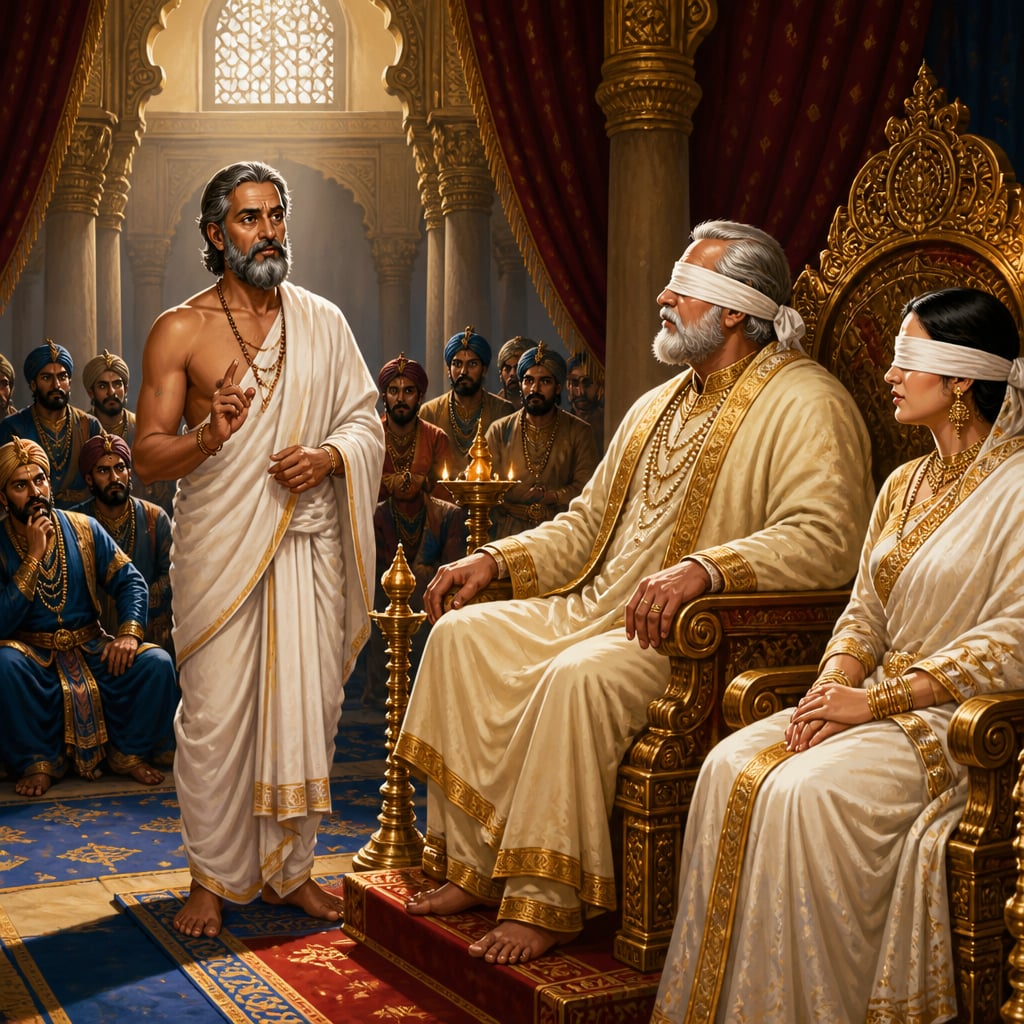
Vidura speaks calmly at the Kuru royal court of Hastinapura

'Vidura,' she said. 'Born of a palace maid. The moral voice of the entire Mahabharata. Read the Vidura Niti, then tell the audience again that every Hindu scripture, without exception, endorses birth-based hierarchy.'

The columnist tried to answer. He could not. He had built his whole sentence on the word every. She had pulled out one thread. The building was already falling.

This is the counter you will learn in this lesson. It has a name in the Nyaya tradition: Vyapti Khandana, breaking the generalization. In plain English: Isolate the Weakness.

Every Big Claim Has a Load-Bearing Sentence

Buildings have load-bearing walls. You can knock down every other wall in a house and the house still stands. Knock down the load-bearing wall and the ceiling comes with it.

Arguments are the same. A big claim looks like a whole building. Paragraphs, examples, emotional weight, tone of voice. But inside that building, there is almost always one sentence that holds the whole thing up. Find that sentence, and you do not need to fight the rest.

That load-bearing sentence is almost always a universal claim. It uses words like:

The moment you hear one of those words, pause. The opponent has just told you where the load-bearing wall is. They have marked it with a sign.

In Nyaya Shastra, this universal link between X and Y is called vyapti, the pervasion. 'Wherever there is smoke, there is fire' is a vyapti. It is what makes the whole argument go. The classical counter, used for more than two thousand years in Indian debate, is Vyapti Khandana, breaking the vyapti. You do not fight the smoke or the fire. You find one case where smoke appears without fire, and the whole chain falls apart.

The Method in Four Moves

Isolating the weakness is a four-move process. The moves are simple. The discipline is in doing only these four and nothing else.

Move 1: Listen for the universal word. All, every, no, without exception, always, never. If the opponent has not used one, keep listening. They usually will. A strong argument rarely needs a universal. A weak argument almost always rides on one.

Move 2: Restate the claim back to them, cleanly. 'So your claim is that all X are Y.' Short. Polite. No sarcasm. You are asking them to confirm the load-bearing sentence. Many opponents will soften it here on their own. 'Well, not all, but most.' The moment they soften it, the universal is dead. You have already won the frame without a single counter-example.

Madhava of Sangamagrama writing infinite series

Move 3: Produce one clear counter-example. Not five. One. The one must be well-known, verifiable, and clearly inside the category X. If you need to explain why your example counts as X, pick a different example. The cleanest counter-examples are ones the opponent themselves would have to acknowledge.

Move 4: Close the loop. 'So the claim that all X are Y does not hold. We can now discuss whether it holds for some X, or most X, or which X, but not all X.' This is the Anavastha Khandana move you will see in Lesson 8.6: closing the door. You do not let the debate drift back to the broken universal.

That is the whole method. Listen, restate, produce one, close. Four moves. Most good Vyapti Khandana counters are over in under ninety seconds.

Why One Counter-Example Is Enough

This is the part most people miss, and it is the most important part. Logic does not grade on effort. Producing twenty counter-examples does not break the claim twenty times harder than producing one. The claim was 'all X are Y.' The moment you show one X that is not Y, the word all is mathematically false. There is no partial credit for the opponent.

The Nyaya tradition calls this vyabhichara, the wandering. If the relation between X and Y wanders even once, if it fails in a single case, the pervasion is broken. It does not matter how strong the correlation looks in the other cases. The universal sentence is gone.

Difficulty: Level 2 (Subtle). Most opponents do not know their own universals are the weak point. They built the universal because it sounded powerful in delivery. They did not stress-test it. Your one counter-example exploits exactly that gap.

This is why adding a second and third counter-example after the first is often a mistake. Once the first example lands, the universal is dead. Piling on more examples signals that you are unsure of the first one. The audience reads the pile-on as weakness. One clean strike is better than five noisy ones.

The Classical Illustration: Smoke and Fire

The Nyaya schools worked out Vyapti Khandana using a single carried example for centuries: smoke and fire.

धूमो यत्र यत्र तत्र तत्र वह्निः।

dhūmo yatra yatra tatra tatra vahniḥ

Wherever there is smoke, there is fire.

Classical Nyaya formulation

This is the textbook vyapti. It looks solid. For most of everyday life, it holds. So the old Naiyayikas asked their students: how do we know it is universal?

The answer was not more fires with more smoke. The answer was: find one smoke without fire. If you can find it, the universal breaks. If you cannot find it after serious looking, the universal stands. One counter-example is worth more than a thousand confirmations.

This is the shape you want to carry into modern debates. You are not collecting evidence for your side. You are looking for the one X that is not Y in the opponent's universal.

Four Places Universals Hide

Universals are not always announced with the word 'all.' They hide in four shapes. Learn to spot each one.

  1. The open universal. 'All Hindu texts endorse birth-based hierarchy.' The word is right there. This is the easiest to counter.

  2. The closet universal. 'Hindu texts endorse birth-based hierarchy.' No 'all,' but the plural noun functions as 'all.' Ask: 'You said Hindu texts. Do you mean all of them, or only some?' If they say all, you are back to case 1. If they say only some, you have already won the frame.

  3. The colonial universal. 'India never developed real mathematics.' The word 'never' is the giveaway. This one shows up constantly in civilisational debates. One counter-example, well chosen, destroys centuries of institutional framing.

  4. The dog-whistle universal. 'We all know how Hindus behave.' Social proof dressed as universal claim. Break it the same way: 'You said we all know. Who is the we, and what is the specific claim you want us to know?' The universal usually cannot survive being restated in plain language.

When Vyapti Khandana Is Not the Right Counter

This counter is powerful, so the temptation is to use it everywhere. That is a mistake.

Use Vyapti Khandana when the opponent has made a clean, load-bearing universal claim. Do not use it when:

The Discipline of the One

A Dharmic debater in full Vyapti Khandana mode looks almost lazy. They listen. They let the opponent build. They note the universal. They restate it once. They offer one example. They stop.

That stillness is the discipline. The goal of this counter is not to humiliate. It is to reveal the single weak point so the rest of the conversation can become honest. Once the universal falls, most opponents do one of two things. They soften the claim, and the real conversation can begin. Or they refuse to soften, and the audience sees the gap. Either way, truth wins.

This is Anvikshiki, critical investigation, in action. The Sanskrit anchor for this lesson is not power. It is investigation. You are the one who went looking for the seam. You found it. You named it. You moved on.

Modern Echoes

The philosopher of science Karl Popper made his career on exactly this idea. He argued that a scientific theory is only respectable if it says what cannot happen. One clear counter-example to 'all swans are white' is enough to falsify the claim, which is why, when a black swan was documented in Western Australia in 1697, the old universal simply died. Popper called this falsifiability. The Naiyayikas had called it vyabhichara almost two thousand years earlier.

Black swan among white swans in Western Australia

Nassim Nicholas Taleb, in his 2007 book The Black Swan, took the same structure into finance and risk. His core claim: the one case that breaks your model matters more than the thousand cases that confirm it. Modern risk managers who ignored this principle blew up in 2008. Ones who took it seriously, like Taleb's own practice, profited from the blow-up. Two and a half millennia after Gautama Nyaya, the market still grades Vyapti Khandana.

Back in the Delhi studio, the clock was at thirty-six minutes. The researcher from Pune had not raised her voice once. She had named Vidura, and then she had stopped talking. The columnist in the white kurta was still searching for a reply.

Case studies

Vidura Breaks the Dinner-Table Universal

A Diwali family dinner in Bengaluru, late October 2024. A relative home from the United States opens an argument the table has heard many times. 'Every Hindu text, without a single exception, treats some people as born superior to others. That is the whole tradition.' Phones go down. The room tenses. One cousin, a twenty-seven-year-old product manager, puts down her plate and answers with three words before expanding. 'Vidura Niti. Mahabharata. The moral conscience of the entire epic is given to a man born of a palace maid, counselling a blind king. You said every Hindu text without exception. So that is not true.'

This is textbook Vyapti Khandana. The relative built a universal (every Hindu text, without exception). The cousin did not fight the long list of examples that could be marshalled on either side. She produced one vyabhichara: a single, canonical, undisputed counter-example. The Nyaya principle is clean. If even one text in the category does not carry the property, the universal is mathematically broken. The cousin then closed the loop, the Anavastha Khandana move: 'So we can now discuss which texts, not every text.'

The relative tried 'but Manusmriti' as a counter. The cousin's answer was short: 'Manusmriti is not every text.' The conversation shifted from a civilizational verdict to a textual question the table could actually have. Dinner continued. No one raised their voice.

In any 'all of Hinduism does X' argument, the counter is almost never more evidence. It is one well-known, canonical, undisputed figure or text inside the category who clearly does not do X. Vidura is the cleanest one in the tradition.

The Vidura Niti occupies roughly 7,000 verses across the Udyoga and Shanti Parvas of the Mahabharata, one of the longest single counsel-sections in any ancient Indian text.

Madhava Breaks the 'India Never Did Mathematics' Universal

A 2019 podcast debate between an Indian professor and a visiting Western commentator on the history of science. The visitor's load-bearing sentence came thirty-one minutes in. 'India had astrology and mystical speculation, but never produced real mathematics. Calculus, analysis, infinite series, these are Western achievements, full stop.' The professor did not line up ten names. He named one. 'Madhava of Sangamagrama. Fourteenth century Kerala. Derived the infinite series for the arctangent, for sine, and for cosine, almost three hundred years before Leibniz and Newton. The derivation is in Jyesthadeva's Yuktibhasha. You can read the manuscript.'

The visitor had built the classic colonial vyapti: never, ever, full stop. The professor broke it with a single vyabhichara that satisfied every test the visitor himself was using. Madhava's work is: (1) inside the category of real mathematics, not mystical speculation. (2) Pre-colonial, not a modern backfill. (3) Verifiable in an extant manuscript. The universal could not survive one clean counter-example. The Nyaya tradition would have recognised the move as textbook: find the one X that is not Y, and stop.

The visitor tried to soften the claim to 'India did less mathematics than Europe.' The professor let the softening stand and moved on. The broken universal was the win. G. G. Joseph's 'Crest of the Peacock' and Kim Plofker's 'Mathematics in India' now carry the Madhava material into mainstream history-of-science curricula.

When a civilizational universal uses words like 'never' or 'full stop,' one meticulously documented counter-example is worth a hundred vague rebuttals. The counter-example must be a figure the opponent's own framework would have to count as serious.

Madhava's arctangent series, the so-called Madhava-Leibniz series, is documented in the Yuktibhasha manuscript dated to 1530 CE, almost 150 years before Leibniz's 1676 derivation.

The Black Swan of Western Australia

For most of recorded European thought, the sentence 'all swans are white' was a standard textbook example of a solid empirical generalization. Roman poets used 'a black swan' as a figure of speech for something that does not exist. Every swan any European had ever seen was white. Then in 1697, the Dutch explorer Willem de Vlamingh, sailing up a river in what is now Western Australia, documented flocks of swans that were entirely black. He brought specimens back. The universal did not survive the single observation.

The Naiyayikas would have recognised the scene instantly. The vyapti 'swan implies white' had held for centuries, not because it was logically necessary, but because no one had looked for the vyabhichara outside Europe. De Vlamingh's single sighting is a pure act of Vyapti Khandana. One case of a swan without whiteness shattered the pervasion for good. Almost two thousand years earlier, Gautama Nyaya had already written down the rule this illustrates: a single wandering case breaks the universal.

The black swan became, in the West, the canonical example of how a universal empirical claim can be falsified by one observation. Karl Popper built an entire philosophy of science on this pattern in the 1930s. Nassim Taleb made it the title of his 2007 book on rare events in finance. The Nyaya version predated both by millennia.

Universal empirical claims are fragile. The honest debater trains to look for the one counter-example the opponent has not considered, not the many examples that agree. In ideas as in finance, the one black swan matters more than the thousand white ones.

The Latin phrase 'rara avis in terris nigroque simillima cygno' (a rare bird on earth, and very like a black swan) appears in Juvenal's Satires around 82 CE, sixteen centuries before de Vlamingh's sighting confirmed such a bird was not, after all, impossible.

Reflection

More in Khandana Yukti: The Art of Clarity

All lessons in Khandana Yukti: The Art of Clarity · Vaada Shastra: The Dharmic Art of Debate course