Combo Khandana: When They Chain Tactics

Find the Transition Point. Break the Chain.

Real opponents rarely use one archetype cleanly. They chain four or five tactics in under sixty seconds: Strawman to Moral Shame to Topic Shift to Fake Neutral. If you counter each tactic individually, you lose the exchange by exhaustion. The Dharmic counter is Combo Khandana. Identify the transition point where one tactic becomes the next, intervene there, and use the Anchor and Reset technique to return the debate to the original question. The Nyaya tradition called this Samyukta-Yukti, combined method.

The Ninety Seconds That Break Most Debaters

A Wednesday night in April 2020, three weeks into the first lockdown. A Mumbai news studio, almost empty. An anchor is questioning why the news cycle has gone quiet about the mob lynching of two Hindu sadhus and their driver at Gadchinchle village in Palghar district on the night of 16 April. A senior party spokesperson joins the split screen from her living room. The exchange that follows is ninety seconds long. In those ninety seconds, she does four things in order.

First, she recasts the anchor's question. "So you are saying the entire community is responsible for what a mob did." That is a Strawman. The anchor did not say that. He asked why the story had disappeared from most news channels within forty-eight hours.

Second, she pivots to 2002. "And where was your outrage when Gujarat happened." That is Whataboutism. Gujarat 2002 is a different event, different decade, different parties, different victims. But the pivot buys her ten seconds, during which the original question about Palghar is no longer on the table.

Third, as the anchor tries to return to Palghar, she raises her voice. "Shame on you for using three dead bodies for your politics. Have you no decency." That is Moral Shame. The emotional spike steals another twenty seconds of airtime and repositions the anchor from questioner to defendant.

Fourth, she reframes herself as the balanced voice. "I am the only person on this panel tonight who is actually thinking about this rationally. The rest of you are communalising everything." That is Fake Neutral. She has now spent ninety seconds on four tactics and zero seconds on the Palghar question.
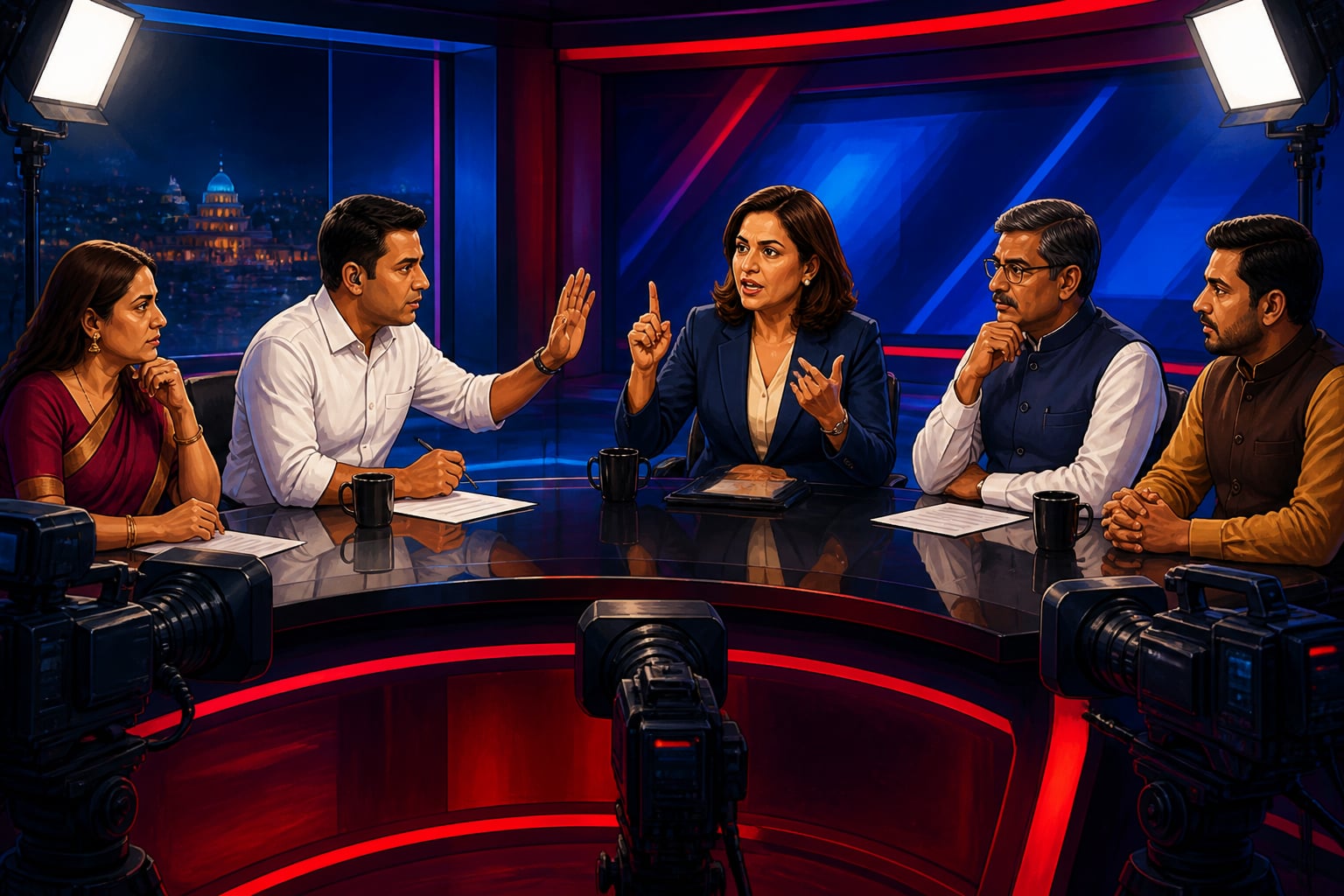
A frenetic TV panel with chained tactics in motion

The anchor has a choice. He can try to counter each of the four tactics in turn. Strawman with a clarification. Whatabout with a distinction. Moral Shame with his own indignation. Fake Neutral with a counter-claim. By the time he finishes, the segment is over, three more tactics have been fired, and no one in the audience remembers what the original question was.

Or he can use Combo Khandana. One move. Three seconds. That is what this lesson teaches.

Krishna rises with the Sudarshana Chakra at the Rajasuya assembly

Why Chains Work

Real opponents do not fight fair. They chain tactics deliberately, because the chain is stronger than any single link. Watching a Jalpa debater in rhythm is like watching a street fighter throw combinations. Jab, cross, hook, uppercut. No single punch does the damage. The chain does the damage.

Chains work for three reasons, and each reason tells the Dharmic debater where to cut.

Reason one: the audience loses the thread. A single strawman is easy to name. Four tactics in sixty seconds overwhelms the audience's working memory. They cannot hold four counter-arguments at once. By tactic number three, they have quietly forgotten what the original question was. This is not a coincidence. It is the point. The chain is designed to erase the question.

Reason two: each counter costs time. If you respond to the strawman, that takes ten seconds. The opponent has already moved to tactic two. If you respond to the whatabout, another fifteen seconds. The opponent is on tactic four. You are playing a game where you must run twice as fast just to stay in place. You will run out of breath before they run out of tactics.

Reason three: the transitions are invisible. Each tactic on its own is recognisable. But the seam between one tactic and the next is where the real sleight of hand lives. The speaker moves from Strawman to Whatabout by using a single connective word, usually and or meanwhile. That single word is the pivot. If the audience notices the pivot, the chain breaks. If the audience does not, the chain flows.

The Nyaya tradition saw this clearly. The word Samyukta-Yukti, combined method, appears in the later commentaries on the Nyaya Sutras as a name for the opponent's practice of using multiple tactics together. It also appears as a name for the defender's practice of using a single combined counter. The same Sanskrit name for both sides. This is not accident. The tradition is telling you that a combined attack requires a combined counter, not four separate ones.

एकोऽपि हेत्वाभासश्चतुर्ष्वपि विकल्प्यमानः सहस्रधा भिद्यते।

eko'pi hetvābhāsaś caturṣvapi vikalpyamānaḥ sahasradhā bhidyate

Even a single fallacy, when spread across four distinct tactical moves, splinters into a thousand pieces. The wise debater does not chase the pieces. She returns to the single fallacy at the root.

Udayana, Nyaya-Kusumanjali, in the tradition of later Nyaya commentary

Udayana's eleventh-century observation is the philosophical core of Combo Khandana. The four tactics in the Palghar exchange are not four separate problems. They are one problem, wearing four masks. Name the root. Ignore the masks.

The Transition Point

The single most important concept in this lesson is the transition point. It is the exact moment where one tactic becomes the next. In the Palghar ninety seconds, there were three transition points.

Four total seconds of transition inside a ninety-second exchange. The rest is window dressing. If you intervene anywhere inside those four seconds, you break the entire chain. If you intervene anywhere outside those four seconds, you are fighting one tactic while the next is being loaded.

The transition point is almost always marked by a specific connective device. Learn to hear these devices as alarm bells. The three most common are:

  1. A connective word. And, but, meanwhile, speaking of, by the way, now. When the speaker uses any of these after a failed or half-finished tactic, the next tactic is arriving.
  2. An emotional spike. A sudden rise in volume, a personal accusation, the word shame or decency. The emotional spike is almost always the doorway to Moral Shame or Emotional Hijack.
  3. A self-positioning claim. I am the only one who, as someone who, speaking as a, unlike everyone else. These phrases always introduce Fake Neutral, Victim Card, or Authority Quote.

A Dharmic debater who has trained her ear to these three connective devices can locate the transition point in real time. With practice, she does it within the first one or two seconds of the pivot. That is the window Combo Khandana needs.

The Anchor and Reset Technique

Once you have located the transition point, the counter is a single technique with a single sentence structure. It is called Anchor and Reset.

The Anchor is the original question. Before the chain started, there was a question on the table. The Palghar anchor's question was: why has the Palghar lynching story gone quiet in under forty-eight hours. That question is the anchor. The chain is designed to drift you away from it. Your job, as the Dharmic debater, is to refuse the drift.

The Reset is the act of publicly returning the exchange to the anchor. You do this in a single sentence that has three beats, delivered calmly, in under seven seconds.

Three beats. Three clauses. Roughly twenty seconds total. Half the time of the chain it breaks. The speaker, in the moment, may protest that you are being unfair. The audience, watching, sees you as the one person in the room still tracking what the exchange was supposed to be about. The audience is who Anchor and Reset is for. It is not an attack on the speaker. It is a gift to the listener.

Notice the discipline the technique requires. You must not list the four tactics. You must not name each transition. You must not score points. The moment you do any of these, you have been dragged back into playing the game on the chain's terms. The Nyaya tradition was specific about this. The word nigraha means to close, to seal, to hold firmly. Anchor and Reset is nigraha applied to the original question. You hold it. You do not let go.

The Five Canonical Combos

Over two years of watching Indian news panels, international policy forums, and long-form podcasts, the same five combos appear with remarkable consistency. Learn the five. You will recognise roughly eighty percent of the chains you meet this year.

Combo Chain Transition Signal Anchor and Reset
1. The Silencer Strawman to Moral Shame A sudden rise in volume, the word shame "That is not my position. The question was X."
2. The Credentialler Authority Quote to Emotional Hijack As someone who has worked in, speaking as "Authority is not evidence. The question was X."
3. The Runaway Whatabout to Topic Shift to Moving Goalpost And, meanwhile, by the way "Those are separate questions. The question on the table is X."
4. The Performer Fake Neutral to Sealion to Victim Card I am only asking, I just want to understand "I have answered. If you have a position, state it."
5. The Historian Cherry Pick to Selective History to Pseudo-Intellectual Historically, going back to, the literature shows "That is one slice. The question was X."

The five combos cover most of what you will encounter. They do not cover everything. A sophisticated opponent can mix combos: start with Combo 1, pivot to Combo 3, finish with Combo 5. The counter does not change. The counter is always the same. Name the chain, refuse the drift, restate the anchor. You do not need a different move for a different combo. The Dharmic discipline is one move, applied with consistency.

Dharmic Lens: Western Fact-Checking vs Dharmic Combo Khandana

The Western tradition has also noticed that debaters chain tactics. The Western response is fact-checking. A team of researchers, usually working in parallel with the debate, verifies each claim made by each side, publishes the checks on a website or a live banner, and hopes that the audience will look up the corrections after the exchange. It is careful, rigorous, and mostly ignored. The audience has already left by the time the checks are published. The chain has already done its work.

The Dharmic approach is structurally different in four ways.

First, it is in the room. Combo Khandana happens live, in the ninety seconds the chain is being thrown, in front of the same audience. The Nyaya tradition called this sabha-madhye, in the middle of the assembly. A counter that arrives after the assembly has dispersed is not a counter. It is an archive.

Second, it targets the chain, not the claims. Fact-checking verifies individual statements. Anchor and Reset intervenes in the structural move the speaker is making. The speaker can tell the literal truth in every individual sentence and still be running a chain that evades the original question. Fact-checkers pass her through. Combo Khandana stops her.

Third, it does not require parallel infrastructure. Fact-checking needs a team of researchers, a website, a Twitter account, and a banner. Anchor and Reset needs one trained debater with a pen on the desk for writing down the anchor question in the first five seconds of the exchange. One person, one technique, no infrastructure.

Fourth, it is symmetrical. Fact-checking is run by a third party on the combatants. Anchor and Reset is run by the combatant herself. The Dharmic debater does not need anyone else to intervene on her behalf. She is her own sabha-madhye. This is the deepest point. The Western tradition routes the solution through an external body. The Dharmic tradition places the solution inside the debater.

The two traditions are not enemies. Fact-checking is useful after-the-fact infrastructure, and a civilisation that has both Anchor and Reset in the room and fact-checkers in the archive is better equipped than one with only the archive. But if you can only build one, build the in-the-room capacity first. The room is where the audience actually is.

What You Have Learned Across Chapter Eight

This lesson closes the Shat-Khandana System. You now have the six named counters and the combined counter.

  1. Expose the Pattern (Pramana Khandana): name the tactic, break the illusion.
  2. Anchor the Frame (Avaccheda Khandana): define terms and scope before engaging.
  3. Redirect the Burden (Tarka Khandana): make the opponent defend her claims.
  4. Isolate the Weakness (Vyapti Khandana): pull the one load-bearing assumption.
  5. Dissolve the Emotion (Prayojana Khandana): separate feeling from mechanism.
  6. Close the Loop (Anavastha Khandana): nail the conclusion, refuse regress.
  7. Combo Khandana (Samyukta-Yukti): identify the transition point, anchor and reset.

The first six handle single tactics. The seventh handles chains. Together they form a complete system. Any Jalpa move a real-world opponent can throw, the Shat-Khandana can name and counter. This is the inheritance the Nyaya tradition has given the Dharmic debater. It was waiting, in a Sanskrit manuscript, for two thousand years. You are now one of the small number of living Indians trained in it.

Modern Echoes

The Anchor and Reset technique is being rediscovered, without the Sanskrit name, by a handful of sharp public communicators.

Bari Weiss, the American journalist and founder of The Free Press, has made a career out of refusing to chase tactical drift in interviews. Watch any of her long-form exchanges with hostile guests and count how often she restates the original question in the exact words she opened with. The count is usually three to five times per hour. That is Anchor and Reset delivered in American English. Douglas Murray, in his public debates on identity and Islam, does the same move with a distinctive phrase: "With respect, that is not what I said and that is not the question." Two clauses. The anchor is in the second clause. The speaker is always on a chain when Murray uses it.

The closest living Indian model is Sanjay Dixit, whose podcast appearances and Twitter threads show the Anchor and Reset reflex at civilizational speed. He does not chase Whatabouts. He does not chase Moral Shames. He restates the question in the exact words it was asked, often two or three times in a single five-minute exchange, until the chain collapses for lack of oxygen. The reflex is recognisable to anyone who has read the Nyaya Sutras, though Dixit does not usually name the sutra in the moment. The tradition is doing its work through him even when the Sanskrit label stays in the background.

Across these three modern voices, the technique is the same. Name the chain, refuse the drift, restate the anchor. It is a portable skill. It travels across languages, platforms, and topics. The Nyaya debater from the eleventh century and the American podcaster from 2024 are executing the same single move. That is the durability of a tradition that got the underlying logic right.

Shashi Tharoor at the Oxford Union lectern

Back to the Studio

Back in that Mumbai studio in April 2020, the anchor made the right call in the ninth second. He did not try to counter each of the four tactics. He named the chain. "That is four tactics in sixty seconds. The question was: why did the Palghar story disappear in forty-eight hours." Twenty-two seconds. One sentence. The spokesperson paused. The audience paused. For the first time in the exchange, the original question was visible in the room again. She did not answer it. But the chain was broken, and everyone watching now knew that it had been a chain.

In Chapter Nine, the discipline shifts from counter to construction. You have learned to break. Now you learn to build.

Case studies

Krishna at the Rajasuya: A Hundred Insults, One Intervention

During the Rajasuya Yajna of Yudhishthira at Indraprastha, as narrated in the Sabha Parva of the Mahabharata, Krishna was honoured with the Agra-Puja, the first worship reserved for the most distinguished guest. Shishupala, king of Chedi, rose to object. His objection was not a single argument. It was a deliberate chain thrown across the ceremony. He restated Krishna's deeds in weakened and absurd forms (Strawman). He invoked his own royal lineage and the honour of the assembled Kshatriyas (Authority Quote). He accused the Pandavas and Krishna of unforgivable moral failures (Moral Shame). He positioned himself as the sole victim of a partisan ceremony (Victim Card). The chain ran long. Krishna, who had received a boon from Shishupala's mother forgiving up to a hundred offences, counted silently. The elders in the assembly grew uncomfortable. Many urged immediate reply. Bhishma advised patience. Krishna allowed the chain to complete. At the hundred-and-first insult, he did not reply to any single tactic in the chain. He raised the Sudarshana Chakra. One movement. The chain ended.

The Shishupala-vadha is the Mahabharata's canonical demonstration of Samyukta-Yukti at epic register. Shishupala's hundred offences are a literal shrinkhala, a chain of linked tactics. Krishna's method across the episode is a three-part discipline that maps precisely onto the Anchor and Reset technique. First, he does not chase individual tactics; he counts the chain as a single object. Second, he allows the chain to complete, so that the assembly sees the pattern as a pattern rather than as a series of separate offences. Third, when he intervenes, the intervention is one, not many. This is nigraha at severity. The Nyaya reading of the episode is that Krishna demonstrates the timing principle the sutras alone cannot transmit. A chain broken too early looks like nitpicking. A chain broken at the moment the audience has seen it for what it is lands with the full weight of the tradition. The modern Dharmic debater on a ninety-second news panel scales this discipline down. She does not need to wait a hundred tactics. She waits two or three. Long enough for the audience to see the chain; short enough to still be in the room.

After the single intervention, the Sabha Parva narrates that the assembly understood what had happened. The chain was not a series of arguments that had each been refuted. It was a chain that had been named and ended. The Rajasuya ceremony continued. Yudhishthira's sovereignty was confirmed. The Dharmic order of the assembly, which had been tested by the chain, was restored in a single moment. In the long arc of the epic, the episode becomes the reference point for every later discussion of when to counter and when to wait, and for the principle that a chain of tactics deserves one counter, not many.

The question a Dharmic debater must answer in every chain is not only how to counter but when. Intervene too early and you look petty. Intervene at the moment the audience has seen the chain, and the single counter carries the weight of every unanswered tactic in the chain. The Krishna discipline, scaled to a modern panel, is the timing spine of Combo Khandana.

The Shishupala-vadha sequence in the Critical Edition of the Mahabharata runs across roughly ten chapters of the Sabha Parva. The hundred-offence count is specified in the text and is the canonical basis for the Sanskrit idiom shata-aparadha, meaning a chain of transgressions forgiven until it breaks the forbearance threshold.

Shashi Tharoor at the Oxford Union, 2015: One Anchor, Sixty Minutes

On 28 May 2015, Shashi Tharoor delivered a speech at the Oxford Union arguing the proposition that Britain owes reparations to its former colonies. The fifteen-minute speech went viral, eventually accumulating over eight million views. What is less often analysed is the hour-long Q and A that followed. Opposing speakers and student questioners ran a deliberate chain that has since become recognisable as the standard British-defender Combo 4 template: Fake Neutral framing of the question (so you are saying Britain should pay every former colony forever, which is impossible), Sealion-style endless polite follow-ups designed to exhaust (but what about specific years, specific sectors, specific figures), and Victim Card invocation (the British taxpayer today has no responsibility for events before she was born). Tharoor did not take the bait. He anchored to a single figure early in the speech, calculated from Utsa Patnaik and other economic historians: the specific rupee-equivalent of wealth extracted from India to Britain between 1765 and 1938, which he presented as 'forty-five trillion dollars in today's money'. Every subsequent question, regardless of which link in the chain it pulled on, was returned to that anchor. 'The specific figure is forty-five trillion dollars. The mechanism by which it was extracted is documented. The question is what acknowledgement that history requires today.' He restated the anchor five times in the hour. Five Anchor and Resets.

Tharoor's method is structurally identical to the Nyaya Anchor and Reset, and is striking precisely because Tharoor is not working from Sanskrit sources. He is an Oxford and Fletcher-trained diplomat operating in the Western public-speaking tradition. And yet the Dharmic discipline is visible in every turn of the exchange. He does not chase the Fake Neutral framing. He does not chase the Sealion follow-ups. He does not concede to the Victim Card. He returns, every time, to the one figure and the one question. This is nigraha in English. The tradition would recognise it immediately. The particular strength of Tharoor's execution is the specificity of the anchor. A general anchor (colonialism was bad) would drift. A specific figure (forty-five trillion dollars, documented mechanism) does not. The Dharmic principle is that the anchor must be concrete enough that no amount of chain-throwing can dissolve it. Tharoor's figure is a Nyaya-strength anchor because it is a single, checkable, numerate claim. The opponent can only engage by addressing the specific claim, or by revealing, in the act of avoiding it, that she is running a chain.

The speech and Q and A became a global cultural moment, shared across platforms for the subsequent decade. The figure Tharoor cited entered mainstream reparations discourse and has been the numerical anchor of the British-India reparations conversation ever since. The more important outcome for Combo Khandana students is that the Q and A functioned as a public training video. Every attempt to run the standard British-defender chain in a subsequent debate has been handicapped by the existence of that hour of footage, because viewers now recognise the pattern. Anchor and Reset, demonstrated at Oxford by a non-Nyaya-trained speaker, became, by accident, a Nyaya teaching tool.

The stronger your anchor, the less your chain-throwing opponent can do to displace it. Choose an anchor that is specific, numerate, and checkable. A vague anchor dissolves under a chain. A concrete one holds. The discipline is not only about refusing the drift; it is about designing the anchor before the drift arrives.

The Oxford Union video of Tharoor's speech and its Q and A has accumulated over twelve million views on YouTube in the decade since 2015, making it one of the most-watched examples of a single-anchor public defence in the platform's history of political oratory.

The Palghar Panel, April 2020: Breaking the Chain on Live TV

On the night of 16 April 2020, a mob at Gadchinchle village in Palghar district, Maharashtra, lynched two Hindu sadhus and their driver as they travelled to a funeral in Surat. The incident was captured on multiple phone videos. Over the subsequent forty-eight hours, the story received heavy coverage in a small number of news channels and almost none in several others. A senior news anchor in Mumbai used the following week's segments to pursue the question of why the coverage had collapsed so quickly. In one late-April panel, a party spokesperson was invited to respond. She delivered the ninety-second chain reconstructed in this lesson's opening scene: Strawman (recasting the question as a collective-guilt accusation), Whatabout (pivoting to 2002 Gujarat), Moral Shame (accusing the anchor of politicising dead bodies), and Fake Neutral (positioning herself as the only rational voice on the panel). The chain was professionally executed. The transitions were clean. Under the old television dialectic, the anchor would have tried to counter each tactic in turn and run out of time. Under Combo Khandana, he did one thing. Twenty-two seconds into tactic four, he said: 'That is four tactics in sixty seconds. The question was why the Palghar story disappeared in forty-eight hours. Please answer that.' The spokesperson did not answer it. But the chain was visible to the audience, and the shape of the segment changed.

The Palghar exchange is the cleanest available live-television demonstration of Anchor and Reset delivered at news-panel speed. Every element of the Dharmic technique is present. The anchor waits for the chain to show itself (three to four links, consistent with the Krishna principle of letting the pattern become visible). He names the chain as a chain rather than listing the individual tactics (the critical difference between Combo Khandana and the Western fact-check reflex). He refuses the drift explicitly. He restates the original question in the exact words it was first asked. The whole counter is under twenty-five seconds, less than half the duration of the chain it breaks. The tradition would read this as a textbook demonstration of nigraha. The point that the Nyaya commentators add, which is not always obvious in the modern register, is that the technique is useful even when the speaker does not answer. The counter is for the audience. The audience now knows that what it watched was a chain and not a dialogue, and that knowledge persists beyond the segment.

The segment circulated widely on social media in the days that followed. The phrase 'four tactics in sixty seconds' entered Indian debate-literate vocabulary and is now used by a number of journalists and commentators as a shorthand for the Combo 1 and Combo 3 chains. The Palghar coverage itself did not recover to its original intensity on the channels that had dropped it. But the example of the counter has become a teaching artifact. Young Indian debaters who have watched the clip know what Combo Khandana looks like before they have ever heard the Sanskrit name. The tradition is doing its work through them even without the label.

At news-panel speed, the counter must be short, named, and anchored. Short because you have seconds. Named because the audience needs to see the chain as a single object. Anchored because without the original question restated in plain words, the segment drifts again the moment the counter ends. Short, named, anchored. Three requirements. One technique.

Independent monitoring by the Network of Women in Media, India and several regional press-tracking groups found that Palghar-related coverage on major English and Hindi news channels fell by an estimated eighty percent between 18 April and 20 April 2020, within approximately seventy-two hours of the incident, which is the precise coverage-collapse pattern the anchor's question had raised.

Reflection

More in Khandana Yukti: The Art of Clarity

All lessons in Khandana Yukti: The Art of Clarity · Vaada Shastra: The Dharmic Art of Debate course