Anchor the Frame (Avaccheda Khandana)

Limit the Scope, Control the Debate

Anchor the Frame. Define terms and scope before engaging. The opponent wants unlimited territory; you fence the battlefield. This is the second counter in the Shat-Khandana System, rooted in Avaccheda Khandana from the Nyaya tradition: limiting the scope. The frame controls the answer, so the frame must be controlled first. The lesson teaches the four-part protocol (define the term, fix the scope, name the metric, set the time window) and shows it operating across a Vedic court, a classical shastrartha, and a modern Supreme Court.

The Question That Was Never The Question

On the morning of 28 September 2018, in Court Number One of the Supreme Court of India, the Chief Justice of India read out the operative line of a 4-1 majority judgment. The line was simple. The state of Kerala could no longer permit the Sabarimala temple to bar the entry of women between the ages of ten and fifty. The headline that ran across English-language newspapers the next day was simpler still. It read, in some version, 'Supreme Court strikes down ban on women in Hindu temple.'
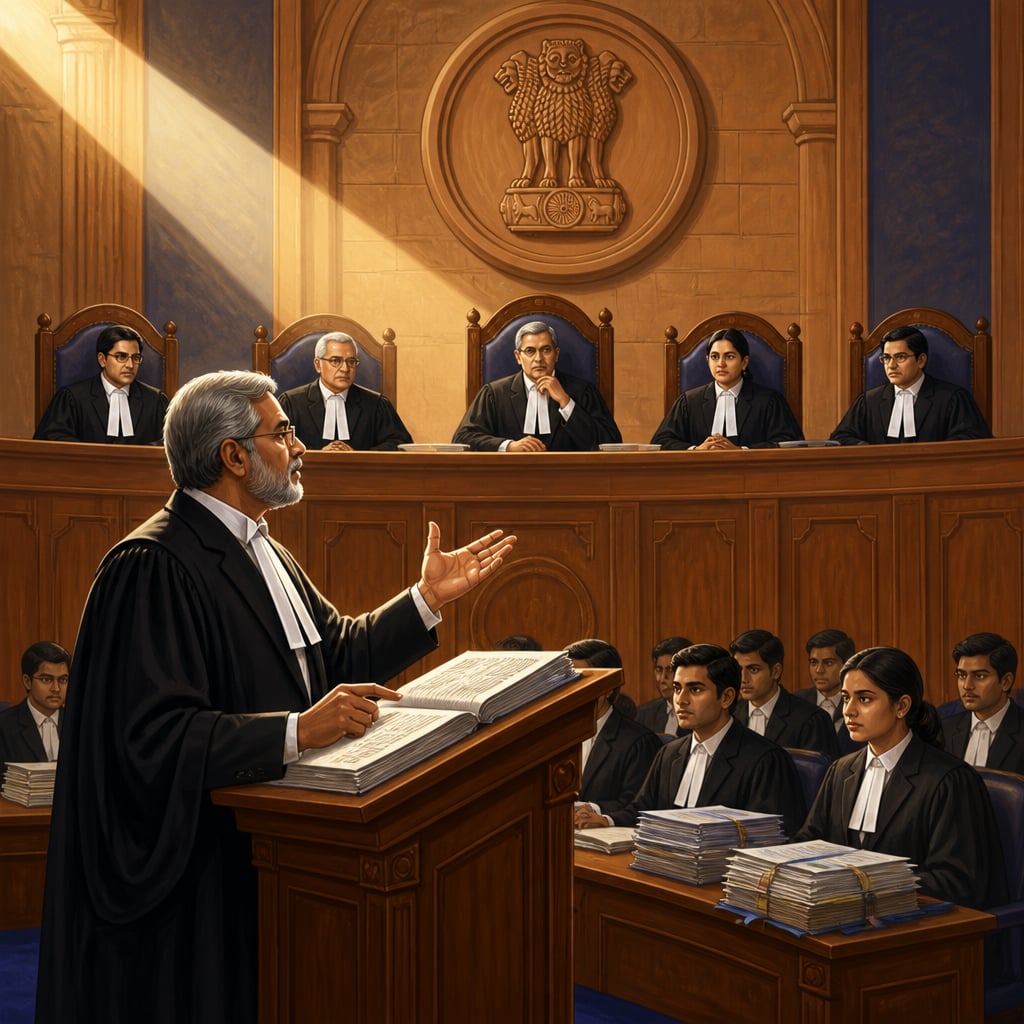
Senior advocate at the Supreme Court of India lectern

The headline was true in the sense that every word in it was a word in the judgment. The headline was also, by the standards of the Nyaya tradition, a near-perfect inversion of what the case had actually been about. The temple did not bar women in general. More than a hundred temples to the Devi across India bar men in general, and many bar them lifelong. What Sabarimala observed was a deity-specific practice rooted in the vow of Ayyappa as a brahmacharin. The eligibility rule was attached to the deity's own vow, not to women, and it applied to the years a devotee would observe the forty-one-day Vratam to enter the sanctum. The question the Court had agreed to answer was, in plain language, a wide question about gender and religion. The question the temple had spent eight centuries answering was a narrow question about one deity's vow at one shrine.

The two questions were not the same question. Once the wide question was accepted as the frame, the narrow answer could not survive inside it, no matter how true the narrow answer was. The case was not lost on the law. The case was lost on the frame. By the time the Review Bench convened, J. Sai Deepak's submissions, in plain English, did one thing first, before any constitutional argument: he asked the bench to redefine the scope of the question. Not 'do Hindu temples bar women', but 'does this deity's vow, observed by men and women alike for the forty-one-day Vratam, fall within Article 26's protection of denominational practice'. The frame change was load-bearing. Every later argument depended on it.

This is the second counter of the Shat-Khandana System. Anchor the Frame. The Sanskrit name is Avaccheda Khandana: limiting the scope. The opponent wants unlimited territory because unlimited territory is where loaded questions hide. You fence the battlefield because a fenced battlefield is where the truth becomes visible. The first counter, Expose the Pattern, broke the source. This counter shapes the room.

The Four-Part Protocol

A frame is not one thing. It is four things, stacked. To anchor the frame is to fix all four before the debate begins. Most debates collapse because one of the four is left floating, and the floating one becomes the door through which the entire question slips out of scope.

One. Define the term. Every loaded debate carries one or two words doing the work of three or four. 'Caste', in English, simultaneously names jati, varna, and gotra. 'Tolerance' simultaneously names patient acceptance, doctrinal indifference, and absence of legal remedy. 'Secularism', in Indian political vocabulary, names something almost opposite to what the same word means in French or American constitutional law. The first move is to ask, calmly, which of these meanings are you using. Either the speaker picks one, in which case the debate proceeds at the chosen meaning, or the speaker refuses to pick, in which case the speaker has admitted the debate has no anchor.

Two. Fix the scope. A scope is a fence. Inside the fence is what the debate covers. Outside the fence is what the debate does not cover. The most common manipulation in modern discourse is to argue a narrow case under a wide fence, so any Hindu defender finds themselves accidentally defending things they do not believe. 'Hindu nationalism' is the textbook example. The phrase, as deployed in Western media, names electoral politics, civilizational pride, RSS membership, and rare acts of violence simultaneously. Any Hindu who defends one is read as defending all four. The Anchor the Frame counter is direct. Which of the four meanings are we discussing in this conversation? The wide fence collapses into a narrow one, and the discussion becomes possible.

Three. Name the metric. Every claim of better or worse, more or less, just or unjust, requires a measure. The measure must be named, or the debate becomes an exchange of unmoored adjectives. 'Were Hindu kings tolerant?' Tolerant by what measure? By the number of religious minorities given asylum? By the number of houses of worship of other faiths protected during conquest? By the absence of forced conversion? By the literacy rate of religious minorities? Each metric produces a different verdict. The metric, named first, fixes the debate on a defensible empirical claim. The metric, left unnamed, allows the opponent to switch metrics every time the debate threatens to land.

Four. Set the time window. Every comparison demands a time window. 'Were Hindus historically intolerant?' Compared to whom, and across which centuries? The 11th to 17th centuries of forced conversion, temple destruction, and jiziya were not produced by Hindus. The 18th to 20th centuries of colonial economic extraction were not produced by Hindus. A debate about 'Hindu intolerance' that floats across all of human history without a time window is not a debate. It is a Rorschach test. The Anchor the Frame counter sets the window. 'In the period you are referencing, name the years.'

When the four are anchored, the debate has terrain. The opponent who wanted unlimited territory now has to fight on a fenced field. Many opponents, faced with the field, prefer to leave. The ones who remain are the ones the truth can meet.

The Nyaya Source: Avaccheda As Limitation

Stone craftsman cutting a granite block to dimension

The Sanskrit word Avaccheda comes from the verbal root chid, meaning to cut or to sever, with the prefix ava meaning down or away. To avaccheda a thing is to cut it down to size, to bound it, to give it a defined edge. In the Nyaya literature the word is technical. It refers to the specifying condition without which a claim cannot be evaluated. A statement like 'the pot is on the table' is incomplete in the strict Nyaya sense, because the relation between the pot and the table is unspecified. The pot is on the table at what time? In what state? Touching how much of the surface? The Avaccheda is the specifying condition that turns a vague claim into a testable one.

In Vatsyayana's Nyaya Bhashya the same logic is applied to debate.

देशकालावच्छिन्नो विषयो विवादस्य नियामकः।

deśa-kāla-avacchinnaḥ viṣayaḥ vivādasya niyāmakaḥ

The subject of debate, bounded by place and time, is what governs the debate.

Tradition of the Nyaya Bhashya, in the discussion of Vada-vidhi

The sentence is precise. Desha-avacchinna means bounded in place. Kala-avacchinna means bounded in time. Niyamaka means the governing or regulating element. Without these two boundaries, what is being claimed cannot be claimed about anything in particular, and therefore cannot be falsified, and therefore is not a claim. A claim that cannot be falsified is, in the technical Nyaya register, not an object of debate. It is something the debater has yet to produce.

Yajnavalkya answering Gargi at Janaka's court

The Nyaya Sutras themselves list Vada-niyama, the rules of debate, as a precondition for debate proper. Among the rules: the Vishaya (subject matter) must be agreed in advance, the Pramana (admissible means of knowledge) must be named in advance, the Siddhanta (the position to be defended) must be stated in advance. None of these is optional. A debate that begins without them is, by classical definition, not a debate. It is something else. It might be a quarrel (kalaha), a recital (pravachana), or a performance (pradarshana), but it is not a Vada.

This is the structural point the Western tradition has not, until recently, taken seriously. In the Western frame, two parties argue, and the rules of the argument are usually understood after the fact, by what one or the other has done. In the Dharmic frame, the rules of the argument are understood before the fact, by what both have agreed. Avaccheda Khandana is the live-room enforcement of that prior agreement. When the frame slips, the Dharmic debater names the slip and pulls it back. Not as a procedural objection. As the substance of the counter.

Dharmic Lens: The Steelman Versus The Sized Frame

The Western tradition has one good move adjacent to this lesson. It is called steelmanning, sometimes the principle of charity, and in formal philosophy it is sometimes called the strongest interpretation principle. The instruction is: when responding to an opponent, restate the opponent's argument in its strongest form, then respond to that strongest form. The instruction is correct. It produces better debate.

It is also, on its own, insufficient. Steelmanning gives the opponent the strongest version of their argument. It does not size the frame the argument is being made inside. A perfectly steelmanned argument inside a wrongly sized frame is still an argument that cannot land on truth, because the frame, not the argument, is doing the harm. A debater who only steelmans, and never anchors the frame, is giving the opponent both the strongest argument and the unfenced battlefield. This is generosity converted into self-injury.

The Dharmic protocol does both, in order. First, anchor the frame. Define the term, fix the scope, name the metric, set the time window. Only then steelman the opponent's argument, inside the now-fenced frame. The Sanskrit ordering is Purva Paksha (state the opponent's position) after the Vada-niyama rules (the frame rules) have been agreed. The classical shastrartha, with Shankara and Mandana Mishra as its archetype, ordered the protocol exactly this way. They spent the first day fixing the frame. They spent the next days inside it.

The Western tradition's good adjacent move runs the order backwards, and consequently runs out of room before the debate has begun.

The Hidden Move: When To Anchor The Frame Yourself, Without Permission

The most common reason the frame goes unanchored is that the speaker is waiting for the opponent or the moderator to anchor it. They will not. Most opponents benefit from a loose frame, and most moderators have not been trained to fix one. The Dharmic debater does not wait. The frame anchoring is performed by the debater, in the first thirty seconds, without asking permission and without seeking agreement.

The phrasing is calm and structural. Before I respond to that, let me make sure we are answering the same question. By X, do you mean A or B? By Y, are we discussing the period from year P to year Q, or the period from year R to year S? By Z, is the metric the rate, the absolute number, or the comparison to the contemporary baseline? The three sentences are delivered as if they were a courtesy. They are, in fact, the entire counter. By the time the opponent has answered the three questions, the frame has been anchored on the debater's terms, in public, with the audience watching.

The move's strength is that it cannot be refused without cost. An opponent who refuses to define the term has admitted the term is undefined. An opponent who refuses to fix the scope has admitted the scope is loose. An opponent who refuses to name the metric has admitted the comparison is unfounded. An opponent who refuses to set the time window has admitted the verdict is being read from no specific period at all. The audience hears these admissions in real time. The opponent who answers, on the other hand, has just walked onto the fenced field. Either outcome is a counter.

This is the Avaccheda move performed unilaterally. It does not require the opponent's cooperation. It does not require the moderator's permission. It does not require an institutional venue. It works on a panel, in a courtroom, on a podcast, in a classroom, and on a quote-tweet. The phrasing changes by venue. The structure does not.

A Word On Tone

The move is tonally easy to get wrong. Anchoring the frame can be heard, by an audience not trained to it, as evasion. Why won't you answer the question? The risk is real. The remedy is in the delivery.

Match the tone of curiosity, not the tone of objection. A tone of objection sounds like the debater is dodging. A tone of curiosity sounds like the debater is thinking out loud about how to give the best possible answer. The line, let me make sure we are answering the same question, is heard by the audience as care, not as evasion, because care is what the words actually carry.

Offer to answer in plural. I can answer for the period 1100 to 1700, or for the period 1947 to today, or for both. Which one are we discussing? The plural offer makes clear that the debater is not refusing to answer. The debater is offering to answer two distinct true things, depending on which is being asked. The opponent now has to pick. Once they pick, the debate becomes specific.

Anchor before steelmanning, not instead of. The order matters. Anchor the frame, then steelman the opponent's argument inside the fenced frame, then respond. A debater who anchors but never steelmans looks combative. A debater who steelmans but never anchors looks soft. A debater who does both, in order, looks unshakeable, because they have given the opponent the strongest version of their argument on the most defensible terms.

What Comes Next

The first counter named the tactic. This counter shaped the room. The third counter, Redirect the Burden, will turn the questioning back on the opponent. Once the room is shaped and the frame is anchored, the next move is to ask the opponent to defend their own claims inside that frame. The order is deliberate. Naming, anchoring, redirecting. By the third counter, the debate is no longer happening on the opponent's terms.

Case studies

Krishna at the Kuru Sabha (Mahabharata, Udyoga Parva)

After the thirteen-year exile of the Pandavas had been completed and the Kauravas refused to return the kingdom, Krishna travelled to Hastinapur as the Pandavas' envoy. The Mahabharata's Udyoga Parva records the negotiation in detail. Krishna entered the Kuru Sabha, the Kaurava court, with one explicit pre-condition for the conversation. The negotiation would be bounded. Either the Kauravas returned the full kingdom of Indraprastha to the Pandavas, in which case there would be peace, or the Kauravas refused, in which case there would be war. Krishna then offered, on the Pandavas' behalf, a further reduction of the scope: only five villages. The five-village offer was not weakness. It was the second Avaccheda. The Kauravas were now answering a defined yes-or-no question about five named villages, not an open-ended philosophical debate about kingship, dharma, or fate. Duryodhana wanted the open-ended frame, in which his rhetorical training, his court of supporters, and his elder Bhishma's reluctance to oppose him directly would all carry weight. Krishna refused that frame from the first sentence. The conversation in the Sabha is recorded as one of the most disciplined diplomatic exchanges in the entire Mahabharata, precisely because the frame had been anchored before any party began to speak.

Krishna's negotiation in the Kuru Sabha is the Mahabharata's worked example of Avaccheda Khandana operating in statecraft. The four anchors of the modern protocol are visible in the source. Krishna defines the term (the question is about kingship, not about dharma in the abstract). Krishna fixes the scope (Indraprastha first, five villages as the reduced offer, no further negotiation). Krishna names the metric (the metric is whether the kingdom is returned, not whether the Kauravas feel justified). Krishna sets the time window (now, in this Sabha, before the assembly disperses). Duryodhana attempts at every turn to widen the scope to general philosophical debate about whether the Pandavas had ever been the rightful rulers, whether the dice game was binding, whether the exile was complete. Krishna refuses each widening as a structural violation, just as Yajnavalkya did with Gargi's third question. The Mahabharata records the audience, including Bhishma and Vidura, as recognising the legitimacy of Krishna's frame-anchoring. The widening attempts are heard, by the assembly, as evasion.

The Kauravas refused the five-village offer. Duryodhana attempted to seize Krishna and was rebuffed by the Vishvarupa darshan. War followed at Kurukshetra. The Mahabharata's framing is unambiguous: the war was not Krishna's failure of negotiation. The war was Duryodhana's failure to operate inside the anchored frame. Krishna had given the Kauravas a defined, defensible, and dignified path to peace. The path was rejected. The dharma of the negotiation was preserved by the anchored frame, and the Pandavas' subsequent war was, by the source's own account, fought from a position of moral clarity that an unanchored negotiation could not have produced.

Anchoring the frame does not guarantee that the opponent agrees to the anchored frame. It guarantees that, when the opponent refuses the frame, the refusal is visible to the audience as the opponent's own act. The defender who anchored the frame retains the moral and rhetorical position even if the negotiation fails. The Mahabharata makes this point structurally. The Pandavas did not lose the rhetorical war because Krishna had anchored the frame. The Kauravas lost it because they had refused the anchored frame in the open court.

The Udyoga Parva of the Mahabharata, in the BORI Critical Edition, devotes more than 190 verses to the Kuru Sabha negotiation across multiple chapters of the Bhagavad-yana sub-parva. Of these, the five-village reduction (Krishna's second Avaccheda) occupies a single short sequence. The remaining verses are largely devoted to Duryodhana's attempts to widen the scope, and Krishna's refusals. The structural ratio of the source itself, in other words, is mostly frame-anchoring.

Shankara and Mandana Mishra at Mahishmati (8th c. CE)

When the young Adi Shankara arrived at Mahishmati to challenge Mandana Mishra, the foremost Mimamsa scholar of the age, the two did not begin debating immediately. The hagiographical sources, including the Madhaviya Shankara Vijayam and the earlier Brihat Shankara Vijayam tradition, record the days of preparation that preceded the first claim. The Vishaya was fixed. The two parties agreed in writing that the question to be debated was whether ritual action (karma-kanda, Mandana Mishra's domain as a Mimamsa scholar) or knowledge (jnana-kanda, Shankara's Advaita position) constituted the highest path to liberation. The Pramanas were named. Both parties agreed in advance which sources of knowledge would be admissible: the Vedas, the Upanishads, the Brahma Sutras, and the agreed commentarial tradition. Sources outside this list were ruled inadmissible. The judge was named. Mandana Mishra's wife, the scholar Ubhaya Bharati, was agreed by both parties as the impartial adjudicator. The stake was named. If Shankara won, Mandana Mishra would take sannyasa and join Shankara's lineage. If Mandana Mishra won, Shankara would marry and take up household life. The frame-fixing took days. The debate that followed lasted weeks. At its end, Ubhaya Bharati ruled in Shankara's favour on the agreed Vishaya, and Mandana Mishra, by the agreed stake, took sannyasa and became Sureshwaracharya.

Mahishmati is the institutional model of Avaccheda Khandana in classical India. The four anchors of this lesson appear there as institutional realities, not as informal courtesies. The Vishaya is the anchored term: the debate is about karma versus jnana, no other question. The Pramana list is the anchored scope: this is the literature inside the fence; everything outside is ruled out. The judge is the anchored metric: Ubhaya Bharati determines who has won, by the agreed criteria. The stakes set the anchored time window: at the moment of judgment, the loser performs the agreed action. This is not a metaphor for modern debate. It is the structural template that modern shastrartha at the Kanchi and Sringeri lineages still preserves. The reason the debate is studied as a model is that the frame-fixing did the heavy lifting. Inside an anchored frame, the actual claims could be examined cleanly, without the constant slippage of scope that disfigures most modern public debate.

Mandana Mishra became Sureshwaracharya, one of the four principal disciples of Adi Shankara, and inherited the Sringeri Sharada Peetham as its first acharya. Ubhaya Bharati, having ruled the case, went on to challenge Shankara herself in a follow-up debate on a separate Vishaya, again with anchored frames. The Mahishmati debate is preserved across the Advaita commentarial tradition as the foundational example of how the highest-stake intellectual exchanges in classical India were conducted. Every later shastrartha, from the Vijayanagara court to modern Kanchi mathas, draws its procedural structure from this template.

When the stakes of a debate are very high, the frame-fixing should be longer than the debate. This inverts the modern expectation, in which frames are improvised at the start of a panel and adjusted by the moderator on the fly. The classical model is the opposite: the frame is the product of careful prior agreement, and the debate is a controlled exchange inside it. Modern Dharmic debaters who borrow even one feature of this model (a written pre-agreement on the Vishaya, on the Pramanas, on the metric of judgment) raise the quality of the exchange dramatically, because the structural conditions that make a real debate possible have been supplied in advance.

The Madhaviya Shankara Vijayam, attributed to the 14th-century scholar Vidyaranya, reports the Mahishmati debate as having lasted between fifteen and seventeen days of substantive argumentation following several days of preliminary frame-fixing. The frame-fixing phase, according to the same source, occupied between three and four days, a ratio of approximately one preparatory day for every four debate-days. Modern academic debates rarely allocate any preparatory time to frame-fixing at all.

Sabarimala: From 'Gender Equality' Frame to 'Article 26 Denominational Practice' Frame (2018-2020)

In September 2018, in Indian Young Lawyers' Association versus the State of Kerala, a Supreme Court Constitution Bench ruled four to one that the Sabarimala temple's centuries-old observance of restricting entry to women aged ten to fifty during the forty-one-day Vratam period was unconstitutional. The majority's framing of the legal question was, in effect, a question about gender equality and religion. Stated this way, only one answer was structurally available to the court: the restriction had to fall. The framing did not engage the temple's actual position, which was that the restriction was a deity-specific observance attached to Ayyappa's vow of brahmacharya, applied during the specific Vratam window, and paralleled by more than a hundred Devi temples across India where men are restricted by analogous deity-specific vows. The wide frame had erased the narrow, defensible, doctrinally precise answer. Within months, more than 65 review petitions were filed. The Review Bench was constituted. J. Sai Deepak's submissions, beginning in early 2019, performed an Avaccheda Khandana of the original framing. He did not argue gender equality versus religion. He argued that the original frame was incorrectly sized. The actual constitutional question, he submitted, was whether a deity-specific observance, observed by men and women alike during a specific religious calendar window, fell within the protections of Article 26 of the Constitution, which guarantees denominational autonomy in matters of religion. He defined the term (Article 26's denominational practice, not generic religion). He fixed the scope (this deity at this shrine, not Hindu temples in general). He named the metric (the constitutional test of essential religious practice within a denomination, not the general test of equality between groups). He set the time window (the centuries-long observance of the vow, attested in the temple's documented practice). The four anchors were performed in legal English, in writing, before the highest court.

Sai Deepak's reframing is the most studied contemporary instance of the four-part protocol in Indian public life. Every move in his submission has a Nyaya counterpart. The redefinition of 'religion' as 'Article 26 denominational practice' is the Vishaya-fixing. The reduction from 'all Hindu temples' to 'this specific deity at this specific shrine' is the desha-avacchinna in operation. The substitution of 'denominational essential practice' for 'gender equality in religion' is the niyamaka-shift, replacing one governing element with another. The pointing to the centuries-long documented observance is the kala-avacchinna, the time-window anchor. None of this was procedural manoeuvring. Each was the substance of the constitutional argument. The Dharmic tradition predicts the move: a debate framed wrongly produces a wrong answer no matter how good the inside-the-frame argumentation. Sai Deepak's intervention re-sized the frame and made the right answer constitutionally available for the first time.

In November 2019, the Supreme Court referred the review petitions and several connected matters to a larger nine-judge bench, on questions including the Article 26 protections of denominational practice, the limits of judicial review of religious practices, and the relationship between Articles 25 and 26. As of mid-2026, the nine-judge bench's hearings on the broader constitutional questions remain ongoing, with the Sabarimala-specific question functionally on hold. The 2018 majority verdict, while not formally overturned, no longer operates as the unchallenged frame. The reframing did not produce a final win on the original case. It produced something structurally larger: it forced the constitutional question itself to be re-sized at the apex court, with the Article 26 frame now in the centre of the inquiry. The Dharmic intellectual community, including Rajiv Malhotra in Snakes in the Ganga and J. Sai Deepak in his three-volume Bharat sequence, has documented the reframing as a structural template for future cases on temple administration, denominational autonomy, and personal-law matters.

A wrongly framed legal or public question cannot be answered correctly inside its own frame. The Dharmic counter is to refuse the frame, not the answer. Refusing the frame requires courage, because the audience will, in the first minutes, mistake the refusal for evasion. The remedy is the protocol of this lesson: define the term, fix the scope, name the metric, set the time window, and then perform the steelman of the opponent's argument inside the now-fenced frame. The Sabarimala Review Bench submissions are the contemporary template. They are studyable, in English, by any Indian advocate, debater, or commentator.

The original 2018 Indian Young Lawyers' Association v. State of Kerala judgment runs to more than 400 pages across the four majority opinions and the lone dissent of Justice Indu Malhotra. Justice Malhotra's dissent is, structurally, the only opinion in the original judgment that argued from the Article 26 frame; all four majority opinions argued from the Article 14-15 (equality and non-discrimination) frame. The numerical asymmetry (four to one) tracks the framing asymmetry exactly. When the frame was wide, the answer was four to one against the temple. When the frame was narrowed in the Review Bench submissions to Article 26, the same Court found the question difficult enough to refer to a nine-judge bench. The frame, not the facts, drove the verdict.

Reflection

More in Khandana Yukti: The Art of Clarity

All lessons in Khandana Yukti: The Art of Clarity · Vaada Shastra: The Dharmic Art of Debate course