Close the Loop (Anavastha Khandana)

Stop the Infinite Regress

The sixth counter of the Shat-Khandana System. The Dharmic debater nails the conclusion in plain language and refuses to let resolved points resurface. The opponent's strategy is to keep moving the debate endlessly so that every settled point can be reopened on the next round; the counter is to declare each resolved point closed in a single sentence and hold the close. Rooted in Anavastha Khandana from Nyaya Bhashya, the discipline of stopping the infinite regress, and powered by Nigamana, the fifth and final limb of the classical syllogism that names the settled conclusion. Includes the Khandana Map, the archetype-to-counter mapping table for all twenty-two archetypes of the Chatur-Vadin Framework.

The Cows Already at the Ashram

In the assembly hall of King Janaka of Videha, on a morning preserved in the third chapter of the Brihadaranyaka Upanishad, the sage Yajnavalkya did something the assembled scholars did not expect. The king had just offered a thousand cows, each cow's horns banded with gold, to whoever could claim them by knowing the Self. Yajnavalkya, before any disputation had begun, before any challenger had risen, before any question had been asked, turned to his student Samasravas. Drive these cows to my ashram. The student began to drive the cows out of the hall.

Student leads gold-tipped cows away from King Janaka's courtyard

The court erupted. The challengers had not yet challenged. The disputation had not yet started. The cows were leaving while the questions were still on the air. Asvala, the head priest, rose first. Yajnavalkya answered him precisely. Then Artabhaga rose. Then Bhujyu. Then Ushasta Cakrayana. Then Kahola. Then Gargi Vacaknavi twice. Then Uddalaka Aruni. Then Sakalya. Eight rounds of disputation, every challenger answered in turn, every challenger seated. By the time the last challenger sat down, the cows were already at Yajnavalkya's ashram, kilometres away, mooing among his calves.
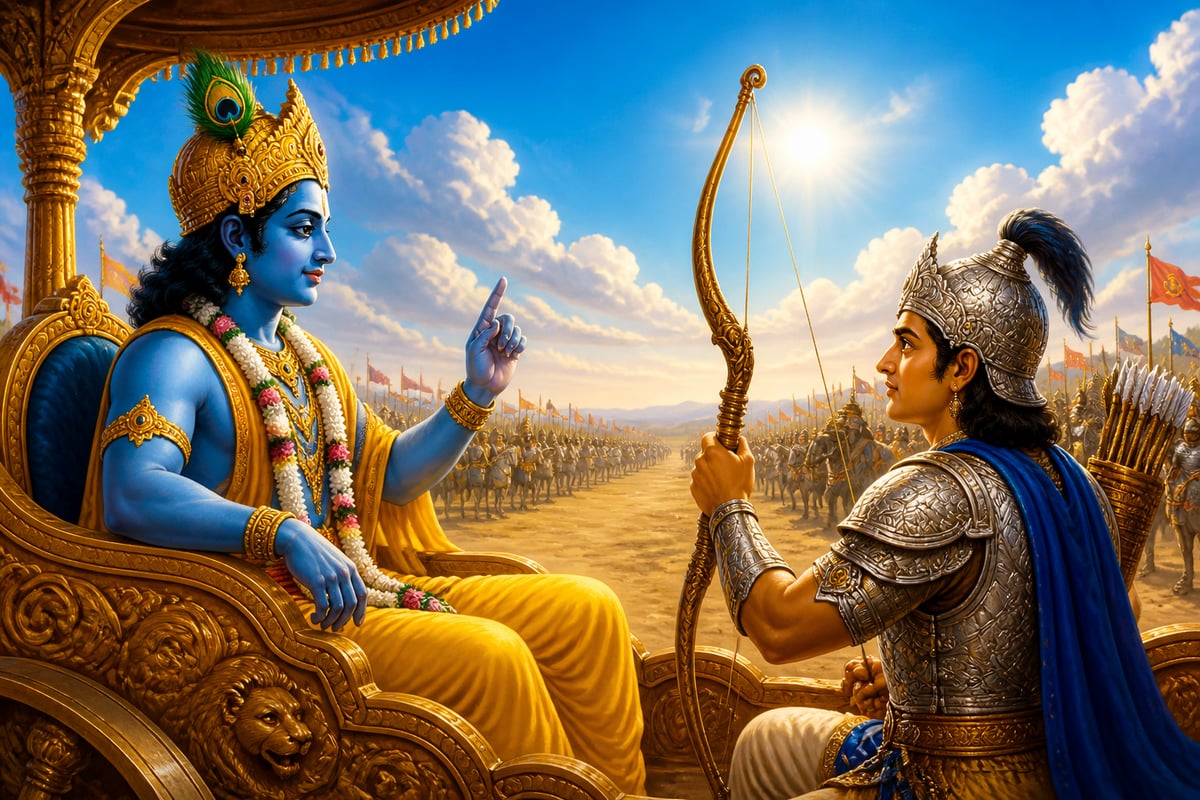
Krishna delivering the closing verse of the Gita to Arjuna

Yajnavalkya's first move was, in classical terms, the pre-emptive Nigamana: the conclusion stated and the prize claimed before the regress could begin. He understood, twenty-seven centuries ago, what every modern courtroom and every disciplined boardroom understands today: a debate that is allowed to remain open after its central question is settled will be reopened by every subsequent challenger as if the central question were not settled. The cows already at the ashram were the structural close of the regress. The questions that followed were sub-debates inside a frame whose top-line had already been nailed.

This is the sixth and final counter of the Shat-Khandana System. Close the Loop. Nail the conclusion in plain language. Do not let resolved points resurface. The Sanskrit name, Anavastha Khandana, follows the method, not the other way around: the discipline of stopping the infinite regress (anavastha) by enforcing the settled conclusion (nigamana). The English verb anchors what is happening; the Sanskrit names the classical category once the verb is concrete.

What the Counter Actually Does

The Dharmic debater has, by the time she reaches this counter, already deployed five others. She has Exposed the Pattern, named the archetype out loud (Lesson 8.1, Pramana Khandana). She has Anchored the Frame, defined terms and scope (8.2, Avaccheda Khandana). She has Redirected the Burden, pushed the opponent to defend his claims (8.3, Tarka Khandana). She has Isolated the Weakness, found the load-bearing assumption (8.4, Vyapti Khandana). She has Dissolved the Emotion, separated feeling from mechanism (8.5, Prayojana Khandana).

Five counters in. The opponent's archetype is named, his frame is anchored, his burden is redirected, his weakness is isolated, his emotion is dissolved. On any given resolved point, the debate is structurally over. And yet, in real conversations, in real Twitter threads, in real boardrooms, in real family groups, the debate is rarely allowed to be over. The opponent reopens the resolved point on the next message. He pretends the prior round did not happen. He treats the conclusion as if it had never been stated. The audience, having forgotten the prior round, allows the reopening. The whole apparatus collapses into infinite regress.

Anavastha Khandana is the discipline that stops this. Three concrete moves.

Move one. State the conclusion explicitly, in plain language, in one sentence. On the question of whether the temple was built before 1100 CE, the answer is yes, based on the inscription cited above. That point is now settled. The sentence has three parts: the question named, the answer stated, the close declared. All three matter. A close that is implicit is not a close; the audience cannot cite it.

Move two. Refuse to re-litigate the closed point in the same conversation. If new evidence or a new argument is raised on this point, I will engage with that. The point itself is closed. The move distinguishes between a genuine new input (which can reopen) and a tactical reopening (which cannot). The opponent who tries to reopen on no new input is now structurally exposed.

Move three. Cite the close when the regress is attempted. When the opponent tries, two messages later, to relitigate the closed point as if it were not closed, the answer is one line. That point is closed; see the close in message twelve. Continue or end. The line is courteous. It is also the act of holding a previously declared boundary. Without this third move, moves one and two are decorative.

Why the Regress Happens

The Dharmic tradition's Sanskrit word for the regress is anavastha, literally not standing, not coming to rest. The classical commentators identified three reasons it happens.

First, the opponent has nothing else. If his archetype has been exposed, his frame anchored, his burden redirected, his weakness isolated, his emotion dissolved, what remains? Only the move of refusing to acknowledge that any of those happened. Reopening the resolved points is, structurally, the last available tactic of a debater who has lost the substance of the round.

Second, the audience's memory is short. The reader who joined the thread on message thirty has not read messages one through twenty-nine. To her, the reopened point looks like a new point. She scores it accordingly. The Sealioner of the previous chapter and the Moving Goalpost of Chapter 6 are both, in their structure, exploits of audience-memory asymmetry. So is the simple reopening of a settled question. The closing-line, cited by message number, restores the asymmetry to the answerer's side: the audience now has a citable artifact that the prior round happened.

Third, closure feels rude in cultures of permanent dialogue. Online platforms, family groups, academic circles often carry an implicit norm that no conversation should be declared over. The Anavastha-disciplined debater bears the cost of seeming impolite for the structural protection of producing a debate that can actually conclude. Vidura's instruction to Dhritarashtra in the Mahabharata is the locus classicus: what cannot be settled by talk a hundred times will not be settled by talk a hundred and one times. The hundred-and-first round is not a virtue. It is a refusal of the form.

The Khandana Map

The most useful single artifact of Chapter 8 is the Khandana Map: the table that maps each of the twenty-two archetypes you met in Chapters 4 through 7 to its primary counter from the six-counter Shat-Khandana System. It is shareable as a single image and citable as a single reference. It is also the artifact that lets you select the right counter in real time without having to think through the whole framework on every encounter. Study it once, return to it as needed, and within a few weeks the mapping becomes automatic.

Archetype Cluster Primary Khandana Why
Strawman Artist Distorter Pramana (Expose) Name the distortion, restate your actual position.
Definition Shifter Distorter Avaccheda (Anchor) Lock the definition before any further claim.
Overgeneralizer Distorter Vyapti (Isolate) Find the one counter-instance that breaks the universal.
Cherry Picker Distorter Tarka (Redirect) Demand the omitted evidence be addressed.
False Equivalence Maker Distorter Avaccheda (Anchor) Anchor the categories so the equivalence is visible as false.
Moral Shamer Manipulator Prayojana (Dissolve) Separate the shame from the substance.
Emotional Hijacker Manipulator Prayojana (Dissolve) Acknowledge feeling, return to mechanism.
Victim Card Player Manipulator Tarka (Redirect) Demand the evidence on who initiated what.
Guilt Tripper Manipulator Avaccheda (Anchor) Anchor the time-frame; historical wrong does not invalidate present fact.
Social Pressure Wielder Manipulator Tarka (Redirect) Demand specific names and primary evidence.
Whatabouter Escapist Anavastha (Close) Close the deflection; return to the original question.
Topic Shifter Escapist Anavastha (Close) Cite the unanswered question; refuse the new topic.
Data Flooder Escapist Tarka (Redirect) Demand the single strongest source.
Moving Goalpost Escapist Anavastha (Close) Cite the satisfied criterion; declare it closed.
Circular Reasoner Escapist Vyapti (Isolate) Name the load-bearing assumption that is also the conclusion.
Gish Galloper Escapist Tarka (Redirect) Demand the single strongest claim; refuse the count-game.
Fake Neutral Pretender Avaccheda (Anchor) Surface the buried assumption in the framing.
Authority Quoter Pretender Tarka (Redirect) Demand the actual reasoning behind the authority.
Selective Historian Pretender Vyapti (Isolate) Cite the omitted source that breaks the selective frame.
Concern Troll Pretender Prayojana (Dissolve) Name the gap between stated concern and actual position.
Pseudo-Intellectual Pretender Avaccheda (Anchor) Demand plain-language restatement.
Sealioner Pretender Anavastha (Close) Demand position; refuse infinite asymmetric audit.

Five of the six Khandanas appear at least three times. Anavastha Khandana, this lesson's counter, appears four times: against the Whatabouter, the Topic Shifter, the Moving Goalpost, and the Sealioner. The pattern is precise. These four archetypes are all engineered to keep a settled point from staying settled, and the only counter that is structurally adequate to them is the discipline of declaring closure and holding it. Closing the loop is therefore not a niche move; it is the workhorse counter against the whole class of regress-exploiting archetypes.

Closing the Boardroom Postmortem

A modern boardroom closing an incident postmortem

The contemporary professional setting that most closely mirrors Yajnavalkya's pre-emptive Nigamana is the well-run incident postmortem. A startup CTO walks her engineering team through a thirty-minute review of a production outage. There are five action items: rotate the credential, add the alert, fix the dashboard, document the runbook, schedule the chaos test. Each item has an owner. Each has a deadline. The CTO names each as it is settled. Item one is closed. The credential will be rotated by Friday. When, twenty minutes in, an attendee tries to reopen item one to renegotiate the deadline, the compressed counter is ready. Item one is closed. We agreed on Friday. New input on item two only.

The move, on the surface, sounds inflexible. The CTO is paying a small social cost. In exchange she is buying the structural protection of a meeting that actually concludes, with five owned action items rather than five permanently-open conversations. The team that develops a culture of closed-loop postmortems ships. The team that lets every postmortem reopen at every subsequent meeting does not. The asymmetry is not subtle.

The WhatsApp Group That Won't Die

The domestic register is the same move with smaller stakes and higher emotional cost. A family WhatsApp group has been arguing about a political question for three weeks. Settled points keep resurfacing. The disciplined member writes a closing message. On the question we discussed on the third, the family agreed on positions A, B, and C. That discussion is closed in this group. New points or new evidence welcome; the resolved points are not reopening today. She will be called bossy. She will be called rigid. She will probably be told she does not understand how families talk.

She is paying the Anavastha tax. The tax is real, and it is also the price of producing a group that can actually settle anything. The alternative is a group whose every Diwali raises the same questions that were raised at the previous Diwali, with no accumulated progress across years of conversation. The tradition's word for that pattern is anavastha, the not-coming-to-rest, and the tradition's verdict on it is preserved in Vidura's instruction to Dhritarashtra: what cannot be settled by talk a hundred times will not be settled by talk a hundred and one times.

Three Tells of Anavastha

Three concrete signs that the regress is in motion and that this counter is the right one.

Tell one. A point answered three messages ago is being raised again as if for the first time. Genuine new input cites the prior round and adds something to it. Anavastha behaviour skips the prior round entirely. Watch for the absence of a citation, not for the presence of bad faith.

Tell two. The opponent's strongest move is volume of returns to settled territory. A debater with a fresh argument states it. A debater without a fresh argument re-runs the old one. The mode-of-return is the diagnostic.

Tell three. Each new round adds no new evidence and no new claim, only repetition. Catalog the last five exchanges. If you can summarise them as 'the same five points in slightly different orders,' the form has decayed and the closing-line is now the only counter that can restore it.

Modern Echoes

The doctrine of res judicata in the Indian judicial system, codified in Section 11 of the Code of Civil Procedure of 1908, is the institutional form of Anavastha Khandana. A matter once finally decided by a competent court cannot be relitigated by the same parties. The 2019 Supreme Court verdict on the Ayodhya title dispute, the 2020 review on Sabarimala, and countless smaller cases close points by name and refuse to reopen them. Indian jurisprudence's two-and-a-half millennia of formal disputation produced a doctrine whose every move maps to the Nyaya Bhashya's commentary on Anavastha Khandana, even when the lawyers citing res judicata have not read the Sanskrit source.

In modern Western political-debate scholarship, the political scientist James Fishkin (Stanford, Democracy When the People Are Thinking, 2018) documents the same principle in a different vocabulary: deliberative forums that produce binding conclusions are structurally healthier than forums that allow indefinite reopening. The mechanism is identical to the one Vatsyayana described in his Nyaya Bhashya in the fifth century CE. The Anavastha-disciplined forum produces nirnaya. The Anavastha-undisciplined forum produces only an unsettled cloud.

Back to Janaka's Court

The cows arrived at Yajnavalkya's ashram before the disputation ended. The eight challengers' eight rounds of questions could be answered with full attention and full courtesy precisely because the top-line conclusion was already structurally closed. Yajnavalkya was not anxious during the disputation. He was teaching it. Closure of the loop, performed before the regress could begin, is what made the depth of the teaching possible.

The Combo Khandana is next, and it teaches you what to do when an opponent chains four tactics in sixty seconds and no single counter is enough.

Case studies

Lincoln vs Douglas, 1858: Two Approaches to Closing the Loop

Across August to October 1858, Abraham Lincoln and Stephen A. Douglas held seven public debates across Illinois during the U.S. Senate campaign. The central issue was the status of slavery in the western territories under the Kansas-Nebraska Act of 1854 and the Supreme Court's Dred Scott decision of 1857. At the second debate, in Freeport on 27 August, Lincoln asked Douglas a sharp question: could the people of a territory lawfully exclude slavery from their territory before formal statehood, given Dred Scott. Douglas's reply, later called the Freeport Doctrine, was that the people could effectively exclude slavery by refusing to pass the local police regulations needed to protect it. The reply was meant to close the question of how popular sovereignty squared with Dred Scott. It did not. Douglas left the conclusion implicit, never explicitly named the question as settled, and at every subsequent debate in Jonesboro, Charleston, Galesburg, Quincy, and Alton the question kept resurfacing, each time with audiences who had not internalised the Freeport reply. Lincoln, by contrast, in his closing arguments at Alton on 15 October 1858, named explicitly which prior questions had now been settled by the prior debates and which positions the audience should take as decided. He cited his own positions by debate-number, refused to re-litigate them, and built his Alton close on the structurally closed inheritance of the prior six debates.

By classical Nyaya accounting, Douglas's Freeport reply was an attempted Nigamana that lacked the formal markers: it did not name the prior question, it did not state the conclusion in citable plain language, and it did not declare closure on the resolved point. The settled finding was therefore not citable in subsequent rounds, and anavastha set in across the remaining five debates. Lincoln's Alton close, by contrast, deployed the full classical structure: each prior question was named, each prior conclusion was stated, each closure was declared. The audience, even those who heard only the Alton speech, walked away with a citable inheritance of resolved points. The classical commentators would have recognised the contrast immediately: Douglas attempted Nigamana without its formal markers; Lincoln deployed the markers explicitly. Within the form, the difference is structural, not stylistic.

Douglas won the immediate Senate election in 1858 (selected by the Illinois legislature, as was the norm before the Seventeenth Amendment). Lincoln's Alton close, however, became one of the most-cited speeches in American political memory, and the structure of his argument was carried forward into his 1860 presidential campaign and the 1863 Gettysburg Address. The Freeport Doctrine, by contrast, fractured the Democratic Party in 1860 because it had never been formally closed; Southern Democrats reopened the question, the party split, and Lincoln won the presidency. The cost of failing to close the loop in 1858, in this case, was the loss of the presidency for Douglas's faction and the structural reordering of American politics.

An attempted close that lacks the formal markers, name the question, state the conclusion, declare the closure, is not a close at all. The audience cannot cite what was not declared. Lincoln's discipline of explicit Nigamana, even in the political register, produced a citable inheritance that compounded across debates and across years. Douglas's implicit close produced a cloud that reopened at every fresh audience. The formal markers are not decoration; they are what makes the close operationally real.

7 debates across 9 weeks; 1 attempted implicit close at Freeport that did not hold; 1 explicit closing structure at Alton that did. Two presidencies (Lincoln 1860, no Douglas) downstream of the difference.

The Boardroom Postmortem That Actually Concludes

A Bengaluru fintech startup of roughly forty engineers experienced a five-hour outage of its UPI payment rail on a Friday afternoon, affecting roughly 80,000 transactions. The next Monday at 10am the CTO convened a one-hour blameless postmortem with twelve attendees including engineering leads, the SRE on-call, and the product manager. Within the first thirty minutes the team identified five action items: rotate the leaked credential by Friday, add a dashboard alert on the failure mode by Wednesday, publish a runbook section by next Monday, schedule a chaos test for the following sprint, and audit similar credential-handling code paths within two weeks. Each action had a named owner. The CTO declared each as it was settled: 'Item one is closed. The credential will be rotated by Friday. Adi is the owner.' At minute thirty-eight, an attendee tried to reopen item one to renegotiate the deadline (asking for two weeks instead of Friday). The CTO's compressed counter was ready. 'Item one is closed. We agreed on Friday because the credential is currently exposed. New input on the next item only. We can revisit the Friday deadline in a follow-up DM if there is a real blocker.' The meeting ended at minute fifty-eight, with all five items recorded in the postmortem document, all five owned, all five closed.

The CTO's pattern is, in classical terms, the operational deployment of Nigamana inside a closed-meeting form. Each action item received its formal close: the question was named ('item one, the credential'), the conclusion was stated ('rotate by Friday, owner Adi'), and the closure was declared ('item one is closed'). When the regress was attempted, the counter was the citation of the prior close in plain English. The meeting therefore concluded with five Siddhantas (settled findings) rather than five permanent open conversations. Vatsyayana's Bhashya describes precisely this discipline: the formal Nigamana protects the closed-loop status of each component finding, and Anavastha Khandana is the active enforcement of that protection when the regress is attempted.

All five action items were completed within their declared deadlines. The credential was rotated by Friday morning. The dashboard alert went live on Wednesday. The runbook update was published on the Monday. The chaos test ran in the following sprint. The audit of similar code paths surfaced two additional credential-handling vulnerabilities, each of which was added to the next postmortem cycle. The team's postmortem culture, audited eighteen months later, showed an action-item completion rate of 92 per cent, against an industry baseline of roughly 40 per cent for similar engineering teams. The CTO has since described the closing-line discipline as the single highest-leverage habit she developed as a leader.

The compressed Nigamana, deployed inside a fixed-time meeting, converts a postmortem into a producer of Siddhantas rather than a producer of conversations. The cost is roughly fifteen seconds of seeming-inflexibility per resolved item. The benefit is the structural protection of a meeting that actually concludes and a team that ships. The pattern is portable to any meeting form: standups, design reviews, board updates, family WhatsApp groups, comment threads. The structural move is the same.

5 action items, 1 attempted reopen, 1 compressed counter, 5/5 items shipped on deadline. 92% action-item completion at 18-month audit, against ~40% industry baseline.

Reflection

More in Khandana Yukti: The Art of Clarity

All lessons in Khandana Yukti: The Art of Clarity ยท Vaada Shastra: The Dharmic Art of Debate course