Expose the Pattern (Pramana Khandana)
Name the Tactic, Break the Illusion
Expose the Pattern is the first counter in the Shat-Khandana System. The moment you name the tactic out loud, the illusion it depends on collapses. Rooted in Pramana Khandana from the Nyaya Sutras: invalidating the opponent's source of knowledge. When the source is shown to be flawed, every claim built on it falls with it. This lesson trains the single most important live-room move in the whole course.
The Boy Who Said The Word
A Tuesday evening in April 2021, a small studio in Noida. A news anchor is two minutes into a segment on Hindu concerns about a new Netflix series. The other guest, a senior academic, has already used the phrase majoritarian anxiety three times. He has cited two American scholars. He has said, in a patient voice, that "serious researchers long ago settled this question." The screen is split into six boxes. The scroll at the bottom is running at speed. The guest who has been invited to represent the Hindu side is twenty-three years old. He has one minute, maybe less, before the anchor cuts to a break.
He does not try to answer the academic on the academic's terms. He leans into the camera. In a calm voice, at normal speaking speed, he says one sentence.
"Sir, with respect, that is not an argument. That is an appeal to authority. Which specific claim are you making, and what evidence would convince you otherwise?"
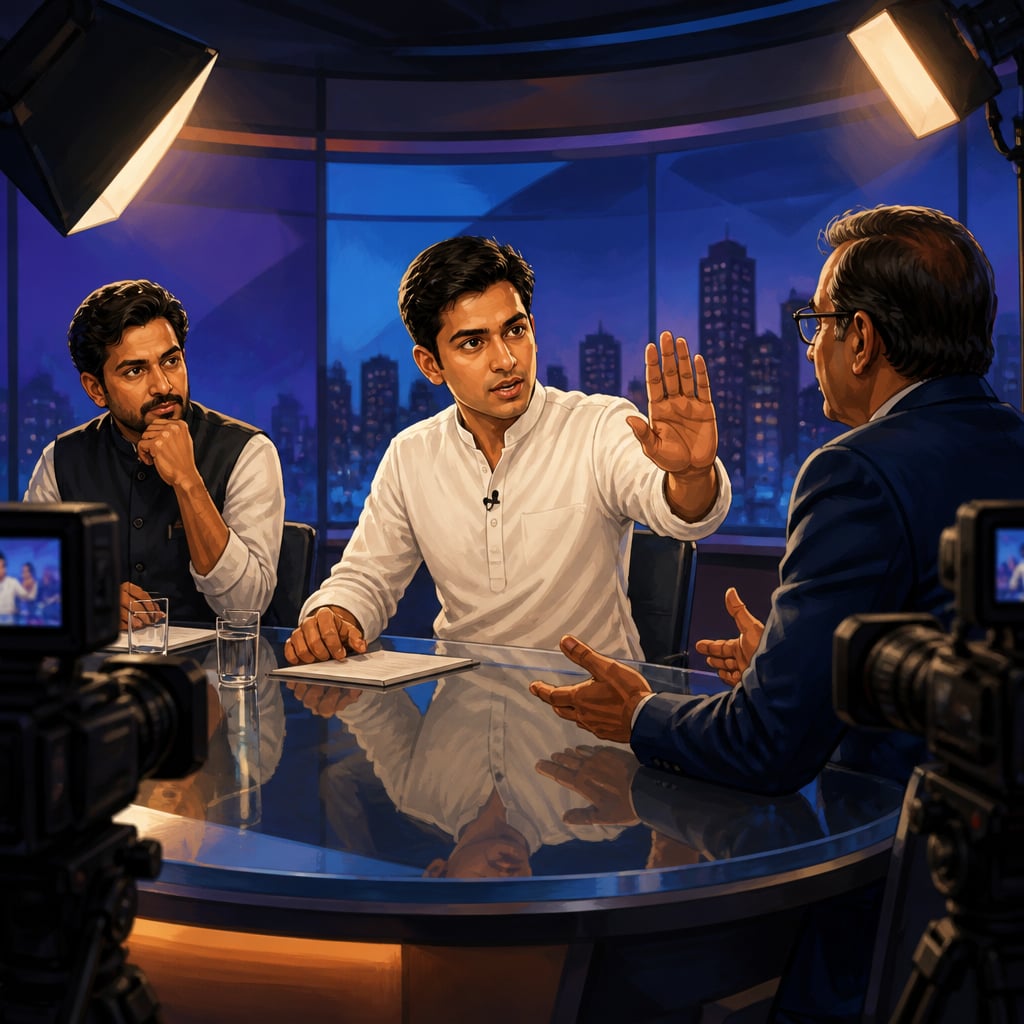
The academic blinks. The anchor pauses. The room, which had been a jargon weather system for ninety seconds, suddenly has a shape. The audience, some of whom have been nodding along without quite knowing why, can now see what the exchange is actually about.
The boy just used the first Shat-Khandana counter. He named the pattern. He called out the source the academic was leaning on (prestige citations) and showed the room that the source was not load-bearing. In the Nyaya Sutras, this counter has a name that is two thousand years old. It is called Pramana Khandana: invalidating the opponent's pramana, their claimed source of knowledge. When the source falls, the claim falls with it.
What "Expose the Pattern" Actually Means
For the next ninety-five lessons of your life, this is the single move you will use the most. It is worth slowing down and seeing it clearly.
A Jalpa debater does not argue with facts. He argues with vibes. A specific vibe, carried by a specific tactic. If you respond to the facts he has mentioned, you have already lost, because the facts were never the point. The tactic was the point. And the tactic only works while it is unnamed.
Exposing the pattern is a three-beat move.
- Recognise. You identify which of the twenty-two archetypes from Chapters 4-7 is being used. Strawman. Whatabouter. Fake Neutral. Sealioner. One of the twenty-two.
- Name. You say it out loud. In plain English. In the room. "That is a strawman." "That is an appeal to authority." "That is whataboutism." "That is a shifted definition."
- Anchor. You return, in one sentence, to the original question. You do not let the naming become its own argument.
The whole move lives in beat two. The naming is the counter. Everything else is support.
Why does naming work? Because the archetype depends on the audience not seeing the tactic. A strawman only wins if the audience mistakes it for the opponent's actual position. The moment someone says "that is a strawman" clearly and calmly, the audience looks again. And this time, the audience sees the gap between what was actually said and what is being attacked. Once the audience sees the gap, no amount of rhetorical energy can close it. The illusion needed the audience's first-glance attention. You took the first glance away.
This is why the Nyaya tradition placed Pramana Khandana first among the six counter-methods. Not because it is the most sophisticated. Because it is the one everything else is built on.

Pramana Khandana: The Sanskrit Root
A pramana is a source of valid knowledge. The Nyaya Sutras of Gautama, composed around the second century BCE, list six of them. Pratyaksha (direct perception). Anumana (inference). Shabda (testimony of a reliable source). Upamana (analogy). Arthapatti (postulation). Anupalabdhi (non-apprehension). An argument is only as strong as the pramana it rests on. If the pramana is valid, the claim is defensible. If the pramana is broken, the claim is hollow no matter how many sentences dress it up.
Khandana means breaking, refuting, cutting. The Nyaya tradition is uncompromising about it. A khandana is not rudeness. It is a service to truth. When you break a false pramana in public, you have not attacked the speaker. You have removed a false claim from the room so that a true one can be found.
Pramana Khandana is therefore precise. You do not dismiss the whole person. You do not call them dishonest. You identify the specific pramana they are leaning on, show why it is not doing the work they need it to do, and invite them to produce a stronger one. That is the entire move. The Nyaya debater who does this well is feared not because she is aggressive but because she is accurate.
न्यायो नाम प्रमाणैरर्थपरीक्षणम्।
nyāyo nāma pramāṇair artha-parīkṣaṇam
Nyaya is the examination of claims through the lens of their sources of knowledge.
Vatsyayana, Nyaya Bhashya, opening of Book 1

Vatsyayana, the fifth-century commentator on Gautama's sutras, opens his Bhashya with this definition. Notice what it does not say. It does not say Nyaya is clever argument. It does not say Nyaya is winning. It says Nyaya is the examination of claims through their pramanas. Every debate, in the Nyaya frame, is an examination of sources. The student who internalises this sentence has the whole Shat-Khandana System in miniature.
The Four Most Common Broken Pramanas
Out of the twenty-two archetypes in the Chatur-Vadin Framework, four are especially common in live exchanges today. Each one leans on a different broken pramana. Learning to name these four cleanly covers perhaps seventy percent of the Pseudo-Intellectual, Authority Quoter, Whatabouter, and Strawman moves you will encounter this month.
The Appeal to Authority. The opponent invokes an institution, a credential, a famous name. "Harvard says." "The UN report found." "Every serious scholar agrees." The pramana being claimed is shabda, testimony of a reliable source. The test is whether the source is actually reliable on this specific question, and whether the claim has been checked. The counter-sentence is short: "Authority is not evidence. What is the actual reasoning, and what would count against it?"
The Strawman. The opponent restates your position in a weaker, more extreme, or more absurd form, then demolishes the weaker version. The pramana being claimed is a shabda of your own speech, but the shabda is fabricated. The counter-sentence: "That is not my position. My actual position is X. Please respond to X."
Whataboutism. The opponent responds to your claim by pointing at a different claim in a different context. The pramana being claimed is a fake upamana, a forced analogy that the two cases are equivalent. The counter-sentence: "That is a separate question. We can discuss it next. Right now, the question on the table is Y."
The Shifted Definition. The opponent uses a key word to mean one thing at the start of the argument and a different thing at the end. The pramana being broken is internal coherence. The counter-sentence: "You used this word to mean A earlier and B now. Which one are we discussing?"
Notice what all four counters have in common. Each one is a single sentence. Each one names the pramana that has failed. Each one returns the debate to the question that was actually on the table. The Nyaya tradition trained its students to produce these sentences in under three seconds. With a week of practice, you can too.
Dharmic Lens: The Western "Spot the Fallacy" Approach vs Nyaya
The Western logic tradition also teaches pattern-naming, under the heading of informal fallacies. Any Western debate club textbook lists roughly fifteen to twenty of them: ad hominem, appeal to authority, red herring, slippery slope, false dilemma, straw man, tu quoque, and so on. The list is real. The diagnosis is often correct. And yet the Western frame is strangely shallow compared to Nyaya. It is worth seeing why.
Western frame: a flat list of labels. The student is given the fallacy names and told to spot them. There is no underlying theory of why these specific failures cluster together, no hierarchy of which one to use first, and no protocol for what to say next after you have spotted it. The list is a grocery list.
Nyaya frame: a structured taxonomy rooted in pramana theory. Every fallacy in the Nyaya system is a failure of one of six specific pramanas. This is not decoration. It tells the debater exactly where to probe. An appeal to authority is a shabda failure, so the probe is is the testifier reliable on this specific question. A false analogy is an upamana failure, so the probe is are the two cases genuinely comparable in the relevant respect. A contradiction is an internal-coherence failure, so the probe is which of the two conflicting claims is load-bearing. The taxonomy does not just name the failure. It tells you where to push.
| Western "spot the fallacy" | Nyaya Pramana Khandana |
|---|---|
| Flat list of ~20 named fallacies | Six pramanas, each with a family of failure modes |
| No theory of why these failures cluster | Each failure maps to a specific broken source of knowledge |
| Private hygiene: improve your own reasoning | Public test: run in the room, in real time |
| No protocol for what to say next | Counter-sentence template for each pramana family |
| Naming ends the exchange | Naming opens the real exchange |
The Nyaya frame also treats the naming as a beginning, not an end. The Western habit is to name the fallacy and walk away, as if spotting it is the whole victory. The Nyaya debater names the pramana failure and then immediately returns to the original question, invites a stronger claim, and carries on. This is why the tradition calls the move Khandana, breaking, rather than vijaya, winning. Breaking the bad claim is a step. The debate keeps going.
The two traditions are not enemies. A well-trained Dharmic debater absorbs the Western list without losing the Nyaya architecture. But if you can only hold one frame in your head, hold the Nyaya one. It tells you where to probe, what to say, and how to keep the exchange moving toward truth.
The Counter-Sentence Habit
The working unit of Pramana Khandana is the counter-sentence. One line. Plain English. Delivered calmly. Ending with a return to the original question.
Notice the structure. Every counter-sentence has three beats in order.
- Beat 1: Name the pramana failure. "That is an appeal to authority." One clause. No dressing.
- Beat 2: State the real test, briefly. "Authority is not evidence." One clause. The principle, not a lecture.
- Beat 3: Return to the question. "What is the actual reasoning, and what would count against it?" One clause. Back on track.
Three beats. Three clauses. Roughly twenty-five words total. The whole sentence fits in a single breath. That is the working size of Pramana Khandana in a live room.
The tone matters as much as the structure. The counter does not sneer. It does not sound triumphant. It sounds like a careful student genuinely asking the speaker for a stronger claim. The speaker, in the moment, may feel challenged; the audience, watching, sees only a reasonable request for rigour. The audience is who the move is for. You are not trying to defeat the speaker. You are trying to let the audience see.
Five Live Scenarios, Five Named Patterns
To make this concrete, here are five sentences you have probably heard in the last week, each with the pramana failure named and the counter-sentence written out. Learn the shape. Build the reflex.
- Said: "All serious economists agree that this policy is disastrous." Name: Appeal to authority, shabda without verification. Counter: "Consensus is not evidence. Which specific economist, with what specific reasoning, and what would disprove it?"
- Said: "So you are saying Hindus should never criticise anything, ever." Name: Strawman, fabricated shabda of your speech. Counter: "That is not what I said. My actual position is X. Please respond to X."
- Said: "What about the caste system, though?" (said in response to a critique of Islamic conquest) Name: Whataboutism, false upamana. Counter: "That is a separate question worth its own discussion. Right now we are discussing the specific historical record of conquest. Shall we finish that first?"
- Said: "Secularism in India means something different from secularism in France." (said after arguing for twenty minutes that Indian secularism is identical to the French version) Name: Shifted definition, internal incoherence. Counter: "You have just used the word with two different meanings. Which one is the one we are arguing about?"
- Said: "A recent study showed that, but also you have to consider, and of course there is, and we cannot forget, and, and, and..." (forty seconds of continuous data citation) Name: Data flooder, shabda-overload without a claim. Counter: "Which single data point is your strongest? Let us examine that one carefully."
Reading these through is not enough. Speaking them aloud, on camera, on a phone, into a mirror, until the counter-sentence arrives automatically within three seconds of the pramana failure, is the practice. The lesson teaches the theory. The practice exercises below teach the reflex.
Modern Echoes
The Pramana Khandana protocol is being rediscovered, without the Sanskrit name, by several sharp public thinkers of the last decade.
Nassim Nicholas Taleb has spent twenty years naming the appeal-to-authority pattern in finance and public health, and his method is structurally identical to shabda-khandana: he isolates the specific institution being invoked, identifies the specific claim that needs evidence, and asks, in public, what would falsify it. Jonathan Rauch, in The Constitution of Knowledge (2021), argues that healthy public debate requires an explicit "epistemic constitution" with agreed-on rules for what counts as evidence. The Nyaya Sutras wrote the first draft of that constitution in the second century BCE. Bret Weinstein and Heather Heying, on their podcast DarkHorse, routinely open segments by naming the specific rhetorical move they are about to dissect before addressing its content. That opening gesture is Pramana Khandana delivered in English without a Sanskrit term.
The closest modern Indian voice is Rajiv Malhotra, whose public debates over the last fifteen years have been a running demonstration of the protocol. Watch any of his exchanges with Western Indologists and count the number of times he opens a response by naming the specific pramana failure in the prior turn. The count is almost always one per turn. That is not coincidence. That is the Nyaya discipline at work in a modern microphone.
The protocol is not culturally owned. Taleb and Rauch are not drawing from Sanskrit sources. But they are converging on the same method the Nyaya tradition named and systematised two thousand years before them. If the Dharmic debater carries any cultural pride about this, it should be the pride of early authorship, not exclusive ownership. The tool is available to anyone who wants public discourse to actually work.
Back to the Studio
Back in that Noida studio in April 2021, the academic did not concede the point. He shifted to a different tactic, as Jalpa debaters do. But something had changed in the room. The audience had seen the move named. The anchor, who had been running the segment on vibes, started asking the academic for specific citations. The second half of the segment was cleaner than the first. Not because anyone won. Because someone had exposed the pattern, and the pattern could not operate as smoothly afterward.
In the next lesson, the counter shifts from naming the tactic to fencing the territory. You will learn to Anchor the Frame before the debate begins, so the Jalpa debater has nowhere to plant the broken pramana in the first place.
Case studies
Rajiv Malhotra vs Sheldon Pollock: Naming the Colonial Pramana Chain
Beginning around 2012 and continuing through the 2016 book The Battle for Sanskrit, Rajiv Malhotra undertook a sustained public examination of Sheldon Pollock's work, a Columbia University Sanskritist whose Murty Classical Library was at that point the largest Western-funded Sanskrit translation project in history. Malhotra's method was explicitly Pramana Khandana, though he did not always use the Sanskrit name. He named the specific pramana chain that Pollock's authority rested on: Western university credentialling, peer review by a small circle of non-practitioner Indologists, funding by Western philanthropy, and interpretive frameworks imported from European theory. For each link, Malhotra showed in public that the pramana was not doing the work it was claimed to be doing. A Sanskritist who had never undertaken any practice rooted in the tradition was being treated as a more reliable shabda than practising pandits in India. Malhotra's counter was simple: name the chain, examine each link, invite a public response.
This is a textbook Pramana Khandana at civilisational scale. Pollock was invoking shabda, institutional testimony, as his claim to authority on Sanskrit interpretation. The Nyaya test for shabda is three-fold: the testifier must be reliable, must speak within her domain of expertise, and the testimony must cohere with other pramanas. Malhotra ran all three tests in public. He did not attack Pollock personally. He did not reject Western scholarship wholesale. He named the specific pramana failures: a testifier without practice of the tradition being tested, a peer circle that reinforced a single interpretive frame, and a citation economy that shielded the claims from outside verification. The counter was Nyaya-shaped from start to finish, and the tradition's prediction (a pramana chain that will not survive public plain-language examination) was confirmed.
The Murty Classical Library proceeded, but the public conversation around Western Indology shifted visibly between 2012 and 2020. Several Indian scholars began using the phrase 'Being Different' protocol to mean exactly what Nyaya calls Pramana Khandana. Pollock's own later writing began to acknowledge the methodological questions Malhotra had raised, though not always in the same language. More importantly, a generation of younger Indian public intellectuals (Sankrant Sanu, Vamsee Juluri, Koenraad Elst's Indian readers) absorbed the method as a reflex.
A pramana chain that depends on being unexamined will not survive public examination. The Dharmic debater does not need institutional power to break it. She needs the counter-sentence, the Sanskrit backbone that Nyaya gives her, and the willingness to say the quiet part out loud in a room that is usually polite about it.
The Murty Classical Library of India was launched in 2015 with an initial endowment of 5.2 million US dollars, making it at the time the single largest Western philanthropic commitment to Sanskrit translation. In 2016, after the first wave of public Pramana Khandana from Malhotra and others, the library's editorial board structure was publicly debated for the first time in its history.
Climategate 2009: When the Pramana Chain Was Opened to Daylight
On 17 November 2009, a large archive of emails and data files from the Climatic Research Unit at the University of East Anglia was released into the public internet. The archive covered more than a decade of internal correspondence among the scientists whose work formed the backbone of the Intergovernmental Panel on Climate Change's assessments. For roughly twenty years before the release, climate-policy debate had been running on a specific pramana chain: institutional testimony (the IPCC), peer review, and raw data that outside researchers were told they could not inspect because of licensing and confidentiality agreements. The release broke the data opacity link in the chain. Within forty-eight hours, statisticians, programmers, and independent journalists around the world began running their own examinations on the newly-visible materials. Skeptics named what they called 'the trick' (a technique for splicing proxy records with instrumental records in published graphs) and asked, in public, for a plain-language justification. Defenders argued that the term was benign in context. Both sides were forced, for the first time, to conduct the examination in daylight rather than behind the peer-review wall.
The release converted a chain that had been running on unchecked shabda into a chain that could now be tested against anumana (inference from the data) and pratyaksha (direct inspection of the code). That is Pramana Khandana at the level of a whole scientific field. Notice what the counter was and what it was not. It was not 'climate change is false', which would have been a counter-claim. It was 'the specific pramana chain you have been invoking cannot be tested, and for the claim to be load-bearing the chain must be testable.' The Nyaya tradition would recognise this move immediately. A shabda that cannot be checked against pratyaksha and anumana is shabda in name only. The Dharmic debater also recognises what happened next, which is what usually happens when a pramana chain is broken in public: the institution responded by tightening the chain rather than by accepting the examination. The IPCC's subsequent reports made their data-handling more transparent, which is the Pramana Khandana working as intended, even though neither side framed it in those words.
Multiple independent reviews cleared the CRU scientists of fraud but acknowledged serious failures of transparency and data-sharing. The IPCC subsequently revised its procedures and the climate-science community moved, over the next decade, toward far more open data and code practices. The underlying science was substantially vindicated, but the episode permanently changed how climate-policy pramana chains are examined. The lesson for the Dharmic debater is independent of one's views on climate policy: a broken pramana chain, once named in public, cannot be re-sealed by institutional authority alone.
The most durable counter to a shabda-heavy position is not a counter-claim but a demand that the shabda be openable to pratyaksha and anumana. If the chain cannot withstand daylight, the weakness is not in the debater asking the question. It is in the chain.
Within the first seventy-two hours after the 17 November 2009 release, the Climategate archive was downloaded at an estimated rate exceeding 10,000 unique copies per hour across mirror sites. By the end of 2010, at least five independent institutional reviews had been commissioned across the UK, the US, and the Netherlands to examine the pramana chain the archive had exposed.
Reflection
- Think of a specific exchange in the last week, online or face-to-face, in which someone invoked an authority (a study, an institution, a famous name) to close an argument. What specific pramana chain were they relying on, and would that chain have survived a calmly-asked plain-language question? What, in the moment, stopped you from asking it?
- The Nyaya tradition placed Pramana Khandana as the first of six counters, not because it is the most sophisticated, but because everything else is built on it. Why might a tradition that lasted two thousand years have ordered its toolkit this way? What is it about naming that makes it the foundation rather than an advanced move?
- The Bhagavad Gita warns that sva-dharma, even imperfectly performed, is better than para-dharma performed well. Applied to debate, this suggests the Dharmic debater should prefer Nyaya tools over borrowed Western ones. Yet Western informal-logic training is sharp and widely available. Where is the line? When is it sva-dharma to adopt a Western framing, and when is it para-dharma to do so?