Dissolve the Emotion (Prayojana Khandana)
Expose the Real Intent
The fifth counter in the Shat-Khandana System. Lead with the plain-English verb: Dissolve the Emotion. The opponent's argument is carrying a heavy emotional charge, often genuine, often performative, often both at once. You do not dismiss the feeling. You separate it from the mechanism. Then you ask the harder question: what is the real purpose this argument is serving, and is it the same as the stated purpose? When the two diverge, you name the gap. The Sanskrit anchor is Prayojana Khandana, the Nyaya method of exposing the real intent. The Dharmic anchor is Vairagya, the dispassion that lets a debater stay close to a feeling without being carried by it.
The Bow That Slipped
On the first morning of the war at Kurukshetra, between two armies that together held more than a million men, a single chariot rolled into the open ground between the lines. The horses were white. The flag carried the figure of Hanuman. The charioteer was Krishna. The warrior in the chariot was Arjuna. Arjuna had asked Krishna to drive him forward, between the armies, so that he could see clearly the men he was about to fight.
What Arjuna saw, when the chariot stopped, was not soldiers. He saw his teacher Drona at the head of the opposing line. He saw Bhishma, the patriarch who had carried him as a child. He saw cousins he had wrestled with, uncles he had eaten with, fathers-in-law and sons-in-law and friends. The Bhagavad Gita preserves the next sentence in Sanskrit. Sidanti mama gatrani, mukham cha parishushyati. My limbs sink. My mouth dries up. The bow Gandiva slipped from his hand. He sat down in the chariot.
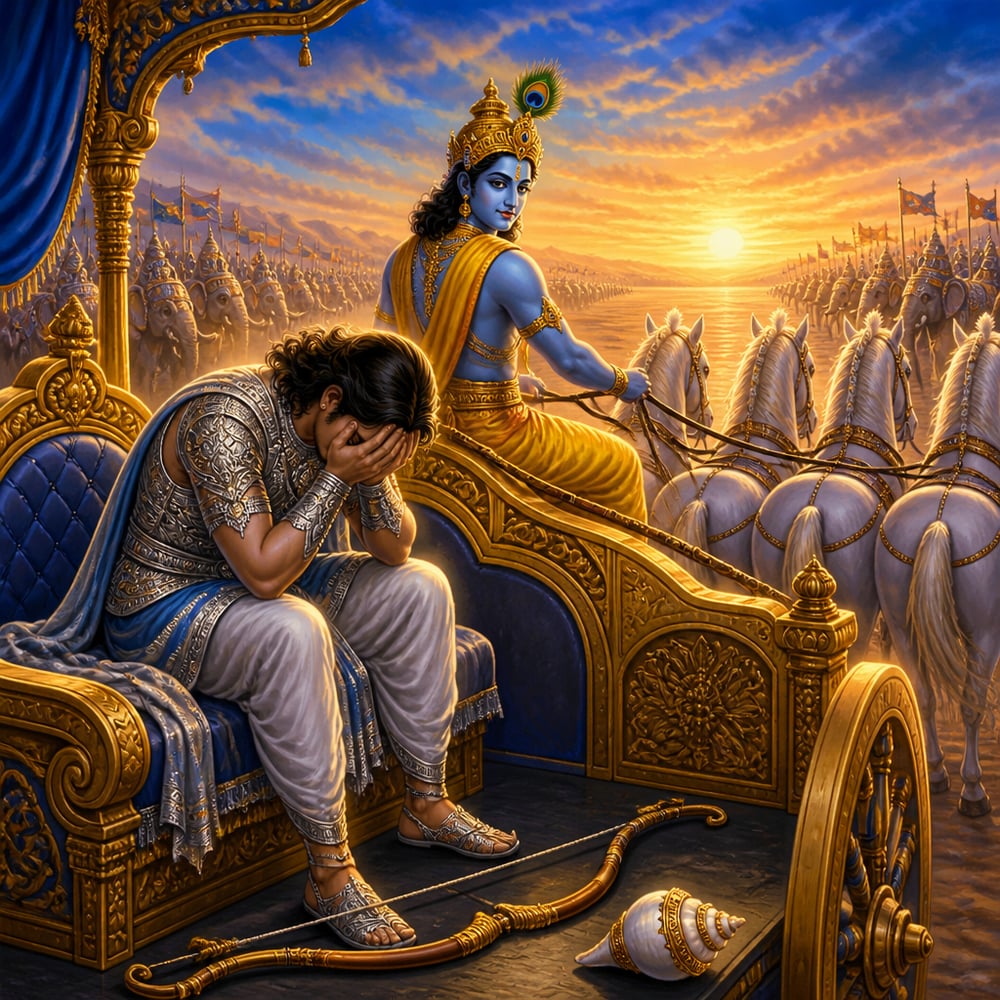
Krishna watched him sit. The army watched. A million men, with conch shells already raised, watched the foremost warrior of the age fold under the weight of what he was about to do. Arjuna spoke. He spoke in the register of compassion. Killing them would be a sin. Better to live as a beggar than to feast on the blood of one's own. He named the dharmic vocabulary for everything he felt. Kripa (compassion), vishada (despondency), moha (delusion). His sentences were grammatically the speech of a man performing virtue. His action was a paralysis that would have cost the war and the kingdom and the future of the dynasty if it had been allowed to stand.
Krishna did not dismiss the feeling. He also did not accept the framing. What he did, in the eighteen chapters that followed, was the move this lesson teaches. He dissolved the emotion. He separated the feeling from the mechanism. Then he named the gap between Arjuna's stated purpose (compassion) and the actual purpose the paralysis was serving (the protection of Arjuna's own ego, his own attachment to specific faces, his own preference for clean hands). The fifth counter in the Shat-Khandana System has its prototype in this exact scene.
What The Counter Does
The move has three beats. The order matters.
- Acknowledge the feeling, do not contest it. A debater who attacks the feeling is positioned by the audience as cold, harsh, or unfeeling. The audience tunes out. You say, calmly, "That is a real feeling. I hear it." The acknowledgement is honest. The acknowledgement is also strategic.
- Separate the feeling from the mechanism. Once the feeling is held, you set it gently to one side. "Now, separate from the feeling, what is the specific mechanism we are debating?" The sentence does not deny the feeling. It says the feeling and the mechanism are two different objects, and the debate is about the second.
- Name the gap between the stated purpose and the actual purpose. This is the Nyaya core. Prayojana means purpose, intent, the operative reason for an action. Khandana means the breaking, the dissolution, the cutting through. Prayojana Khandana, in the Nyaya tradition, is the move of exposing the real intent when the stated intent has been used as cover. "The stated purpose is X. The action being asked for is Y. Y does not follow from X. What is Y actually serving?" The room hears the gap. The gap does the work.
This is not the same as Move 1 (Expose the Pattern) or Move 4 (Isolate the Weakness). Expose the Pattern names the tactic. Isolate the Weakness pulls one load-bearing assumption. Dissolve the Emotion is more delicate. It works in the register where the opponent has placed the debate (the register of feelings) without staying in that register. The Dharmic debater walks into the emotional room, holds the feeling for a moment, and then carries the conversation calmly to the mechanism, where the actual debate happens.
Why Dissolve, Not Suppress
A student who has just learned this counter will be tempted to deploy it as suppression. "Calm down. Let us look at the facts." That is not the move. That is a different, more brittle move that the audience reads as condescension. The Dharmic counter dissolves; it does not suppress.
The Sanskrit verb that fits the move is prashamana, meaning to soothe, to settle, to bring to rest. The Bhagavad Gita uses the related noun prashanta in chapter six to describe the meditator whose mind has come to rest, not because the mind has been forced to be still but because the agitation has been resolved at its root. The same root informs the medical vocabulary of Ayurveda, where prashamana names the class of treatments that calm an aggravated dosha rather than expel it. The metaphor is exact. You do not expel the opponent's emotion. You let it settle.
The move requires Vairagya. Vairagya is not the absence of feeling. It is the freedom from being carried by feeling. The Yoga Sutras define it as drishta-anushravika-vishaya-vitrishnasya vashikara-samjna vairagyam: the conscious mastery of one whose thirst for sense-objects, both seen and heard about, has cooled. The Vaada-applied translation is simple. Vairagya is the debater's ability to stand close to a strong feeling, the opponent's or her own, without being moved by it. The mind stays clear. The voice stays low. The argument continues.
The Counter, In Three Sentences
In the live room, the counter compresses to three sentences a Vaada student should be able to deliver in under thirty seconds. Memorise the sentences. Practice the delivery. The sentences in working memory are the difference between holding the room and losing it.
- "That is a real feeling. I hear it."
- "Setting the feeling beside us for a moment, the specific mechanism we are debating is X."
- "The stated purpose of this argument is A. The action it is asking for is B. What is B actually serving?"
The first sentence holds the feeling. The second separates the feeling from the mechanism. The third names the Prayojana gap. Together they are roughly seventy words. Delivered slowly, without any rise in volume, they take about thirty-five seconds. That is the entire counter. The room hears the calmness as authority. The opponent has to choose between answering the third question (which forces an honest restatement) or refusing it (which the audience reads correctly).
Dharmic Lens: Western Containment vs Dharmic Dissolution
The Western tradition has noticed the same move and treats it differently. The Western frame is containment. Cognitive Behavioural Therapy teaches its clients to identify catastrophising and rephrase it. Stoicism teaches the practitioner to step back from a reactive feeling and observe it. Daniel Goleman's emotional-intelligence framework, popularised in 1995, teaches the manager to recognise emotion in herself and in others as a workplace skill. Each of these is useful. Each is, in its core, defensive. The aim is to keep the feeling from running the practitioner's behaviour.
The Dharmic frame is dissolution. The Gita does not teach Arjuna to contain his feeling. It teaches him to resolve it at its root. The eighteen chapters that follow Arjuna's collapse are not breathing exercises. They are a complete restatement of who Arjuna is, what action is, what consequence is, and what the relationship is between the actor and the action. By the end, Arjuna is not suppressing his grief. He is acting from a place where the grief no longer prevents the action, because the framing that produced the grief has been replaced. Prashamana, not nigraha. Dissolution, not containment.
The Nyaya tradition adds the public-debate version of the same move. Where the Yoga Sutras teach Vairagya as a private discipline of the practitioner, Nyaya's Prayojana Khandana teaches the public discipline of separating, in front of an audience, the stated purpose of an argument from the actual purpose it is serving. The two disciplines are mirror images. Yoga teaches the debater to sit calmly with her own feeling. Nyaya teaches her to sit calmly with the opponent's feeling. The Vaada student needs both. Western containment teaches the first, partially. Western public discourse, in 2026, teaches almost no version of the second. The audience is left to absorb whichever feeling is delivered most loudly. The Dharmic alternative is older, calmer, and more effective.
Reading The Gap: Stated Purpose vs Actual Purpose
The operative diagnostic is the gap. Every emotionally-charged argument carries two purposes. The stated purpose is the reason the speaker offers in the room. The actual purpose is what the action being demanded would accomplish if performed. When the two coincide, the argument is honest, and the only question is whether the action is wise. When the two diverge, the argument is either confused (the speaker has not noticed the divergence) or instrumental (the speaker is using the stated purpose as cover for the actual purpose).
A short worked sequence is enough to make the move concrete.
| Stated Purpose | Action Demanded | Actual Mechanism |
|---|---|---|
| End racism in policing. | Defund municipal police departments. | Reduces the consequences of crime; falls heaviest on poor non-white neighbourhoods. |
| Protect women from abuse. | Believe all accusations without process. | Erases due process; concentrates power in whoever gets to decide which accusations count. |
| Save the planet. | Block specific developing-country infrastructure projects. | Locks in the historical emissions advantage of already-developed economies. |
| Defend free speech. | Prosecute the speech you disagree with. | Asymmetric speech regulation under a neutral-sounding name. |
The table is not a moral judgement on the stated purposes. The stated purposes are usually genuine in the room. The diagnostic is whether the demanded action is the mechanism the stated purpose actually requires. Often it is not. Naming the gap, calmly, in plain language, is the entire counter.
The Same Move, Across Centuries
Krishna at Kurukshetra around the third millennium BCE according to traditional dating, in the second millennium BCE according to Indus Valley archaeology, in the first millennium BCE according to most academic Sanskritists. Whichever timeline a reader prefers, the prototype is older than any other extant text on the same move. Across centuries, the same diagnosis recurs.

Vidura, in the Udyoga Parva of the Mahabharata. Counselling the blind king Dhritarashtra against an emotionally-loaded course of action, Vidura runs the entire counter in one chapter. He acknowledges the king's love for his sons. He separates the love from the question of the kingdom. He names the gap between the stated purpose (paternal duty) and the actual purpose (the protection of Duryodhana's specific ambitions, against the kingdom's interest). The chapter is a textbook of Prayojana Khandana, eight centuries before the Nyaya Sutras codified the term.

Buddha, after his enlightenment, on the encounter with the angry brahmin. A famous Pali account preserves the moment. A brahmin came to the Buddha and abused him with hot, performative outrage. The Buddha asked him a question. "If a guest refuses the food you offer him, to whom does the food then belong?" The brahmin said: to me. The Buddha said: just so. He did not meet the rage with rage. He acknowledged it, separated it from the mechanism (the offering), and named the actual purpose (the brahmin's own anger, which would return to its owner). The structure is identical to the lesson's three sentences.
Adi Shankara, debating Mandana Mishra in the eighth century CE. The seventeen-day debate is preserved in the Madhaviya Shankara-vijaya. At the moment when Ubhaya Bharati, the judge, charged Shankara with limited experience as a young sanyasi, Shankara could have responded defensively. He did not. He acknowledged the charge, separated the feeling of being challenged from the mechanism of the debate, and asked for time to acquire the missing experience. The dissolution is identical. The point of the move is not to win the moment. It is to keep the debate honest.
Three examples, across more than two thousand years, all running the same three-beat sequence. The counter is not a modern invention. It is one of the oldest stable techniques the Dharmic tradition has preserved.
Modern Echoes
The contemporary literature is catching up.
Marshall Rosenberg's Non-Violent Communication (1999) supplies a four-step protocol that overlaps significantly with the Vaada three-beat counter. Rosenberg starts with observation, then feeling, then need, then request. The acknowledgement and separation steps are present. The Prayojana step (naming the gap between stated and actual purpose) is the move Rosenberg's protocol does not include and the Dharmic version does. Rosenberg keeps the conversation in the register of feelings; the Vaada move walks the conversation, calmly, into the register of mechanism, where the actual debate is.
The Stoic revival, particularly the work of Massimo Pigliucci and the journalism of Ryan Holiday, has reintroduced premeditatio malorum and dichotomy of control into mainstream Western self-help. Both are private disciplines. Both are useful. Neither addresses the public-debate problem the Dharmic tradition solved with Prayojana Khandana.
In the diplomatic register, the negotiator William Ury, co-author of Getting to Yes, has popularised the move he calls going to the balcony. The metaphor is the Vaada Vairagya in everyday English: step up to a place from which the emotion can be observed without being run by it, then return to the conversation. Ury, knowingly or not, has rebuilt half of the Dharmic discipline. The other half, the Prayojana gap, is what the Dharmic debater can add to a Western conversation that has already learned to go to the balcony.
Back On The Battlefield
The bow had slipped from Arjuna's hand. The conch shells were silent. A million men were waiting. Krishna did not pick up the bow. He did not raise his voice. He held the feeling, separated it from the mechanism, and named the gap between Arjuna's stated purpose and his actual one. By the eighteenth chapter, Arjuna picked up the bow himself. Karishye vachanam tava. I will do as you have said. The feeling had not been suppressed. It had been dissolved. The action that followed was no longer paralysed.
In the next lesson, the sixth counter arrives. Once the emotion has been dissolved and the mechanism has been seen, the closing move is to seal the conclusion before the opponent reopens it. That move is Anavastha Khandana, the closing of the loop.
Case studies
Krishna's Counsel to Arjuna at Kurukshetra
On the first morning of the war at Kurukshetra, in the open ground between two armies that together held more than a million men, Arjuna ordered his charioteer Krishna to drive the chariot into the gap between the lines. He saw, in the opposing army, his teacher Drona, his patriarch Bhishma, his cousins, his uncles, and his sons-in-law. The Bhagavad Gita preserves the Sanskrit of his collapse. His limbs sank, his mouth dried, the bow Gandiva slipped from his hand. He sat down in the chariot and spoke for the next twenty-eight verses in the register of compassion. Killing them would be a sin. Better to live as a beggar than to feast on the blood of one's own. He used the dharmic vocabulary for everything he felt: kripa, vishada, moha. His action was a paralysis that, if allowed to stand, would have cost the war, the kingdom, and the future of the dynasty. Krishna watched. The army watched. He did not pick up the bow. He spoke.
This is the prototype of Prayojana Khandana in the Dharmic canon. Krishna's first intervention is the three-beat counter compressed. He acknowledges the feeling (he does not say it is wrong to grieve). He separates the feeling from the mechanism (he asks Arjuna to consider what the action of withdrawal would actually accomplish). He names the gap (Bhagavad Gita 2.11: you grieve for those not worthy of grief, and you speak the language of wisdom). The stated prayojana is compassion. The actual prayojana, on Krishna's diagnosis, is the protection of Arjuna's specific attachments to specific faces. The eighteen chapters that follow are a sustained prashamana, dissolving the framing within which the grief arose, until the action becomes possible from a different place. The Vaada student who watches this scene watches the entire counter unfold at full length.
By the eighteenth chapter, Arjuna has picked up the bow himself. The Sanskrit of his closing line is karishye vachanam tava: I will do as you have said. The feeling has not been suppressed; it has been dissolved. The action that follows is no longer paralysed. The Mahabharata's wider arc bears the result. The war proceeds. The Pandava cause holds. The kingdom is preserved long enough for Yudhishthira's later coronation and the dharmic restoration the entire epic was driving toward.
When an opponent or a colleague or a self has produced a feeling-driven paralysis dressed in dharmic vocabulary, the counter is not to attack the vocabulary or the feeling. The counter is to dissolve the framing within which the feeling arose. Acknowledge, separate, name the gap. The mechanism that follows is no longer the one the paralysis was protecting.
George Floyd, the Riots, and the Defunding Demand (2020)
On 25 May 2020, George Floyd died under the knee of a Minneapolis police officer. The video, recorded by a teenage bystander, circulated globally within hours. The stated emotional charge of the response was clear and was widely shared: the death of an unarmed Black man at the hands of a police officer is unacceptable, and the pattern it is taken to represent is unacceptable. The riots that followed across more than 140 American cities produced, by the property-damage estimates of the insurance industry, between $1 billion and $2 billion in losses, the costliest civil disorder in modern US history (Property Claim Services, 2021). The policy demand that crystallised in the weeks that followed, branded as Defund the Police, called for the redirection of municipal police budgets to other services. By July 2020, Minneapolis, Los Angeles, New York, and a dozen other major cities had announced budget cuts or restructurings. By 2022, several of those cities had reversed course, citing rising violent-crime rates that had fallen disproportionately on poor and majority-non-white neighbourhoods. The Brennan Center for Justice and other bipartisan analysts published reviews concluding that the actions taken did not, in mechanism, address the specific failure that had produced Floyd's death (a knee-on-neck restraint by a single officer with a long disciplinary record), and were largely uncorrelated with the rates of police killings of unarmed civilians.
The Prayojana Khandana diagnosis applies cleanly. The stated purpose was the prevention of police killings of unarmed Black men. The action demanded was the defunding of police departments. The mechanism by which the action would prevent the stated harm was, on inspection, absent or weak; the specific failure that killed Floyd was an officer-conduct failure, not a budget level. The Dharmic counter does not reject the feeling; the feeling is real and serious. The counter dissolves the emotion, separates it from the mechanism, and names the gap. Beat one: the death is real, the grief is real. Beat two: setting the feeling beside us, the mechanism we are debating is the relationship between municipal police budgets and the specific kind of killing in question. Beat three: the stated purpose is the prevention of these killings; the action being demanded is a budget cut; the mechanism connecting them is unstated and, where examined, weak. What is the action actually serving? In several documented cases, the answer turned out to be a different policy agenda (statue removal, curriculum revision, bail reform) that did not follow logically from the trigger event but that was attached to it by the emotional charge.
Murder rates in the United States rose by approximately 30 percent in 2020, the largest single-year increase in modern record (FBI Uniform Crime Reporting, 2021). Murder rates in majority-Black neighbourhoods rose more sharply than in majority-white ones. By 2023, Minneapolis, Los Angeles, San Francisco, and several other cities had quietly reversed defunding decisions and increased police budgets. The original concern (police killings of unarmed Black men) had not been solved by the actions taken, because the actions taken were not the mechanism the stated purpose required. The case is a textbook study in what happens when an emotion is allowed to drive the action without dissolution.
When a real grievance is paired with a policy demand whose mechanism does not address the grievance, the Dharmic move is not to dismiss the grievance and not to accept the demand. The move is to name, in plain language, the gap between the stated purpose and the actual mechanism, and to ask what other purpose the demand is actually serving. The dissolution of the emotion is what allows the better mechanism, if there is one, to be identified.
US murder rates rose roughly 30 percent in 2020, the largest single-year increase in the FBI Uniform Crime Reporting series. By 2023, the Brennan Center for Justice and the Council on Criminal Justice had both published reviews concluding that the policy actions branded under Defund the Police were largely uncorrelated, in either direction, with the underlying rate of police killings of unarmed civilians.
International Coverage of the Manipur Ethnic Violence (2023)
Beginning in May 2023, the north-eastern Indian state of Manipur experienced a wave of inter-ethnic violence between the majority-Hindu Meitei community in the valley and the largely-Christian Kuki-Zo communities in the hills. By the end of the year, Indian government and independent civil-society counts placed the death toll at roughly 200 across both communities, with displaced populations on both sides exceeding 50,000 in total. International coverage in the New York Times, the Guardian, the BBC, Al Jazeera, and several human-rights NGO reports framed the violence overwhelmingly in the register of concern for the Christian Kuki-Zo minority, with Meitei deaths, displacements, and church-and-temple destructions covered marginally or not at all in the same outlets. Indian community organisations and several Indian state-level inquiries documented violence against Meitei civilians, including killings of women and children, attacks on Meitei villages by hill-side armed groups, and the destruction of Meitei religious sites, at scales comparable to the violence covered in the international register. The international coverage's stated emotional purpose was protection of a vulnerable Christian minority. The mechanism produced was uni-directional advocacy that influenced US Congressional hearings, USCIRF recommendations, and EU Parliament resolutions, while the parallel violence in the other direction was almost entirely absent from the same venues.
The Prayojana Khandana diagnosis applies. The stated emotional purpose was protection of a minority population from inter-ethnic violence. The action produced was a sustained, asymmetric advocacy campaign that named one community's losses and not the other's, despite both being documented in the public record. The Dharmic counter is the three-beat sequence applied to a sovereign-media venue. Beat one: the killings are real, the displacements are real, the grief is real. Beat two: setting the grief beside us, the mechanism we are debating is the relationship between the editorial choices of the covering outlets and the actual structure of the violence on the ground. Beat three: the stated purpose is the protection of a minority from communal violence; the action being executed is uni-directional coverage of one community's suffering; the mechanism connecting the two assumes that the suffering is uni-directional, which the primary-source documentation does not support. What is the asymmetric coverage actually serving? When asked in plain language, the question is answerable; when not asked, the framing operates by default.
By early 2026, the international framing of the Manipur violence as a one-sided minority-persecution event had become the operative reference frame in US Congressional hearings, USCIRF country reports, and the standard-textbook accounts being produced for South Asian Studies syllabi. The Indian state-level inquiry findings, the Meitei civil-society documentation, and the substantial body of evidence on the bilateral character of the violence remained available in the public record but had not entered the dominant Western reference frame. The structural archetype was rarely named in the mainstream English-language commentary. Ndian responses were primarily case-level corrections (you missed this incident, you missed that village) rather than structural Prayojana Khandana (the asymmetric coverage is itself the issue, what is it actually serving), which, as the previous lesson on the Concern Troll predicted, leaves the framing intact even when individual facts are corrected.
When an emotionally-loaded coverage frame is being applied uni-directionally to a bilateral situation, the Dharmic counter is not to compete inside the frame with case-level corrections. The counter is to name the asymmetry as the question. The stated purpose is protection of victims of communal violence. The mechanism is the asymmetric editorial allocation of attention. The two diverge. The audience that sees the gap, named calmly and in plain language, can then form an honest view of what the coverage is actually doing.
Across the May 2023 to December 2023 reporting window, a keyword-and-frame audit of the New York Times, the Guardian, the BBC, and Al Jazeera Manipur coverage (Centre for Policy Studies, 2024 audit) found a coverage ratio of roughly 7-to-1 in favour of Kuki-Zo victim narratives over Meitei victim narratives, against an underlying death-toll ratio that several Indian state-level inquiries placed at roughly 1.2-to-1 in the other direction during the same window.
Reflection
- Recall a specific moment in the last six months when an emotionally-loaded argument carried you, in a conversation you cared about, into responding from your own feeling rather than from the mechanism. What exact phrase or image triggered the response? Looking back, can you reconstruct, in plain language, the gap between the stated purpose of the original argument and what its demanded action would actually have accomplished? Would the three-beat counter (acknowledge, separate, name the gap) have changed the outcome of that conversation, and if not, what other element was missing?
- The Western tradition treats the dissolving of emotion as a private discipline (CBT, Stoicism, emotional intelligence). The Dharmic tradition treats it as both private (Vairagya) and public (Prayojana Khandana). What specifically does the public version add that the private version cannot supply on its own? What is the cost, to a civilisation, of having only the private version of the discipline? What does the absence of the public version look like in current Western public discourse, and which specific recent events would have unfolded differently if the public discipline were widely available?
- Genuine emotion is dharmic. Krishna does not tell Arjuna that grief is wrong; he restates the framing within which the grief arose. Weaponised emotion is adharmic. The Concern Troll uses real-sounding worry as cover. What is the dharmic test that distinguishes the two in a live moment? When the same outward feeling can be either, what does the answer require the Vaada debater to do about her own discernment, and what does it require her to refuse to do about the opponent's character? Can the same feeling be dharmic in one direction and weaponised in another, simultaneously?