Unity in Diversity & Civilizational Integrity
Ekatmata, Sanskrit Revival, and the Development-Identity-Security Triad
From the Kashi Tamil Sangamam to Shankaracharya's four mathas, India's counter to separatism has always been the same: build connections faster than enemies can sever them. This lesson presents the Development-Identity-Security Triad as the unified counter-strategy for linguistic, regional, and separatist faultlines.
See It Today: When Kashi Met Tamil Nadu
In November 2022, something happened in Varanasi that would have bewildered Robert Caldwell. Over 2,400 delegates from Tamil Nadu, scholars, artisans, weavers, musicians, and spiritual leaders, arrived in Kashi for the first Kashi Tamil Sangamam: a month-long celebration of the civilizational bonds between India's oldest sacred city and its oldest literary tradition.
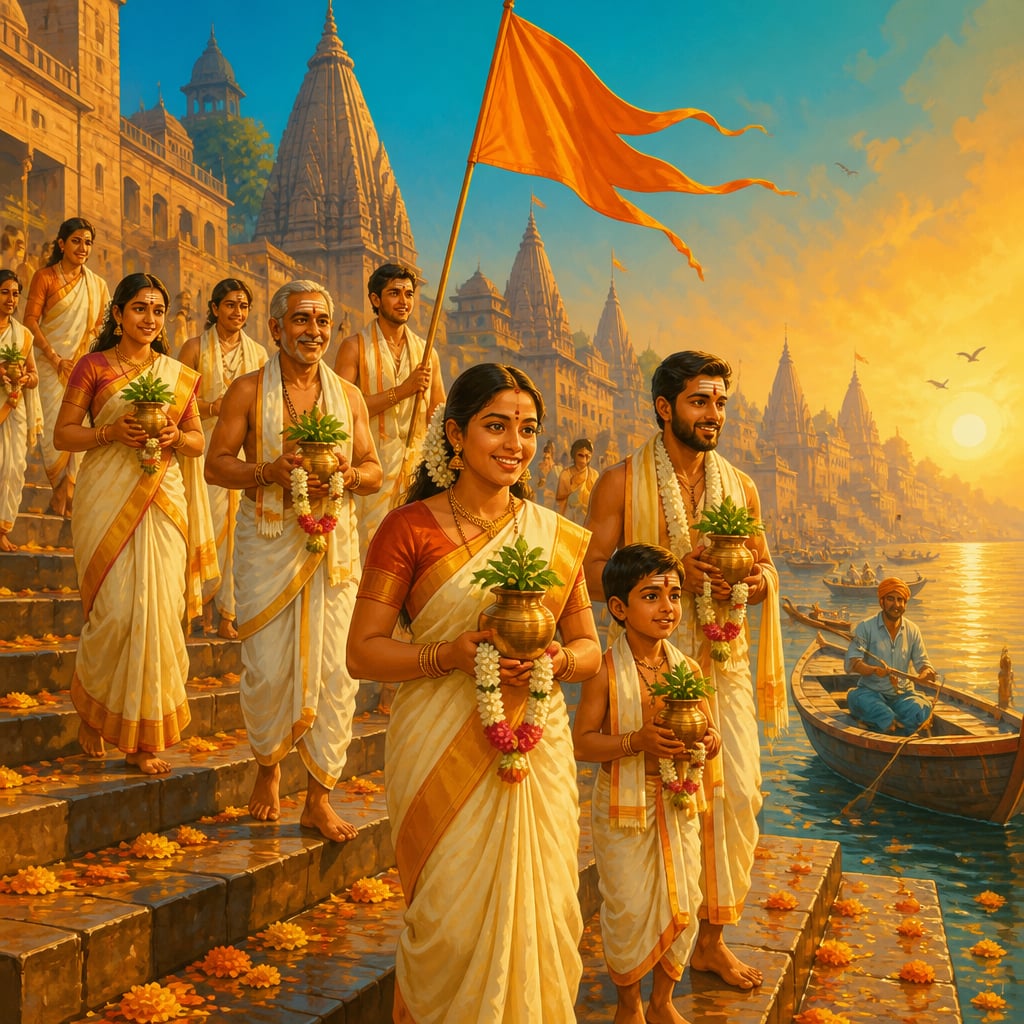
The event was not subtle in its message. Tamil Shaiva scholars sat with Kashi pandits comparing Tirumurai with Sanskrit Shaiva texts. Tamil weavers from Kanchipuram demonstrated their silk techniques alongside Banarasi weavers. Tamil musicians performed Thyagaraja's Telugu-Sanskrit compositions in the same halls where Hindustani musicians played Tansen's ragas. The Ganges met the Kaveri, not as rival civilizations but as tributaries of the same civilizational ocean.
Prime Minister Modi, who inaugurated the event, made the strategic intent explicit: Tamil and Sanskrit are not opponents. They are two eyes of Indian civilization. This was a direct intellectual counter to the Caldwell thesis examined in Lesson 06_01, the claim that Tamil and Sanskrit represent two distinct and opposed racial-civilizational streams.
The Sangamam's second edition in December 2023 expanded to include academic conferences documenting shared vocabulary, architectural styles, philosophical traditions, and trade routes between Kashi and Tamil kingdoms. Scholars presented evidence of Tamil merchants in Varanasi from the Chola period and Sanskrit scholars in Madurai's royal courts from the Pandya period.
The event generated predictable opposition. Dravidian politicians denounced it as "cultural imperialism" and "saffronization of Tamil identity." But the delegates themselves, many of them Tamil scholars with no political affiliation, responded by pointing to the evidence: Sangam literature's Vedic references, the Alvars' Sanskrit-Tamil synthesis, Chola temples' bilingual inscriptions. The facts were on display for anyone willing to look.
This was counter-strategy in action. Not argument but demonstration. Not denial of Tamil distinctiveness but celebration of it as part of a larger civilizational whole.
The Mechanism: The Development-Identity-Security Triad
Chapter 6 has examined six distinct faultlines: the Dravidian identity construction (06_01), the Church-Dravidian alliance (06_02), the North-South linguistic divide (06_03), Khalistani separatism (06_04), Northeast insurgency (06_05), and Naxalism (06_06). Each has different actors, different histories, and different dynamics. But the counter-strategy for all of them rests on a single structural insight.
Every separatist faultline requires three conditions to sustain itself: a grievance (real or manufactured), an identity narrative ("you are different from them"), and external support (funding, ideology, or strategic backing). Remove any one of the three and the faultline weakens. Remove two and it collapses.
The counter-strategy must therefore operate on all three simultaneously. This is the Development-Identity-Security Triad.
Development: Addressing Grievances Before They Are Weaponized
Separatism feeds on genuine suffering. Naxalism could not survive without tribal displacement and forest rights violations. Northeast insurgency drew strength from decades of developmental neglect. The "Hindi imposition" narrative resonates because Hindi-belt states did, for decades, receive disproportionate central attention while southern states generated disproportionate revenue.
The development response is not buying off separatism. It is removing the fuel. When tribal communities in Chhattisgarh have land rights, healthcare, and education, the Maoist recruiter's pitch becomes hollow. When northeastern states have roads, internet, and economic opportunity, the insurgent's promise of a "better future through independence" becomes absurd. When southern states see their fiscal contributions acknowledged and their languages honored at the national level, the "internal colony" narrative loses its emotional foundation.
Development must be targeted at the specific grievances that each faultline exploits. Generic "growth" is not enough. The grievance must be addressed at its root, publicly, and with acknowledgment that it was real.
Identity: Celebrating Distinctiveness Within Civilizational Unity
The Kashi Tamil Sangamam model demonstrates the identity counter-strategy. It does not deny Tamil distinctiveness. It celebrates Tamil as one of India's greatest civilizational treasures. But it insists that Tamil greatness is part of Indian civilizational greatness, not separate from it.
This principle applies across all six faultlines:
For the Dravidian faultline: Tamil is not "Dravidian as opposed to Aryan." Tamil is Bharatiya. Its Sangam literature, its temple architecture, its philosophical contributions, its devotional poetry are among the highest achievements of Indian civilization. Celebrate them as such.
For the linguistic divide: Every Indian language is a civilizational treasure. Hindi is not the master language. Sanskrit is not the enemy. A multilingual civilizational identity, where a person can be proudly Tamil, proudly Indian, and connected to Sanskrit heritage simultaneously, is the goal.
For Khalistan: Sikh identity is rooted in the soil of Punjab and the larger Bharatiya civilizational context. Guru Nanak drew from both Hindu and Sufi traditions. Guru Gobind Singh's sacrifice was for dharma, not for a separate nation. Sikh distinctiveness is honored not by separation but by recognition of its indispensable role in India's civilizational defense.
For the Northeast: Tribal cultures of the Northeast are indigenous Indian civilizations. Their traditions, their ecological wisdom, their social structures are not "primitive" cultures awaiting modernization. They are unique expressions of the same civilizational impulse that produced Vedic philosophy and Tamil Sangam poetry. Integration means recognizing them as equals in the civilizational family, not as cultural appendages.
For Naxalism: Adivasi communities have been dispossessed. Acknowledging this does not validate Maoist ideology. It removes the emotional ground on which Maoist ideology stands.
Security: Cutting External Supply Lines
No separatist movement in India survives purely on internal grievance and identity politics. Every single one examined in this chapter depends on external support:
- The Dravidian movement received missionary institutional backing (06_02)
- Khalistani separatism depends on ISI funding and diaspora radicalization (06_04)
- Northeast insurgencies received Chinese and Myanmarese support (06_05)
- Naxalism drew ideological and material support from foreign Maoist networks (06_06)
The security dimension is non-negotiable. Address grievances, celebrate identity, but simultaneously cut the funding pipelines, prosecute the foreign handlers, and disrupt the external networks that keep faultlines active long after their domestic rationale has been addressed.
This is not a police-state approach. It is the Arthashastra's recognition that internal security and external diplomacy are inseparable. A kingdom that addresses internal grievances while ignoring external enemies is naive. A kingdom that only uses force while ignoring grievances is tyrannical. The triad requires all three legs to stand.
The Pattern: Shankaracharya and the Architecture of Civilizational Unity
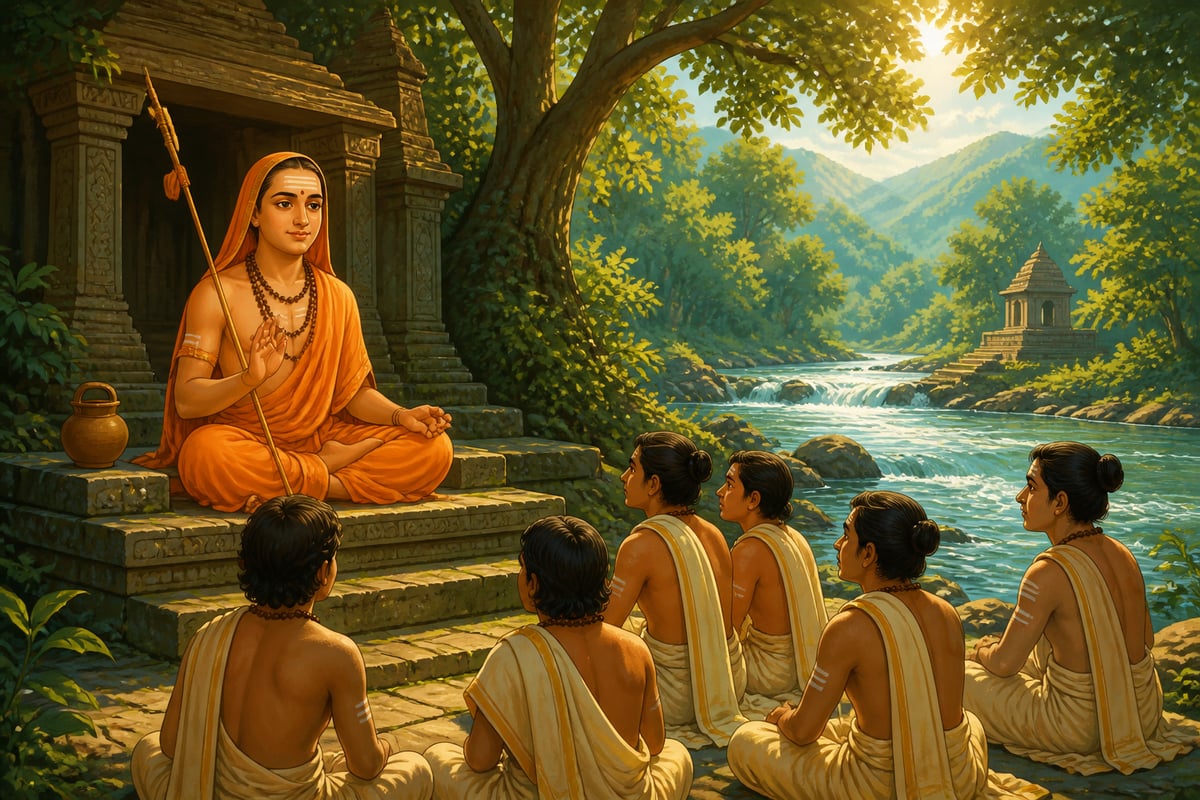
In the 8th century CE, a young Brahmin from Kaladi in Kerala undertook a journey that would reshape Indian civilization's self-understanding. Adi Shankaracharya, born in the far south, traveled the entire length and breadth of Bharatavarsha on foot, debating scholars, establishing institutions, and weaving together a civilizational consciousness that transcended every regional and linguistic boundary.
What Shankaracharya built was not a centralized religious authority. It was a network. He established four mathas (monastic seats) at India's four geographical extremes: Sringeri in the south (Karnataka), Dwarka in the west (Gujarat), Puri in the east (Odisha), and Jyotirmath in the north (Uttarakhand). Each matha was assigned one of the four Vedas and one of the four Mahavakyas (great utterances from the Upanishads).
The genius was structural. A Tamil Brahmin from Kerala placed the headquarters of civilizational authority not in his own region but distributed them across the entire geography. The Sringeri matha's head could be from anywhere in India. The Puri matha served eastern India regardless of its acharya's birthplace. The institution was designed to be pan-Indian by structure, not just by aspiration.
Shankaracharya debated in Sanskrit across every region, proving that a shared intellectual language could host conversations between traditions as different as Kashmir Shaivism and Tamil Shaiva Siddhanta, between Buddhist logicians in Bihar and Mimamsa ritualists in Varanasi. He did not impose uniformity. His Advaita philosophy explicitly held that the apparent diversity of the world (vyavaharika) is real at its own level, even as it is grounded in a deeper unity (paramarthika).
The Char Dham pilgrimage circuit reinforced this architecturally. A pilgrim from Tamil Nadu traveling to Badrinath, a pilgrim from Kashmir traveling to Rameshwaram: these physical journeys wove the geography into a single sacred tapestry. The pilgrim did not cease being Tamil or Kashmiri. They became more fully Bharatiya through the journey itself.
Contrast this with the faultline strategies examined in this chapter. Caldwell's project (06_01) sought to sever Tamil from the larger civilizational network. The Church-Dravidian alliance (06_02) sought to provide an alternative identity framework. The linguistic chauvinism of 06_03 sought to make language a wall rather than a bridge. Each faultline operation attacked the connections. Shankaracharya's model built them.
The lesson is structural: civilizational unity is maintained through institutions that connect regions, languages that enable cross-regional dialogue, and practices like pilgrimage, festivals, and shared texts that create lived experience of belonging to a whole larger than any part.
Dharmic Wisdom: Ekatmata and the Civilizational Body
The Rig Veda's Purusha Sukta offers a foundational metaphor for civilizational unity. The cosmic being's diverse limbs, each with a distinct function, form a single living body. The mouth speaks, the arms protect, the thighs sustain, the feet support. No limb is the whole. No limb is dispensable. The body functions only when all parts work in coordination.
Apply this to India's linguistic and regional diversity. Tamil is not a lesser limb. Hindi is not the head and Manipuri the foot. Each linguistic tradition, each regional culture, each tribal community is a vital organ of the civilizational body. The Ekatmata (organic oneness) principle insists that weakening any part weakens the whole.
The Arthashastra provides the strategic dimension. Kautilya's concept of Saptanga Rajya (the seven-limbed state) treats the kingdom as an organic system where the king, ministers, territory, fortified cities, treasury, army, and allies are interdependent. Weaken any limb and the organism is vulnerable. The Arthashastra explicitly warns against allowing any region to feel alienated from the center, because alienated regions become entry points for the enemy's Bheda (dissension) strategy.
The concept of Akhandata (integral wholeness) adds philosophical depth. Where Western political unity relies on constitutional contract, and Marxist unity relies on class solidarity, the dharmic model of Akhandata rests on the recognition that civilizational diversity is not a problem to be managed but a strength to be cultivated. India's unity is not despite its diversity. It is through its diversity. The 22 official languages, the hundreds of dialects, the thousands of jatis, the dozens of philosophical schools are not weaknesses. They are the civilizational immune system's diversity, making it resilient against any single-vector attack.
This is why every faultline strategy examined in Chapter 6 follows the same template: isolate a part from the whole, convince that part it is oppressed by the whole, and offer separation as liberation. Ekatmata reveals the fundamental error. Separation is not liberation. It is amputation.
The Defense: Building the Unbreakable Network
The counter-strategy for Chapter 6's faultlines requires building connective tissue that makes separatism structurally impossible. Not through force but through bonds so numerous and deep that the cost of severance exceeds any conceivable benefit.
Sanskrit as civilizational bridge, not imposition. Sanskrit is not "Hindi's big brother" or a Brahminical conspiracy. It is the intellectual operating system that connects Tamil Shaiva Siddhanta to Kashmiri Shaivism, Bengali Vaishnavism to Marathi Bhakti, Nyaya logic to Yoga practice. Reviving Sanskrit does not mean replacing regional languages. It means restoring the common channel through which India's diverse intellectual traditions can speak to each other. Support Sanskrit learning initiatives like Samskrita Bharati. Learn basic Sanskrit yourself. Read one text in the original. The connections become visible immediately.
Regional language celebration, not competition. Every regional language is a civilizational treasury. Tamil's Sangam literature, Kannada's Vachana poetry, Telugu's padya kavita, Malayalam's philosophical tradition, Bengali's literary renaissance, Marathi's saint-poet legacy: each contains civilizational wealth that belongs to all of Bharatavarsha. Create and consume translations. A Tamil reader discovering Tulsidas through translation, a Hindi speaker reading Thirukkural: these are civilizational integration events more powerful than any government program.
Institutional bridges across regions. Shankaracharya built four mathas. The modern equivalent is institutions that structurally require cross-regional collaboration. National universities with campuses across states. Cultural exchange programs like the Kashi Tamil Sangamam, expanded to cover every major regional pair. Business networks that connect entrepreneurs across linguistic boundaries. Every institution that brings people from different regions into sustained productive contact weakens the separatist narrative.
Address the real grievances, loudly and publicly. When southern states raise legitimate fiscal federalism concerns, respond with data, dialogue, and reform, not dismissal. When northeastern communities point to decades of neglect, acknowledge it and demonstrate change. When tribal communities in the Red Corridor document displacement and exploitation, act on the evidence. Every genuine grievance addressed is one fewer weapon in the separatist arsenal. Every grievance dismissed is a recruitment poster for the next insurgency.
Expose the external hand with evidence. Document foreign funding of separatist movements. Make FCRA data public and accessible. Trace the intellectual genealogies that connect Western academic frameworks to domestic separatist narratives. But do this with evidence, not conspiracy theory. The facts are sufficient. Caldwell was a missionary. That is documented. ISI funds Khalistani networks. That is documented. Foreign Maoist organizations provide ideological support to Indian Naxals. That is documented. Let the evidence speak.
Individual action: become the bridge. Learn a second Indian language. Travel to a region you have never visited. Read literature from outside your linguistic tradition. Attend a festival that is not "your" festival. When someone from another region shares a grievance about their experience with Indian unity, listen first and argue second. Civilizational unity is not built by government programs alone. It is built by millions of individual choices to be Bharatiya first and regional second, without ever demanding that anyone stop being regional.
The faultlines of Chapter 6 are among the most dangerous facing Indian civilization because they attack the most visible markers of diversity: language, region, ethnicity. But the same diversity, properly understood and institutionally connected, is India's greatest civilizational asset. The network that Shankaracharya built, that Bhakti saints sustained, that pilgrimage routes maintained, that shared festivals celebrated: this network is India. The task is not to build unity from scratch. It is to restore and strengthen the connections that were always there.
Case studies
Kashi Tamil Sangamam: Counter-Strategy as Cultural Demonstration (2022-2023)
In November 2022, the Indian government organized the first Kashi Tamil Sangamam, bringing over 2,400 delegates from Tamil Nadu to Varanasi for a month-long celebration of civilizational bonds between India's oldest sacred city and its oldest literary tradition. Tamil Shaiva scholars compared Tirumurai with Sanskrit Shaiva texts. Tamil weavers demonstrated Kanchipuram silk techniques alongside Banarasi weavers. Academic conferences documented shared vocabulary, architectural styles, philosophical traditions, and trade routes between Kashi and Tamil kingdoms dating to the Chola and Pandya periods. The second edition in December 2023 expanded the scope further. The event directly countered the Caldwell-era narrative that Tamil and Sanskrit represent opposed civilizational streams.
The Sangama model reflects the Rig Veda's Samjnana Sukta (10.191): 'Common be your intention, united be your hearts.' The event did not impose uniformity. It celebrated distinctiveness within a shared civilizational framework, exactly what Ekatmata prescribes. The Arthashastra's concept of Sandhi (alliance-building through shared interest) applies: the Sangamam created cultural alliances across the North-South divide through demonstration of shared heritage rather than political argument.
Dravidian politicians denounced the event as 'saffronization,' but the delegates themselves, including Tamil scholars with no political affiliation, responded by citing Sangam literature's Vedic references, the Alvars' Tamil-Sanskrit synthesis, and Chola temples' bilingual inscriptions. The event demonstrated that counter-strategy through cultural evidence is more powerful than counter-strategy through political argument. A second edition followed in 2023 with expanded academic programming.
The most effective counter to separatist narratives is not argument but demonstration. When Tamil and Kashi scholars sit together documenting shared heritage, the Caldwell thesis becomes absurd not because someone refuted it intellectually but because the evidence is visually, culturally, and experientially overwhelming.
The Sangamam model can be replicated for every major regional pair: Kashi-Bengal, Kashi-Northeast, Gujarat-Tamil Nadu, Punjab-Kerala. Each cultural exchange event creates institutional memory of civilizational unity that makes separatist narratives harder to sustain.
The first Kashi Tamil Sangamam (November-December 2022) hosted over 2,400 delegates from Tamil Nadu over approximately one month, with participation from academic institutions, cultural organizations, and artisan communities from both regions.
Shankaracharya's Four Mathas: The Original Civilizational Integration Architecture
In the 8th century CE, Adi Shankaracharya, a Tamil Brahmin born in Kaladi, Kerala, undertook a Digvijaya (conquest of all directions) across the entire Indian subcontinent. He debated and defeated scholars from Buddhist, Jain, Mimamsa, and rival Hindu schools in every region. At the culmination of his travels, he established four mathas at India's four geographical extremes: Sringeri Sharada Peetham in the south (Karnataka), Dwaraka Peetham in the west (Gujarat), Govardhan Peetham in the east (Puri, Odisha), and Jyotirmath Peetham in the north (Uttarakhand). Each matha was assigned one of the four Vedas and one of the four Mahavakyas. The institution was designed to be pan-Indian by structure: a Keralite established it, the heads could come from any region, and each matha served its entire quarter of the subcontinent regardless of linguistic or regional identity.
Shankaracharya's Advaita philosophy was not just a theological position. It was a civilizational architecture. His teaching that apparent diversity (vyavaharika) is real at its own level while grounded in deeper unity (paramarthika) provided the intellectual framework for holding regional distinctiveness and civilizational unity simultaneously. The four mathas were the institutional expression of this philosophy: four distinct institutions in four distinct regions, all connected by a single philosophical and organizational framework. Sanskrit served as the connecting language, and the Char Dham pilgrimage circuit created physical pathways of civilizational integration.
The four mathas have functioned continuously for over 1,200 years, making them among the oldest continuously operating institutions in the world. They survived multiple invasions, colonial rule, and post-independence political upheaval. The Shankaracharya tradition remains one of the most recognized symbols of Hindu civilizational unity. The Char Dham pilgrimage circuit continues to draw millions annually, physically weaving India's geography into a single sacred tapestry.
Civilizational unity is maintained through institutions, not just ideas. Shankaracharya did not just theorize about unity. He built institutions that structurally required cross-regional connection. The modern equivalent is any institution that brings people from different regions into sustained, productive contact: universities, cultural exchanges, business networks, pilgrimage circuits.
Every separatist faultline in Chapter 6 attacked connections: Caldwell severed Tamil from Sanskrit, Hindi imposition narratives severed North from South, Khalistani ideology severed Sikh from Hindu. Shankaracharya's model shows that the counter-strategy is to build connections faster and more durably than opponents can sever them.
The Char Dham pilgrimage circuit (Badrinath, Dwarka, Puri, Rameshwaram) spans roughly 6,000 km across four states in four different linguistic regions. An estimated 2-3 million pilgrims complete portions of the circuit annually, making it one of the largest ongoing acts of civilizational integration in the world.
Reflection
- How many Indian languages can you speak, read, or understand beyond your mother tongue? Have you ever read literature, watched films, or listened to music from a linguistic tradition other than your own, not as entertainment but as a deliberate act of civilizational connection? What would change if you invested one hour per week in a second Indian language?
- Shankaracharya, a Tamil Brahmin from Kerala, established civilizational institutions at India's four corners rather than in his own region. What does it mean to place the civilizational whole above regional identity? Is this even possible in today's India, where political identity is built almost entirely on regional and linguistic loyalty? What would a modern Shankaracharya look like?
- The Development-Identity-Security Triad argues that separatism requires three conditions: grievance, identity narrative, and external support. If you could only address one of these three for each of Chapter 6's faultlines, which would you prioritize and why? Does the answer change depending on the specific faultline?