Naxalism, Urban Naxalism & Foreign Hands
Maoist Insurgency, Academic-Activist Pipeline, and Multi-State Destabilization
India's Maoist insurgency is not a peasant revolution that went wrong. It is a multi-layered destabilization architecture with three distinct operating layers: a rural armed insurgency that has killed over 12,000 people since 1980 while running parallel governments across India's tribal belt, an urban intellectual network that launders revolutionary violence as social justice through universities and NGOs, and a foreign funding pipeline that selectively blocks Indian development projects while leaving identical projects untouched in donor countries. This lesson maps how genuine adivasi grievances were captured by an imported ideology, how the academic-activist pipeline sustains the movement's legitimacy, and how external actors exploit both layers to keep India strategically weakened.
See It Today: The Red Corridor That Never Fully Closed
In April 2010, Maoists ambushed a patrol of 76 CRPF personnel in Dantewada, Chhattisgarh. It was the single deadliest attack on Indian security forces by an internal insurgent group. The Maoists stripped the dead of their weapons and melted back into the forests of Bastar. Within days, newspaper editorials across India and op-eds in Western publications framed the event not as a terrorist attack but as a symptom of state oppression against tribals. The attackers were presented as desperate forest-dwellers pushed to the brink. The 76 dead jawans, most of them from working-class families themselves, became statistical footnotes.
This framing was not accidental. It is the product of a three-layered destabilization architecture that has been operating in India for over five decades. At its base: a rural armed insurgency built on genuine adivasi grievances but controlled by cadres committed to overthrowing the Indian state. In the middle: an urban intellectual network that translates Maoist violence into the language of human rights, social justice, and anti-state resistance. At the top: foreign funding channels that selectively target Indian development while framing obstruction as environmental or humanitarian activism.
Understanding this architecture requires separating three things that are deliberately kept entangled: the real suffering of India's tribal populations, the ideological movement that captured that suffering, and the external actors who benefit from India's continued internal bleeding.
The Mechanism: Three Layers of the Naxal Architecture
Layer 1: The Rural Insurgency, from Naxalbari to the Red Corridor
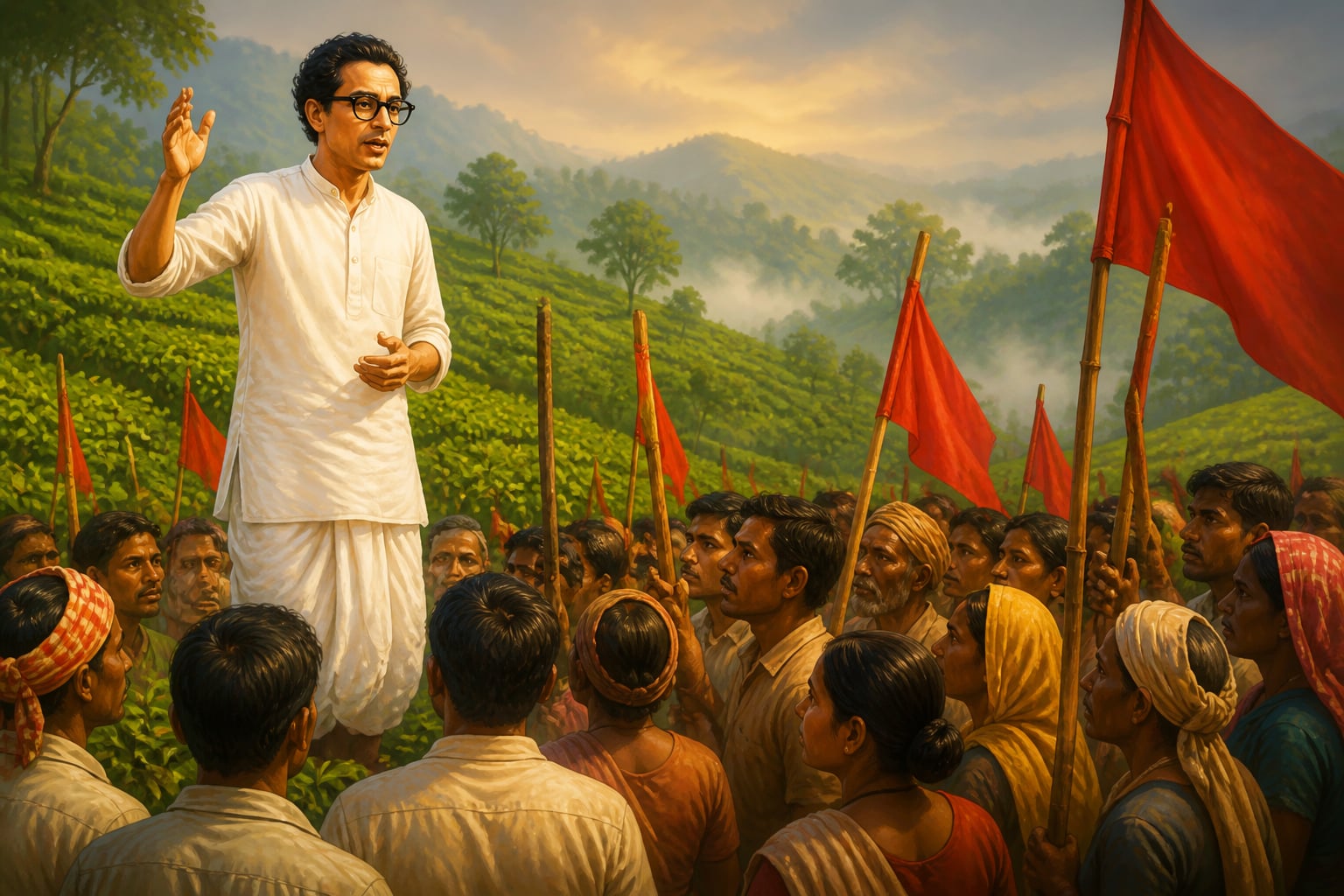
On May 25, 1967, in the village of Naxalbari in West Bengal's Darjeeling district, a tribal farmer named Bimal Kissan was attacked by local landlords for plowing land that had been legally awarded to him. The local Communist cadres, led by Charu Majumdar and Kanu Sanyal, organized armed resistance. Within weeks, tribal farmers across the region were seizing land, attacking landlords, and redistributing grain. The Naxalbari uprising was born.
The grievances were real. Tribal communities across India's central and eastern belt had been systematically dispossessed for generations. Colonial forest laws had stripped them of customary rights over the lands they had inhabited for centuries. Post-independence, the Indian state continued many of the same extractive policies. Mining corporations moved into tribal areas. Dams displaced hundreds of thousands. Forest officials treated adivasis as encroachers on their own ancestral land. The anger was legitimate.
What Charu Majumdar did with that anger was not. Drawing directly from Mao Zedong's theories of protracted people's war, Majumdar reframed local land disputes as the opening battles of a Chinese-style communist revolution. His strategy was explicit: use rural guerrilla warfare to encircle and eventually capture India's cities. The Communist Party of India (Marxist-Leninist) was founded in 1969 with this goal. Majumdar's famous "Historic Eight Documents" laid out a program for annihilation of class enemies, meaning the physical killing of landlords, government officials, and anyone deemed a class enemy by the party.
The Indian state responded with force. Majumdar was arrested and died in police custody in 1972. The movement appeared crushed. But it was not. Over the next three decades, fragmented Maoist groups reorganized, merged, and expanded. In 2004, the People's War Group and the Maoist Communist Centre of India merged to form the Communist Party of India (Maoist), or CPI(Maoist), creating a unified command structure across multiple states.
By 2006, Prime Minister Manmohan Singh called the Naxal movement "the single biggest internal security threat to India." The Red Corridor, the zone of active Maoist influence, stretched across roughly 90 districts in 11 states, from Nepal's border in the north through Jharkhand, Chhattisgarh, Odisha, Andhra Pradesh, and into parts of Maharashtra, West Bengal, and Bihar. In these areas, Maoists ran parallel governments: collecting taxes, adjudicating disputes, controlling movement, recruiting children into armed dalams (squads), and executing anyone who cooperated with the Indian state.
The human cost has been staggering. Between 1980 and 2023, Naxal violence killed over 12,000 people, including security forces, civilians, and suspected informers. Thousands of schools were destroyed or forced to close. Healthcare workers refused to enter Maoist zones. Roads and bridges were bombed to prevent connectivity. The very development that could address tribal grievances was systematically prevented by the movement that claimed to fight for tribal rights.
This is the core paradox of the Naxal movement: it feeds on genuine deprivation while actively ensuring that deprivation continues. Every school burned is a generation that remains uneducated and recruitable. Every road destroyed is a village that remains isolated and dependent on the Maoist parallel state. The insurgency does not want tribal development. It needs tribal suffering to survive.

Layer 2: Urban Naxalism and the Academic-Activist Pipeline
Armed insurgencies cannot survive on bullets alone. They need legitimacy. They need a narrative framework that makes violence appear justified, even noble. In India, this function is performed by what security analysts call the "urban Naxal" network: a constellation of academics, lawyers, journalists, filmmakers, and NGO workers who operate in cities but serve as the intellectual supply chain for the rural insurgency.
The pipeline works in stages. At the university level, certain academic departments, particularly in sociology, political science, and cultural studies, produce frameworks that present the Indian state as fundamentally oppressive and Maoist resistance as a legitimate response to structural violence. Students radicalized through this intellectual environment are then connected to ground-level activist networks working in tribal areas. Some become lawyers who defend arrested Maoists. Others join NGOs that operate in the Red Corridor. A smaller number join the armed movement directly.
The Bhima Koregaon case of 2018 brought this pipeline into public view. On January 1, 2018, violence erupted at the annual commemoration of the 1818 Battle of Bhima Koregaon near Pune. The preceding day, an event called the Elgar Parishad had been held, where speeches allegedly incited the violence. The subsequent investigation by the National Investigation Agency (NIA) uncovered a network of activists, academics, and lawyers whom investigators alleged were connected to the CPI(Maoist).
Digital forensic analysis of seized devices reportedly revealed communications discussing Maoist strategy, fundraising for armed operations, and plans to destabilize the Indian state. The accused included prominent civil liberties activists, a Jesuit priest, lawyers, and university professors. The case remains one of the most contested legal proceedings in modern Indian history, with defenders arguing the evidence was planted and prosecutors arguing it revealed the urban backbone of the Maoist movement.
Regardless of the legal outcome of that specific case, the structural pattern is well-documented by India's intelligence agencies. The urban network performs several critical functions for the insurgency. It provides legal defense for arrested cadres. It produces academic literature that frames Maoist violence as resistance. It organizes protests that create political pressure against security operations. It channels funding from sympathizers in India and abroad. And it recruits the next generation of cadres from university campuses.
The term "Urban Naxal" became politically charged after 2018, with critics arguing it was used to criminalize legitimate dissent. This conflation is itself part of the problem. There is a vast difference between a citizen who protests government policy and an operative who provides material support to an armed insurgency while maintaining a civilian cover. The deliberate blurring of this line, by both the state (which sometimes targets genuine dissenters) and by the movement (which uses genuine dissent as cover), makes the problem nearly impossible to address through conventional law enforcement.
Layer 3: Foreign Hands and the Funding Architecture
The third layer operates at the international level. For decades, foreign-funded NGOs have played a significant role in Indian civil society. Many do genuine humanitarian work. But a subset has been documented operating in ways that systematically obstruct Indian development, particularly in the energy, mining, and infrastructure sectors.
The pattern is consistent. When India attempts to develop its mineral resources, build nuclear power plants, construct dams, or lay industrial corridors through resource-rich areas, organized resistance emerges. This resistance is often framed in environmental or indigenous rights language. The funding frequently traces back to foreign foundations, churches, or international NGOs.
Consider the pattern across India's mining and industrial sector. When Vedanta attempted to mine bauxite in the Niyamgiri Hills of Odisha, an international campaign backed by foreign-funded groups successfully blocked the project, framing it as a battle for tribal sacred lands. When POSCO, the South Korean steel giant, planned a $12 billion steel plant in Odisha, what would have been India's largest foreign direct investment, years of organized resistance, substantially supported by foreign-funded activism, contributed to the project's eventual cancellation. When coal mining projects were proposed in central India's forest areas, environmental campaigns with significant foreign funding worked to block them.
The argument is not that these projects were perfect or that environmental concerns were fabricated. Tribal displacement is real. Environmental degradation is real. The argument is about selectivity and intent. The same foundations that fund anti-mining activism in India raise no comparable objections to mining operations in Australia, Canada, or Africa. The same organizations that campaign against Indian nuclear energy do not mount equivalent campaigns against French or American nuclear programs. The same groups that invoke indigenous rights to block Indian infrastructure projects remain silent when identical projects proceed in Latin America or Southeast Asia.
A leaked Intelligence Bureau report from 2014 estimated that foreign-funded NGO activism was costing India 2 to 3 percent of GDP annually by delaying or blocking development projects. The report identified specific organizations and funding chains. The government's subsequent tightening of the Foreign Contribution Regulation Act (FCRA) led to the cancellation of FCRA licenses for over 20,000 NGOs between 2015 and 2023.
The three layers, rural insurgency, urban intellectual network, and foreign funding, do not always coordinate explicitly. But they function as a mutually reinforcing system. The rural insurgency creates the conflict. The urban network produces the narrative that legitimizes the conflict. The foreign funding sustains both the narrative production and the on-ground obstruction. Together, they ensure that India's most vulnerable populations remain trapped in a cycle where genuine grievances are never addressed because the movements that claim to represent those grievances need them to persist.
The Pattern: Grievance Capture as Civilizational Weapon
The pattern visible across all three layers is what we might call grievance capture. Every civilization has internal grievances: groups that have been wronged, regions that have been neglected, communities whose rights have been violated. These grievances are real and deserve remedy. Grievance capture occurs when an external ideology or actor seizes control of a legitimate grievance and redirects it from reform toward destruction.
The Naxal movement did not create tribal suffering. But it captured that suffering and weaponized it. Instead of demanding that the Indian state deliver on its constitutional promises to scheduled tribes, the Maoist movement demands that the Indian state be destroyed. Instead of fighting for tribal land rights within the legal framework, the movement fights to replace the legal framework entirely with a Maoist dictatorship.
This is the signature of ideological warfare. The grievance is the entry point. The ideology is the payload. Once a legitimate movement has been captured, any attempt by the state to address the underlying grievance is reframed as co-option. Any attempt to engage the affected community is labeled as counterinsurgency. The captured movement becomes self-sustaining: it prevents the solution to the problem it claims to solve.
Dharmic Lens: Matsya Nyaya and the Failure of Rajadharma
The Mahabharata describes Matsya Nyaya, the law of the fishes, where the strong devour the weak in the absence of just governance. This is precisely the condition that enables Naxalism. Where the state fails to perform its Rajadharma, its duty to protect and provide justice to all citizens, a vacuum opens. Into that vacuum steps whoever is willing to use force.
Kautilya's Arthashastra identifies four types of internal threats to a state: those arising from greed, those arising from anger, those arising from fear, and those arising from contempt. The Naxal architecture exploits all four. It channels the anger of dispossessed tribals. It leverages the fear of communities trapped between insurgents and security forces. It feeds on the contempt that marginalized populations feel toward a state that has ignored them. And it is sustained by the greed of those, domestic and foreign, who profit from India's continued instability.
The Arthashastra's prescription is not merely military suppression. Kautilya insists that the root cause, the failure of governance, must be addressed simultaneously with the security response. A king who only sends armies without sending administrators, teachers, and judges has understood only half the problem. This ancient insight remains India's most important lesson: the Naxal insurgency cannot be defeated by force alone. It can only be rendered irrelevant by a state that fulfills its Rajadharma so completely that no external ideology can capture the grievances of its most vulnerable citizens.

The Defense: Breaking the Three-Layer Architecture
Defending against this three-layer system requires operating at all three levels simultaneously.
At the rural level, the priority is genuine tribal development that addresses the grievances Maoists exploit. This means enforceable land rights, functional schools and hospitals in remote areas, economic opportunities that do not require tribal communities to abandon their land and culture, and security forces that protect tribals from Maoists rather than treating tribals as the enemy. Andhra Pradesh demonstrated in the 1990s and 2000s that this combination, development plus targeted policing plus rehabilitation of surrendered cadres, can break the insurgency cycle.
At the urban level, the challenge is distinguishing between legitimate dissent and material support for armed insurgency. This requires a legal framework precise enough to target actual Maoist operatives without criminalizing genuine critics of government policy. It also requires building counter-narratives within academia itself: not through censorship, but through the production of rigorous scholarship that tells the story of tribal exploitation by Maoists, not just by the state.
At the international level, the defense is transparency and reciprocity. Every rupee of foreign funding entering Indian civil society should be publicly traceable. Organizations that receive foreign funding should face the same disclosure requirements that apply in the United States (FARA) or Israel (NGO transparency laws). And India's diplomatic establishment should be willing to name and challenge the selective targeting of Indian development by foreign-funded activism.
The deepest defense, however, is civilizational. A society that knows its own history, understands its own philosophical traditions, and takes active responsibility for the welfare of its most marginalized members cannot be easily captured by imported ideologies. The Naxal movement succeeded not because Maoism is compelling, but because the Indian state left a vacuum that Maoism filled. Closing that vacuum is not a security operation. It is a civilizational project.
Case studies
Naxalbari to Red Corridor: The Hijacking of Tribal Grievances
In May 1967, a tribal land dispute in the village of Naxalbari escalated into armed resistance when Communist cadres led by Charu Majumdar and Kanu Sanyal organized tribal farmers to seize land from landlords. The grievances were genuine: colonial-era forest laws and post-independence extraction policies had systematically dispossessed adivasi communities for over a century. But Majumdar reframed the local uprising as the first battle of a Chinese-style communist revolution, founding the CPI(ML) in 1969 with an explicit program of class annihilation. Despite Majumdar's death in 1972, the movement fragmented, regrouped, and expanded over three decades. The 2004 merger of the People's War Group and MCC into the CPI(Maoist) created a unified insurgency spanning 90 districts across 11 states.
The Mahabharata's concept of Matsya Nyaya explains why the movement took root. In the absence of just governance, the strong devour the weak. Tribal India experienced exactly this: mining corporations extracted resources, forest departments criminalized traditional livelihoods, and the state apparatus served urban interests while ignoring tribal ones. Kautilya warns that a king who neglects his subjects creates the conditions for internal enemies to flourish. The Naxal movement did not create the vacuum. It occupied a vacuum that decades of governance failure had produced.
Between 1980 and 2023, Naxal violence killed over 12,000 people. Thousands of schools were destroyed. Healthcare and road infrastructure were systematically targeted. The insurgency peaked around 2010, when it controlled significant territory across central and eastern India. Andhra Pradesh became the rare success story: a combination of elite policing (the Greyhounds), genuine tribal development programs, and a structured surrender and rehabilitation policy broke the movement's hold in the state, reducing Naxal violence by over 90 percent.
Imported ideologies capture domestic grievances only when the state has failed to address them. The cure for Naxalism is not primarily military. It is the fulfillment of Rajadharma: delivering justice, development, and dignity to those the state has neglected.
As of 2024, the Red Corridor has significantly shrunk but not disappeared. The areas where Maoists retain influence are still the areas with the weakest governance infrastructure. The question remains whether India will close the governance gap before a new generation of tribals is recruited into a movement that has never served their actual interests.
At its peak in 2010, the CPI(Maoist) operated across approximately 90 districts in 11 Indian states, running parallel governments that collected taxes, adjudicated disputes, and recruited child soldiers in areas where the Indian state had minimal presence.
Bhima Koregaon and the Urban-Maoist Pipeline
On January 1, 2018, violence erupted during the 200th anniversary commemoration of the 1818 Battle of Bhima Koregaon near Pune. The previous day, an event called the Elgar Parishad had been organized where inflammatory speeches were delivered. The subsequent NIA investigation alleged that the Elgar Parishad was organized at the behest of the CPI(Maoist) and that a network of urban activists, academics, lawyers, and a Jesuit priest had been operating as the intellectual and logistical backbone of the banned insurgency. Digital forensic analysis of seized devices reportedly uncovered communications discussing Maoist strategy, fundraising for armed dalams, and plans to destabilize the Indian state through coordinated urban-rural action.
The Arthashastra distinguishes between the open enemy (prakaasha-shatru) who attacks from outside and the concealed enemy (guudha-shatru) who operates from within. Kautilya considers the concealed enemy far more dangerous because they exploit the state's own institutions, its legal system, academic freedom, and civil liberties protections, as shields against detection. The Vidura Niti warns specifically about those who speak words of compassion while harboring destructive intent, noting that both harmful and helpful speech present themselves as truth.
Sixteen individuals were arrested under the Unlawful Activities Prevention Act. The case became one of the most polarizing legal proceedings in modern India, with supporters calling it a crackdown on dissent and prosecutors calling it the exposure of an urban Maoist infrastructure. The accused included retired professors, human rights lawyers, cultural activists, and a Catholic priest. Several accused died during the prolonged legal proceedings. As of 2024, the case continues to work through India's judicial system.
The line between legitimate dissent and material support for armed insurgency is the most critical boundary a democracy must maintain. When the state draws it too broadly, genuine critics are silenced. When the movement blurs it deliberately, armed insurgency hides behind academic freedom. Both failures damage the republic.
The Bhima Koregaon case forced India to confront a question every democracy faces: how do you distinguish between a citizen who disagrees with government policy and an operative who provides material support to a banned armed group while maintaining a civilian identity? Neither criminalizing all dissent nor ignoring all insurgent networks is acceptable. The answer lies in precise legal frameworks, independent judiciary, and transparent evidence.
The NIA investigation reportedly analyzed over 13,000 pages of digital evidence from seized electronic devices, making it one of the largest digital forensic operations in an Indian domestic security case.
Mining Activism and the Selective Sabotage of Indian Development
Between 2005 and 2017, a series of major Indian industrial and mining projects were blocked or cancelled following sustained campaigns by organizations with significant foreign funding. Vedanta's bauxite mining project in the Niyamgiri Hills of Odisha was blocked after an international campaign framed as protecting the Dongria Kondh tribe's sacred mountain. POSCO's planned $12 billion steel plant in Odisha, which would have been India's largest foreign direct investment at the time, was cancelled after years of organized resistance supported by foreign-funded groups. Coal mining projects across central India faced environmental campaigns with traceable foreign funding chains. In each case, the activism was framed in the language of indigenous rights and environmental protection.
The Arthashastra recognizes Kuta Yuddha, covert warfare, as a legitimate strategic tool. Economic sabotage disguised as humanitarian concern is a form of Kuta Yuddha. Kautilya would immediately ask the diagnostic question: who benefits from India's inability to develop its own resources? When the same foundations that fund anti-mining activism in India support or remain silent about identical operations in Australia, Canada, or Chile, the selectivity reveals the strategic intent. The compassion is the camouflage. The target is India's economic sovereignty.
A leaked 2014 Intelligence Bureau report estimated that foreign-funded NGO activism was costing India 2 to 3 percent of GDP annually by blocking or delaying development projects in energy, mining, and infrastructure. The government subsequently tightened the Foreign Contribution Regulation Act, cancelling FCRA licenses for over 20,000 NGOs between 2015 and 2023. India also began investing in domestic alternatives and sovereign development frameworks less vulnerable to external obstruction.
Environmental and indigenous rights concerns are real and must be addressed. But when the same organizations that champion these causes in India remain silent about identical issues in their donor countries, the selectivity exposes strategic intent. The defense is not to dismiss all environmental activism but to demand transparency about funding sources and consistency across geographies.
India's experience has parallels in other developing nations where foreign-funded activism has blocked resource development. The broader pattern suggests that controlling which nations can develop their own resources is a form of economic leverage that operates through NGOs rather than through traditional diplomatic or military channels.
The POSCO project cancellation represented the loss of approximately $12 billion in foreign direct investment, which would have been the single largest FDI in Indian history at the time of its announcement.
Reflection
- Think of a cause or movement you have supported, donated to, or amplified on social media. Have you ever traced its funding sources, examined who benefits from its framing, or questioned whether the people it claims to represent actually endorse its methods? What would change if you applied the grievance-capture lens to causes you already support?
- The Naxal movement has killed more tribals than it has protected, destroyed more schools than it has built, and blocked more development than it has delivered. Yet it has survived for over five decades by claiming to fight for tribal rights. What does this tell you about the relationship between a movement's stated purpose and its actual function? Why do movements that harm their own base survive?
- Kautilya insists that the state's failure of Rajadharma is the root cause of internal insurgency, not the ideology of the insurgents. If this is true, does the Indian state bear primary moral responsibility for the Naxal movement's existence, even though the movement itself has caused immense suffering? Can a state that fails its people legitimately claim the moral authority to suppress the movements that arise in response to that failure?