North-South Divide & Language as Weapon
Hindi Imposition, Fiscal Federalism, and Linguistic Chauvinism
The 'Hindi imposition' debate conceals a deeper pattern: language, once a civilizational bridge connecting India's diverse regions through Sanskrit, has been systematically weaponized into a tool of fragmentation. From the Tanittamil Iyakkam's purging of Sanskrit vocabulary to the NEP 2020 controversy, this lesson traces how genuine linguistic grievances get hijacked for separatist politics, while English quietly consolidates as the real language of power.
See It Today: When "One Language" Becomes a Battle Cry
September 14, 2019. Hindi Diwas. Home Minister Amit Shah posted on Twitter: "One country, one language." The statement was meant to celebrate Hindi, but within hours, #StopHindiImposition was trending across southern India. DMK leader M.K. Stalin called it an assault on India's diversity. Karnataka politicians, usually at odds with their Tamil Nadu counterparts, found common cause. Telugu film stars weighed in. The message was clear: the South would not accept linguistic diktat from Delhi.
The anger was not invented from nothing. Non-Hindi speakers have legitimate frustrations. Try filing a railway complaint in Kannada. Try navigating a central government portal in Malayalam. Hindi-first design in national institutions is a real accessibility problem, and dismissing that concern is both arrogant and counterproductive.
But here is where the story gets interesting. Look at the platform where #StopHindiImposition trended. Twitter. In English. The activists demanding Tamil pride were not tweeting in Tamil. The Telugu politicians defending linguistic sovereignty were drafting their statements in English. The Kannada intellectuals writing op-eds about "Hindi colonialism" were writing them for English-language newspapers.
This is the contradiction that nobody wants to examine. The language that actually dominates Indian courts, corporate boardrooms, elite universities, and upward mobility is not Hindi. It is English. Hindi is the mother tongue of roughly 44% of Indians and functions as a lingua franca for perhaps 55-60%. But English is the language of power, the gatekeeper to India's professional class.
So why does the fury focus on Hindi rather than English? Because the "Hindi imposition" narrative, while anchored in genuine grievance, has been carefully cultivated over decades into a tool for fracturing civilizational solidarity. The fault line is real. The earthquake is engineered. This lesson examines who engineered it, how the mechanism works, and what it costs India.
The Mechanism: How Language Becomes a Weapon
1. The Hindi Imposition Playbook
The pattern is remarkably consistent. A central government initiative defaults to Hindi, whether it is a bank form, a highway signboard, or a national education policy draft. This creates a real inconvenience for non-Hindi speakers. So far, so legitimate.
Then the escalation begins. Political operators reframe the inconvenience as an existential threat. "Hindi colonialism" enters the discourse. Parallels are drawn to British imperialism, with Delhi cast as the new London. Secessionist language creeps in: "Why should we stay in a union that erases our identity?" Social media amplifies the most extreme voices. Nuance disappears.
The critical move is the leap from "government services should be available in my language" to "Hindi-speaking North India is colonizing us." The first is a policy demand. The second is a civilizational accusation. Conflating the two serves political entrepreneurs who build careers on regional identity, but it damages the shared fabric of Indian society.
The 1965 anti-Hindi agitations in Tamil Nadu were a genuine grassroots response to the planned removal of English as an official language. People died. The grievance was real. But the political infrastructure built on that grievance has long outlived the original cause. The three-language formula was adopted. English was retained. Yet the "Hindi imposition" narrative persists as a permanent political resource, activated whenever it serves electoral purposes.
2. Fiscal Federalism as a Language Weapon
Southern states generate a disproportionate share of India's tax revenue. Karnataka, Tamil Nadu, Telangana, Kerala, and Andhra Pradesh collectively contribute significantly more per capita to the central pool than they receive back. The 15th Finance Commission's use of the 2011 census for devolution calculations penalized southern states that had successfully controlled population growth.
This is a legitimate fiscal grievance. States that governed well, investing in education and family planning, effectively subsidize states that did not. The policy creates a perverse incentive.
But watch how the framing works. The economic argument gets wrapped in linguistic packaging. "Hindi-speaking states are parasites living off the South" became a popular talking point. The BIMARU states (Bihar, Madhya Pradesh, Rajasthan, Uttar Pradesh) are characterized not by their governance failures but by their language. The problem is coded as linguistic, not administrative.
This framing obscures the real issue. The fiscal imbalance is a structural problem in Indian federalism that requires technical reform: revised devolution formulas, performance-based incentives, better governance metrics. Wrapping it in language politics makes it unsolvable, because it transforms a negotiation into an identity conflict. You can negotiate resource allocation. You cannot negotiate identity.
3. Linguistic Chauvinism on All Sides
The weaponization is not a one-way street. Hindi-belt chauvinism is equally destructive. The casual assumption that "everyone should just learn Hindi" dismisses the literary and cultural depth of languages with histories as long as or longer than Hindi's. Tamil has a continuous literary tradition spanning over two thousand years. Telugu was called "the Italian of the East" for its phonetic beauty. Kannada's Kavirajamarga predates most Hindi literary works by centuries.
Within the South, the fractures multiply. The Karnataka-Tamil Nadu border dispute over Kaveri water is also a language dispute. Kannadigas resent Tamil signboards in Bengaluru. Tamils in Bengaluru resist learning Kannada. The Gokak agitation of 1982 in Karnataka was a demand for Kannada primacy that mirrored the very same Hindi imposition it opposed, just at a state level.
Maharashtra's "Marathi Manoos" politics, Raj Thackeray's MNS targeting Hindi-speaking migrants in Mumbai, Assam's language movements against Bengali speakers: every state has its version. Each act of linguistic chauvinism provides ammunition for the next, creating a self-reinforcing cycle of grievance.
4. English: The Elephant in the Room
While Indians fight over which Indian language deserves primacy, English quietly wins every round. India's Supreme Court functions in English. IIT entrance coaching happens in English. Corporate India operates in English. The most prestigious schools in every Indian city, from Chennai to Chandigarh, are "English-medium."
The data tells a stark story. English speakers constitute perhaps 10-12% of India's population, but they control a wildly disproportionate share of institutional power. A 2014 study by Azim Premji University found that English-speaking men in India earn 34% more than their non-English-speaking counterparts with equivalent qualifications. The premium for women was even higher.
Every Hindi-vs-Tamil debate, every Kannada-vs-Telugu dispute, every "one language" controversy leaves English untouched. It is the ultimate beneficiary of India's language wars, strengthening its position as the neutral prestige language precisely because Indians cannot agree on which of their own languages should hold that role.
This is not an accident. It is the residue of colonial language policy, and it is maintained by an English-speaking elite that benefits from the arrangement. The language debate in India is a three-body problem, but public discourse treats it as a two-body problem, conveniently ignoring the third body that holds the most gravitational pull.
5. The Infrastructure of Division
None of this operates in a vacuum. The intellectual infrastructure for weaponizing linguistic difference was laid decades ago. Bishop Robert Caldwell's 1856 "Comparative Grammar of the Dravidian Languages" did not merely classify languages. It constructed a racial category. "Dravidian" became not just a language family but a civilizational identity defined in opposition to the "Aryan" North. As explored in lesson 06_01, this was a taxonomic choice with political consequences, one that served missionary interests by severing South India's connections to the broader Hindu civilizational framework.
The Church-Dravidian alliance examined in lesson 06_02 built on this foundation. The caste faultline from Chapter 5 reinforced it: caste oppression, reframed through a racial lens, became "Aryan Brahmin domination of Dravidian people." The academic networks explored in Chapter 4 gave it scholarly legitimacy, with Western universities producing papers that treated the Aryan-Dravidian divide as settled science.
Language weaponization is not a standalone phenomenon. It is one node in an interconnected system of faultline activation.
The Pattern: The Systematic Severing of Civilizational Bridges
The Pure Tamil Movement and Its Consequences
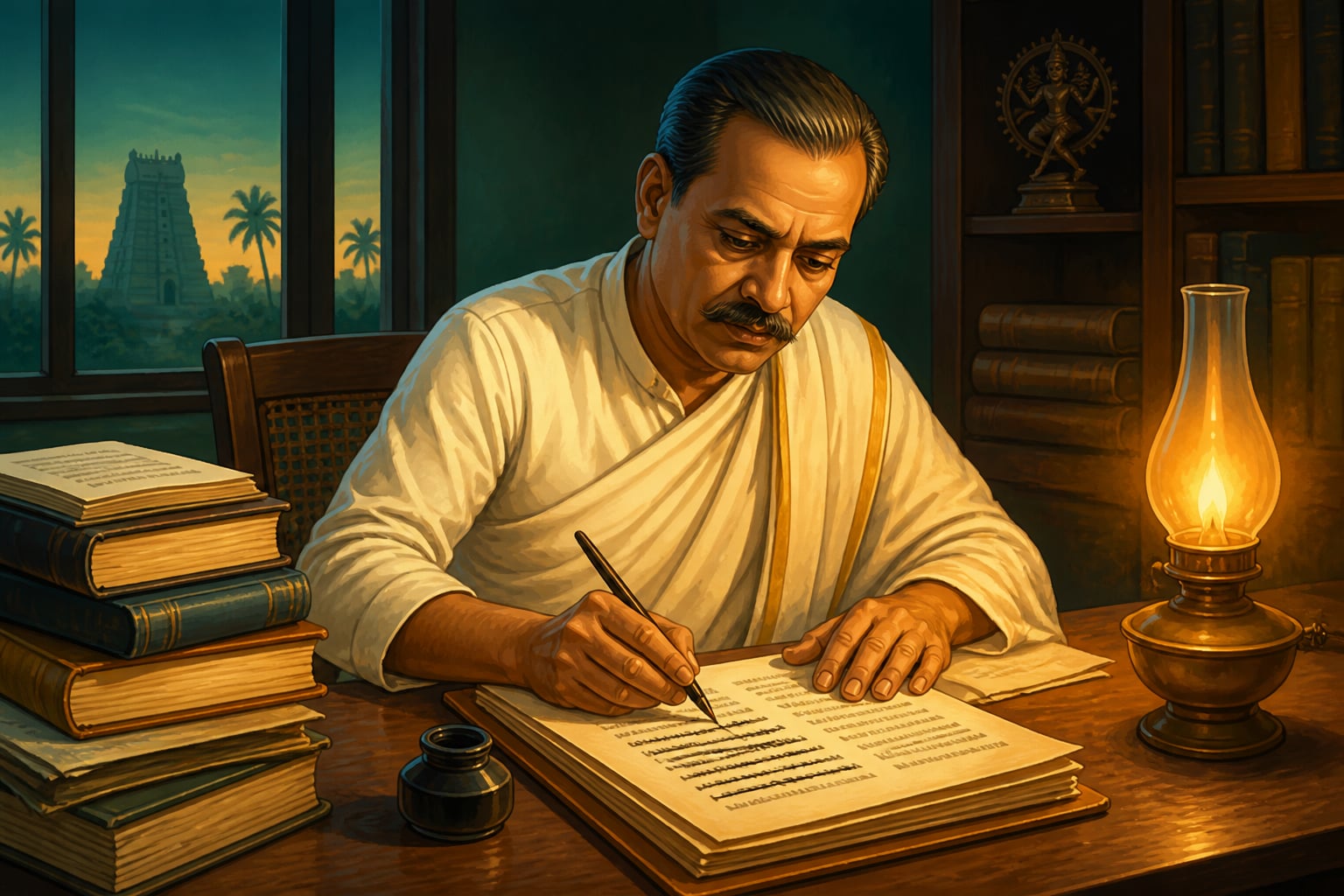
In the early twentieth century, Maraimalai Adigal launched the Tanittamil Iyakkam, the Pure Tamil Movement. His goal was to strip Tamil of all Sanskrit-derived words and restore what he considered its original purity. "Namaskaram" was to be replaced with "vanakkam." "Vidyalaya" gave way to "kalloori." "Dinam" was swapped for "naal."
The DMK-era leaders took this further. Under C.N. Annadurai and M. Karunanidhi, de-Sanskritization became state policy. Tamil textbooks were rewritten. Official nomenclature was purged. The movement presented itself as anti-Brahmin and anti-North Indian, but its deepest effect was something else entirely: it severed modern Tamil speakers from their own classical heritage.
Here is the irony that the purists never addressed. The Tolkappiyam, Tamil's oldest surviving grammar (dated between the 3rd century BCE and 5th century CE), explicitly acknowledges Sanskrit influence and categorizes loan words from "the northern language." The Sangam literature, the crown jewel of classical Tamil, is saturated with Sanskrit vocabulary. The great Tamil Shaiva and Vaishnava poets, Thirunavukkarasar, Nammalvar, Andal, moved fluidly between Tamil and Sanskrit registers. Purging Sanskrit from Tamil did not recover an ancient purity. It amputated a living linguistic relationship that was at least two thousand years old.
The Broader Amputation
This pattern is not unique to Tamil. Telugu underwent similar pressures. Kannada nativists pushed to replace Sanskrit-origin terminology. The Telugu movement to coin "acchu" neologisms for Sanskrit borrowings created words that no classical Telugu poet would recognize.
The cumulative result across South Indian languages is devastating. A modern Tamil speaker cannot easily read Kamban's Ramavataram (12th century). A modern Telugu speaker struggles with Nannaya's Mahabharatam (11th century). The classical literature of these languages, their greatest intellectual and artistic achievements, has become inaccessible to their own native speakers. Not because the languages evolved naturally, as all languages do, but because a deliberate political project severed the Sanskrit bridge that connected classical and modern registers.
Translation as Distortion
The damage extends to how Indian concepts travel into English. "Dharma" is translated as "religion," collapsing a concept that encompasses cosmic order, ethical duty, and natural law into a category designed for Abrahamic monotheism. "Karma" becomes "fate," erasing the agency and intentionality at its core. "Varna" becomes "caste," flattening a fluid system of functional classification into a rigid hierarchy modeled on European feudalism.
These are not innocent translation choices. They lock Indian thinkers into Western conceptual categories. When an Indian intellectual wants to discuss dharma in English, they must first spend three paragraphs explaining what dharma is not before they can say what it is. The conceptual vocabulary has been colonized.
Script Politics
Even the scripts carry political freight. Resistance to Devanagari in non-Hindi regions is matched by occasional pushes to impose it as a "national script." Both positions ignore a fundamental historical fact: virtually all major Indian scripts, Tamil Brahmi, Telugu, Kannada, Malayalam, Devanagari, Gurmukhi, Bengali, Odia, descend from the ancient Brahmi script. They are cousins, not strangers. The visual differences mask a shared structural ancestry, much like the languages themselves.
The script debate mirrors the language debate perfectly. Genuine concerns about accessibility and cultural identity get escalated into civilizational separatism, while the shared foundations go unexamined.
Dharmic Wisdom: Vak and the Sacred Architecture of Language
In the Vedic worldview, language was never merely a tool for exchanging information. It was understood as a fundamental force of creation. Vak Devi, the goddess of speech, appears in the Rig Veda as a cosmic power: "I am the queen, the gatherer of treasures, most thoughtful, first of those worthy of worship" (Rig Veda 10.125). Speech does not describe reality. It participates in generating reality.
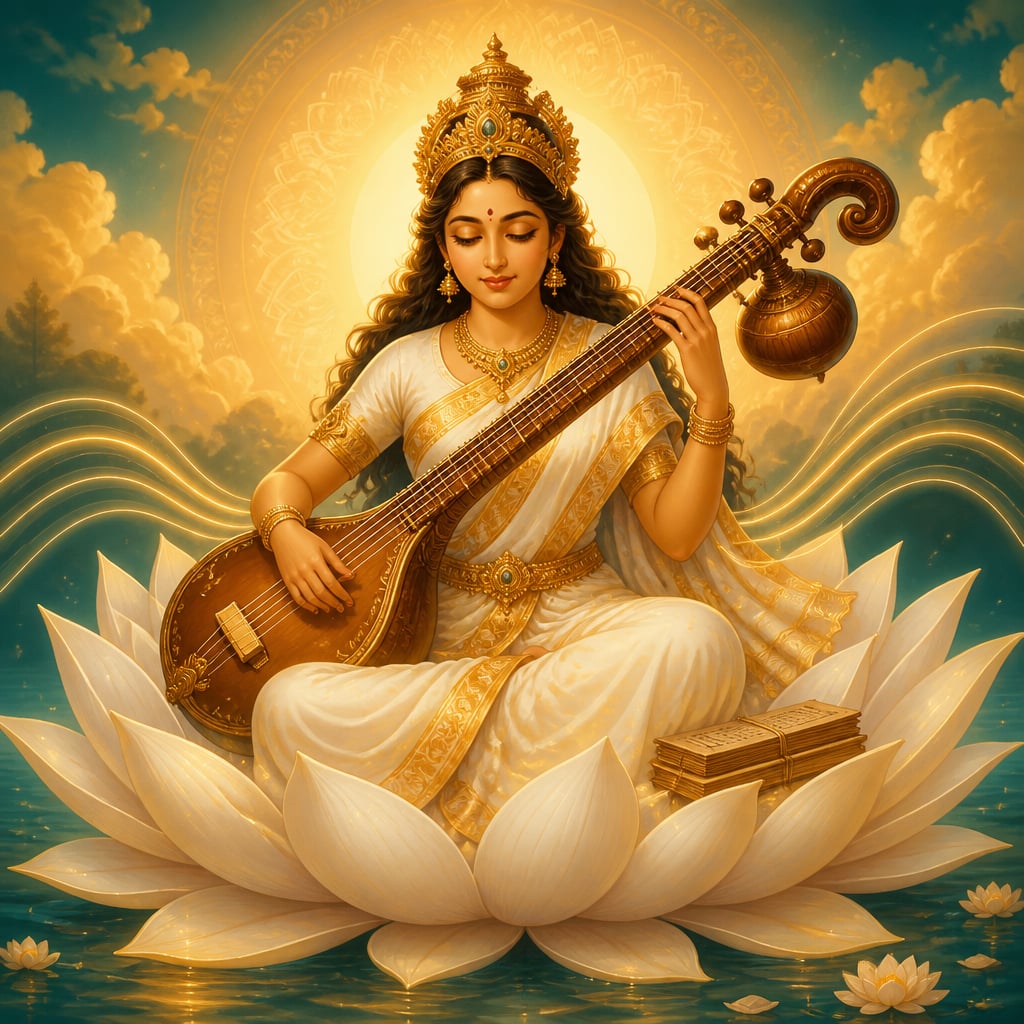
The Rig Veda identifies four levels of speech. Vaikhari is ordinary spoken language, the surface level. Madhyama is the mental formulation behind speech, the thought before the word. Pashyanti is the visionary level, where meaning exists as a unified perception before it fragments into sequential words. Para is the transcendent, undifferentiated source of all expression. This four-level model suggests that the ancient Indian understanding of language was far more sophisticated than the instrumentalist "language is communication" view that dominates modern linguistics.
Sanskrit itself was engineered with extraordinary precision. Panini's Ashtadhyayi, composed around the 4th century BCE, contains approximately 4,000 grammatical rules that generate the entire Sanskrit language through a system so rigorous that computer scientists have compared it to a programming language. Panini's grammar predates formal logic in Europe by centuries. It is arguably the first formal system in human intellectual history.
This matters because it reveals how Indian civilization thought about linguistic diversity. Sanskrit was never intended to replace spoken languages. It functioned as a knowledge bridge, a shared layer that sat above the regional spoken tongues. A scholar in Kerala and a scholar in Kashmir could both access the Upanishads, the medical texts of Charaka, the mathematical works of Aryabhata, and the philosophical debates of Shankara and Ramanuja through Sanskrit, while continuing to speak Malayalam and Kashmiri at home.
This is fundamentally different from the European model, where Latin replaced local languages in education and governance, and where English and French later displaced indigenous tongues across colonized territories. The Indian model was additive: you added Sanskrit to your linguistic repertoire. The European model was subtractive: the prestige language consumed the local one.
The current linguistic fragmentation is therefore not just a political failure. It is a civilizational inversion. The very culture that invented the most sophisticated approach to multilingualism in human history is now tearing itself apart over language.
The Defense: Rebuilding the Linguistic Bridge
1. Separate Genuine Grievances from Manufactured Ones
The first step is intellectual honesty. Hindi-only government services in non-Hindi states are genuinely exclusionary. A farmer in Tamil Nadu should not need Hindi to access agricultural subsidies. A student in Kerala should not face Hindi-only options on national exam portals. These are real problems that deserve real solutions.
The solution is straightforward: all central government services available in all scheduled languages, plus Hindi, plus English. This is technologically feasible. India's UPI payment system already operates in multiple languages. The National Education Policy 2020 endorses the three-language formula. Implementation is the gap, not intent.
What must be resisted is the escalation from "I deserve services in my language" to "Hindi speakers are my civilizational enemies." That escalation serves political careers, not linguistic rights. Call it out every time, regardless of which direction it comes from.
2. Sanskrit as a Bridge, Not a Weapon
The most counterintuitive solution is also the most historically grounded: reviving Sanskrit as a shared knowledge language. Not to replace Tamil, Telugu, Kannada, or any regional language. To restore the civilizational bridge that connected them all for millennia.
The paradox is striking. Sixteen German universities maintain Sanskrit departments. The University of Hamburg's Sanskrit library is one of the finest in the world. Meanwhile, Indian universities have been steadily defunding Sanskrit programs for decades. India is outsourcing the study of its own civilizational operating system to Europe.
Sanskrit revival does not mean making everyone speak Sanskrit at the dinner table. It means restoring Sanskrit literacy in the way that classical education once worked: as access to a shared knowledge tradition. A Tamil student who learns basic Sanskrit can read the Thirukkural's philosophical context. A Telugu student can reconnect with the Andhra Mahabharata tradition. A Malayali student can access Adi Shankara in the original. The bridge works in every direction.
3. Restore Classical Vocabulary
Regional language movements should be encouraged to add, not subtract. Tamil with its Sanskrit connections is a richer language than Tamil without them. The same is true for Telugu, Kannada, and Malayalam. Classical vocabulary restoration is not about imposing a foreign element. It is about recovering what was always native to these languages' literary traditions.
Practical steps include: publishing classical literature with modern commentary, creating digital tools that trace word etymologies across Indian languages, and developing school curricula that teach the shared linguistic heritage of Indian language families. When a Tamil student discovers that "puja" and "poo" share deep etymological connections, or that Kannada and Sanskrit share grammatical structures, the "Dravidian vs. Aryan" binary starts to dissolve under the weight of evidence.
4. Break the English Monopoly on Prestige
The real battle is not Hindi versus Tamil. It is Indian languages versus English. As long as English remains the sole gateway to professional success, elite education, and institutional power, every Indian language, including Hindi, is fighting for second place.
This requires structural change. Court proceedings in regional languages. Engineering and medical education in regional languages, as Japan, South Korea, and China provide in their national languages. Regional language technology platforms. Regional language media that commands the same intellectual prestige as English-language outlets. Make it possible to live a complete professional life in an Indian language, and the artificial hierarchy collapses.
5. Build Horizontal Bridges
India's language politics flows vertically: region versus center, state versus Delhi. The missing dimension is horizontal connection. Tamil students learning Telugu. Marathi students learning Kannada. Bengali students learning Odia. These cross-state linguistic exchanges build solidarity that does not pass through either Hindi or English.
When a young person from Chennai can hold a conversation in Telugu, or a student from Pune can read basic Kannada, the "alien other" narrative loses its foundation. The languages themselves reveal their kinship. Shared vocabulary surfaces. Common literary themes emerge. The civilizational unity that politicians deny becomes audible in the languages themselves.
The goal is not uniformity. India was never linguistically uniform, and attempting to make it so is both futile and undesirable. The goal is interconnection: a web of mutual intelligibility, shared reference points, and civilizational vocabulary that makes it impossible to pretend that Tamil Nadu and Uttar Pradesh are separate civilizations. They are not. They never were. The languages themselves, honestly studied, prove it.
Case studies
Tanittamil Iyakkam: The Pure Tamil Movement
In the early 20th century, Maraimalai Adigal launched the Tanittamil Iyakkam (Pure Tamil Movement), a systematic campaign to purge all Sanskrit-origin words from the Tamil language. What began as a linguistic project became a political weapon. DMK-era leaders like C.N. Annadurai and M. Karunanidhi turned de-Sanskritization into state policy. 'Namaskaram' was replaced with 'vanakkam,' 'vidyalaya' with 'kalloori,' and hundreds of Sanskrit-rooted words were stripped from official usage, textbooks, and public discourse. The movement framed Sanskrit influence as alien contamination of a 'pure' Dravidian language, positioning Tamil identity as fundamentally opposed to anything associated with the Sanskrit tradition. This linguistic engineering was not merely cultural preference. It was a deliberate severing of civilizational continuity, turning language into a faultline between 'Dravidian' South and 'Aryan' North.
The Indic tradition has always treated languages as members of a family, not rivals in a zero-sum contest. The Tolkappiyam, the oldest surviving Tamil grammar (dated between 3rd century BCE and 5th century CE), explicitly acknowledges Sanskrit's influence on Tamil phonology and grammar. Sangam literature, the crown jewel of ancient Tamil literary achievement, is saturated with Sanskrit vocabulary and Vedic references. The Tirukkural, perhaps the most celebrated Tamil text, articulates dharmic concepts (ahimsa, karma, dana) that flow directly from shared Indic philosophical traditions. The great Tamil Alvars and Nayanars composed devotional poetry that seamlessly wove Tamil expression with Sanskritic spiritual concepts. The relationship between Sanskrit and Tamil was not colonizer and colonized. It was symbiotic, each enriching the other for over two millennia.
The result of linguistic purging is measurable and tragic. Modern Tamil speakers educated under the de-Sanskritized curriculum cannot read classical Tamil literature from even 300 years ago without specialized training. The very literary heritage the movement claimed to protect has become inaccessible to the people it was supposed to serve. Tamil's classical depth has been flattened into a modern political construct that severs the language from its own history.
When language is weaponized for political identity, the first casualty is the language itself. Purging Sanskrit from Tamil did not make Tamil 'purer.' It made Tamil poorer, cutting speakers off from their own literary inheritance and creating a generation that cannot access the classical tradition in its original form.
The Tanittamil framework continues to shape Tamil Nadu politics. Any policy touching language, whether Hindi on signboards or Sanskrit in school curricula, is instantly filtered through the 'imposition' lens. This makes rational multilingual policy nearly impossible in the state, even when such policy would benefit Tamil students in a competitive national and global economy.
The Tolkappiyam, Tamil's oldest grammar and the foundational text the 'Pure Tamil' movement claims to defend, itself contains rules for integrating Sanskrit loanwords into Tamil. The text the purists cite as proof of Tamil independence actually documents Tamil-Sanskrit interdependence.
NEP 2020: When Policy Debate Became Separatist Theatre
In 2019, the draft National Education Policy proposed a three-language formula encouraging students to learn three languages, with at least two being Indian languages. The policy was designed to promote multilingualism, not impose any specific language. Within hours of the draft's release, a firestorm erupted in Tamil Nadu. Both the DMK and AIADMK, political rivals on virtually every other issue, united to condemn the proposal as 'Hindi imposition.' Social media campaigns framed it as an existential threat to Tamil identity. Student protests erupted. The central government revised the language within 24 hours, clarifying that no language would be imposed. But the damage to rational discourse was already done. The actual text of the policy had explicitly stated that the choice of languages would be left to states and students. The controversy was not about what the policy said. It was about what political actors claimed it said, exploiting decades of cultivated linguistic anxiety to score political points.
India's civilizational history is one of extraordinary multilingualism. The Mughal courts operated in Persian, Sanskrit, and regional languages simultaneously. The Vijayanagara Empire administered in Kannada, Telugu, Tamil, and Sanskrit across its territories. Buddhist monasteries at Nalanda hosted scholars speaking Pali, Sanskrit, Chinese, Tibetan, and Central Asian languages. The idea that learning an additional language threatens one's mother tongue has no precedent in Indian civilizational practice. In the dharmic framework, knowledge (vidya) in any language is valued. The Arthashastra recommends that rulers learn multiple languages for effective governance. Multilingualism was a sign of cultivation, not cultural surrender.
The policy was revised to make the three-language formula entirely flexible, with states retaining full authority over language choices. But the episode revealed how deeply the 'language as threat' narrative has been embedded in Southern political culture. A policy designed to expand linguistic capability was successfully framed as linguistic oppression, demonstrating that the faultline infrastructure built over decades can be activated on demand.
When a population has been primed for decades to interpret any language policy as 'imposition,' even genuinely flexible proposals trigger reflexive opposition. The faultline is not in the policy. It is in the framing that generations of political actors have embedded in public consciousness.
The NEP controversy exposed a structural problem in Indian federalism: legitimate policy debate on education, language, and national integration can be instantly hijacked by separatist framing. This pattern repeats with any central policy that touches language, from highway signage to competitive exam requirements. It makes constructive national-level education reform extraordinarily difficult.
Tamil Nadu has operated under a two-language formula (Tamil and English only) since 1968. Meanwhile, students in states like Kerala, Karnataka, and Andhra Pradesh routinely learn three languages. Tamil Nadu's refusal to adopt multilingual education has not protected Tamil. Instead, it has left Tamil students less competitive in national-level examinations and government recruitment.
Sanskrit's Paradox: Studied Abroad, Defunded at Home
As of the 2020s, at least 16 German universities offer Sanskrit programs. The University of Hamburg houses one of the world's finest Sanskrit manuscript libraries. Harvard, Columbia, Yale, and the University of Chicago maintain robust Sanskrit departments with endowed chairs and dedicated research centers. In Japan, scholars at the University of Tokyo and Kyoto University have made significant contributions to Sanskrit textual scholarship, producing critical editions of texts that Indian universities have not undertaken. Meanwhile, in India itself, Sanskrit departments in state universities struggle for basic enrollment. Funding has been cut repeatedly. Faculty positions go unfilled for years. Students are actively discouraged from pursuing Sanskrit studies, which are portrayed as backward, impractical, and communally charged. The country that produced Sanskrit is systematically outsourcing the study of its own civilizational knowledge system to foreign institutions.
Sanskrit is not merely a 'religious language,' as it is often framed in Indian political discourse. It is the vehicle for an enormous body of knowledge spanning mathematics (Aryabhata, Brahmagupta), medicine (Charaka, Sushruta), linguistics (Panini's Ashtadhyayi, which anticipated modern computational grammar by 2,500 years), philosophy (the six darshanas), political science (Arthashastra), astronomy (Surya Siddhanta), metallurgy, architecture, and the performing arts. Defunding Sanskrit does not just affect priests and ritual specialists. It cuts off access to a vast intellectual tradition that is still being mined by researchers worldwide for insights in fields from computational linguistics to pharmaceutical chemistry.
The practical consequence is a growing knowledge asymmetry. German and American scholars are producing the critical editions, translations, and analytical studies of India's own texts. Indian scholars who want to do advanced work on Sanskrit texts increasingly need to travel to Hamburg, Harvard, or Kyoto for access to resources, training, and institutional support that Indian universities no longer provide. India is becoming a consumer of scholarship about its own heritage, dependent on foreign institutions for access to its own intellectual history.
A civilization that allows foreign universities to become the primary custodians of its foundational knowledge system has effectively surrendered intellectual sovereignty. When Hamburg knows your texts better than Hyderabad, the problem is not about religion or politics. It is about a civilizational failure to value your own inheritance.
The defunding of Sanskrit in India is often framed as progressive secularism. But no one calls Germany's investment in Sanskrit 'communal.' The double standard reveals that the opposition to Sanskrit in India is not about secularism at all. It is about the politics of civilizational erasure, where studying your own tradition is treated as a political act rather than an intellectual one.
Panini's Ashtadhyayi (4th century BCE) contains 3,959 rules that describe Sanskrit's grammar with a precision that linguists compare to modern programming languages. A 2022 Cambridge University study confirmed that Panini's system is a complete, consistent grammatical framework. The world's first complete formal language description was written in India, yet most Indian computer science students have never heard of it.
Reflection
- Think about the languages you speak, the one you think in, and the one you use in professional settings. How have these choices shaped your relationship with your own cultural roots, and have you ever felt a tension between linguistic utility and cultural belonging?
- If a civilization's deepest philosophical and spiritual concepts can only be fully expressed in its native languages, what happens to that civilization's self-understanding when those languages are sidelined in education, governance, and prestige? Can translation ever be a complete substitute, or is something irretrievably lost?
- The Vedic tradition treats Vak (speech) as sacred and creative, not merely communicative. If language is understood as carrying the power to shape reality and consciousness, does the deliberate suppression or distortion of a people's language constitute a deeper violation than political oppression alone? Where is the line between natural linguistic evolution and engineered linguistic displacement?