The Khalistani Separatist Infrastructure
Diaspora Networks, ISI Exploitation, and 1984 as Political Tool
The Khalistan movement today is primarily a diaspora phenomenon sustained by three pillars: transnational networks in Canada and the UK, decades of ISI exploitation, and the deliberate weaponization of 1984 as a permanent political tool. Understanding this infrastructure reveals how genuine grievances become instruments of external statecraft, and why justice is the strongest antidote to separatism.
See It Today: The Nijjar Affair and a Diplomatic Earthquake
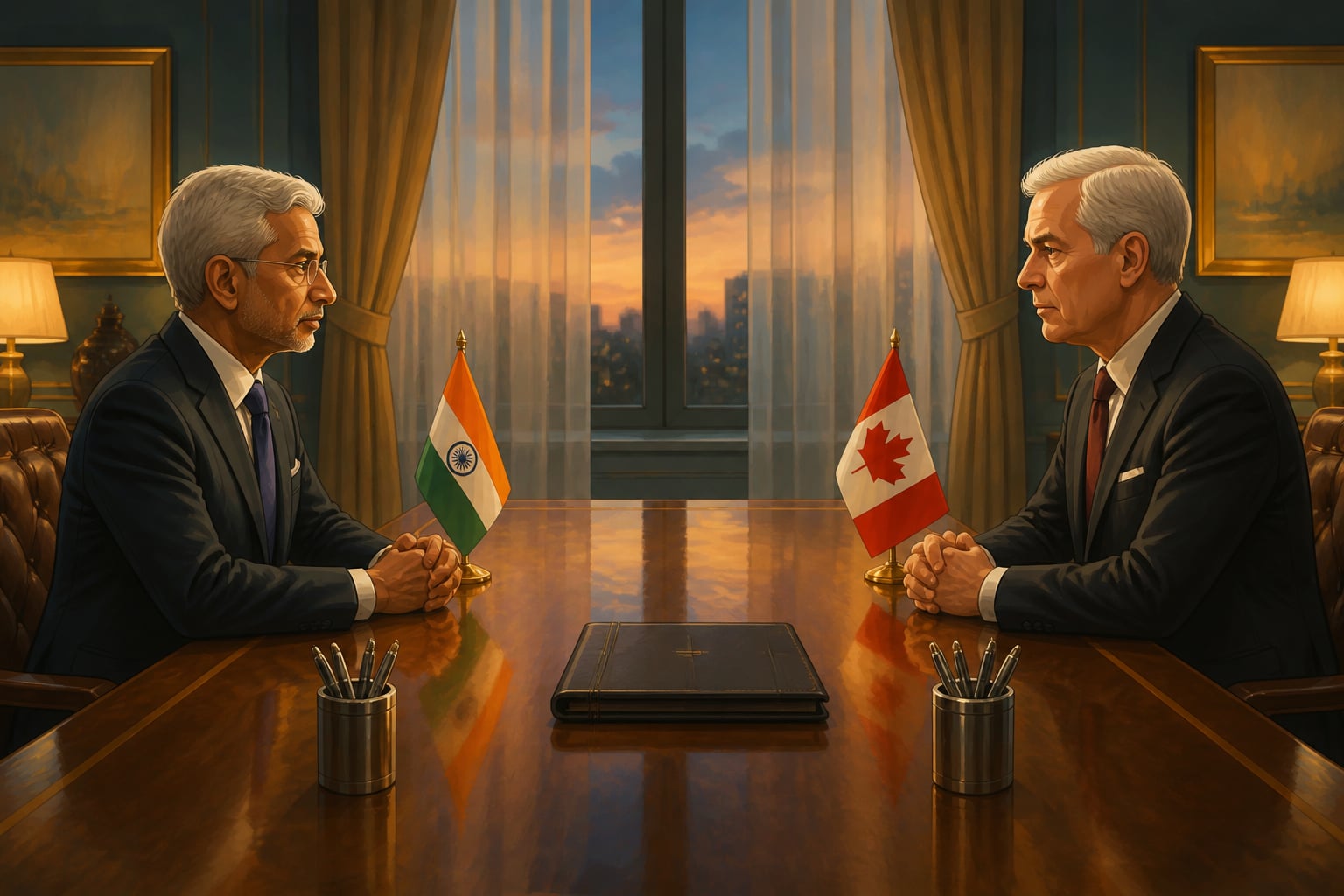
In June 2023, Hardeep Singh Nijjar, a designated terrorist by India's National Investigation Agency, was shot dead outside a gurdwara in Surrey, British Columbia. Within months, Canadian Prime Minister Justin Trudeau stood in the House of Commons and accused the Government of India of involvement in the killing on Canadian soil.
The diplomatic fallout was immediate and severe. Both nations expelled diplomats. Canada pulled out intelligence officers. India suspended visa services. Five Eyes allies were briefed. What had been a functioning bilateral relationship between two democracies became a geopolitical crisis centered on one question: how did a man listed as a terrorist by one country come to be publicly mourned as a community leader by another?
The answer lies in an infrastructure that took decades to build. Nijjar was not an isolated activist. He was a node in a transnational separatist network that operates openly in Canada, the UK, and Australia while being banned in India. The Sikhs for Justice (SFJ), designated as an unlawful association under India's UAPA, continues to operate freely from North American soil. Its founder, Gurpatwant Singh Pannun, openly calls for the dismemberment of India from a law office in New York.
The Nijjar affair did not create the Khalistani separatist infrastructure. It revealed it. It exposed a network that has survived for four decades by exploiting three pillars: diaspora grievance politics, Pakistani state support, and the transformation of 1984 from a historical trauma into a perpetual political weapon.
This lesson examines how that infrastructure was built, who sustains it, and why it persists long after the Punjab insurgency ended.
The Mechanism: The Three Pillars of Khalistani Separatism
The Khalistan movement today is not a Punjab phenomenon. It is a diaspora phenomenon. Surveys consistently show that support for Khalistan within Punjab itself is negligible. In the 2022 Punjab state elections, not a single party running on a Khalistan platform won a single seat. The movement's center of gravity has shifted entirely to the diaspora, particularly Canada, the UK, and to a lesser extent the United States and Australia.

Pillar One: The Diaspora Dimension
The diaspora provides three things that Punjab cannot: financial resources, political leverage in host countries, and freedom from Indian law enforcement.
Canada alone has approximately 770,000 Sikhs, the largest Sikh population outside India. In key electoral ridings in British Columbia and Ontario, Sikh voters constitute a decisive voting bloc. This creates a political economy where Canadian politicians, regardless of party, attend events organized by Khalistan sympathizers, pose for photographs with known separatists, and avoid any public criticism of the movement. The cost of alienating Sikh voters in Surrey, Brampton, and Mississauga is higher than any Canadian politician is willing to pay.
This is not a conspiracy. It is vote-bank politics operating within a democratic system. The same mechanism that makes politicians attend church fundraisers or union rallies makes them attend events where Khalistan imagery is prominent. The difference is that this particular constituency's demands include the dismemberment of another sovereign nation.
The financial dimension is equally significant. Diaspora donations fund organizations, media outlets, social media campaigns, and legal battles. SFJ alone has organized multiple "Referendum 2020" events across several countries, complete with voter registration drives for a non-existent country. This requires sustained funding that could never be generated within Punjab.
The digital dimension compounds the problem. TikTok, Instagram, and YouTube algorithms create a radicalization pipeline where second and third-generation diaspora youth, who have never lived in Punjab, encounter 1984 imagery as emotional content that feeds into separatist community identity and then political mobilization. The pipeline is: trauma content leads to emotional identification, which leads to community belonging, which leads to political radicalization.
Pillar Two: ISI Exploitation
Pakistan's Inter-Services Intelligence has maintained a Khalistan desk since the 1980s. The relationship between the ISI and Khalistan separatism is one of the longest-running examples of state-sponsored faultline exploitation in modern geopolitics.
The logic is strategic, not ideological. Pakistan has no natural interest in Sikh sovereignty. But a destabilized Punjab weakens India. A Khalistan movement that ties up Indian security resources, damages India's international image, and creates diplomatic friction between India and Western democracies serves Pakistan's strategic interest at minimal cost.
During the Punjab insurgency of the 1980s and early 1990s, ISI support was direct and kinetic: arms, training camps in Pakistan-occupied Kashmir, safe passage across the border, and coordination with militant groups. After the insurgency was crushed by the mid-1990s, the ISI adapted. Direct military support became untenable, but the diaspora offered a new vector.
The modern ISI-Khalistan relationship operates through intermediaries: narco-terror networks that use drug money to fund separatist activities, social media operations that amplify grievance narratives, and connections with diaspora organizations that provide political cover. Indian intelligence agencies have documented numerous instances of ISI handlers coordinating with Canada and UK-based Khalistan activists.
The key insight is that the ISI did not create the Khalistan movement. It exploited a genuine grievance. Operation Blue Star and the 1984 anti-Sikh riots created real trauma. The ISI's contribution was to ensure that trauma never healed, by funding the infrastructure that keeps the wound open.
Pillar Three: 1984 as Political Tool
The events of 1984, Operation Blue Star in June and the anti-Sikh riots in November, constitute a genuine historical wound. The military operation at the Golden Temple complex and the subsequent pogrom in which an estimated 3,000+ Sikhs were killed in Delhi alone represent a catastrophic failure of the Indian state.
No honest analysis of the Khalistan movement can dismiss this grievance. The wound is real.
What the separatist infrastructure does is ensure the wound never heals. 1984 is not remembered as history. It is wielded as a weapon. Every June, Operation Blue Star anniversaries become recruitment events. Every November, the anti-Sikh riots are presented not as a past injustice requiring justice, but as proof that Sikhs can never be safe in India.
This is the mechanism of grief weaponization: take a genuine trauma, prevent any healing or closure, and use the perpetual wound as evidence that separation is the only solution. Notice what this requires. The separatist infrastructure actually benefits from justice being delayed. If the perpetrators of the 1984 riots had been swiftly and comprehensively prosecuted, the political utility of the grievance would diminish. The fact that justice has been incomplete serves the separatist narrative perfectly.
The three pillars are mutually reinforcing. Diaspora networks keep the 1984 narrative alive. The ISI funds organizations that amplify it. 1984 serves as the emotional core that makes diaspora youth receptive to separatist messaging. Remove any one pillar, and the infrastructure weakens but does not collapse.
The Pattern: When Diaspora Becomes the Weapon
The Khalistan movement fits a pattern that recurs across modern history: diaspora communities becoming more radical than the homeland population, with external state actors exploiting the gap.
Air India Flight 182, bombed on June 23, 1985, killing all 329 people aboard, remains the deadliest terrorist attack in Canadian history and was the deadliest aviation attack globally until September 11, 2001. The bomb was planted by Khalistan extremists operating from Canada, led by Talwinder Singh Parmar.
The Air India bombing reveals the lethal potential of unchecked diaspora separatist infrastructure. Parmar had been under CSIS (Canadian Security Intelligence Service) surveillance. Canadian intelligence had specific warnings. Yet the attack occurred because the surveillance was inadequate, inter-agency coordination failed, and the political will to confront diaspora extremism was absent.
The subsequent investigation and prosecution took over two decades. The trial, Canada's longest and most expensive, ended in acquittals in 2005. A subsequent Commission of Inquiry found catastrophic failures in Canadian intelligence and law enforcement. Justice was not served. And the message was received: Canada is a permissive environment for Khalistan extremism.
This pattern of diaspora radicalization outpacing homeland reality is not unique to the Sikh community. The Tamil Tigers' most effective fundraising operation was among the Tamil diaspora in Canada and the UK, not in Sri Lanka. The Irish Republican Army raised millions through NORAID in the United States. Kurdish PKK supporters in Europe maintained networks more militant than many Kurds in Turkey.
The common mechanism is distance. Diaspora communities, separated from the daily realities of the homeland, often develop a frozen-in-time relationship with their cause. Second and third-generation diaspora youth inherit trauma without context. They experience the narrative of persecution without the daily experience of actually living in Punjab, where Sikhs hold political power, run major businesses, dominate the military officer corps, and practice their faith without restriction.
This distance creates a paradox: the people most invested in Khalistan have never lived in Punjab. The people living in Punjab show no interest in Khalistan.
The Arthashastra recognizes this pattern. Kautilya describes how discontented elements operating from outside a kingdom's borders (Bahya Prakriti) can be more dangerous than internal dissent because they are beyond the ruler's reach and can be manipulated by rival kings (Shatru). The diaspora is the modern Bahya Prakriti, and the ISI is the modern Shatru exploiting them.
Dharmic Wisdom: Kshama, Nyaya, and the Weaponization of Wounds
The Mahabharata offers a precise framework for understanding how genuine grievance becomes a tool of destruction. Draupadi's humiliation in the sabha was a real injustice. Her anger was righteous. But the Mahabharata shows that even righteous anger, when it becomes the only lens through which one sees the world, can be exploited by those who have no interest in justice, only in destruction.
Shakuni did not create the Kauravas' injustice against the Pandavas. He exploited it. He ensured that every possibility of reconciliation was sabotaged, not because he cared about the Kauravas' cause, but because perpetual conflict served his agenda of destroying the Kuru dynasty from within.
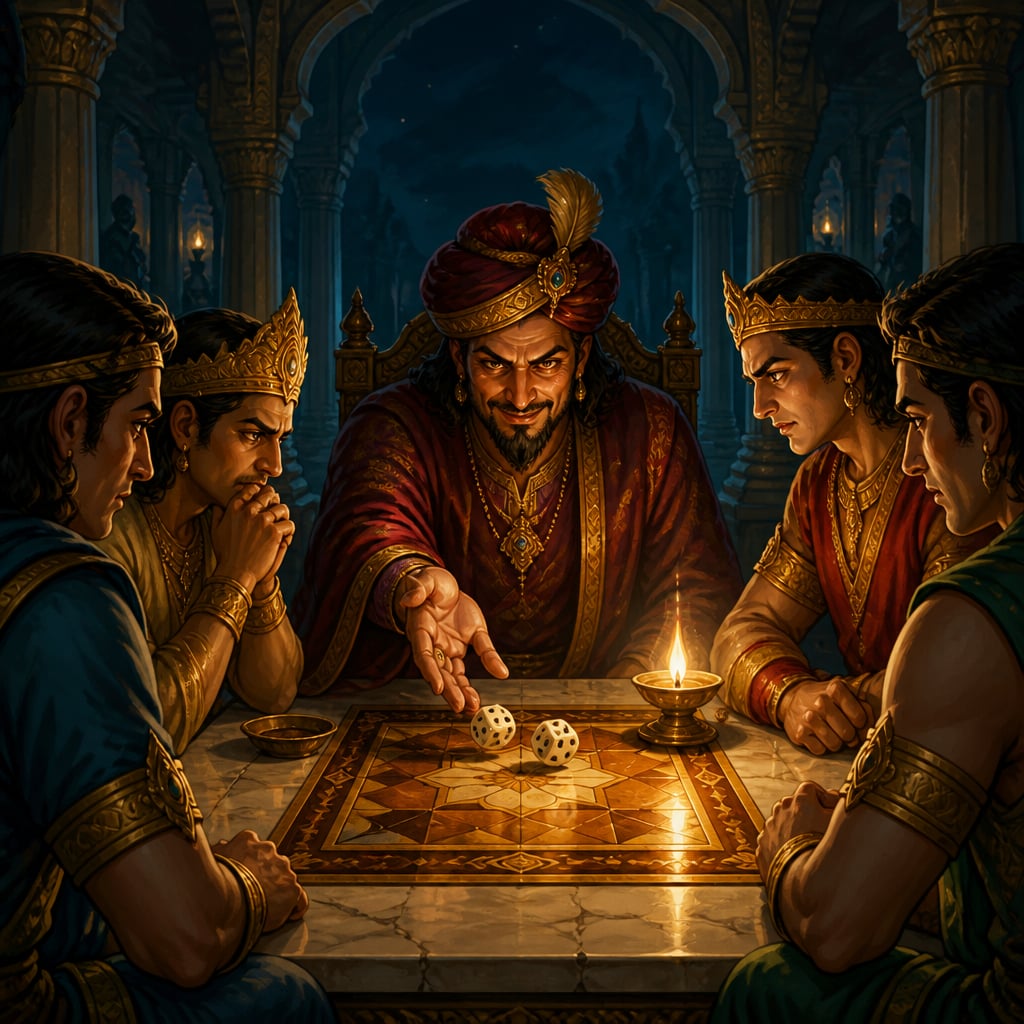
The ISI plays the Shakuni role in the Khalistan context. It did not create Operation Blue Star or the 1984 riots. It simply ensures that every possibility of healing is undermined, because a healed wound has no strategic value.
The Arthashastra provides the analytical framework. Kautilya warns that a ruler's greatest vulnerability is Kopa, anger that has become chronic. Chronic anger clouds Viveka (discernment). A population in chronic anger cannot distinguish between those who seek justice and those who seek to exploit their pain for unrelated strategic objectives.
The antidote, according to both Vidur Niti and the Arthashastra, is not to suppress the grievance but to address it through Nyaya (justice). Swift, visible, and comprehensive justice for the victims of 1984 would not erase the wound. But it would deny the separatist infrastructure its most powerful recruitment tool. Every year that justice is delayed, the infrastructure grows stronger.
Kshama (forgiveness) in the dharmic tradition is not the absence of justice. It is the ability to seek justice without allowing the pursuit to consume one's entire identity. The distinction matters: pursuing justice is dharmic. But allowing injustice to become one's entire identity makes one a tool of whoever controls the narrative of that injustice.
The Defense: Building Immunity Against Separatist Infrastructure
Countering the Khalistani separatist infrastructure requires action on all three pillars simultaneously. No single approach is sufficient.
Address the genuine grievance. The single most powerful counter to the separatist narrative is comprehensive justice for the victims of 1984. The Nanavati Commission and subsequent prosecutions have been painfully slow and incomplete. A civilization that cannot deliver justice to its own people cannot credibly claim that separatism is unnecessary. India's democratic institutions must demonstrate that Sikh interests are better served within the Indian framework than outside it, and this must be demonstrated through action, not rhetoric.
Counter the diaspora narrative with facts. The separatist narrative depends on presenting India as a place where Sikhs are persecuted. The factual record tells a different story. Sikhs constitute approximately 2% of India's population but are dramatically overrepresented in the military officer corps, business leadership, agricultural prosperity, and political power (including the Prime Minister's office from 2004-2014). The Sikh Panth has thrived within the Indian civilizational framework in ways that would be impossible in a landlocked "Khalistan" surrounded by hostile neighbors.
This is not an argument against acknowledging 1984. It is an argument for presenting the full picture rather than allowing a single traumatic event to define the entire relationship between the Sikh community and the Indian nation.
Expose the ISI connection relentlessly. Every time the Khalistan movement is discussed, the ISI's role must be documented and publicized. The separatist narrative depends on presenting itself as an organic community movement. The documented evidence of ISI funding, coordination, and strategic direction demolishes this narrative. Indian diplomatic, intelligence, and media institutions should treat ISI-Khalistan links not as classified intelligence but as public information to be disseminated widely.
Engage the diaspora, not just the governments. India's traditional diplomatic approach has been to lobby host governments (Canada, UK, Australia) to suppress Khalistan activities. This has largely failed because host governments respond to domestic political incentives, not Indian diplomatic pressure. A more effective approach is direct engagement with the diaspora Sikh community: consular services, cultural programs, heritage tourism, business connections, and educational exchanges that strengthen the connection between diaspora Sikhs and India without going through the filter of separatist organizations.
Strengthen Sikh representation in national narratives. One reason the separatist narrative finds traction is that mainstream Indian national narratives sometimes underrepresent the Sikh contribution to civilizational defense. From Guru Gobind Singh's sacrifice to the Sikh regiments' role in both World Wars, from Maharaja Ranjit Singh's empire to Bhagat Singh's revolutionary sacrifice, the Sikh contribution to India's civilizational story is immense. When this story is told fully and prominently, it becomes harder to argue that Sikhs are "foreign" to the Indian civilizational project.
Build digital counter-narratives. The social media radicalization pipeline that targets diaspora Sikh youth must be met with equally sophisticated digital content: documentaries, podcasts, social media campaigns, and influencer engagement that presents the Sikh story within the Indian civilizational framework. You cannot defeat a narrative with silence. You can only defeat it with a better narrative grounded in truth.
The Khalistani separatist infrastructure has survived for four decades because it addresses a genuine grievance, operates from permissive foreign jurisdictions, and receives state backing from Pakistan. Defeating it requires addressing the grievance, engaging the diaspora directly, exposing the foreign hand, and telling a better, truer story. Civilizational defense is not about denying pain. It is about ensuring that pain becomes a path to justice rather than a tool of destruction.
Case studies
The Nijjar Affair: When Separatist Infrastructure Becomes a Geopolitical Crisis
In June 2023, Hardeep Singh Nijjar was killed outside a gurdwara in Surrey, British Columbia. Nijjar had been designated a terrorist by India's NIA for his alleged involvement in Khalistan-linked activities. In Canada, however, he was known as a community leader and gurdwara president. When Canadian PM Trudeau accused India of involvement in the killing, it triggered the worst diplomatic crisis between the two countries in history. Diplomats were expelled, intelligence sharing was affected, and the Five Eyes alliance was drawn into the dispute.
The Arthashastra's concept of Bahya Prakriti (external elements) explains why this crisis was possible. Nijjar operated in the space between two sovereign jurisdictions: designated a threat by one, protected by another. Kautilya recognized that discontented elements operating beyond a king's borders are inherently more dangerous because the king cannot reach them, and rival powers can easily cultivate them. The Nijjar affair demonstrates that India's Bahya Prakriti problem has matured to the point where it can trigger diplomatic earthquakes.
The diplomatic fallout exposed the full depth of the Khalistan infrastructure in Canada. Subsequent investigations revealed alleged connections between Indian intelligence and the killing, while also bringing unprecedented public attention to the network of separatist organizations operating freely on Canadian soil. The crisis forced both nations to confront the reality that the Khalistan issue could no longer be managed through quiet diplomacy.
Separatist infrastructure that is tolerated for decades does not remain static. It grows until it becomes a geopolitical liability for everyone involved. Canada's decades of tolerance for Khalistan activism culminated in a diplomatic crisis that damaged its relationship with the world's most populous democracy.
The Nijjar affair demonstrates that India's Khalistan challenge is no longer primarily a security problem. It is a diplomatic, narrative, and civilizational challenge that requires engagement with diaspora communities, not just with governments.
Following the Nijjar affair, India suspended visa services in Canada and expelled Canadian diplomats. The crisis marked the most significant rupture in India-Canada relations since Canadian PM Pierre Trudeau's perceived sympathy toward Khalistan separatists in the 1980s, demonstrating a four-decade pattern of this infrastructure disrupting bilateral relations.
Air India Flight 182: The Deadliest Consequence of Unchecked Diaspora Extremism
On June 23, 1985, Air India Flight 182 was destroyed by a bomb while flying from Montreal to London, killing all 329 people aboard. The bomb had been planted in luggage at Vancouver International Airport by Khalistan extremists led by Talwinder Singh Parmar, founder of the Babbar Khalsa International. Parmar had been under intermittent surveillance by CSIS, Canada's intelligence service, which had recorded him testing explosive devices weeks before the attack. A second bomb intended for another Air India flight detonated prematurely at Tokyo's Narita Airport, killing two baggage handlers.
The Arthashastra's warning about Vyasana (affliction) inviting Shatru (enemy) action applies precisely. The internal vyasana was Canada's systemic failure: intelligence agencies that surveilled but did not act, law enforcement that did not coordinate with intelligence, and a political establishment that treated diaspora extremism as someone else's problem. The external shatru, the broader separatist network, exploited every one of these failures. Kautilya would note that Canada's institutional vyasanas were as responsible as the attackers' intent.
The investigation became the longest and most expensive criminal case in Canadian history. After 20 years, the 2005 trial resulted in acquittals of the remaining accused, largely due to evidence handling failures and witness intimidation. The 2010 Commission of Inquiry found systematic failures across Canadian intelligence and law enforcement. Of the 329 killed, 268 were Canadian citizens, yet the attack was treated as an 'Indian problem' for years, reflecting the deep institutional indifference that enabled it.
The Air India bombing is the ultimate case study in what happens when a host country tolerates separatist infrastructure. The cost was 329 lives. The subsequent failure of justice reinforced the perception that Canada would not hold Khalistan extremists accountable, a perception that shaped the next four decades of diaspora separatism.
Families of Air India victims continued to advocate for accountability well into the 2020s. The pattern established by the bombing, tolerance leading to violence leading to inadequate justice, directly connects to the conditions that produced the Nijjar affair nearly 40 years later.
329 people were killed in the bombing, making it the deadliest terror attack in Canadian history. The subsequent trial cost over CAD $130 million and lasted 20 years. Despite this investment, key accused were acquitted. In comparison, India lost approximately 21,000 people to Punjab insurgency-related violence between 1981 and 1993.
ISI's Multi-Decade Khalistan Investment: Adapting Faultline Exploitation Across Eras
Pakistan's ISI has maintained continuous engagement with the Khalistan movement since the early 1980s, adapting its approach across four distinct phases. In the 1980s, support was kinetic: arms, explosives, and training provided through camps in Pakistan-occupied Kashmir. Militant leaders received direct ISI handling and cross-border facilitation. In the 1990s, as Indian security forces crushed the Punjab insurgency, the ISI shifted to cross-border infiltration attempts and narco-terror funding, using the drug trade as a financial pipeline. In the 2000s, with direct operations increasingly difficult, the ISI pivoted to cultivating diaspora networks in Canada, the UK, and Australia. By the 2010s, the strategy had evolved again: social media radicalization, funding of online propaganda, and coordination with diaspora organizations through intermediaries.
Chanakya's principle that 'friendships and enmities are bound only by interest' explains the ISI-Khalistan relationship perfectly. The ISI has no ideological commitment to Sikh sovereignty. Its sole interest is India's destabilization. The Arthashastra's concept of Shatru (the rival king) using multiple methods across time, adapting from Dana (funding) to Bheda (division) to information warfare, maps precisely onto the ISI's four-phase evolution. Kautilya would recognize this as a textbook case of persistent, adaptive statecraft by an adversary.
The ISI's investment has yielded returns far exceeding its costs. At minimal financial expenditure, the Khalistan infrastructure continues to tie up Indian security resources, damage India's international image, create friction between India and Western democracies, and maintain a permanent irritant on India's western border. The Punjab insurgency itself was defeated, but the infrastructure the ISI helped build in the diaspora outlived the insurgency by decades.
State-sponsored faultline exploitation is not a one-time event. It is a sustained, adaptive strategy that evolves across decades and vectors. Defeating one phase (crushing the Punjab insurgency) does not defeat the strategy if the adversary simply shifts to a new vector (diaspora radicalization). Civilizational defense must be equally adaptive.
Indian intelligence agencies have documented ongoing ISI connections to diaspora Khalistan organizations through narco-terror networks and social media operations. The 2023 NIA designations of multiple diaspora-based individuals reflect India's attempt to publicly map this infrastructure. The ISI's Khalistan playbook also serves as a template for its operations in other Indian faultlines, including Kashmir.
Indian security agencies have seized over 500 consignments of arms and narcotics linked to ISI-Khalistan networks along the Punjab border since 2017 alone. Multiple drone-based weapon deliveries from Pakistan have been intercepted, demonstrating that the ISI's kinetic support channel, though reduced, has never been fully shut down even as the strategy shifted toward diaspora cultivation.
Reflection
- Have you ever witnessed a legitimate grievance in your community or family being co-opted by outside actors or political opportunists for their own agenda? How did you recognize the shift from genuine concern to manufactured outrage?
- Why do diaspora communities often become more radical about homeland politics than the people who actually live there? What does physical distance do to political identity, and how does unresolved grief calcify into ideology when it cannot be grounded in lived reality?
- If nyaya (justice) is truly the antidote to separatism, what does it mean that decades of delayed or incomplete justice for 1984 created the very vacuum that hostile forces filled? Does a civilization bear responsibility not just for preventing injustice, but for healing it swiftly enough that external actors cannot exploit the wound?