The Construction of Dravidian Identity
Robert Caldwell and the Linguistic-to-Racial-to-Political Pipeline
The term 'Dravidian' as a racial identity was not discovered by linguists. It was constructed by a missionary. In 1856, Robert Caldwell, an Irish-born Church of England missionary stationed in Tamil Nadu, published 'A Comparative Grammar of the Dravidian Languages,' a text that took a legitimate linguistic observation (South Indian languages share a distinct grammatical family) and welded it to a racial theory (Dravidians are a separate race from Aryans) with missionary intent (Hinduism is Aryan colonialism, Christianity is liberation). This linguistic-to-racial-to-political pipeline would, over the next century, sever Tamil identity from its deep Sanskritic and Vedic roots, fuel anti-Brahmin politics, and create a faultline that external forces continue to exploit today.
A Missionary with a Theory
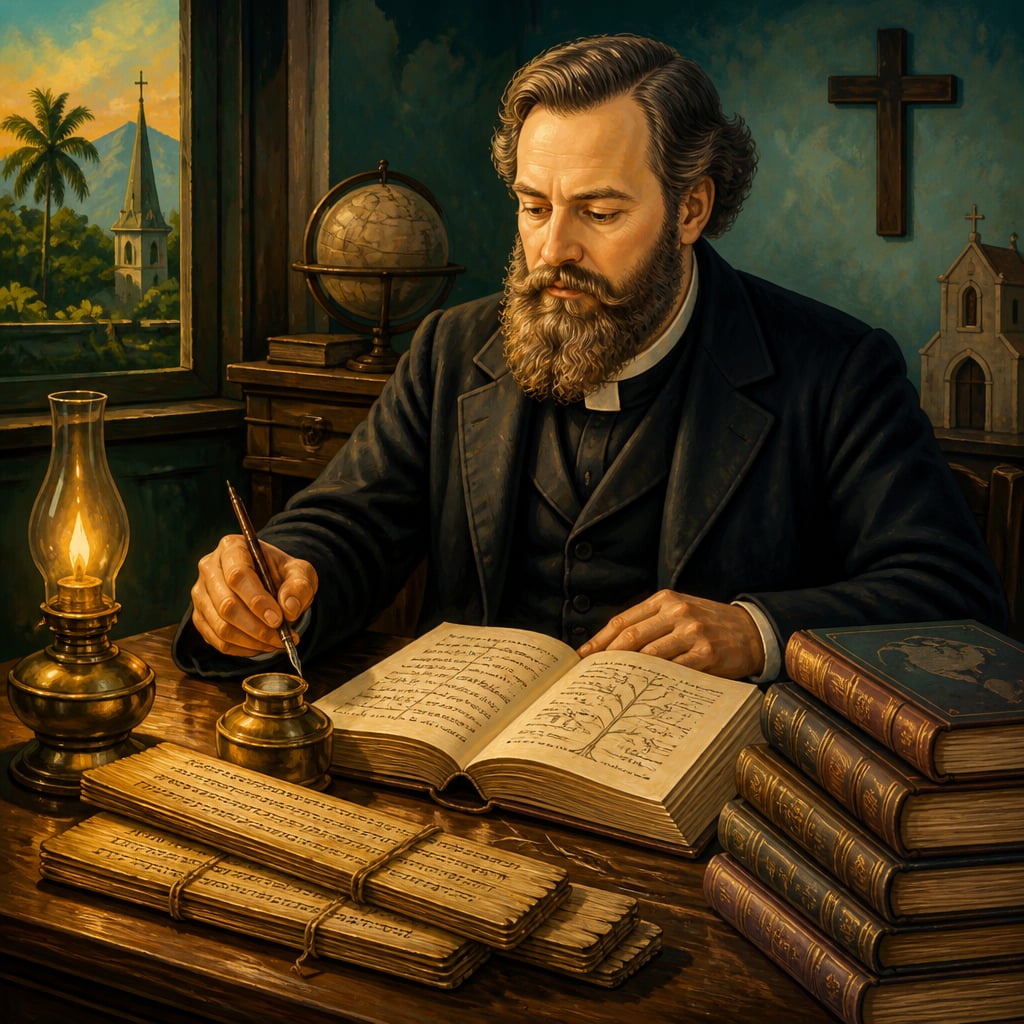
In the mid-19th century, an Irish-born clergyman named Robert Caldwell arrived in the Tirunelveli district of Tamil Nadu as a missionary for the Society for the Propagation of the Gospel. He would spend over four decades there, eventually becoming Bishop of Tirunelveli. He was not a trained linguist. He was a churchman with a conversion mandate.
In 1856, Caldwell published A Comparative Grammar of the Dravidian or South-Indian Family of Languages. The book made a legitimate linguistic observation: the languages of South India (Tamil, Telugu, Kannada, Malayalam, and others) share grammatical structures that are distinct from the Indo-Aryan languages of North India. They are agglutinative rather than inflectional. They use retroflex consonants in ways Indo-Aryan languages do not. Their verb systems, case markers, and syntax follow patterns that link them to each other but not to Sanskrit.
This linguistic observation was real. Modern linguistics confirms that Dravidian languages constitute a separate language family.
But Caldwell did not stop at linguistics. He welded his grammatical findings to a racial theory, and that racial theory to a missionary agenda. This is where observation ended and construction began.
The Three-Stage Pipeline
Caldwell's work set in motion a pipeline that would reshape South Indian identity for the next 170 years. Each stage built on the previous one, escalating from academic claim to political weapon.
Stage 1: Linguistic (1856)
Caldwell established 'Dravidian' as a language family. The term itself came from the Sanskrit word Dravida, which referred to a geographic region and its people. Caldwell repurposed it as a scientific-sounding category for an entire language group. So far, defensible scholarship.
Stage 2: Racial (1860s-1900s)
Here the leap occurred. Caldwell argued that if the languages were fundamentally different, the peoples must be fundamentally different too. 'Dravidians' were a separate race from 'Aryans.' The Brahmins of South India were Aryan colonizers who had migrated south and imposed their religion, language, and social hierarchy on the native Dravidian population.
Caldwell wrote that Brahmins were 'strangers' in the Dravidian lands, foreign settlers who had 'gradually acquired ascendancy' over the original inhabitants. Hinduism, in this framing, was not the indigenous religion of Tamil people. It was an alien imposition by Aryan invaders.
This racial leap had no scientific basis. Language families do not map onto races. English speakers are not a 'race.' Swahili speakers are not a 'race.' The assumption that linguistic difference equals racial difference was a product of 19th-century European racial pseudoscience, the same intellectual framework that produced phrenology and the 'Great Chain of Being.'
Stage 3: Political (1916 onwards)
Once 'Dravidian' became a racial identity, it was only a matter of time before it became a political one. If Brahmins were Aryan colonizers, then anti-Brahminism was anti-colonialism. If Hinduism was foreign imposition, then rejecting Hindu identity was liberation.
The Justice Party (1916), the Self-Respect Movement (1925), the Dravida Kazhagam, and eventually the Dravida Munnetra Kazhagam and its offshoots all drew, directly or indirectly, on the identity framework that Caldwell had constructed. A missionary's grammar book became the intellectual foundation for an entire political movement.
The Missionary Motive
Why would a churchman invest decades in constructing a racial theory out of a linguistic observation? Because the theory served his mission.
Caldwell was explicit about his objectives. He was in Tamil Nadu to convert. His challenge was that Tamil identity was deeply woven into Hindu civilization. Tamil literature, festivals, temple traditions, philosophy, and daily life were saturated with Hindu and Sanskritic elements. Converting Tamils required separating Tamil identity from Hindu identity.
The Dravidian racial theory accomplished exactly this. If Tamils were Dravidians, a race distinct from the Aryans who brought Hinduism, then:
- Hindu practices were foreign impositions, not authentic Tamil culture
- Brahmin priests were colonial administrators, not spiritual leaders
- Sanskrit was the language of the oppressor, not a shared civilizational inheritance
- Christianity was not a foreign religion replacing a native one. It was one 'foreign' religion replacing another 'foreign' one, and at least Christianity did not come with caste
This was not conspiracy theory. This was strategy, documented in Caldwell's own writings and in the missionary communications of the period. The Society for the Propagation of the Gospel understood that identity engineering was a prerequisite for mass conversion.
The Severance: Tamil from Sanskrit
The most consequential effect of Caldwell's theory was the artificial severance of Tamil from its deep relationship with Sanskrit and Vedic civilization.
The historical reality is that Tamil and Sanskrit had coexisted, interacted, and enriched each other for millennia:
Sangam Literature (roughly 300 BCE to 300 CE), the oldest body of Tamil literary works, is filled with references to Vedic deities, rituals, and philosophical concepts. The Sangam poems mention Vishnu, Shiva, Indra, and Vedic sacrifices as natural parts of Tamil life, not as foreign intrusions. The Tolkappiyam, the oldest surviving Tamil grammar (dated variously from 3rd century BCE to 5th century CE), explicitly acknowledges the relationship between Tamil and Sanskrit literary traditions.
The Alvar and Nayanar poet-saints (6th-9th centuries CE) composed some of the most profound devotional poetry in any language, deeply rooted in both Tamil literary traditions and Vedic-Agamic theology. Nammalvar's Tiruvaimozhi is considered equivalent to the Sama Veda in the Sri Vaishnava tradition. These were not Brahmin imports. They were Tamil poets expressing Tamil devotion through a framework that seamlessly integrated both traditions.
Temple culture across Tamil Nadu represents one of the most elaborate syntheses of Sanskrit and Tamil traditions anywhere in India. The temples of Chidambaram, Madurai, Thanjavur, and Rameswaram are architectural expressions of a civilization that saw no contradiction between Tamil identity and Sanskritic learning.
Vocabulary exchange flowed in both directions. Tamil absorbed thousands of Sanskrit words (tatsama and tadbhava borrowings), and Sanskrit itself carries words of Dravidian origin. The two traditions were not sealed compartments. They were rivers that fed into each other.
Caldwell's theory required erasing all of this. It required pretending that the integration was contamination, that the synthesis was subjugation, that the exchange was exploitation. It required Tamil people to see their own civilization's greatest achievements as evidence of their oppression.
The Aryan Invasion Theory: The Larger Framework
Caldwell's Dravidian racial theory did not operate in isolation. It plugged directly into the larger Aryan Invasion Theory (AIT) that was being constructed by European scholars in the same period.
The AIT claimed that a light-skinned 'Aryan' race had invaded the Indian subcontinent from Central Asia around 1500 BCE, conquering the dark-skinned indigenous population and imposing their language (Sanskrit), religion (Vedic Hinduism), and social system (caste) on the defeated natives.
Caldwell's contribution was to give the 'defeated natives' a name: Dravidians. His theory completed the picture. Aryans came from outside. Dravidians were already here. Everything 'Hindu' was Aryan imposition. Everything 'authentic' was pre-Aryan, pre-Hindu, and therefore available for Christian appropriation.
The AIT itself has been increasingly challenged by archaeological, genetic, and textual evidence. But its political utility ensured its survival long after its scholarly foundations crumbled. As long as the AIT stood, the Dravidian identity as 'non-Hindu indigenous people' remained coherent. The two theories propped each other up.
What Was Actually Constructed
Let us be precise about what Caldwell built:
- A legitimate linguistic category (Dravidian language family) was converted into a racial identity (Dravidian race)
- A racial identity was given a political narrative (Aryan colonization of Dravidians)
- The political narrative was given a missionary application (Hinduism is foreign, Christianity is liberation)
- The entire construction required severing Tamil from Sanskrit, erasing millennia of cultural synthesis to create an artificial opposition
None of this means that South Indian languages are not distinct. They are. None of this means that social inequities did not exist in Tamil society. They did. None of this means that every grievance expressed through Dravidian politics is illegitimate. Many are genuine.
What it means is that the identity framework through which those grievances were channeled, the framework that says 'you are Dravidian, not Hindu; Brahmins are your colonizers; Sanskrit is your chains,' was manufactured by a foreign missionary to serve conversion objectives. The grievances were real. The framework was constructed.
And constructed frameworks, once they acquire political power, become self-sustaining. They no longer need the missionary who built them. They generate their own institutions, their own intellectuals, their own momentum. That is the story of the next lesson.
Case studies
Caldwell's Grammar Book: Linguistic Observation to Racial Theory
In 1856, Robert Caldwell, an Irish missionary of the Society for the Propagation of the Gospel (SPG), published 'A Comparative Grammar of the Dravidian or South-Indian Family of Languages.' The book made a legitimate linguistic observation: South Indian languages form a distinct family separate from Indo-Aryan languages. But Caldwell did not stop at linguistics. He described Brahmins as 'Aryan strangers' who had invaded the South, imposed Sanskrit on indigenous Dravidians, and suppressed their original culture. He constructed a racial theory from a language classification. SPG missionary communications from the same period reveal the strategic logic: if Brahmins were foreign invaders, then Brahminism (Hinduism) was also foreign, and converting 'original' Dravidians to Christianity was not conversion but liberation. Caldwell systematically ignored evidence that contradicted this framework. The Tolkappiyam, the oldest extant Tamil grammar (dated between 3rd century BCE and 5th century CE), explicitly acknowledges Sanskrit literary traditions and treats Tamil and Sanskrit as complementary, not adversarial. Sangam literature is saturated with Vedic references, Puranic narratives, and Sanskrit vocabulary integrated organically into Tamil poetic forms. Caldwell had to erase this integration to sustain his racial theory.
The Tolkappiyam's Porul Adhikaram (section on content/meaning) references Vedic and Puranic themes as foundational to Tamil literary composition. Sangam works like the Purananuru and Akananuru weave Sanskrit-derived concepts of dharma, karma, and cosmic order into Tamil poetic conventions without any sense of foreign imposition. Nammalvar's Tiruvaimozhi, composed in Tamil, was recognized by the Sri Vaishnava tradition as the 'Tamil Veda,' not as an alternative to the Sanskrit Vedas but as their organic expression in Tamil. The tradition saw no contradiction between Tamil and Sanskrit. They were two languages serving one civilizational vision. Caldwell's framework required manufacturing a conflict that the literary record itself does not support.
Caldwell's grammar became the intellectual foundation for the Dravidian political movement of the 20th century. The Justice Party, the Self-Respect Movement, and eventually the Dravida Kazhagam and DMK all drew on Caldwell's Aryan-invasion-based racial framework. A single missionary text, written to facilitate conversion, generated an entire political identity that has dominated Tamil Nadu's politics for over seven decades.
A single text, motivated by conversion objectives, manufactured an entire racial identity from a linguistic observation. When the motivation behind scholarship is not truth but strategic separation, academic work becomes a weapon of identity engineering.
Caldwell's racial framing of the Aryan-Dravidian divide continues to shape Tamil Nadu's political discourse in 2026. Recent genetic studies (Rakhigarhi, 2018) have found no evidence of a large-scale Aryan invasion, yet the political identity built on Caldwell's missionary framework persists because it serves electoral purposes independent of its historical accuracy.
Caldwell's 1856 grammar went through three editions and remained the standard Western reference on Dravidian languages for over a century, despite the fact that its racial conclusions had no basis in the Tamil literary tradition it claimed to study.
Bishop Caldwell vs. U.V. Swaminatha Iyer: Two Approaches to Tamil Heritage
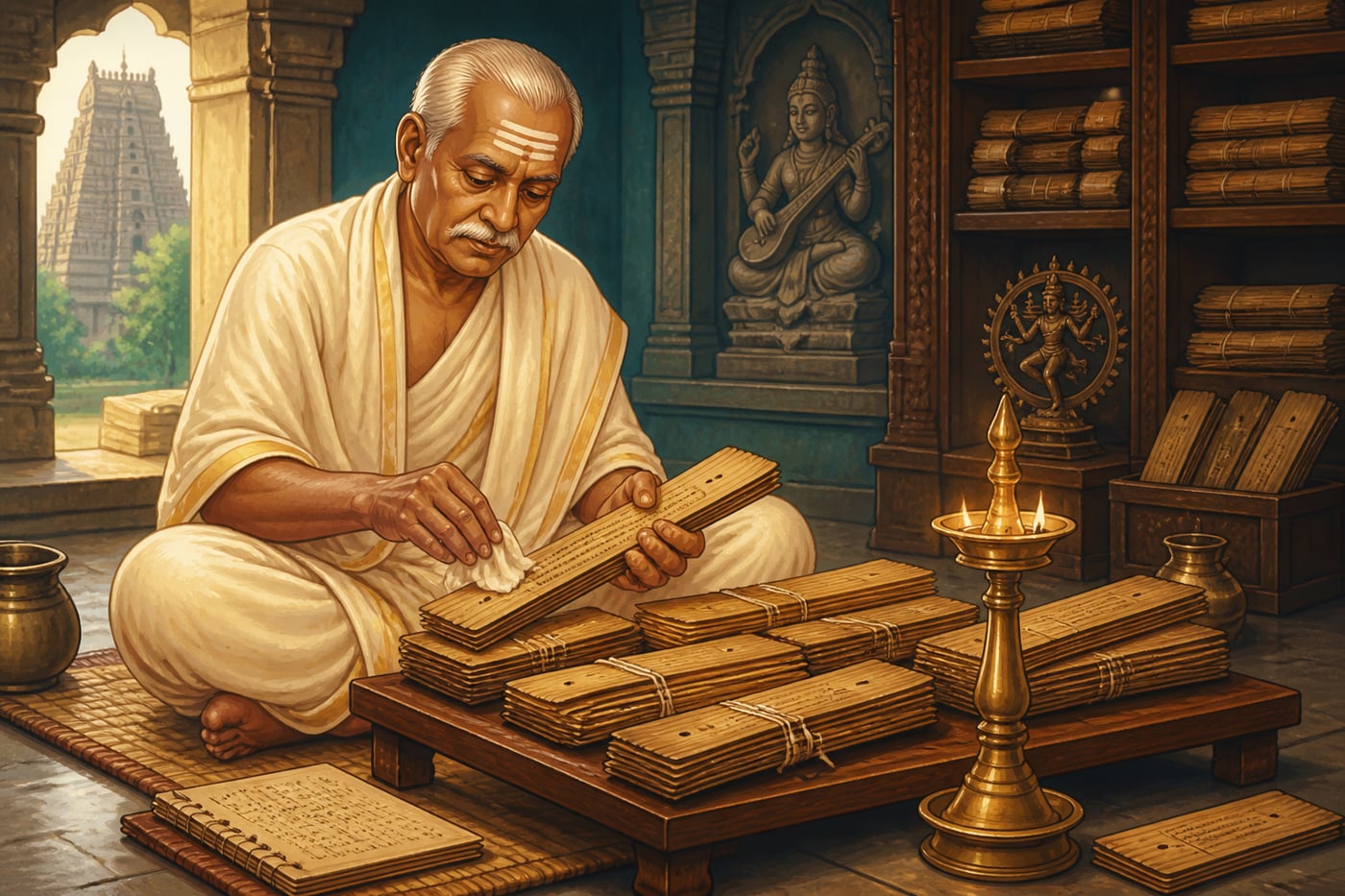
Two men shaped how the world understands Tamil heritage. Their approaches could not be more different. Robert Caldwell (1814-1891), an Irish missionary and later Bishop of Tirunelveli, arrived in South India with a conversion mandate from the SPG. He used linguistic scholarship to construct a racial divide between 'Dravidian' Tamils and 'Aryan' Brahmins, positioning Christianity as liberation from Brahminical oppression. U.V. Swaminatha Iyer (1855-1942), a Tamil Brahmin scholar from Uttamadanapuram, spent his entire life recovering ancient Tamil manuscripts that were crumbling into oblivion. Working with palm-leaf manuscripts in deteriorating condition, he single-handedly rescued the Silappadikaram, Manimekalai, Purananuru, and Pattupattu from extinction. He traveled to remote villages, negotiated with reluctant manuscript holders, deciphered damaged texts, and published critical editions with meticulous annotations. The Tamil people themselves honored him with the title 'Tamil Thatha' (Grandfather of Tamil). The irony is devastating: by the Dravidian narrative Caldwell helped create, Swaminatha Iyer was a 'Brahmin oppressor.' Yet he was the one who saved the very Tamil literature that the Dravidian movement claims to champion. The texts he recovered show exactly what Caldwell needed to deny: Tamil and Sanskrit existed in organic integration, not opposition.
The texts Swaminatha Iyer rescued prove the unity Caldwell denied. The Silappadikaram features both Shaiva and Jain themes alongside Tamil Bhakti traditions. The Purananuru references Vedic rituals performed by Tamil kings as a natural part of their royal identity. The Pattupattu describes Tamil landscapes using imagery that blends local geography with Puranic cosmology. These were not Sanskrit impositions on Tamil culture. They were Tamil culture. The guru-shishya parampara through which Swaminatha Iyer received his training, under the great Meenakshisundaram Pillai, itself embodied the cross-community knowledge transmission that Caldwell's framework said was impossible.
Swaminatha Iyer's recovered texts are today Tamil Nadu's most cherished literary heritage. The Silappadikaram is taught in every Tamil school. The Sangam anthologies are the pride of Tamil identity. A Brahmin scholar's life work became the foundation of modern Tamil cultural pride, while a missionary's racial theory became the foundation of a political movement that vilifies Brahmins. The people who celebrate the texts often do not know that a Brahmin saved them from oblivion.
The framework that says 'Brahmins suppressed Tamil' collapses when a Brahmin is the one who rescued Tamil literature from extinction. When the preserver of a culture is cast as its oppressor, the narrative has departed from history and entered the territory of political engineering.
The contrast between Caldwell and Swaminatha Iyer exposes a pattern still active today: foreign-funded scholarship that fragments Indian identity receives global academic attention, while indigenous scholarship that demonstrates civilizational unity is marginalized as 'nationalist.' The framing of who counts as a legitimate scholar remains a live battleground.
U.V. Swaminatha Iyer published over 90 works of Tamil literature from palm-leaf manuscripts, many of which existed in single, deteriorating copies. Without his intervention, major portions of the Sangam corpus would have been permanently lost.
Living traditions
Tamil-Sanskrit synthesis lives on in every dimension of Tamil cultural life, despite decades of political effort to sever the connection. Bharatanatyam, Tamil Nadu's signature classical dance, is performed to compositions in both Tamil and Sanskrit, choreographed using the Sanskrit Natya Shastra, and named with a Tamil-Sanskrit hybrid word. Carnatic music, the classical music tradition of South India, uses Sanskrit-origin ragas, Telugu and Sanskrit kritis by Tyagaraja and Dikshitar, and Tamil compositions by Muthuswami Dikshitar and Papanasam Sivan in the same concert. Tamil film music, consumed by tens of millions daily, freely mixes Tamil lyrics with Sanskrit-origin words, Carnatic ragas, and devotional phrases from both traditions. Temple worship across Tamil Nadu continues to integrate Tamil Divya Prabandham and Tevaram with Sanskrit Vedic and Agamic rituals in every daily puja, exactly as it has for over a thousand years. The Tamil calendar, Tamil festivals like Pongal and Karthigai Deepam, and Tamil personal names routinely incorporate Sanskrit elements that speakers do not experience as foreign. Even the political parties that built their identity on Caldwell's separation thesis conduct their rallies with Tamil oratory saturated in Sanskrit-origin vocabulary. The synthesis is so deep that separating Tamil from Sanskrit would require dismantling the Tamil language itself. This is the ultimate proof that Caldwell's construction was political, not linguistic. The languages themselves refused to be divided.
- Divya Prabandham and Vedic Parayana at Sri Vaishnava Temples: In every Sri Vaishnava temple across Tamil Nadu, the Nalayira Divya Prabandham (4,000 Tamil hymns composed by the twelve Alvars between the 6th and 9th centuries) is recited alongside Sanskrit Vedic mantras as part of daily worship. The Divya Prabandham is honored as the 'Tamil Veda' (Dravida Veda), and its recitation holds equal liturgical authority with the Sanskrit Vedas in temple ritual. During festivals, processions feature both Tamil and Sanskrit chanting in sequence, with the Tamil Prabandham verses preceding the Sanskrit mantras in many temple traditions. This is not a modern compromise or syncretism. It is the original design of Sri Vaishnava worship as codified by Nathamuni (10th century) and systematized by Ramanujacharya (11th century).
- Tevaram Recitation (Odhuvars): The Tevaram, a collection of Tamil devotional hymns to Shiva composed by the three great Nayanar saints (Thirugnana Sambandar, Thirunavukkarasar, and Sundarar between the 7th and 8th centuries), is sung daily in Shiva temples across Tamil Nadu by hereditary singers called Odhuvars. These Tamil hymns are recited alongside Sanskrit Agamic rituals. The Chola king Rajaraja I (10th century) institutionalized Tevaram singing at the Brihadeeswarar Temple in Thanjavur, establishing dedicated endowments to ensure the tradition's continuity. The practice continues today at Chidambaram, Thanjavur, Madurai, and hundreds of other Shiva temples.
- Sri Ranganathaswamy Temple, Srirangam: The world's largest functioning Hindu temple and the premier Divya Desam. Visit to witness Tamil-Sanskrit synthesis as a lived daily reality, not a historical claim. Attend the morning puja to hear Sanskrit Vedic chanting and Tamil Divya Prabandham recitation performed in sequence as a single unified worship. Walk through the seven concentric enclosures (prakarams) to see Sanskrit Agamic architecture, Tamil inscriptions of Chola and Pandya kings, and sculpted narratives from both Sanskrit Puranas and Tamil Alvar poetry. The temple's museum displays inscriptions documenting how Tamil and Sanskrit traditions have coexisted here for over a thousand years. If visiting in December-January, attend the Vaikunta Ekadashi festival to see the Paramapada Vasal opening ceremony.
- Thanjavur Saraswati Mahal Library: One of the oldest libraries in Asia, established by the Nayak kings in the 16th century and expanded by the Maratha rulers of Thanjavur. Houses over 49,000 manuscripts in Sanskrit, Tamil, Telugu, Marathi, and other languages. The collection itself demolishes the Tamil-Sanskrit separation thesis: Chola and Nayak courts commissioned works in both languages, and the library's holdings show that the same scholars, the same patrons, and the same institutions produced literature in Tamil and Sanskrit as complementary expressions of a single civilization. The adjacent Brihadeeswarar Temple (UNESCO World Heritage Site), built by Rajaraja Chola I, features Sanskrit Agamic rituals, Tamil Tevaram singing endowed by the same king, and inscriptions in both languages carved into the same walls.
- Sri Ranganathaswamy Temple, Srirangam: The largest functioning Hindu temple in the world (156 acres, 7 concentric enclosures) and the foremost of the 108 Divya Desams. Srirangam is the living embodiment of Tamil-Sanskrit synthesis. Its architecture follows Sanskrit Vastu and Agamic design. Its daily worship integrates Sanskrit Vedic recitation with Tamil Divya Prabandham recitation in equal measure. The temple's theological foundation is Vishishtadvaita, the philosophy of Ramanujacharya, who wrote in Sanskrit but whose tradition reveres the Tamil Alvars as equal to the Vedic rishis. The temple's very name combines Sanskrit (Sri, Ranganatha) with Tamil geographical identity (Srirangam, the island of Ranga). Caldwell's thesis that Tamil and Sanskrit represent separate civilizational streams collapses the moment you walk through Srirangam's gopurams.
- Chidambaram Nataraja Temple: One of the Pancha Bhuta Sthalams (five elemental Shiva temples), representing Akasha (space/ether). Chidambaram uniquely synthesizes every strand of Tamil-Sanskrit integration. The temple's name itself is a Sanskrit compound (chit + ambaram, 'consciousness-space'). Its architecture follows Sanskrit Shilpa Shastra. Its rituals follow the Vedic tradition maintained by the Dikshitar priests, a community that traces its lineage to rishis who migrated from Kashi and adopted Tamil land as home. The Tevaram hymns of the Tamil Nayanar saints are sung daily alongside Sanskrit Vedic chanting. The Nataraja bronze, perhaps the most recognized symbol of Indian civilization globally, represents Shiva performing the Ananda Tandava as described in both Sanskrit Puranic texts and Tamil Shaiva literature.
Reflection
- Think about the identity labels you carry: regional, linguistic, community-based. How many of these categories reflect your actual lived experience of cultural connection, and how many were assigned to you by systems (education, politics, census forms) that needed you sorted into a box?
- Caldwell's 'Dravidian race' theory has been academically discredited for decades, yet the political and cultural categories it generated remain deeply entrenched. Why do manufactured identity categories persist long after their intellectual foundations collapse, and what would it take for a civilization to reclaim its own self-understanding?
- Dravidian languages are genuinely distinct from Indo-Aryan languages. That is a legitimate linguistic observation. Yet Caldwell turned this observation into a racial theory and then a political weapon. At what point does categorization become weaponization, and can a civilization hold genuine internal diversity without those differences being exploited as fault lines?