The Church-Dravidian Alliance: Past & Present
Missionary Symbiosis and Modern Identity Politics
The Church-Dravidian alliance trades missionary funding and institutions for political protection of conversion. From the Justice Party (1916) through Periyar to modern electoral politics, genuine cultural pride became a tool for civilizational erosion.
See It Today: The Kanyakumari Transformation
Kanyakumari, the southernmost district of Tamil Nadu, tells a story that few Indian textbooks will touch. In the 1951 census, the district was overwhelmingly Hindu. By 2011, Christians constituted roughly 32% of the population, with some taluks showing even higher concentrations. Villages that had Hindu names for centuries now bear the names of European saints. Church spires outnumber temple gopurams in parts of the coastal belt.

This did not happen by accident, and it did not happen through spiritual persuasion alone. Walk through certain coastal villages today and you will find that the local temple, once the center of community life, stands neglected, while a newly built church hosts the majority of social gatherings, school functions, and community welfare activities.
Kanyakumari's transformation was engineered through a decades-long partnership between two forces that, on the surface, have nothing in common: Christian missionary organizations and Dravidian political parties. The missionaries brought foreign funding, institutional infrastructure (schools, hospitals, orphanages), and a conversion apparatus refined over centuries. The Dravidian parties brought political protection: blocking anti-conversion legislation, ensuring police non-interference during conversion campaigns, and using the state's Hindu Religious and Charitable Endowments (HR&CE) Act to weaken Hindu temple institutions while leaving churches entirely autonomous.
The result is a district where the demographic ground has shifted beneath the feet of the Hindu population. Not through violence or coercion in the legal sense, but through a systematic alliance between spiritual enterprise and political power. Kanyakumari is not an anomaly. It is a model. And the alliance that produced it has roots stretching back more than a century.
The Mechanism: How the Symbiosis Operates
The Church-Dravidian alliance works through a simple but powerful exchange: each party provides what the other lacks.
What Missionaries Provide to Dravidian Politics
First, an intellectual framework. Robert Caldwell's 1856 thesis, covered in the previous lesson, gave Dravidian politics its founding mythology: that Tamils were a separate race, that Sanskrit and Vedic culture were "Aryan impositions," and that the Brahmin was a foreign colonizer. Without Caldwell's missionary linguistics, the Dravidian movement would have lacked its origin story.
Second, institutional infrastructure. Missionary organizations operate thousands of schools, colleges, hospitals, and social service centers across Tamil Nadu. These institutions serve as both conversion pipelines and political mobilization points. A church-run school does not just educate; it shapes the worldview of the next generation. A mission hospital does not just heal; it creates gratitude-based loyalty that translates into political support.
Third, international advocacy. When Dravidian politicians face accusations of anti-Hindu bias, missionary-connected international networks provide diplomatic cover. Reports from organizations like the US Commission on International Religious Freedom (USCIRF) consistently frame Hindu-majority governance as "persecution," while ignoring conversion-driven demographic engineering.
Fourth, funding. Tamil Nadu has consistently been among the top recipients of foreign contributions under FCRA (Foreign Contribution Regulation Act). A significant share flows to Christian organizations that operate educational and healthcare institutions which double as conversion infrastructure.
What Dravidian Parties Provide to Missionaries
First and most critically, political protection. No Dravidian government has ever passed anti-conversion legislation, even as neighboring states like Odisha, Madhya Pradesh, and Gujarat enacted Freedom of Religion Acts. This is not oversight. It is the terms of the alliance.
Second, institutional warfare against Hinduism. The HR&CE Act gives Tamil Nadu's government direct control over approximately 36,000 Hindu temples: their land, their revenue, and their administration. Temple funds are diverted to state coffers. Non-Hindu administrators have been appointed to manage Hindu religious institutions. Temples that once ran schools, fed the poor, and patronized the arts have been hollowed out into revenue sources. Meanwhile, churches and mosques operate with complete institutional autonomy, managing their own funds, properties, and governance without any state interference.
Third, rhetorical legitimacy. When Dravidian politicians attack "Brahmanical Hinduism," "Sanskritic imperialism," or "Aryan domination," they are doing the missionaries' ideological work. Every attack on Hindu identity creates space for conversion. Every young Tamil who internalizes the message that "Hinduism is not your religion, it was forced on you" becomes a potential convert.
The genius of this arrangement is its deniability. Missionaries claim they are doing "social service." Dravidian politicians claim they are pursuing "social justice." Neither openly acknowledges the symbiotic relationship. But the pattern is unmistakable: wherever Dravidian political power is strongest, conversion rates are highest.
The Pattern: From Justice Party to Permanent Alliance
This alliance is not a recent development. Its roots lie in the colonial period, and its evolution follows a clear trajectory.
The Justice Party (1916-1944)
The South Indian Liberal Federation, known as the Justice Party, was founded in 1916 by non-Brahmin elites including T.M. Nair, C. Natesa Mudaliar, and P. Thyagaraja Chetty. The party's founding agenda had genuine substance. Brahmins were disproportionately represented in colonial administration and modern professions, and non-Brahmin communities had legitimate grievances about access to education and government positions.
But the Justice Party's anti-Brahmin platform served two external masters simultaneously. The British colonial government encouraged it as a divide-and-rule tactic: a fractured Indian population was easier to govern. And missionary organizations supported it because anti-Brahmin rhetoric naturally evolved into anti-Hindu sentiment, opening the door for conversion.
Many Justice Party leaders were products of mission schools. The intellectual atmosphere the party created, in which Brahmin identity was synonymous with oppression and Hindu tradition was synonymous with caste tyranny, was precisely the soil in which missionary conversion could flourish.
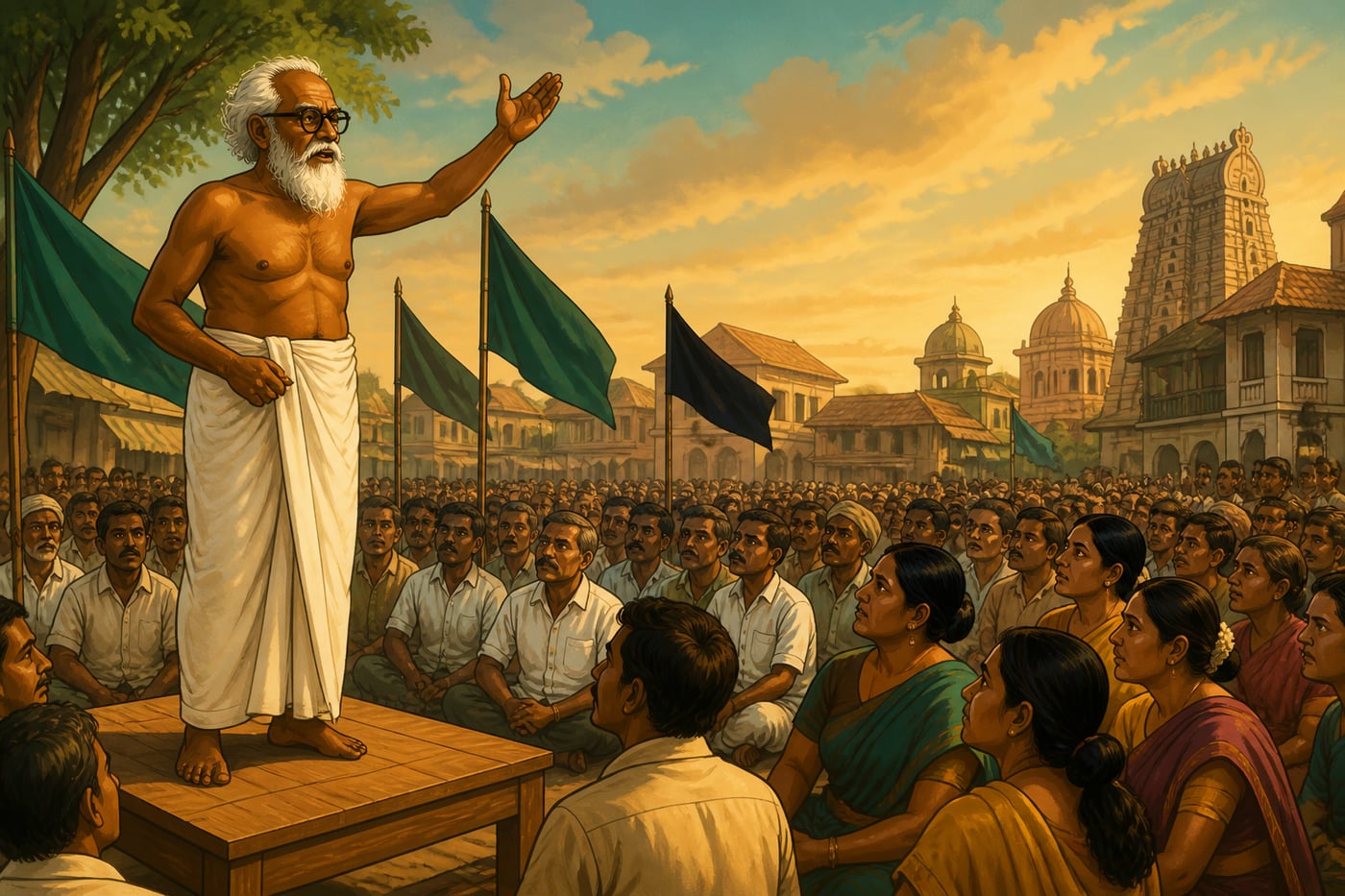
Periyar and the Dravidar Kazhagam (1944)
When E.V. Ramasamy Periyar took control of the Justice Party and transformed it into the Dravidar Kazhagam (DK) in 1944, the alliance deepened. Periyar's Self-Respect Movement was explicitly anti-religious, targeting Hinduism specifically. He publicly burned the Manusmriti, attacked Hindu deities, and called for the complete rejection of Hindu civilization.
For missionaries, Periyar was the ideal ally. He did not merely criticize caste; he attacked the entire Hindu religious framework. His "Self-Respect Marriages," conducted without Brahmin priests or Hindu rituals, normalized the idea that Tamil identity did not require Hindu religious practice. This was, in effect, pre-conversion: once the connection between Tamil identity and Hindu practice was severed, accepting Christianity became culturally frictionless.
The DK's printing presses and propaganda networks distributed anti-Hindu literature that closely mirrored missionary talking points. The ideological overlap was not coincidental. It was structural. Periyar's iconoclasm served missionary interests more effectively than any direct proselytizing campaign could have, because it came from a Tamil voice attacking Tamil Hindu identity from within.
From DK to DMK to Today
When C.N. Annadurai split from Periyar to form the DMK in 1949, the party moderated its atheism enough to become electorally viable. But the structural alliance with missionary networks remained intact. Both the DMK and later the AIADMK maintained relationships with Christian organizations, particularly in southern Tamil Nadu.
The alliance evolved from ideological partnership into electoral arithmetic. Tamil Nadu's Christian population, concentrated in key districts, became a reliable vote bank for Dravidian parties. In return, Dravidian governments ensured that conversion operations faced no legal obstacles. This exchange has continued through every change of government in Tamil Nadu for over seven decades.
The pattern that began with colonial-era missionary support for the Justice Party has become a self-sustaining political ecosystem. Missionaries fund institutions, institutions produce voters, voters support Dravidian parties, and Dravidian parties protect the conversion apparatus. Each link strengthens the next.
Dharmic Wisdom: When Internal Cracks Invite External Forces
The Arthashastra identifies a category of threat that is particularly relevant here: the combination of internal disaffection and external aggression. Kautilya considered this the most dangerous of all strategic situations, because the external enemy exploits wounds that already exist.
The concept of Bheda (भेद), strategic division, is one of the four upayas (methods of statecraft) in the Arthashastra. Kautilya warns that a skilled adversary will always seek to exploit existing fractures within a target society. The key insight is that Bheda does not create divisions from nothing. It identifies real grievances, real inequities, real tensions, and then deepens them until they become structural fractures that serve the adversary's purpose.
This is exactly what happened with the Church-Dravidian alliance. Caste discrimination was real. Brahmin overrepresentation in colonial-era institutions was real. Tamil cultural distinctiveness was real. These were genuine fault lines. The missionary-Dravidian partnership did not invent these problems. It weaponized them.
Chanakya warns of the Mithyamitra (मिथ्यामित्र), the false friend, who appears to serve your interests while actually serving their own. The alliance presents missionaries as educators and healers, and Dravidian politicians as champions of the oppressed. Both are genuinely providing these services. But the cumulative strategic effect is civilizational erosion: weakening of Hindu institutions, demographic transformation of historically Hindu regions, and alienation of Tamil Hindus from their own spiritual heritage.
Vidura counsels Dhritarashtra that danger born of misplaced trust cuts through even the deepest roots. The alliance has survived for a century precisely because it disguises strategic objectives as social service. The dharmic response is not to deny that real problems exist, but to ensure that the remedy does not come from those whose ultimate objective is the patient's conversion.
The Defense: Reclaiming Tamil Dharmic Heritage
The most powerful counter to the Church-Dravidian narrative is the truth about Tamil civilization itself.
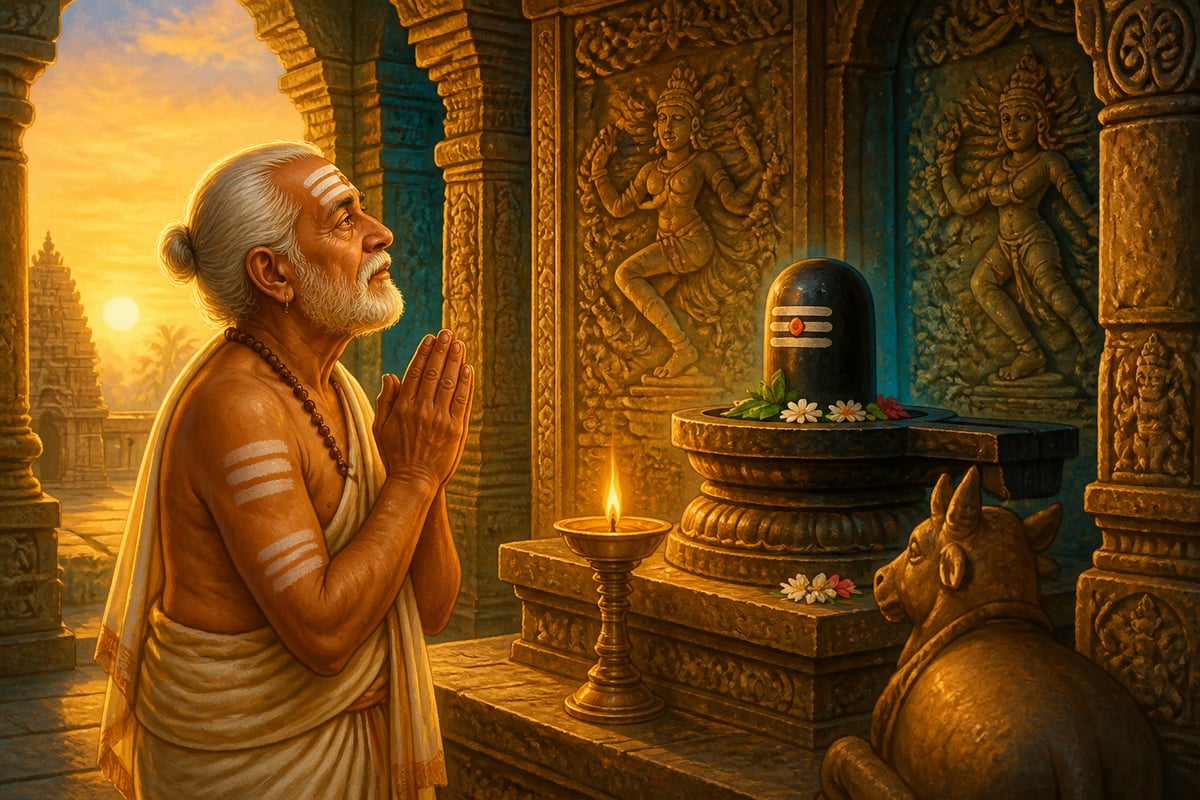
Reclaim the Tamil-Sanskritic Heritage
The single most effective weapon against the "Tamil vs Sanskrit" narrative is the Shaiva and Vaishnava devotional traditions of Tamil Nadu. The Nayanars (63 Shaiva saints) and the Alvars (12 Vaishnava saints) composed some of the most profound spiritual poetry in any language, in Tamil, celebrating Hindu deities, Hindu philosophy, and Hindu temples. Thirugnana Sambandar, Appar, Sundarar, Manikkavasagar, Andal, Nammalvar: these are Tamil civilization's greatest literary voices, and every one of them was deeply, devotionally Hindu.
The Tirumurai (Shaiva canon) and the Nalayira Divya Prabandham (Vaishnava canon) are not "Aryan imports." They are Tamil compositions, in Tamil language, expressing Tamil devotion, rooted in Tamil geography. Every temple these saints sang about stands in Tamil Nadu. Their poetry is Tamil civilization's highest literary achievement. The Dravidian narrative requires Tamils to forget their own greatest poets.
Thiruvalluvar's Thirukkural, revered across the political spectrum, is saturated with concepts of dharma, karma, and virtue that are integral to the broader Indic philosophical tradition. The attempt to claim Thiruvalluvar as "secular" or "non-Hindu" requires ignoring the philosophical content of his own words.
Build Institutional Alternatives
Missionaries succeed because they build institutions: schools that educate, hospitals that heal, orphanages that shelter. The counter is not to attack these institutions but to build better ones. Hindu organizations in Tamil Nadu need to invest in world-class schools, hospitals, and social service networks that serve all communities regardless of caste or economic status. Where the missionary offers education with conversion, the dharmic institution must offer education with civilizational pride and genuine service.
Models already exist. The Ramakrishna Mission, Chinmaya Mission, and Mata Amritanandamayi Math all operate extensive service networks. These need to be scaled dramatically in Tamil Nadu, particularly in districts where conversion activity is highest.
Push for Legal Parity
The HR&CE Act must be challenged as discriminatory. If the state controls Hindu temples, it must control churches and mosques equally, or it must control none. The asymmetry is constitutionally indefensible and serves only the alliance's interests. Temple liberation is not a religious demand. It is a demand for equal treatment under law.
Address Caste Grievances Genuinely
The alliance's greatest strength is the reality of caste-based discrimination. As long as Dalits and OBCs face genuine exclusion in Hindu spaces, the missionary offer of "dignity through conversion" will find takers. The defense is not to deny the problem but to solve it. Temple access, economic empowerment, leadership opportunities, and genuine social inclusion within the Hindu framework are the strongest possible counters to conversion. Every act of caste discrimination is a recruitment tool for the conversion machine.
Make the Alliance Visible
The goal is not to attack individual missionaries or Dravidian politicians. It is to make the structural alliance visible. When voters in Tamil Nadu understand that their political choices are connected to demographic engineering, they can make informed decisions. When parents understand that a "free education" comes with identity costs, they can weigh their options honestly. Transparency is the weapon. Follow the money, trace the institutional connections, document the political protection, and present the evidence calmly and factually. The alliance thrives in shadow. It weakens in sunlight.
Case studies
The Justice Party to DK Pipeline (1916-1944)
In 1916, the South Indian Liberal Federation (Justice Party) was founded by non-Brahmin elites in the Madras Presidency. The party's core agenda was genuine: challenging Brahmin dominance in colonial administration, education, and the professions. But the party operated within a web of colonial and missionary influence. Many of its leaders were educated in mission schools and colleges. British officials encouraged the party as a counterweight to the Indian National Congress, which they saw as dominated by Brahmin nationalists. Missionary networks provided intellectual support, publishing infrastructure, and institutional connections. The party governed the Madras Presidency under the Montagu-Chelmsford reforms (1920-1926), implementing reservation policies that addressed real inequities. When E.V. Ramasamy Periyar took control and transformed the party into the Dravidar Kazhagam in 1944, he radicalized its anti-Brahmin stance into an anti-Hindu civilizational project. The DK's Self-Respect Movement attacked Hindu rituals, deities, and scriptures, creating the ideological foundation that missionaries had been cultivating since Caldwell.
Kautilya's Arthashastra describes how an adversary uses bheda (strategic division) by first identifying genuine internal grievances, then amplifying them until they fracture the target society. The Justice Party's trajectory is a case study in bheda: real social inequity (Brahmin overrepresentation) was identified and then systematically deepened. What began as a demand for fair representation became, within three decades, a civilizational rejection of Hindu identity. The Arthashastra warns that the most effective bheda exploits problems that are real, because the target population cannot dismiss the initial grievance as fabricated.
The Justice Party-to-DK pipeline created a permanent political infrastructure for the Church-Dravidian alliance. Periyar's DK eventually gave birth to the DMK (1949) and later the AIADMK (1972), both of which maintained the alliance in modified forms. The anti-Brahmin political template became the default operating system of Tamil Nadu politics, ensuring missionary interests would be protected regardless of which Dravidian party held power.
Genuine grievances, when left unaddressed by the society that produced them, become raw material for external actors. The Brahmin community's failure to proactively address overrepresentation created the opening that missionaries and colonial administrators exploited into a permanent civilizational fissure.
The template created by the Justice Party is still active. Every Dravidian party in Tamil Nadu today uses anti-Brahmin rhetoric as a political foundation, and every one maintains relationships with missionary organizations. The institutional DNA has not changed in over a century.
The Justice Party won the first elections held under the Montagu-Chelmsford reforms in Madras Presidency (1920), making it one of the first non-Congress parties to govern any Indian province. This early political success locked in the anti-Brahmin template as the dominant framework of Tamil Nadu politics for the next century.
Kanyakumari: Model District of Demographic Engineering
Kanyakumari district in southern Tamil Nadu has undergone one of the most significant demographic transformations in modern India. From a predominantly Hindu district at independence, its Christian population grew to approximately 32% by the 2011 census, with some coastal taluks showing even higher concentrations. This transformation followed a consistent pattern: missionary organizations established schools, hospitals, and social service centers that served as conversion pipelines. Church-run educational institutions, from primary schools to professional colleges, educated generations of children in a framework that presented Christianity as the path to modernity and social mobility. Medical missions provided healthcare in underserved areas, building gratitude-based relationships that facilitated conversion. Meanwhile, successive Dravidian governments in Tamil Nadu provided political cover. No anti-conversion legislation was enacted. Police did not interfere with conversion campaigns. The HR&CE Act weakened Hindu temple infrastructure in the district while churches operated with full autonomy. Hindu community organizations struggled to match the missionary institutional presence, particularly in coastal and rural areas.
Vidura's warning about trust is enacted in Kanyakumari: institutions that appeared to serve the community (schools that educated, hospitals that healed) were simultaneously engineering its transformation. The Arthashastra's concept of 'kuta-yuddha' (indirect warfare) applies here. No army invaded Kanyakumari. No law forced conversion. The demographic shift happened through institutional warfare: building parallel institutions that gradually replaced Hindu community structures with Christian ones, all while appearing to provide charitable service.
Kanyakumari is now a politically Christian-influenced district where church organizations exercise significant social and electoral power. Hindu cultural practices that were dominant for centuries have been marginalized in large parts of the district. The model has been studied and replicated in other districts of southern Tamil Nadu and along the coastal belt.
Institutional presence is the real battlefield. Where Hindu organizations failed to provide schools, hospitals, and social services, missionary organizations filled the vacuum. Demographic transformation followed institutional dominance, not the other way around.
Post-2000 FCRA data shows that Tamil Nadu consistently receives among the highest foreign funding in India, with significant portions directed to Christian organizations in districts like Kanyakumari. The model continues to operate and expand.
Tamil Nadu received over Rs. 18,000 crore in FCRA foreign contributions between 2006-2020, consistently ranking among the top 3 recipient states in India. Christian organizations are among the largest recipients of these funds.
The Dalit-Dravidian-Church Triangle in 21st Century TN
In 21st-century Tamil Nadu, the Church-Dravidian alliance has evolved to incorporate a third vertex: Dalit political mobilization. The Viduthalai Chiruthaigal Katchi (VCK), founded by Thol. Thirumavalavan, operates as an Ambedkarite party focused on Dalit rights. The VCK has been a consistent alliance partner of the DMK in state elections. Simultaneously, Thirumavalavan has been documented at events organized by Christian organizations and has publicly engaged with church-affiliated social groups. Church organizations in Tamil Nadu have increasingly focused on Dalit communities, framing caste discrimination as inherent to Hinduism and offering Christianity as the path to dignity. This creates a three-way exchange: the VCK mobilizes Dalit voters for the DMK alliance, church organizations provide institutional support (social services, organizational infrastructure) to Dalit communities, and the DMK-led government protects conversion operations. Each vertex strengthens the other two. The result is a political ecosystem where Dalit identity politics, Dravidian anti-Hindu rhetoric, and Christian institutional power form a self-reinforcing triangle.
The Mahabharata's narrative of how Shakuni exploited Duryodhana's grievances to serve his own agenda is a framework for understanding this triangle. Each party has genuine motivations: Dalits face real discrimination, Dravidian politicians seek electoral power, missionaries seek to expand their flock. But the strategic outcome serves interests that none of the participants may fully see. Kautilya's concept of 'mandala' (circles of allies and adversaries) describes exactly this kind of multi-party strategic geometry, where each party believes it is using the others while all are caught in a system that serves a deeper agenda.
The triangle has become the dominant political structure in Tamil Nadu's identity politics. Dalit communities are increasingly alienated from Hindu identity, Dravidian parties are locked into anti-Hindu rhetoric by electoral necessity, and church organizations have secured permanent political protection for their operations. The self-reinforcing nature of the triangle makes it extremely difficult to disrupt.
Modern alliances of civilizational erosion are multi-layered and self-reinforcing. Countering them requires addressing the genuine grievance (caste discrimination) at the triangle's foundation while making visible the strategic architecture that converts that grievance into civilizational transformation.
The VCK-DMK-Church triangle represents the evolved form of the original Justice Party-missionary nexus. Understanding this evolution is essential for anyone seeking to address caste discrimination without feeding the conversion machine.
The VCK has been part of the DMK-led alliance in every Tamil Nadu state election since 2006, consistently winning seats in districts with significant Dalit and Christian populations, demonstrating the electoral arithmetic of the triangle.
Reflection
- Think about the institutions that shaped your own worldview: schools, colleges, media, social networks. Can you identify any ways in which these institutions subtly encouraged you to see your own civilizational heritage as inferior or irrelevant? How did this influence your identity formation?
- Why does the disguise of 'social service' make the Church-Dravidian alliance more effective than open hostility would be? What does this tell us about the nature of civilizational warfare in the modern age?
- Is it possible to address genuine caste discrimination within the Hindu framework without that process being co-opted by external forces? Or does every internal reform movement inevitably become a tool for civilizational disruption?