Takshashila: The Great Trading University City

Where Commerce Met Learning on the Silk Road

Explore Takshashila (Taxila), the ancient city that served as both a premier center of learning and a crucial trading hub where East met West.

The Student Who Would Change History
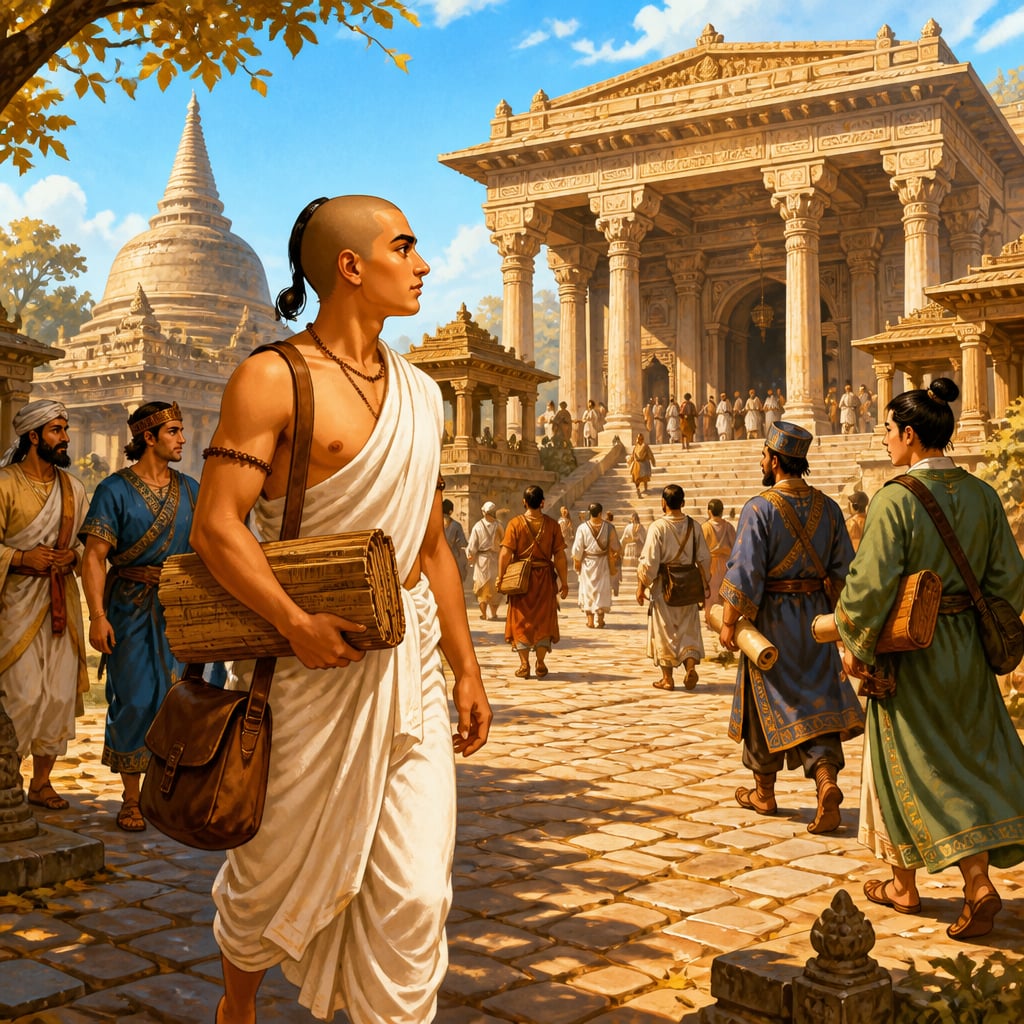
Young Chanakya walking through ancient Takshashila

In 326 BCE, a young Brahmin named Chanakya walked the busy streets of Takshashila, making his way to the great university's debating halls. Around him swirled a cosmopolitan crowd: Greek merchants haggling over Chinese silk, Persian horse-traders inspecting Bactrian stallions, Buddhist monks in saffron robes discussing philosophy with Hindu scholars. The air smelled of cardamom from southern caravans and the dust of the great Northern Road.

Chanakya had come to study, and to teach. But he was about to become something more: the architect of India's first great empire. The education he received at Takshashila, and the commercial networks he observed there, would shape his Arthashastra, the treatise that would influence governance for millennia.

Takshashila wasn't just the world's first university. It was the world's first knowledge-commerce hub, where ideas and goods traveled together, each enriching the other.

Geography as Destiny

Takshashila's location was no accident. The city sat precisely where three great trade routes converged:

This convergence created a unique commercial ecosystem. A merchant arriving from China could find buyers for silk, acquire Indian cotton and spices, and arrange onward transport to Persian markets, all within a single city. The Greeks called the city Taxila; to them, it was a gateway to the fabled riches of India.

"तक्षशिला विद्यानां च वाणिज्यानां च संगमः।" "Takshashila is the confluence of learning and commerce."

This ancient observation captured the city's dual identity. Trade routes brought wealth; wealth attracted scholars; scholars created knowledge; knowledge attracted more trade. The virtuous cycle spun for nearly a thousand years.

The University Without Walls

What made Takshashila's educational model revolutionary? Unlike later universities with fixed curricula, Takshashila operated more like a knowledge marketplace. Famous teachers, acharyas, established themselves in the city, attracting students from across the known world.

Students chose their teachers based on reputation and subject matter. A student might study the Vedas with one acharya, medicine (Ayurveda) with another, warfare with a third, and commerce (vanijya) with a fourth. This modular system allowed for specialization and interdisciplinary combination.

The curriculum was staggering in its breadth:

Tuition was often paid after graduation, based on the student's success, an ancient forerunner of income-share agreements that some modern institutions are rediscovering.

The Great Alumni

Takshashila's alumni list reads like a who's who of ancient achievement:

Chanakya (Kautilya) - The strategist who engineered the Mauryan Empire and wrote the Arthashastra. His economic theories on taxation, trade regulation, and state enterprises shaped Indian governance for centuries.

Panini composing the Ashtadhyayi under a peepal tree

Panini - The linguist who created the world's first formal grammar (Ashtadhyayi), analyzed Sanskrit with mathematical precision that wouldn't be matched until modern computational linguistics.

Charaka - The physician whose Charaka Samhita became foundational to Ayurvedic medicine, systematizing diagnostic techniques and treatment protocols.

Jivaka - The surgeon who studied under the legendary physician Atreya, later becoming the personal doctor of both King Bimbisara and the Buddha himself.

These weren't isolated geniuses; they were products of a system that combined rigorous education with exposure to diverse cultures and ideas. The Silk Road didn't just carry goods through Takshashila, it carried knowledge.

Commerce Driving Education

The connection between trade and learning at Takshashila wasn't accidental. Commerce created demand for specific knowledge:

Languages: Merchants needed translators and interpreters. Takshashila became a center for studying Greek, Persian, Prakrit, Sanskrit, and various Central Asian languages. Panini's grammar systematized Sanskrit precisely because trade required standardized communication.

Medicine: Long-distance trade spread diseases across continents. Takshashila's medical schools developed treatments for ailments unknown in isolated communities. Jivaka trained to treat conditions his teachers had never seen in their home regions.

Mathematics and Accounting: Managing trade across multiple currencies, measuring goods in different systems, calculating interest across months of travel, all required sophisticated mathematical skills. Indian numerals (later called "Arabic numerals" in Europe) enabled commerce that Roman numerals couldn't support.

Law and Contracts: International trade required enforceable contracts, dispute resolution, and consistent legal frameworks. Takshashila's legal scholars developed principles that traveling merchants could rely upon from the Ganges to the Mediterranean.

The Kushan Renaissance

Takshashila reached its zenith under Kushan rule (1st-3rd centuries CE). The Kushan emperors, particularly Kanishka I, patronized both learning and trade. They understood what modern universities are rediscovering: knowledge institutions drive economic development.

Kushan Takshashila became a center for Gandharan art, the remarkable fusion of Greek and Indian artistic traditions. Buddha was depicted in Greek sculptural style with Indian iconography. This artistic innovation wasn't merely aesthetic; it created trade goods that appealed to diverse markets from Rome to China.

The Dharmarajika Stupa and surrounding monasteries attracted Buddhist scholars from China, who came to study original texts and later brought Buddhist teachings back to East Asia. This educational pilgrimage stimulated trade in manuscripts, religious objects, and the services of translators and guides.

Why Takshashila Fell

Takshashila's decline holds lessons as important as its rise. The city survived Alexander's invasion (326 BCE), thrived under Mauryan administration, and flourished under Kushan patronage. But by the 5th century CE, it was abandoned.

What happened? The Hun invasions (460-530 CE) disrupted the Silk Road trade routes that sustained the city's commercial base. Without trade revenue, patronage for scholars declined. Without scholars, the city lost its draw for students. Without students, the merchants lost customers. The virtuous cycle reversed.

The lesson: knowledge hubs require economic sustenance. Academic excellence alone cannot survive; it must be embedded in functioning commercial systems. When the Huns cut the trade routes, they didn't attack the university directly, they simply made it economically unviable.

Modern Echoes: Bangalore and Beyond

Today, Bangalore (Bengaluru) often draws comparisons to ancient Takshashila. Like its predecessor, Bangalore sits at a junction, not of physical trade routes, but of digital information flows. Its universities (IISc, IIMs, IITs) attract students from across India and beyond. Its tech companies connect to global markets. Commerce and education reinforce each other.

Researcher at the IISc Bangalore campus laboratory

The Indian Institute of Science (IISc), founded in 1909 with Tata funding, explicitly aimed to recreate the Takshashila model: attract the best minds, connect them to industry, and generate both knowledge and prosperity.

Prime Minister Modi's vision for education-industry clusters, combining universities, research parks, and manufacturing zones, echoes ancient wisdom. The National Education Policy 2020 explicitly cites Takshashila as inspiration for its multidisciplinary approach.

Your Turn

Chanakya left Takshashila with more than a degree. He left with a network, merchants who would fund his political campaign, scholars who would staff his administration, and frameworks for governance tested against diverse perspectives.

The most valuable education has always combined formal learning with exposure to diverse people, practical applications, and real-world networks. Takshashila institutionalized this combination two millennia before modern universities began experimenting with "experiential learning" and "industry partnerships."

What is your Takshashila? Where do your learning and your networks intersect? How can you position yourself at the junction where knowledge and commerce meet?

Human capital theory, the economic value of knowledge, skills, and competencies that enable productive work.

Gary Becker's 1964 work on human capital formalized the economic returns to education. Theodore Schultz won the Nobel Prize for showing that education investment yields economic growth.

Takshashila operated on these principles two millennia earlier. The income-share agreement model now being tested by Lambda School and others was standard practice in ancient India.

Studies consistently show 8-13% annual returns on education investment, higher than most financial assets. A Takshashila student investing twelve years understood this intuitively.

Knowledge spillovers and agglomeration effects, the economic benefits of clustering related activities in a single location.

Alfred Marshall's 1890 analysis of industrial districts and Paul Krugman's new economic geography formalized agglomeration benefits. Silicon Valley exemplifies how talent, capital, and ideas concentrate.

Verses

विद्या धनं सर्वधनप्रधानम्।

vidyā dhanaṃ sarva-dhana-pradhānam |

The wealth of knowledge is the foremost of all forms of wealth.

Human capital theory, developed by economists Gary Becker in the 1960s, formalized what Takshashila's teachers knew: investment in education yields economic returns that compound over a lifetime.

Traditional saying, Attributed to ancient Takshashila (Various)

विद्याविनयसंपन्ने ब्राह्मणे गवि हस्तिनि।

vidyā-vinaya-saṃpanne brāhmaṇe gavi hastini |

The wise see equally the learned one endowed with knowledge and humility, as they do the cow and the elephant.

Soft skills matter as much as technical knowledge for professional success. Takshashila's emphasis on character alongside competence anticipated modern research on emotional intelligence and workplace effectiveness.

Arthashastra, Book 1, Chapter 5 (R.P. Kangle)

Key figures

Chanakya (Kautilya)

Political strategist, economist, and author of the Arthashastra. Graduate and later teacher at Takshashila who engineered the rise of the Mauryan Empire. · c. 375-283 BCE

Jamsetji Tata

Indian industrialist who envisioned and funded the Indian Institute of Science (IISc) in Bangalore, explicitly seeking to recreate Takshashila's model of world-class education in India. · 1839-1904

Plato

Greek philosopher who founded the Academy in Athens around 387 BCE, often called 'the first university in the Western world.' Student of Socrates and teacher of Aristotle. · 428-348 BCE

Case studies

IISc Bangalore: Recreating Takshashila in Modern India

In 1893, Jamsetji Tata, India's pioneering industrialist, wrote to Swami Vivekananda proposing to establish a 'university of science' in India. Tata had studied the history of Takshashila and was convinced that India's industrial development required indigenous scientific capability. He committed substantial personal wealth, ultimately ₹30 lakh and 14 buildings in Bangalore, to create what would become the Indian Institute of Science (IISc). Tata's vision was explicit: recreate the Takshashila model where research, education, and industry intersect. He insisted that IISc would not be a 'teaching shop' producing graduates for colonial administration, but a research institution solving real problems facing Indian industry. The British initially opposed the idea, preferring Indians to remain dependent on imported technology.

Conventional colonial education treated India as a consumer of Western knowledge, training clerks and bureaucrats, not creators. Tata's vision was dharmic in the truest sense: he saw knowledge creation as a national duty (rashtra dharma). IISc would restore India's ancient role as a knowledge-producing civilization, not merely a knowledge-importing one. The Arthashastra teaches that a wise king invests in institutions that compound over generations. Tata never saw IISc open (he died in 1904; IISc opened in 1909), but his investment continues generating returns 115+ years later. This is the dharmic approach to wealth: build institutions that serve beyond your lifetime.

IISc became Asia's premier research institution, consistently ranked among the world's top universities for scientific impact. It has produced Nobel laureates (C.V. Raman conducted his prize-winning work there), trained generations of scientists and engineers, and spawned countless startups and technologies. Bangalore's emergence as India's Silicon Valley traces directly to IISc's presence, the institution created the talent pool, the research culture, and the industry connections that attracted technology companies. The city's transformation from 'pensioner's paradise' to tech hub exemplifies how a single knowledge institution can transform regional economics, exactly as Takshashila transformed ancient Gandhara.

Knowledge institutions don't just educate individuals, they transform regions. Tata understood what took Western development economists decades to formalize: investment in research and education generates economic returns that far exceed the initial cost. The Takshashila model, properly implemented, remains the highest-return investment a society can make.

The IISc model validates what modern innovation economists call 'research clusters.' Silicon Valley, Shenzhen, and Bangalore all demonstrate that concentrating research talent creates exponential returns. Tata understood this in 1893. The world formalized it a century later.

IISc has an estimated economic impact of over $3 billion annually through research commercialization, startup creation, and talent development. Tata's initial investment of ₹30 lakh has generated returns exceeding 100,000x, vindication of the ancient wisdom that 'vidya dhanam sarva-dhana-pradhanam' (knowledge wealth is the foremost of all wealth).

Panini's Grammar: How Systematic Knowledge Enabled Global Commerce

Around the 4th century BCE, a scholar named Panini studied at Takshashila and produced the Ashtadhyayi, a grammar of Sanskrit containing exactly 3,959 sutras (rules). This wasn't merely a description of the language; it was a generative system that could produce every grammatically correct Sanskrit sentence. Panini's achievement was unprecedented: he had created what modern linguists recognize as a formal grammar, complete with meta-rules, recursion, and exception handling. His notation system was so sophisticated that computer scientists would rediscover equivalent techniques only in the 20th century. Noam Chomsky, the founder of modern linguistics, explicitly acknowledged Panini's influence: 'The first generative grammar in the modern sense was Panini's grammar.' But why would a trading center like Takshashila produce the world's greatest linguist? The answer lies in commerce.

Trade across the ancient world required communication across language barriers. Sanskrit served as the lingua franca of Indian Ocean commerce, but Sanskrit had countless dialects, regional variations, and competing standards. Merchants needed a standardized form that could be written, read, and understood from Gandhara to Tamil Nadu, from Bactria to Burma. Panini's grammar created that standard. By providing definitive rules for correct Sanskrit, he enabled the creation of commercial documents, contracts, and correspondence that could be trusted across vast distances. The dharmic dimension: Panini transformed language from a source of miscommunication and fraud into a reliable medium for honest commerce. This mirrors the Arthashastra's emphasis on standardized weights, measures, and legal terminology, consistent standards enable trust, and trust enables trade.

Panini's standardized Sanskrit became the medium of Indian Ocean trade for over a millennium. Inscriptions in Paninic Sanskrit appear from Afghanistan to Java, from Sri Lanka to Nepal. Buddhist and Hindu missionaries carried Panini's grammar wherever they went, creating a linguistic infrastructure that paralleled the physical trade routes. More remarkably, Panini's methodology, breaking complex systems into elemental rules that combine to generate infinite outputs, became the foundation of computational linguistics. When computer scientists developed programming languages, they discovered they were reinventing Paninian analysis. The 'Backus-Naur Form' used to specify programming language syntax is structurally identical to Panini's metalinguistic apparatus.

Infrastructure isn't just physical, linguistic and conceptual standardization enables commerce as much as roads and ports. Panini, a Takshashila scholar, created infrastructure that outlasted any ancient road. His grammar continues 'carrying' communication today, 2,400 years later. The lesson: invest in knowledge infrastructure that enables countless transactions, not just individual trades.

Panini's formal grammar directly influenced modern computer science, with Backus-Naur Form acknowledging its debt to his rule-based system. Today's programming languages and AI language models are built on the same insight: complex communication can be generated from finite, systematic rules.

Panini's 3,959 sutras can generate every grammatically correct Sanskrit sentence, an infinite set from finite rules. This achievement predated formal language theory by 2,300 years and remains the most compact specification of any natural language ever created.

Historical context

6th century BCE - 5th century CE

Takshashila flourished under multiple political regimes, Persian, Greek, Mauryan, Indo-Greek, Kushan, demonstrating that scholarly excellence transcended political boundaries when economic foundations remained stable.

While Athens and Alexandria also combined learning with commerce, Takshashila predated both as an organized educational center. Its thousand-year run exceeded the Library of Alexandria's existence.

At its peak, Takshashila attracted over 10,000 students from across the known world, from China to Greece, making it the largest educational institution of the ancient world.

Takshashila demonstrates that educational excellence requires economic foundation. Modern education policy in India explicitly draws lessons from both the university's success and its decline.

Living traditions

Reflection

More in The Silk Road & Central Asian Trade

All lessons in The Silk Road & Central Asian Trade · Trade Routes of Ancient Bharat course