Reshmi Marga: India's Role in the Silk Road
The Eastern Anchor of the World's Greatest Trade Network
Discover how India was not merely a stop along the Silk Road but its economic engine, the source of goods that Romans, Persians, and Chinese all desperately wanted.
A Roman Senator's Complaint
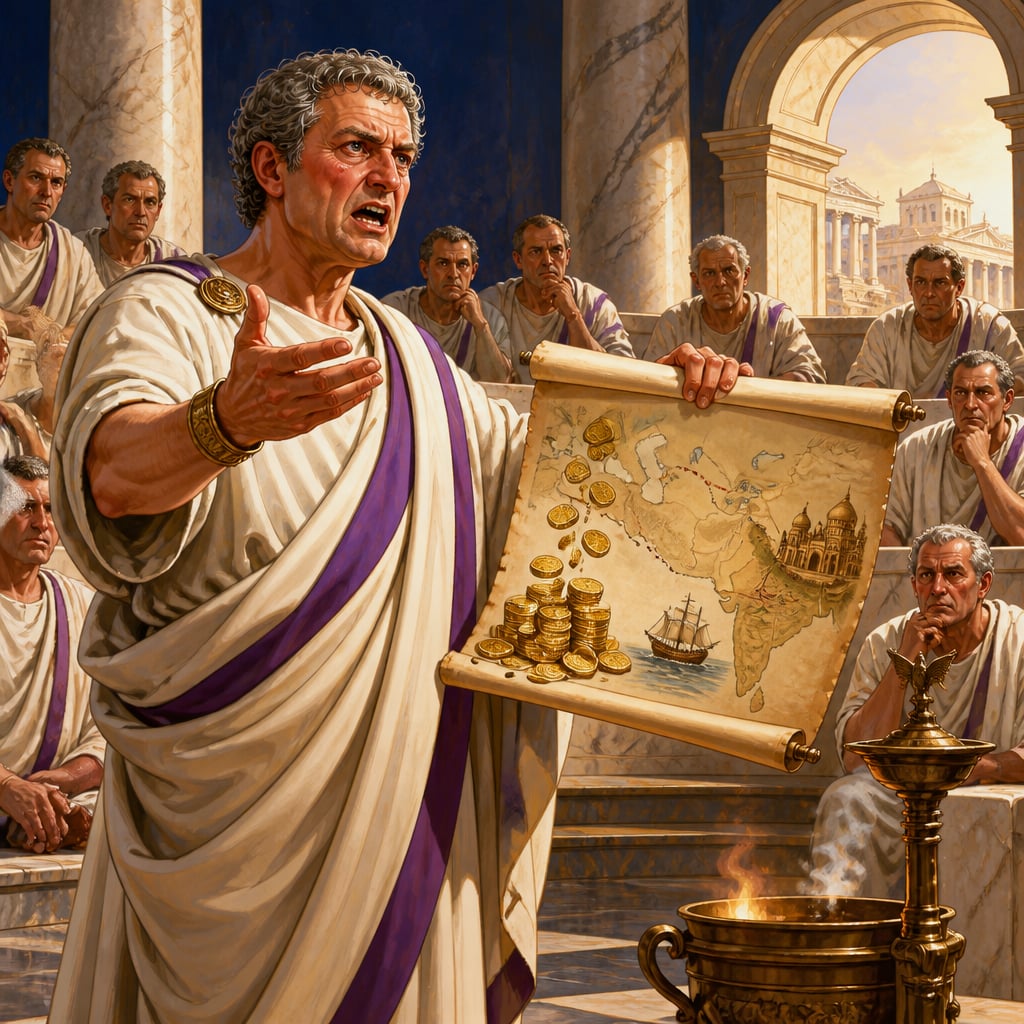
In 22 CE, the Roman Senator Gaius Petronius stood before the Senate in Rome, his face flushed with indignation. "Our Empire bleeds gold," he thundered. "Each year, 100 million sesterces flow eastward, to India, never to return." His fellow senators nodded grimly. They knew the problem well. Roman women demanded Indian silks. Roman kitchens required Indian pepper. Roman temples burned Indian incense. And India, that distant land beyond Persia, would accept nothing in return except Roman gold and silver.
This wasn't merely a Roman problem. The Silk Road, that legendary network of trade routes spanning 6,400 kilometers from China to the Mediterranean, had a secret that historians often overlook: India wasn't just a waypoint on this road. India was its beating heart, the ultimate destination for much of the world's gold, and the source of goods that made the entire network profitable.
The Geography of Desire
Why did ancient India command such power over global trade? The answer lies in what economists call comparative advantage, India could produce things no one else could, or no one else could match in quality.
Consider the humble pepper vine (Piper nigrum), native to the Malabar Coast. Romans called it "black gold." A single kilogram of pepper in Rome cost more than a soldier's monthly salary. The pepper plant refused to grow outside its native Kerala hills, no matter how desperately Mediterranean gardeners tried. India held a natural monopoly.
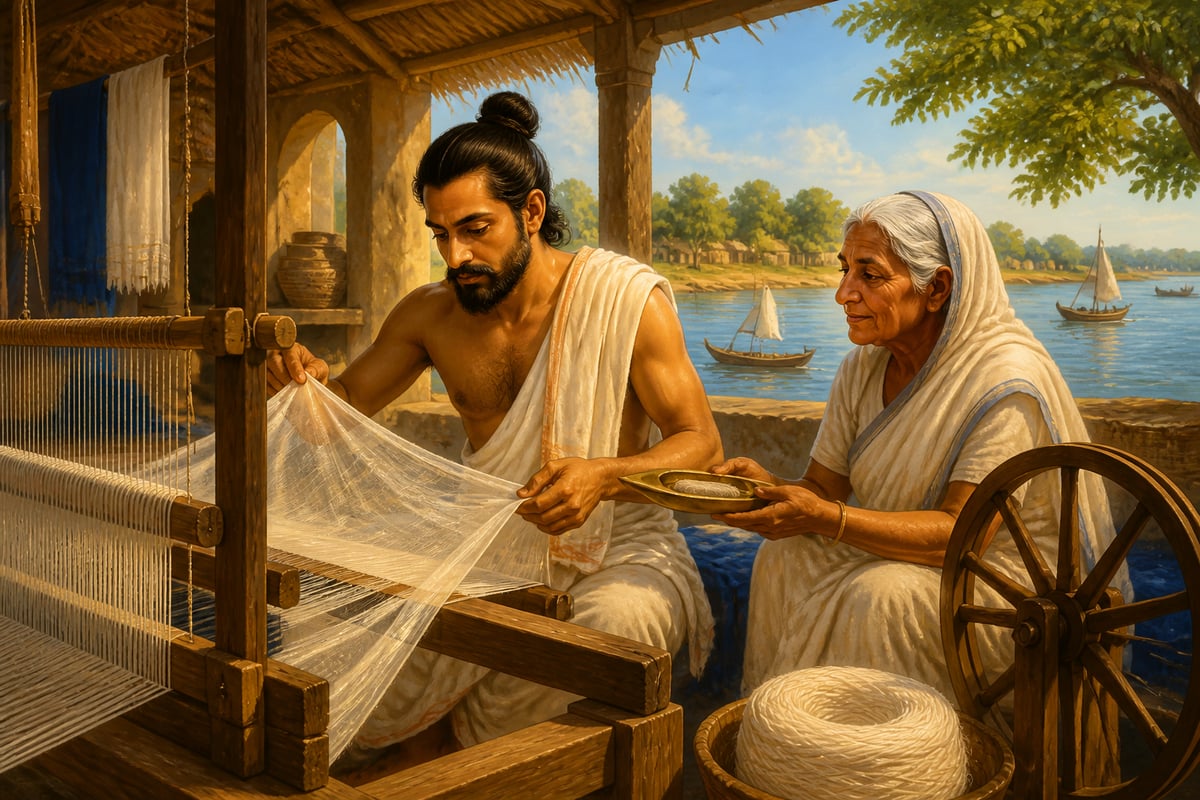
Or consider muslin cloth from Bengal, so fine that Romans called it textilis ventus, "woven wind." Greek writers described how an entire sari could pass through a finger ring. European weavers couldn't replicate it for another 1,800 years.
And then there was Wootz steel, the legendary ukku that Arab traders called Damascus steel. Forged in crucibles across South India, this steel could hold an edge sharper than anything the West could produce.
"सर्वेषां व्यापाराणां स्रोतः भारतं भवति।" "India is the source of all trades."
This ancient Sanskrit saying reflected a truth that commerce proved daily.
The Reshmi Marga Connection
The Sanskrit term Reshmi Marga (रेश्मी मार्ग), literally "Silk Road", captures India's unique position. While the Chinese produced raw silk, Indian craftsmen developed techniques for dyeing, weaving, and embroidering it that elevated the fabric into art. Indian indigo dyed silk into deep blues that Chinese techniques couldn't achieve. Indian artisans added gold thread embroidery that transformed plain cloth into royal garments.
The typical journey of silk illustrates this transformation: Raw silk left China, traveled through Central Asian kingdoms, arrived at Indian cities like Taxila (Takshashila) or Mathura, where it was processed, dyed, and worked into finished luxury goods. These enhanced products then traveled westward to Rome or southward through Indian ports.
India was less a stopping point than a value-adding center, the world's first manufacturing hub.
The Kushan Connection
The Kushan Empire (30-375 CE) demonstrated India's central role in Silk Road economics. Under Kanishka I, the Kushans controlled the critical junction where multiple Silk Road branches converged in what is now Afghanistan and northern India.

Kanishka's coins tell the story, they featured Greek script, Persian religious symbols, and Indian iconography. This wasn't confusion; it was commercial genius. The coins were designed for a multicultural trade network spanning three continents.
The Kushans understood what modern economists call network effects: by positioning their empire at the crossroads, they became indispensable. Every caravan passing from China to Rome, every shipment of Indian spices heading to Persian markets, all had to pass through Kushan territory, paying Kushan taxes, using Kushan infrastructure.
Following the Gold
Archaeological evidence proves what ancient writers complained about. Hoards of Roman gold coins, aurei bearing the faces of Augustus, Tiberius, and Nero, have been discovered across South India. The largest find, at Coimbatore in Tamil Nadu, contained over 9,000 Roman gold coins. At Karur, archaeologists found Roman coins alongside gems clearly destined for Mediterranean markets.
The trade imbalance was so severe that the Roman Emperor Vespasian (69-79 CE) attempted to ban Indian luxuries. He failed. Pliny the Elder estimated that Rome lost 50 million sesterces annually to India alone, roughly equivalent to $500 million in today's terms, year after year.
The Dharmic Framework of Trade
Indian economic success on the Silk Road wasn't merely about natural resources. The Arthashastra provided a sophisticated framework for trade governance that made Indian markets trustworthy.
"वाणिज्यं परमं धर्मं पुरुषस्य विशेषतः।" "Commerce is the highest dharma, especially for society."
Kautilya's text established clear rules: standard weights and measures, regulated customs duties (shulka), merchant guild (shreni) protections, and dispute resolution mechanisms. Foreign traders could trust Indian markets because the rules were transparent and enforced.
Modern Resonance: The IMEC Vision
Today, India is once again positioning itself at the heart of transcontinental trade. The India-Middle East-Europe Economic Corridor (IMEC), announced in 2023, represents a modern Reshmi Marga. The corridor will connect India to Europe via UAE, Saudi Arabia, Jordan, and Israel, deliberately bypassing the Suez Canal chokepoint.
Sanjeev Sanyal, India's Economic Advisor, explicitly draws these parallels: "India was not a passive participant in ancient globalization. We were the engine. IMEC represents India reclaiming that historic role."
Your Turn
The Roman Senator Petronius saw Indian trade dominance as a problem, Rome's wealth flowing eastward to a land that needed nothing Rome could make. The same dynamic challenged Chinese emperors and Persian shahs.
Consider what creates lasting economic advantage: not just natural resources, but the ability to transform them, the institutions that make trade reliable, and the strategic positioning that makes you indispensable.
What resources do you have that others want? How can you add value rather than simply pass things along? How can you position yourself as indispensable in your own networks?
Comparative advantage and natural monopoly, producing goods that others cannot replicate creates sustained economic advantage.
David Ricardo's 1817 theory of comparative advantage explained why trade benefits all parties. But these theories assumed replicable production; India's advantage came from inimitable capabilities.
Indian trade success combined natural factors with accumulated knowledge and institutional frameworks, creating barriers to competition that lasted millennia.
Roman records show 100 million sesterces annually flowing to India, roughly $500 million in modern terms, because Romans could not replicate what they desperately wanted.
Transaction cost economics, reliable institutions reduce the costs of doing business, attracting more commerce.
Douglass North's Nobel Prize-winning work on institutions arrived at similar conclusions in the 1990s: economic growth depends on institutions that reduce transaction costs.
Verses
वाणिज्यं परमं धर्मं पुरुषस्य विशेषतः।
vāṇijyaṃ paramaṃ dharmaṃ puruṣasya viśeṣataḥ |
Commerce is the highest dharma, especially for society.
The dharmic framework transformed trade from zero-sum competition into positive-sum cooperation. When commerce is dharma, cheating a customer becomes not just bad business but sin.
Arthashastra, Book 2, Chapter 16 (R.P. Kangle)
वणिक्पथेषु शुल्कं गृह्णीयात् राजा धर्मतः।
vaṇik-patheṣu śulkaṃ gṛhṇīyāt rājā dharmataḥ |
The king should collect customs duty on merchant roads according to dharma.
Predictable, fair taxation encouraged trade by reducing risk. India's reputation for fair shulka attracted foreign traders throughout antiquity.
Manusmriti, Chapter 9, Verse 331 (Patrick Olivelle)
Key figures
Kanishka I
Emperor of the Kushan Empire who controlled the crucial junction where Silk Road branches converged. · 127-150 CE (estimated)
Sanjeev Sanyal
Indian economist and Principal Economic Advisor to the Government of India. Author of 'The Ocean of Churn' and 'Land of the Seven Rivers.' · Contemporary (b. 1971)
Pliny the Elder
Roman author, naturalist, and naval commander. Author of 'Naturalis Historia' (Natural History), an encyclopedic work documenting Roman knowledge of the world. · 23-79 CE
Case studies
IMEC: The Modern Reshmi Marga
In September 2023, at the G20 Summit in New Delhi, Prime Minister Narendra Modi, US President Joe Biden, and leaders from the UAE, Saudi Arabia, EU, France, Germany, and Italy announced the India-Middle East-Europe Economic Corridor (IMEC). This $20 billion infrastructure project would connect India to Europe via rail and shipping through the Arabian Peninsula, deliberately bypassing the Suez Canal and offering an alternative to China's Belt and Road Initiative. The corridor comprises two segments: an eastern corridor connecting India to the Arabian Gulf and a northern corridor connecting the Gulf to Europe. It would include railways, ship-to-rail transit, electricity cables, hydrogen pipelines, and high-speed data cables. The route would reduce shipping time between India and Europe by 40% compared to the Suez Canal route, from 30-35 days to approximately 20 days.
The ancient Silk Road succeeded because it served multiple stakeholders: producers in India, intermediaries in Central Asia, and consumers in Rome all benefited. IMEC follows this dharmic principle of shared prosperity. Unlike purely extractive colonial trade routes, IMEC positions India as a value-adding partner, not a resource colony. Conventional Western strategy might view this as zero-sum competition with China's BRI. The dharmic lens sees it differently: multiple routes create redundancy and choice. As the Arthashastra teaches, good trade infrastructure benefits all participants, when commerce flows freely, prosperity follows naturally.
While still in development, IMEC has already shifted global trade calculations. Saudi Arabia's $5 billion commitment and UAE's logistics investments signal serious intent. India's pharma exports, electronics manufacturing, and agricultural products would gain faster European access. The corridor's energy component, green hydrogen pipelines, positions India in the clean energy supply chain. More significantly, IMEC demonstrates India's transition from route-taker to route-maker. For the first time since colonial disruption, India is designing trade infrastructure rather than using routes others created.
Strategic positioning in trade networks creates value that pure production cannot. The Kushans prospered by controlling where routes converged; modern India is recreating this advantage through IMEC, proving that ancient trade wisdom scales to the 21st century.
IMEC's multimodal design (rail, port, digital) reflects how modern logistics networks combine physical and digital infrastructure, much as Silk Road trade combined camel caravans, warehouses, and multilingual commercial protocols into one integrated system.
IMEC would reduce India-Europe shipping costs by an estimated 30% and cut transit time from 30+ days to approximately 20 days, a competitive advantage worth billions annually to Indian exporters.
Kanishka's Coins: Engineering Trust Across Civilizations
When Kanishka I ascended the Kushan throne around 127 CE, he inherited an empire sprawling across four civilizations: Greek Bactria, Persian territories, Central Asian steppes, and Indian subcontinent. His merchants needed to trade with Romans who read Latin, Chinese who used liang weights, Persians who worshipped Ahura Mazda, and Indians who followed Hindu and Buddhist traditions. Kanishka faced an impossible problem: how do you create a currency that strangers across 4,000 kilometers will trust? His solution was revolutionary. He minted coins in three scripts, Greek on the obverse, Brahmi and Kharosthi on the reverse, and featured deities from every tradition his merchants might encounter: Buddha, Shiva, Mithra, Nana, Helios. A Roman merchant in Taxila could recognize Greek letters; a Gandharan Buddhist could see the Buddha image; a Persian trader could identify Mithra.
Conventional monetary policy focuses on standardization, one currency, one design, universal acceptance. Kanishka inverted this logic. He created 'designed diversity', a currency that looked different to different cultures but maintained absolute consistency in weight and gold content. This reflects a dharmic principle: unity through diversity rather than uniformity. The Arthashastra teaches that effective governance accommodates local customs while maintaining core standards. Kanishka applied this to currency: the gold content never varied (98% pure, among the finest in the ancient world), but the cultural packaging adapted to each audience.
Kushan coins became the most trusted currency on the Silk Road for over two centuries. Archaeological finds show Kushan gold coins circulating from Rome to China, a geographic range no other ancient currency achieved. The coins' gold content was so reliable that they were often melted down and reminted by other kingdoms, yet Kushan originals commanded premiums in markets thousands of kilometers from Peshawar. Kanishka's innovation outlasted his empire. When the Guptas rose to power, they initially imitated Kushan coin designs, the highest form of monetary flattery. The principle of 'engineered trust' through consistent standards and cultural adaptability influenced Indian coinage for the next thousand years.
Trust in trade comes from reliable standards, not cultural uniformity. Kanishka proved that you can speak many languages while maintaining one standard, a principle modern multinationals still struggle to implement. His coins were early 'glocalization': global quality with local presentation.
Kanishka's multilingual, standardized coinage anticipated modern challenges in global payment interoperability. Today's push for cross-border payment standards through UPI, SWIFT alternatives, and digital currencies solves the same fundamental problem: enabling trust between strangers who use different systems.
Kanishka's gold coins maintained 98% purity, higher than contemporary Roman aurei (97%) and among the purest in the ancient world. This consistency, across coins minted in multiple cities over decades, demonstrates sophisticated metallurgical and administrative systems.
Historical context
1st century BCE - 4th century CE
This period saw India command perhaps 25-30% of world GDP. The Kushan, Satavahana, and early Gupta empires maintained sophisticated trade infrastructure.
While Rome consumed, India produced and accumulated. Chinese Han Dynasty similarly ran trade deficits with India.
Archaeological finds include over 6,000 Roman gold coins in Tamil Nadu alone, physical evidence of Rome's 'drain of gold' to India.
Understanding India's historical role as a trade superpower provides context for modern initiatives like IMEC.
Living traditions
- Pharmaceutical Manufacturing Excellence: India's pharmaceutical industry produces 60% of global vaccines and 20% of generic medicines, echoing the ancient pattern where India dominated production of goods others couldn't replicate.
- IT Services Export Model: Indian IT services export knowledge-intensive work globally, mirroring how ancient India exported processed goods (silk, steel) rather than raw materials.
- Taxila (Takshashila) Ruins: UNESCO World Heritage Site preserving multiple cities spanning 1,000+ years of Silk Road trade.
- National Museum, New Delhi: Houses extensive collections of Kushan-era artifacts, coins, and trade goods.
- Sanchi Stupa Complex: This Buddhist complex flourished as a major pilgrimage and learning center along ancient trade routes. Merchant donations funded its construction, with inscriptions recording gifts from traders across the subcontinent.
- Dharmarajika Stupa, Taxila: One of the most sacred Buddhist sites on the Silk Road, believed to contain relics of Buddha. Taxila was both a spiritual center and commercial hub where traders sought blessings and exchanged goods.
Reflection
- Ancient India prospered by creating goods that no one else could replicate, pepper, muslin, wootz steel. What 'irreplaceable' capabilities does India (or your own organization) possess today? Are we developing new monopolies in knowledge and manufacturing?
- The Kushan Empire prospered by positioning itself at trade route junctions. Where are the 'junctions' in your own professional networks? What specific actions could position you more centrally?