Dharma-Vanikya: Exchange of Goods, Ideas, and Religion
When Trade Carried More Than Merchandise
Discover how the Silk Road became a highway for ideas, carrying Buddhism, Hindu philosophy, art forms, and scientific knowledge alongside silk and spices.
The Merchant Who Became a Monk
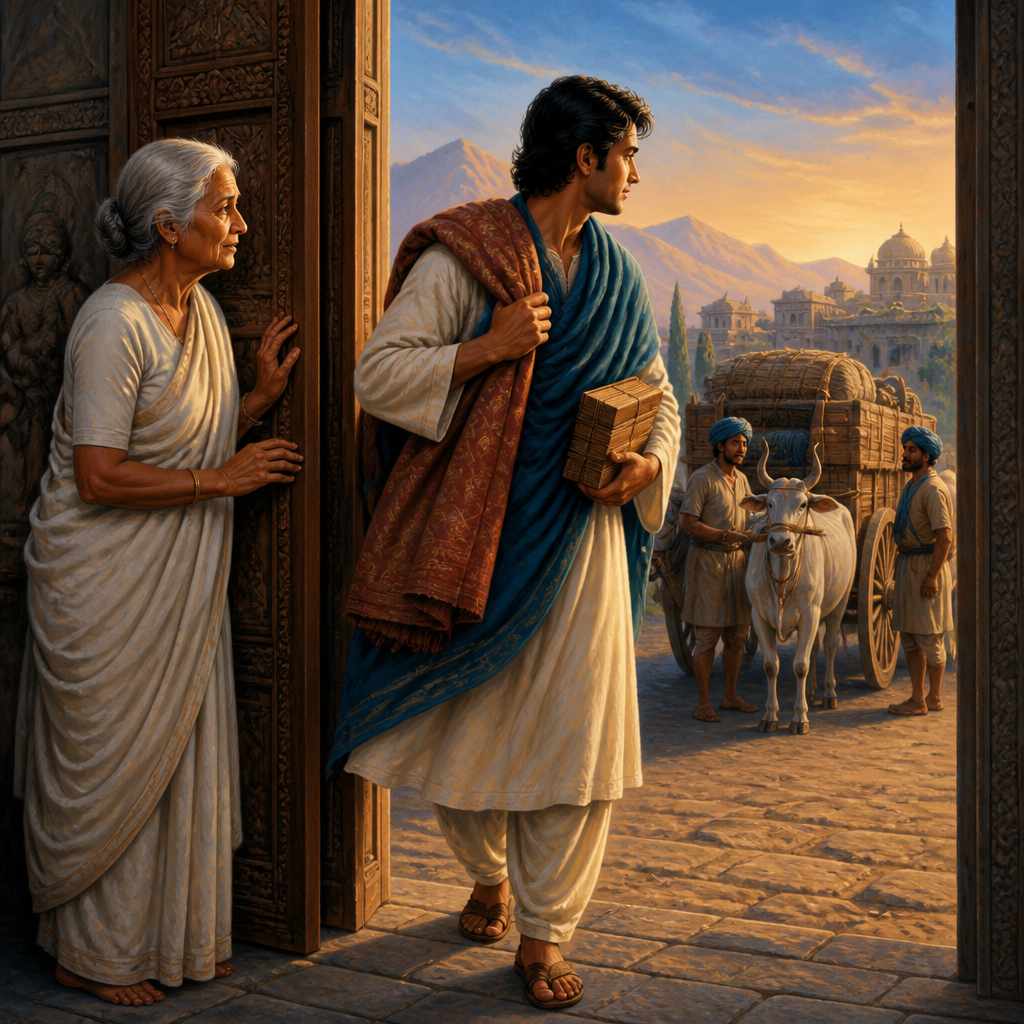
In the 1st century CE, a merchant named Lokaksema left his home in the Kushan Empire for China. He traveled the Silk Road not carrying silk or spices, but something far more valuable: Buddhist scriptures. Arriving in Luoyang, the Chinese capital, he spent forty years translating sutras into Chinese, becoming one of the first to bring Indian dharma to the Far East.
Lokaksema wasn't unusual. Merchants routinely carried ideas alongside merchandise. The same caravans that transported Indian pepper to Rome also carried Indian mathematics. The ships that brought Chinese silk to Indian ports also brought Chinese pilgrims seeking Buddhist wisdom.
The Silk Road was never just about commerce. It was history's greatest channel for the exchange of ideas, and India was the intellectual superpower at its center.
The Sacred and the Commercial
Why did trade routes become highways for religion and philosophy? The answer lies in the nature of long-distance commerce itself.
Merchants needed moral frameworks. Trading across cultures required common ethical ground. When a Sogdian merchant dealt with an Indian counterpart, they needed shared expectations about honesty, contracts, and fair dealing. Religious communities provided these frameworks, Buddhist sanghas, Hindu merchant castes, and later Islamic trade networks all offered moral infrastructure.
Caravanserais became monasteries. Rest stops along trade routes naturally became centers for religious activity. Monks provided education, literacy, and dispute resolution, services merchants valued. Merchants, in turn, funded monasteries. The symbiosis was complete.
Ideas were cargo. A manuscript weighed nothing compared to a bolt of silk, but could be sold for substantial sums. Scholars, monks, and astrologers traveled with caravans, offering their expertise at each stop. Knowledge was tradeable goods.
"धर्मो रक्षति रक्षितः।" "Dharma protects those who protect it."
This ancient saying took on commercial meaning along the Silk Road. Merchants who upheld dharma built reputations that preceded them; reputations opened doors and closed deals.
Buddhism: India's Greatest Export
If India's material exports included pepper, cotton, and steel, its greatest intellectual export was Buddhism. From its birthplace in the Gangetic plain, Buddhism spread along trade routes until it transformed East Asia.
The pattern was consistent: merchants first, monks second, art and philosophy third.
Central Asia received Buddhism through Kushan merchants trading into Bactria and Sogdiana. By the 2nd century CE, Buddhism was the dominant religion from modern Afghanistan to Xinjiang.
China encountered Buddhism through Silk Road traders. The Han Dynasty (206 BCE - 220 CE) initially viewed it as a foreign curiosity. By the Tang Dynasty (618-907 CE), it had become central to Chinese civilization.
Southeast Asia received Buddhism and Hinduism through maritime trade. Merchants from Tamil Nadu and Bengal established communities in Java, Sumatra, and mainland Southeast Asia. Temples like Borobudur (Indonesia) and Angkor Wat (Cambodia) testify to this cultural transfer.
The Kumarajiva Story

Kumarajiva (344-413 CE) embodies the intellectual exchange the Silk Road enabled. Born in Kucha (modern Xinjiang) to an Indian father and a local princess, he studied in Kashmir, mastered Sanskrit scriptures, and was eventually captured by Chinese forces.
In China, Kumarajiva led a massive translation project, rendering crucial Buddhist texts into Chinese. His translations remain authoritative today, 1,600 years later. The Heart Sutra that millions recite uses Kumarajiva's Chinese rendering.
Kumarajiva's journey traces the Silk Road's intellectual geography: Indian knowledge systems, Central Asian synthesis, Chinese systematization. Trade routes carried not just texts but the scholars who could interpret them.
The Reverse Flow: What India Received
The exchange was bidirectional. While India exported philosophy, it imported:
Astronomy and Mathematics: Indian astronomers like Aryabhata and Brahmagupta incorporated Greek astronomical models that reached India through Central Asian trade routes. The concept of the zodiac, Greek planetary models, and certain mathematical techniques enriched Indian astronomy.
Artistic Techniques: Gandharan art, the fusion of Greek and Indian styles, developed in the Kushan trading cities. Greek sculptural techniques transformed Buddha iconography. This hybrid style then traveled eastward along the Silk Road.
Medicinal Plants and Techniques: Chinese medicinal plants reached Indian pharmacopoeias. Persian medical techniques influenced Unani medicine, which developed alongside Ayurveda in medieval India.
Writing Systems: The Kharosthi script used in northwestern India derived from Aramaic, which arrived through Persian-controlled trade routes.
The Hindu Expansion
Buddhism wasn't India's only philosophical export. Hindu traditions spread through the same commercial channels:
Southeast Asia received Sanskrit learning, Hindu epics (Ramayana, Mahabharata), and Brahmanical ritual practices. The Khmer Empire adopted Hindu kingship models; Indonesian islands embraced Hindu-Buddhist synthesis; Thai classical dance still performs the Ramakien (Thai Ramayana).
Scientific Knowledge: Indian mathematics, including the decimal system, zero, and algebraic techniques, traveled westward. Arab scholars encountered Indian mathematics through trade contacts; they then transmitted it to Europe. The "Arabic numerals" Europeans adopted were actually Indian.
Ayurveda and Yoga: Medical and spiritual practices traveled with merchants and monks. Yoga traditions reached Central Asia; Ayurvedic concepts influenced Tibetan medicine.
The Soft Power of Commerce
India's cultural influence worked because it was useful. This wasn't imperial imposition, it was voluntary adoption because Indian ideas solved problems.
Buddhist ethics provided frameworks for merchant communities that needed trust across cultural boundaries.
Sanskrit literacy enabled record-keeping and contract enforcement in societies developing administrative complexity.
Indian numerals made calculation vastly easier than Roman numerals or Chinese counting rods.
Ayurvedic medicine offered treatments for ailments local traditions couldn't address.
Modern strategic thinkers call this "soft power", influence through attraction rather than coercion. Ancient India practiced it masterfully, though the term didn't exist.
Modern Echoes: Yoga and Bollywood
India's cultural exports continue today, traveling digital routes rather than caravan trails:
Yoga has become a global practice. Over 300 million people worldwide practice yoga, more than the population of the United States. What began as esoteric spiritual discipline now operates as health practice, business, and cultural identifier.
Bollywood films reach audiences across Africa, Central Asia, and the Middle East, regions once connected to India through Silk Road trade. The entertainment follows ancient commercial patterns.
IT and Education: Indian software engineers, doctors, and academics in Silicon Valley, Dubai, and Singapore continue patterns of intellectual export established millennia ago.

Prime Minister Modi's promotion of International Yoga Day (June 21) explicitly invokes this heritage, positioning India as a civilizational soft power.
Your Turn
Lokaksema left his merchant career to become a translator, but he used the same trade routes and the same network-building skills. His dharma traveled the infrastructure that commerce had built.
Ideas need infrastructure to spread. They need people willing to carry them. They need audiences prepared to receive them. The Silk Road provided all three, and Indian ideas were compelling enough to transform civilizations.
What ideas are you carrying? Through what networks? Commerce and culture remain intertwined. The modern knowledge economy echoes ancient patterns: value travels through networks, and networks reward those who have value to share.
Knowledge diffusion through network effects, ideas spread faster through established channels than through virgin territory.
Everett Rogers' diffusion of innovations theory shows how ideas spread through social networks. Malcolm Gladwell's 'The Tipping Point' popularized similar concepts.
India's position at the center of Silk Road networks gave its ideas disproportionate reach. Buddhism reached China, Japan, and Southeast Asia because trade routes already connected these regions to India.
Buddhism spread 6,000 km from India to Japan in roughly 600 years, averaging 10 km per year along established trade routes. Without those routes, such transmission would have been impossible.
Value proposition drives adoption, ideas that solve problems spread faster than those that merely seem interesting.
Product-market fit in startup terminology captures the same insight: solutions that address real needs find users; clever ideas without practical application don't.
Verses
सब्बपापस्स अकरणं कुसलस्स उपसम्पदा।
sabba-pāpassa akaraṇaṃ kusalassa upasampadā |
The non-doing of all evil, the accomplishment of good.
Ethical frameworks reduce transaction costs. When parties share moral understanding, they need fewer contracts and less enforcement. Buddhism's portable ethics enabled trust across vast distances.
Dhammapada, Verse 183 (Thanissaro Bhikkhu)
विद्या ददाति विनयं विनयाद् याति पात्रताम्।
vidyā dadāti vinayaṃ vinayād yāti pātratām |
Knowledge gives humility; from humility comes worthiness.
Intellectual humility enables learning from trade contacts. Cultures that believe they have nothing to learn miss opportunities for improvement. India's openness to foreign techniques enriched its own traditions.
Traditional Sanskrit saying, Various (Various)
Key figures
Kumarajiva
Kuchean Buddhist monk and translator who rendered crucial Indian scriptures into Chinese, enabling Buddhism's transformation of Chinese civilization. · 344-413 CE
Narendra Modi
Prime Minister of India who has actively promoted India's soft power through initiatives like International Yoga Day and cultural diplomacy. · Contemporary (b. 1950)
Xuanzang (Hiuen Tsang)
Chinese Buddhist monk who made a legendary 17-year pilgrimage to India (629-645 CE) to study Buddhist scriptures at their source. His journey traversed the entire Silk Road, and his detailed travelogue preserved invaluable records of 7th-century India. · 602-664 CE
Case studies
ISKCON: Krishna Consciousness on a Global Scale
In 1965, a 69-year-old Indian swami named A.C. Bhaktivedanta Swami Prabhupada arrived in New York City with forty rupees, a trunk of books, and a mission to spread Krishna consciousness to the West. He had no organizational backing, no wealthy patrons, and no marketing budget. Within eleven years, before his death in 1977, Prabhupada had established the International Society for Krishna Consciousness (ISKCON) with 108 temples on six continents. Today, ISKCON operates over 800 temples, eco-farms, and centers worldwide. The Bhagavad Gita As It Is, Prabhupada's translation, has sold over 50 million copies in 80 languages. ISKCON's spread followed patterns strikingly similar to ancient Buddhism's transmission: an initial message that resonated with seekers, creation of monastic communities (sanghas), translation of core texts, and gradual institutionalization.
Prabhupada understood what ancient Buddhist missionaries had known: ideas spread through personal transmission, community building, and practical application. He didn't just preach; he created institutions, temples where seekers could practice, farms where devotees could live sustainably, publishing houses that produced translations. The dharmic approach to cultural transmission isn't top-down imposition but invitation and demonstration. ISKCON attracted converts not through marketing but through prasadam (consecrated food) distribution, kirtan (devotional singing) in public spaces, and visible examples of alternative lifestyle. This mirrors how Buddhist monks attracted converts through meditation instruction, ethical teaching, and community services. Critically, ISKCON succeeded because it offered something useful: a coherent worldview, a supportive community, and practices that addressed spiritual needs that materialist culture couldn't satisfy.
ISKCON has become one of the world's fastest-growing religious movements. The Radha Krishna Temple in Vrindavan attracts millions annually. ISKCON's Food for Life program distributes over 2 million meals daily globally, making it the world's largest vegetarian food relief organization. More significantly, ISKCON normalized Hindu philosophy in the West. Concepts like karma, yoga, and vegetarianism, once exotic, are now mainstream. George Harrison's funding of the London temple and his song 'My Sweet Lord' brought Krishna consciousness to millions who never entered a temple. ISKCON demonstrates that India's cultural export capability remains potent. The same dynamics that spread Buddhism across Asia in ancient times, personal transmission, community building, textual preservation, continue operating today.
Ideas spread when they solve problems people actually have. Prabhupada succeeded not because he was a brilliant marketer but because he offered answers to genuine spiritual hunger. The lesson for cultural transmission: authenticity and utility matter more than promotion. Build communities, create practices, translate texts, the rest follows.
ISKCON's global expansion follows the same pattern as modern franchise systems: replicate a proven model, localize the experience, maintain core standards. Starbucks and McDonald's build 'community spaces' worldwide using the same logic that Prabhupada used to build temples.
ISKCON's Food for Life serves 2+ million meals daily in over 60 countries. The Akshaya Patra Foundation alone, inspired by ISKCON, feeds 1.8 million Indian schoolchildren daily, making it the world's largest school meal program run by an NGO.
Borobudur: When Trade Built the World's Largest Buddhist Monument
In 8th century Java, the Sailendra dynasty ruled a maritime kingdom at the heart of Southeast Asian trade routes. Ships carrying spices from the Moluccas, silk from China, and cotton from India all passed through the Strait of Malacca. The Sailendras controlled this chokepoint, and they invested their profits in something extraordinary. Borobudur, completed around 825 CE, is the world's largest Buddhist monument: six square platforms topped by three circular ones, decorated with 2,672 relief panels and 504 Buddha statues. The structure contains more stone than the Great Pyramid of Egypt. It wasn't built by Indian rulers or missionaries, it was built by Javanese kings who had adopted Indian religion through centuries of maritime trade. Borobudur's construction required mobilizing thousands of workers, importing skilled artisans, and developing sophisticated engineering. The resources came from trade; the vision came from India; the execution was entirely local.
Borobudur demonstrates how dharmic ideas spread through attraction rather than conquest. No Indian army ever invaded Java. No political power imposed Buddhism. Maritime merchants brought the teachings; Javanese rulers adopted them because they found them valuable. The temple's design follows Indian Buddhist cosmology: a three-dimensional mandala representing the path from worldly attachment to enlightenment. Pilgrims walk clockwise around each level, ascending from the realm of desire through the realm of forms to the realm of formlessness. The architecture itself teaches, an innovation that combined Indian philosophical content with local artistic tradition. Critically, Borobudur wasn't imitation. Javanese artists developed their own style, depicting local flora, fauna, and daily life alongside Buddhist narratives. This is healthy cultural exchange: the core teaching remains, but the expression becomes indigenous.
Borobudur served as a pilgrimage site for centuries, drawing Buddhist devotees from across Southeast Asia. When the Sailendra dynasty declined and Java turned to Islam, the temple was abandoned and slowly buried under volcanic ash and jungle. Rediscovered in the 19th century and restored with UNESCO assistance in the 20th, Borobudur today attracts over 4 million visitors annually, making it Indonesia's most visited tourist site. The monument generates significant revenue for local communities and has become a symbol of Indonesia's multicultural heritage. Borobudur proves that cultural transmission can be permanent even when political circumstances change. Buddhism declined in Java, but the monument endures, a stone record of how Indian ideas once transformed Southeast Asian civilization.
The most lasting cultural exports are those that local communities make their own. Indian Buddhism didn't simply transplant to Java, it was adopted, adapted, and expressed in distinctly Javanese ways. The lesson: successful cultural transmission empowers local creativity rather than demanding conformity. What endures is what becomes genuinely indigenous.
Borobudur's construction, funded by maritime trade profits, parallels how modern port cities invest commercial wealth into cultural landmarks. Dubai's museums, Singapore's Gardens by the Bay, and Abu Dhabi's Louvre all follow the same pattern: trade wealth crystallized into cultural prestige.
Borobudur contains 2,672 relief panels covering 2,500 square meters, the largest collection of Buddhist reliefs in the world. The temple was built with an estimated 2 million stone blocks, requiring a labor force of 10,000+ workers over several decades.
Historical context
1st century BCE - 10th century CE
India functioned as the intellectual heart of the Silk Road, exporting Buddhism, Hinduism, mathematics, and medicine while importing and synthesizing knowledge from Greece, Persia, and Central Asia.
Rome exported governance and engineering; China exported silk and administrative techniques; India's distinctive export was philosophy and religion, intellectual soft power.
Buddhism became the majority religion across Central Asia, China, Korea, Japan, and Southeast Asia, roughly 500 million people today. This is India's most enduring civilizational legacy.
Cultural influence outlasts political power. India's ancient empires are gone, but Indian ideas continue shaping world civilization.
Living traditions
- International Yoga Day Observance: Since 2015, June 21 has been celebrated globally as International Yoga Day, with millions participating worldwide - a modern institutionalization of India's ancient soft power.
- Indian Diaspora Knowledge Networks: Indian IT professionals, academics, and entrepreneurs carry expertise globally, echoing the ancient pattern of Indian scholars spreading knowledge along the Silk Road.
- Nalanda University Ruins: Remains of the ancient Buddhist university that attracted scholars from across Asia.
- Mogao Caves: Buddhist cave temples along the Silk Road with centuries of murals showing Indian artistic influence.
- Mahabodhi Temple, Bodh Gaya: The site of Buddha's enlightenment and one of the most sacred Buddhist pilgrimage sites. Pilgrims from across Asia traveled ancient trade routes to reach this spiritual destination, combining commerce with pilgrimage.
- Ajanta and Ellora Caves: Buddhist, Hindu, and Jain cave temples showcasing artistic styles that spread along trade routes. The caves were positioned on ancient trade paths connecting the Deccan to northern India.
Reflection
- Buddhism spread because it solved problems for merchant communities, providing ethical frameworks and trust networks. What problems could Indian philosophical traditions solve for today's globalized world?
- The Silk Road spread ideas through commercial networks. What 'trade routes' carry ideas in your professional field? How can you position yourself on those routes to both share and receive valuable knowledge?