Saraya: Caravanserais and Trade Protection
The Infrastructure That Made Long-Distance Trade Possible
Learn how ancient Indian kingdoms built and maintained the infrastructure, caravanserais, customs posts, guards, that protected merchants and enabled trade across thousands of miles.
A Night on the Uttarapatha
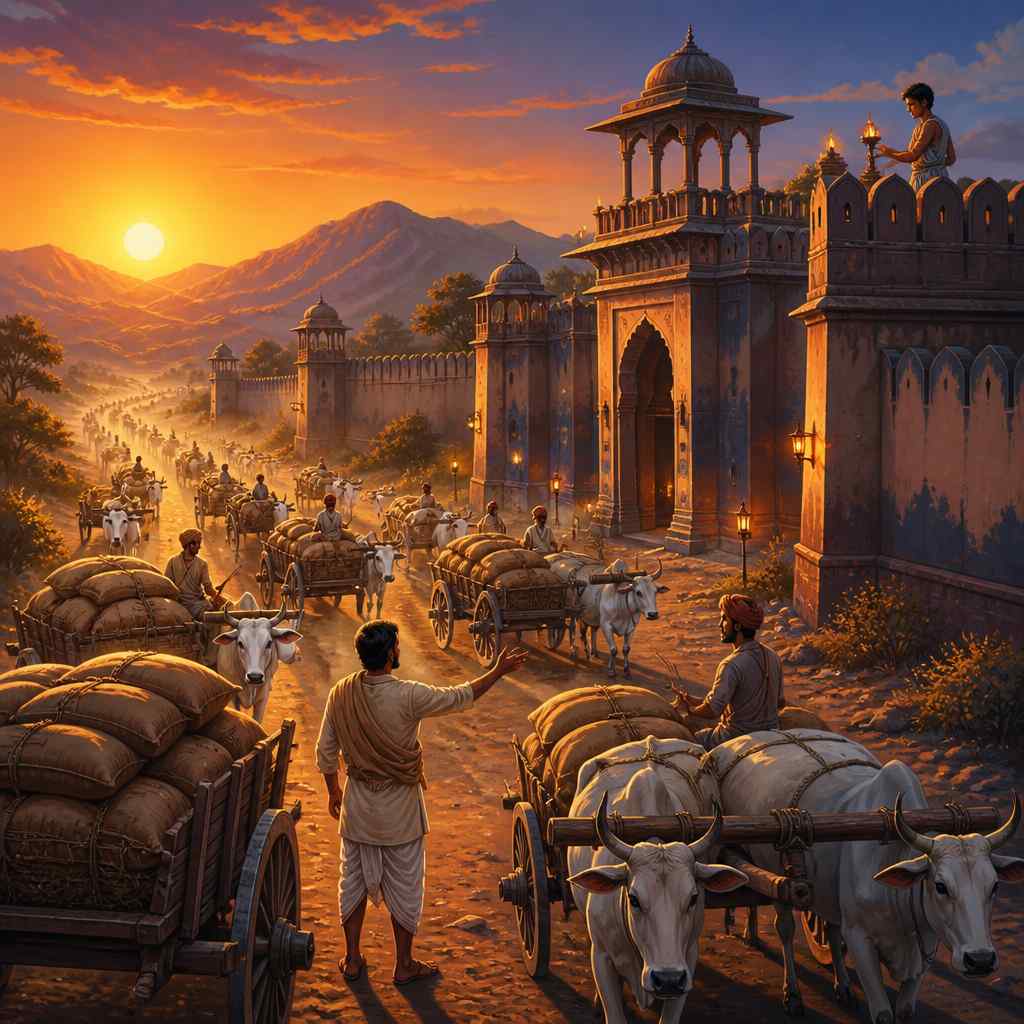
As the sun set behind the Aravalli hills, a caravan of forty bullock carts approached the saraya (rest house) at the junction near Mathura. The sarthavaha (caravan leader) breathed relief, another day survived without bandit attack, another night with walls between his goods and thieves.
Inside the saraya, the familiar routine unfolded: animals led to stables, goods stored in locked warehouses, merchants assigned rooms according to their status. A saulika (customs official) recorded the caravan's cargo; fees were paid; receipts issued. In the central courtyard, merchants from a dozen regions shared news: road conditions ahead, prices in distant markets, which officials could be trusted.
This scene repeated itself every night, across thousands of sarayas stretching from Pataliputra to Bactria. Without these institutions, the Silk Road couldn't have functioned.
The Economics of Trust Infrastructure
Long-distance trade faces a fundamental challenge: you're carrying valuable goods through territory where you're a stranger, vulnerable to theft, deception, and exploitation. Why would anyone take such risks?
The answer lies in trust infrastructure, the institutions, physical structures, and social systems that make strangers' transactions safe.
Physical Security: Walled compounds protected goods overnight. Guards deterred bandits. Fire-resistant construction protected against one of merchants' greatest fears.
Institutional Trust: Customs posts issued receipts proving legal passage. Disputes were resolved by officials with authority. Standardized weights and measures prevented cheating.
Social Networks: Merchant guilds (shrenis) vouched for their members. A guild's reputation preceded its members, opening doors across thousands of kilometers.
"विश्वासो वाणिज्यस्य मूलम्।" "Trust is the root of commerce."
This ancient saying captured what modern economists call "transaction cost theory": trade happens when the costs of trusting strangers are reduced to acceptable levels.
The Saraya System
The Sanskrit term saraya (सराय) referred to rest houses for travelers and traders. Under systematic state administration, particularly during the Mauryan, Kushan, and Gupta periods, these evolved into comprehensive trade-support institutions.
A typical saraya included:
Lodging quarters arranged by status and cargo type. Merchants with valuable goods got more secure rooms; ordinary travelers stayed in common halls.
Stables and fodder storage for draft animals, bullocks, camels, horses. Fresh animals could sometimes be hired or exchanged.
Warehouses with locks and guards where goods could be safely stored. Some offered refrigeration through underground cellars for perishable goods.
Markets where local producers could sell directly to passing merchants, and merchants could sell to local buyers.
Administrative offices where customs were collected, disputes resolved, and travel permits issued.
Food services providing meals for travelers, essential for long journeys where carrying provisions was impractical.
Religious facilities including temples, shrines, and later mosques, recognizing that travelers needed spiritual sustenance alongside physical.
Sher Shah's Grand Trunk Revival

Sher Shah Suri (r. 1538-1545), the Afghan ruler who briefly interrupted Mughal rule, understood that imperial power rested on trade infrastructure. In just seven years, he rebuilt the Grand Trunk Road (ancient Uttarapatha) with a systematic saraya network.
His specifications were precise:
- Sarayas spaced every kos (approximately 2 miles) on major routes
- Larger saraya-khanas at every 8 kos, with more comprehensive facilities
- Separate facilities for Hindus and Muslims (respecting dietary and ritual requirements)
- Trees planted for shade along the entire route
- Wells dug at regular intervals
A contemporary chronicler wrote: "From Bengal to the Indus, a woman could walk with gold on her head, and no one would touch her." This security wasn't accidental, it was engineered through infrastructure and enforcement.
The Arthashastra on Trade Protection
Kautilya's Arthashastra provides the theoretical foundation for trade protection as state responsibility:
Road Maintenance: "The king should construct roads for traffic... The roads should be cleared of obstacles, protected from harassment by courtiers, and made safe."
Criminal Justice: Banditry was treated as an attack on the state itself. Punishments were severe, including death for highway robbery, because the crime threatened the economic foundation of governance.
Customs Administration: The Arthashastra specifies rates (typically 5-20% depending on goods), procedures, and the responsibilities of officials. Corruption was harshly punished because it undermined the trust that trade required.
Merchant Protection: The state was responsible for compensating merchants robbed on royal highways. This created incentive for the state to maintain security, insurance backed by enforcement.
Shreni: The Guild System
Parallel to state infrastructure, merchant shrenis (guilds) provided private trust networks:
Reputation Systems: A guild vouched for its members. A merchant from the Mathura cloth-traders' shreni could present guild credentials in distant markets, inheriting the guild's reputation.
Dispute Resolution: Guilds adjudicated conflicts between members, often faster and more fairly than government courts. This private arbitration reduced transaction costs.
Insurance Functions: Guilds sometimes pooled resources to compensate members for losses, spreading risk across the community.
Quality Standards: Guilds maintained product standards. Goods bearing guild marks could be trusted; counterfeiting guild marks was severely punished.
Political Representation: Guilds lobbied rulers for favorable treatment, negotiated with other guilds, and represented commercial interests in governance.
The shreni system resembles modern chambers of commerce, trade associations, and professional licensing bodies, but operated two millennia earlier.
The Modern Parallel: Logistics and E-Commerce
Today's logistics infrastructure serves the same functions as ancient sarayas:
Warehousing: Amazon's fulfillment centers, like ancient warehouses, hold goods close to markets. Location matters now as then.
Tracking and Security: GPS tracking, CCTV, and digital records replace customs receipts and guard patrols, but serve identical purposes.
Trust Infrastructure: PayPal, credit card guarantees, and platform reviews create the trust that enables strangers to transact, the modern equivalent of guild reputation.
Last-Mile Delivery: The ancient challenge of getting goods from regional sarayas to final customers mirrors today's last-mile logistics challenges.
India's National Logistics Policy (2022) explicitly aims to reduce logistics costs from 13-14% of GDP to 8%, comparable to developed economies. Ancient administrators would recognize the goal: reduce transaction costs to enable more commerce.
Delhivery and the Modern Sarthavaha

Delhivery, one of India's largest logistics companies, represents the modern evolution of ancient sarthavaha functions:
- Managing movement of goods across vast distances
- Maintaining warehouses and sorting facilities (modern sarayas)
- Providing tracking and security (modern customs administration)
- Building trust infrastructure through delivery guarantees
Co-founder Sahil Barua has spoken about the parallels: "India has always been a trading nation. We're just using technology to solve the same problems our ancestors faced, how to move goods safely and efficiently across long distances."
Your Turn
The sarthavaha approaching the Mathura saraya faced challenges that persist today: How do you protect value in transit? How do you create trust between strangers? How do you build infrastructure that enables commerce?
The solutions have evolved, from walled compounds to blockchain tracking, from guild reputation to platform reviews, from customs officers to digital verification. But the underlying problems remain constant.
What trust infrastructure supports your work? What would happen if it disappeared? Understanding the systems that enable modern commerce helps you navigate them, and perhaps improve them.
Transaction cost economics, institutions that reduce the costs of trusting strangers enable more commerce.
Oliver Williamson's Nobel Prize-winning work on transaction costs explains why firms and markets exist. His insight: institutions that reduce trust costs expand economic activity.
Ancient India built elaborate trust infrastructure, guilds, sarayas, customs systems, that enabled commerce across thousands of kilometers between strangers of different languages and cultures.
The Roman Empire's gold outflow to India (50-100 million sesterces annually) depended on trust infrastructure that enabled safe transit across multiple kingdoms and cultures.
Public goods and positive externalities, protection creates value for all traders, not just the protected individual.
Adam Smith recognized that defense is the first duty of government. Modern economics shows that rule of law and property protection are prerequisites for development.
Verses
वणिजां रक्षणं राज्ञः परमं धर्मम्।
vaṇijāṃ rakṣaṇaṃ rājñaḥ paramaṃ dharmam |
The protection of merchants is the highest duty of the king.
States that protect commerce prosper; those that prey on it decline. This insight drove infrastructure investment from Mauryan to modern times.
Arthashastra, Book 2, Chapter 21 (R.P. Kangle)
विश्वासो वाणिज्यस्य मूलम्।
viśvāso vāṇijyasya mūlam |
Trust is the root of commerce.
Transaction costs increase with distrust. Every system that builds trust, reputation, guarantees, enforcement, reduces costs and increases trade volume.
Traditional saying, Various merchant traditions (Various)
Key figures
Sher Shah Suri
Afghan ruler who briefly interrupted Mughal rule and rebuilt the Grand Trunk Road with a systematic saraya network. · 1486-1545 CE
Sahil Barua
Co-founder and CEO of Delhivery, one of India's largest logistics companies, building modern trade infrastructure. · Contemporary (b. 1983)
Crassus
Roman general and statesman who became one of history's wealthiest individuals by creating Rome's first private fire brigade, essentially inventing the protection-as-business model. · 115-53 BCE
Case studies
Amazon Fulfillment: The Digital Saraya Network
In 2005, Amazon was primarily a website, a digital storefront connecting buyers to sellers. The company's logistics were unremarkable: third-party carriers moved packages, and delivery times were unpredictable. Jeff Bezos recognized that e-commerce's limitation wasn't the website but the infrastructure behind it. Between 2006 and 2024, Amazon invested over $100 billion in building the world's largest fulfillment network: 175+ fulfillment centers in North America alone, each averaging 1 million square feet. The company created its own delivery fleet (Amazon Logistics), its own air cargo operation (Amazon Air), and a network of delivery stations bringing packages within miles of customers. The result: Amazon can now deliver to 72% of the US population within 24 hours. Prime's two-day guarantee, revolutionary in 2005, has become standard. The company handles 65% of its own US deliveries, having built infrastructure that rivals FedEx and UPS combined.
Amazon's fulfillment network serves the same function as the ancient saraya system: enabling strangers to transact safely across vast distances. The parallels are striking: - Fulfillment centers are modern sarayas, warehouses where goods rest safely between origin and destination - Tracking systems replace customs receipts, digital proof of where goods are and when they'll arrive - Reviews and ratings create trust between strangers, the modern equivalent of guild reputation - Prime membership creates a community with privileged access, echoing how guild membership opened doors The dharmic principle at work is 'vishwas' (trust): Amazon's massive infrastructure investment exists primarily to create trust that enables commerce. A buyer trusts that goods will arrive as described; a seller trusts that payment will come. This trust, invisible yet essential, required billions in visible infrastructure.
Amazon's infrastructure investment transformed not just the company but global commerce. E-commerce grew from 6% of US retail in 2010 to over 15% by 2023, enabled largely by logistics infrastructure that made online shopping reliable. The company's fulfillment network became so valuable that Amazon now sells it as a service: Fulfillment by Amazon (FBA) allows small sellers to use Amazon's warehouses and delivery. This mirrors how ancient saraya networks served all merchants, not just royal caravans, infrastructure creates more value when widely accessible. Amazon's market capitalization exceeds $1.5 trillion, making it one of history's most valuable companies. But the value lies not in the website, competitors can copy that, but in the physical infrastructure that took two decades and $100+ billion to build. Like the saraya networks of old, logistics infrastructure creates durable competitive advantage.
Digital commerce requires physical infrastructure. Amazon succeeded not because of superior software but because Bezos understood what ancient merchants knew: trust requires tangible investment. The website is the storefront; the fulfillment network is the saraya system that makes commerce possible. Those who control the infrastructure control the commerce.
Amazon's fulfillment network confirms that e-commerce winners are ultimately logistics companies. Shopify, Alibaba, and Flipkart all learned the same lesson: digital storefronts are commoditized; physical infrastructure that guarantees delivery speed and reliability is the true competitive moat.
Amazon operates 175+ fulfillment centers in North America alone, with total global warehouse space exceeding 500 million square feet. The company employs over 750,000 people in its logistics operations, more than the population of many ancient trading cities.
The Venetian Fondaco: How a Warehouse Built an Empire
In medieval Venice, foreign merchants faced a dilemma: the city was Europe's gateway to Eastern goods, but Venetians were notoriously suspicious of outsiders. How could German, Turkish, or Arab traders operate in a city that viewed them as threats? The Venetian solution was the 'fondaco', a combination warehouse, living quarters, and controlled marketplace where foreign merchants were required to stay and conduct business. The most famous, the Fondaco dei Tedeschi (German Warehouse), was a grand building near the Rialto Bridge where all German merchants had to reside, store their goods, and sell only to Venetian intermediaries. The fondaco system was brilliant in its constraints: merchants couldn't roam the city freely, couldn't sell directly to consumers, and couldn't stay indefinitely. Yet within the fondaco, they had guaranteed security, standardized facilities, and assured access to Venetian buyers. The system created trust through limitation, foreigners were safe precisely because they were contained.
The fondaco system reversed the saraya model in revealing ways. Indian sarayas enabled merchant freedom, traders could come and go, sell to anyone, stay as long as business required. Venetian fondacos restricted freedom, but in exchange provided absolute security within those restrictions. This reflects different dharmic approaches: the Indian model trusted merchants and protected them as productive members of society ('vaṇijāṃ rakṣaṇaṃ rājñaḥ paramaṃ dharmam'). The Venetian model distrusted foreigners but recognized their economic value. Both created prosperity, but the Indian approach was more expansive, it welcomed merchants rather than merely tolerating them. The fondaco's deeper lesson: trust infrastructure can be built through either freedom or constraint. India chose freedom with protection; Venice chose constraint with guaranteed security. The Indian model scaled better, it could accommodate unlimited growth, while the fondaco model created bottlenecks that eventually contributed to Venice's decline.
The fondaco system made Venice medieval Europe's wealthiest city. The Fondaco dei Tedeschi alone handled commerce worth millions of ducats annually, spices, silk, and luxury goods flowing from East to West. Venetian intermediaries extracted substantial margins; the republic collected reliable customs revenue; foreign merchants accepted constraints in exchange for access. But the system contained the seeds of its decline. As Atlantic trade routes opened and other cities offered more welcoming terms, merchants had alternatives. By the 17th century, Venice's Mediterranean dominance had faded. The constraint-based model that once guaranteed security became a limitation that merchants could circumvent. The Fondaco dei Tedeschi still stands, today as a luxury department store, a monument to how infrastructure shapes commerce. Its constraints created Venice's golden age; those same constraints eventually rendered it obsolete.
Trust infrastructure can be built through either freedom or constraint, but the models scale differently. India's open saraya system could expand indefinitely; Venice's constrained fondaco system created wealth but also limitations. When alternatives emerged, the open system proved more durable. The lesson for modern infrastructure: design for growth, not just security.
Venice's fondaco system, which monitored foreign merchants while enabling their commerce, anticipated modern Special Economic Zones and bonded warehouses. The tension between facilitating trade and controlling it remains central to every nation's trade policy.
At its peak, Venice's fondaco system channeled trade worth 10 million ducats annually, equivalent to roughly $1 billion in modern terms. The Fondaco dei Tedeschi employed over 200 workers and could house 100+ merchants simultaneously, making it one of medieval Europe's largest commercial buildings.
Historical context
3rd century BCE - 19th century CE
Trade infrastructure evolved through multiple regimes, Mauryan, Kushan, Gupta, Mughal, British, each building on predecessors while adding innovations.
The Persian Royal Road and Roman cursus publicus provided similar functions. The Chinese postal system enabled official communication. India's distinctive contribution was the integration of commercial and administrative infrastructure.
Sher Shah's saraya system included over 1,700 rest houses along the Grand Trunk Road alone, one of history's most ambitious infrastructure projects.
Modern logistics infrastructure, warehouses, tracking, security, solves the same problems that sarayas addressed. Understanding ancient solutions illuminates modern challenges.
Living traditions
- Chandni Chowk Guild Districts: Old Delhi's trading districts maintain ancient shreni patterns: specific trades concentrated in specific lanes (Dariba Kalan for jewelry, Khari Baoli for spices, Kinari Bazaar for textiles).
- Modern Logistics Networks: Companies like Delhivery, Ecom Express, and Amazon's delivery network solve the same problems ancient sarayas addressed: secure storage, reliable transit, and trust infrastructure.
- Sarai Shahji: Preserved Mughal-era saraya showing the layout and facilities of a major rest house.
- Old Delhi Trading Districts: Historic market areas where guild traditions persist in organized trade clusters.
- Gauri Shankar Temple, Chandni Chowk: One of Delhi's oldest temples, serving the trading community of Chandni Chowk for over 200 years. Merchants have traditionally sought blessings here before major business undertakings.
- Digambar Jain Lal Mandir: Delhi's oldest Jain temple, built in 1656, serving the Jain trading community that has been central to Indian commerce for millennia. The Jain emphasis on ahimsa and ethical commerce shaped India's trading culture.
Reflection
- Ancient sarayas provided physical security, institutional trust, and social networks for merchants. What provides these functions in your professional life? Are there gaps in your 'trust infrastructure'?
- Merchant guilds provided reputation, dispute resolution, and collective action. What professional associations or communities serve these functions for you? How actively do you participate?